Free easy piano · Christmas
We Wish You a Merry Christmas, easy piano
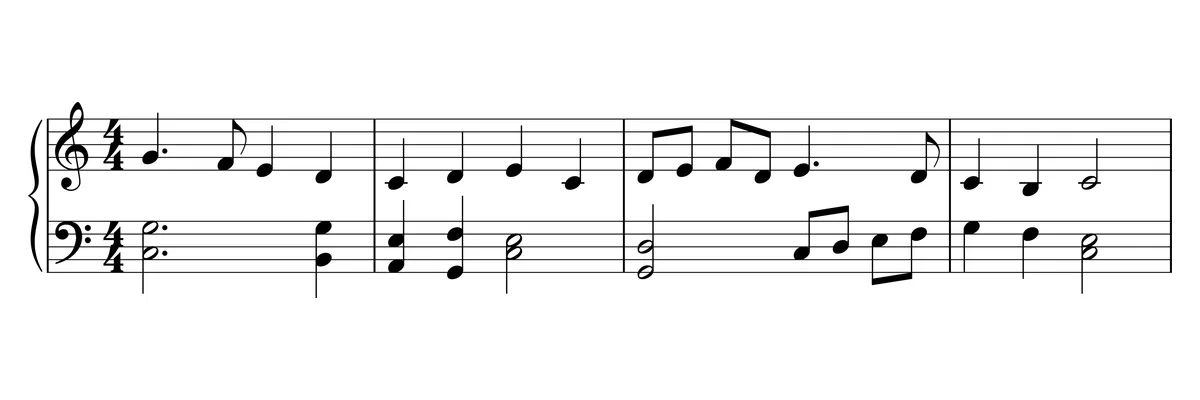
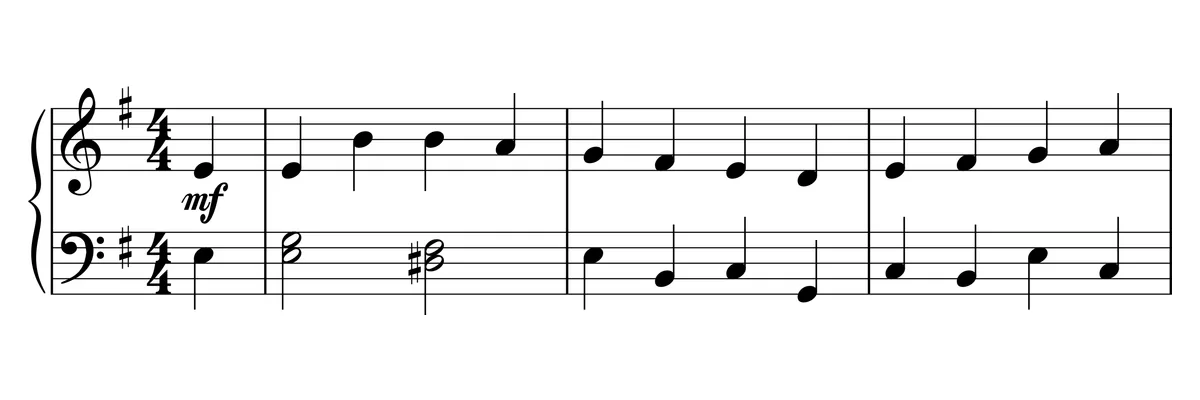
Free easy piano sheet music for We Wish You a Merry Christmas in four versions: an easy arrangement in G, a beginner version with one note at a time in each hand, the same beginner version in C major, and the full piano setting. Play each one here, slow it down or loop a bar, then print the PDF or download the MIDI.
- Traditional English
- Beginner to easy, plus the original
- 18 bars · 3/4
- Free: play, print, MIDI
Versions of We Wish You a Merry Christmas. Each version is a request typed into PlayableNotes. Pick one to hear and print it.
Typed into PlayableNotes“Make this easy for a second-year student. Keep the melody exactly and stay in G major, but give the left hand simple two-note intervals with no eighth notes, and keep the chords that make it sound like the carol.”

What changed
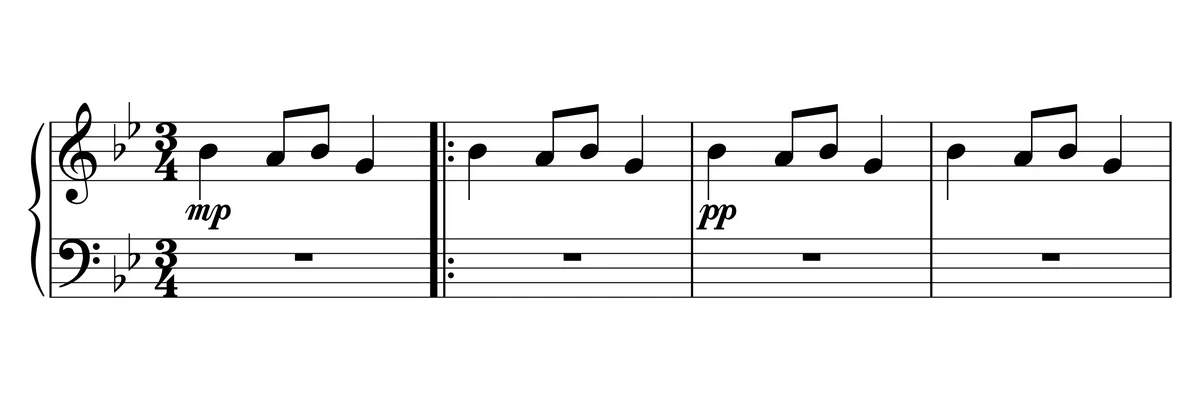
The whole carol with the melody intact and the full setting's chords, over a mostly two-note left hand with no eighth notes.
- Right hand: the melody note for note. The close chords of the original become single notes, with a second note only where it carries the harmony: B under the first G of bars 2 and 9, D under the last E of bar 3, C-sharp in bar 4, D-sharp in bars 6 and 11, C under the D on beat 3 of bar 9 (the seventh of the D7 chord, as in the original), the inner line B, C, C-sharp under the repeated Gs in bar 10, thirds in bar 12, and two-note chords in bars 8, 15, 16 and both endings.
- Left hand: the two-voice part becomes one line of intervals. In bars 2 to 7 it holds a fifth for two beats, then plays a sixth on beat 3 (in bar 5 the tritone C to F-sharp) that leads into the next bar. No eighth notes.
- Chords: the same as the original on every beat, including E7 in bar 3, A7 in bar 4, D7 in bars 5 and 9, B7 in bar 6, the diminished chord on beat 3 of bar 10 and A7 on beat 3 of bar 12. In bar 11 the A of the B7 chord on beat 3 moves from the bass to the top of the left hand, so the chord keeps its root.
- Accidentals: the D-sharp in bar 11 is written again on beat 3, though the first one still applies, so it is not read as D natural.
- Bars 14 and 15: the left hand plays the original's falling bass line, G, F-sharp, E, D, C, B, as the lowest note on each beat.
- Bars 9 and 13: the dotted quarter and eighth rest of the original become a half note.
- Bar 17 (first ending): the G is a half note and the D a quarter on beat 3, like the opening pickup; the original has two dotted quarters.
- Ranges: right hand B below middle C to the D on the fourth line; left hand G on the bottom line to the B below middle C, never wider than a seventh.
For teachers: For a student in the second year who reads eighth notes and a few accidentals. Learn the left hand of bars 2 to 7 first as one pattern: a fifth held for two beats, then a sixth on beat 3 (a tritone in bar 5). The fifths start on G, C, A, D, B and E, so bars 2, 4 and 6 climb G, A, B, and bars 3, 5 and 7 climb C, D, E.
Typed into PlayableNotes“Make a beginner version for a first-year student: the melody in the right hand as single notes, one bass note at a time in the left hand, mostly long notes, and nothing on ledger lines.”

What changed
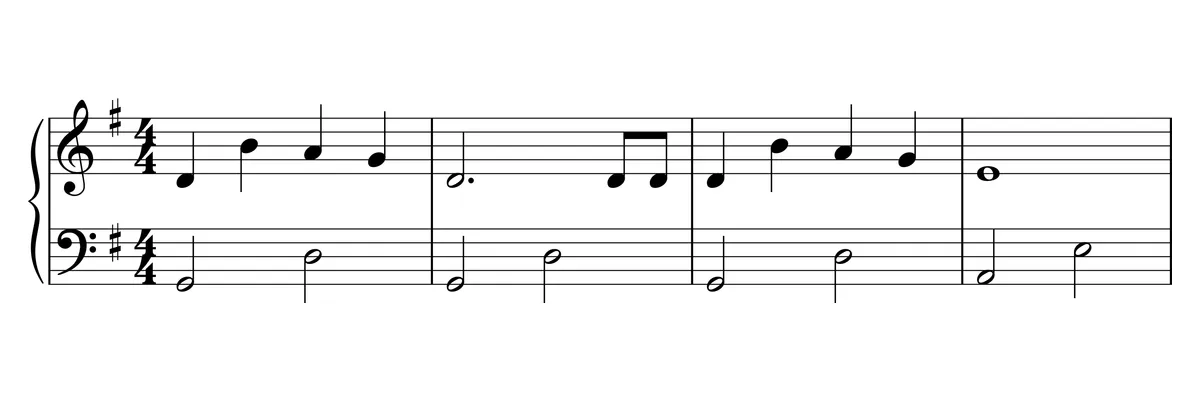
The melody alone in the right hand over one bass note at a time, in G major, with no ledger lines in either hand.
- Right hand: the melody only, single notes, in the original rhythm, except half notes in bars 9 and 13 where the original has a dotted quarter and an eighth rest, and in bar 17 (first ending), where the G is a half note and the D a quarter on beat 3 instead of two dotted quarters. It runs from the D just below the treble staff to the D on its fourth line.
- Left hand: one note per chord, dotted halves and halves, with a quarter note where the chord changes on beat 3, a quarter and then a half in bars 10 and 12 where it changes on beat 2, and three quarters in bars 8 and 16, in a single five-finger position from the bottom-line G up to D. The thumb reaches one note further, to E, in bars 7, 12 and 14.
- Harmony: one note per chord, mostly the chord's root. The original's beat-3 bass notes in bars 2, 4, 6, 9 and 11 are left out, and bar 12 starts on E rather than G. With them go the sharps that color bars 3, 4, 6, 10, 11 and 12 (G-sharp, C-sharp, D-sharp, A-sharp), so those bars sound plainer.
- Bar 10: the bass climbs G to A instead of G, A, A-sharp.
- Bars 14 and 15: the bass is G, E, D, B instead of the original's stepwise G, F-sharp, E, D, C, B, so the left hand moves only on beat 3.
- Last bar: a single G in the left hand, where the original has a tenth.
For teachers: For a first-year student. Most of the right hand sits with the thumb on the D below the treble staff. In bars 4 and 5 keep the thumb on D and spread the hand, 2 on F-sharp, 3 on G, 4 on A, 5 on B, so the hand does not move. Shift up to a G position (thumb on G) for bars 6 and 14; in bar 7 play the G with the thumb, then move the hand down so the thumb takes the Ds. Practice the octave drop in bar 15 on its own. The left hand never leaves its position.
Typed into PlayableNotes“Now put the beginner version in C major, so there are no sharps or flats at all. Change nothing else.”

What changed
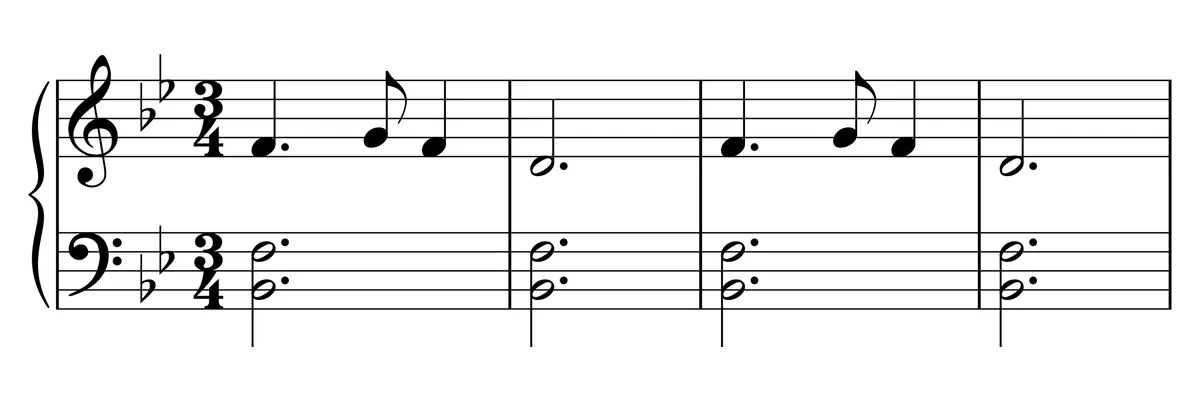
The beginner version a fourth higher, in C major: no key signature and not a single sharp or flat.
- Every note moved up a perfect fourth, from G major to C major. No key signature and no accidentals anywhere.
- Up a fourth rather than down a fifth, so the right hand stays in the treble staff: the melody runs from the G on the second line to the G just above the staff.
- Left hand: the same one-note bass line, now in a C position (C, second space, up to G), with the thumb reaching to A in bars 7, 12 and 14.
- Rhythms, hand positions and the octave drop in bar 15 (G to G) are the same as the version in G, including the half note and quarter of the first ending (bar 17), where the original has two dotted quarters.
For teachers: Choose it when reading the F-sharp is the hurdle. It is not easier to play than the G version: the hand shapes and rhythms are identical, and the right hand sits higher, up to the G above the staff in bar 15.
The piece as published: MuseScore community score 148794 (via PDMX).
Original
What changed
What changed
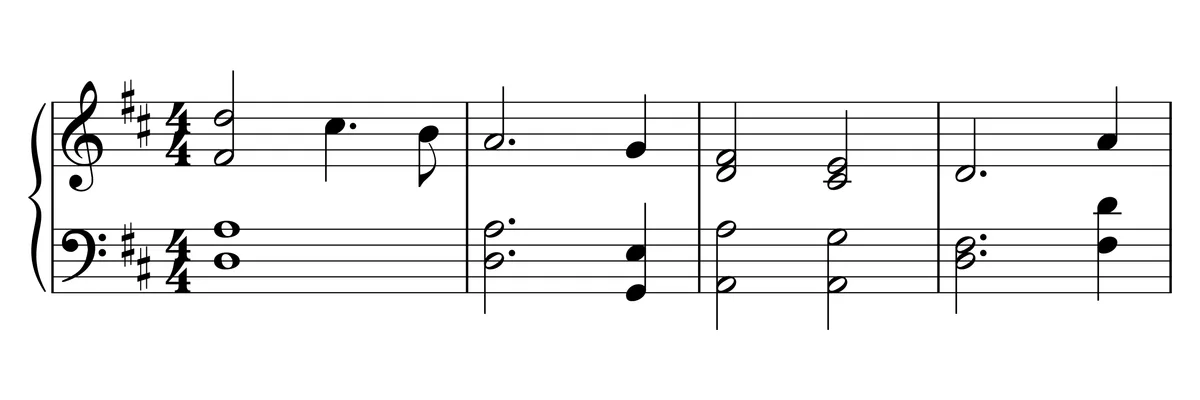
The full two-staff piano setting from the source: the melody over close right-hand chords and a left hand in two voices.
- Nothing in the notes or harmony: this is the source setting, checked bar by bar, with the small fixes listed below.
- The opening pickup is written as a quarter note, as the second ending implies.
- Bar 17 (first ending): the G and the D are two dotted quarters, as the source writes them, so the D comes half a beat early; the other versions put it on beat 3.
- In bars 1, 13, 14 and 17, where both hands struck the same key, the note is played by one hand only. It sounds the same.
For teachers: For an intermediate player. The right hand plays the melody on top of two-note chords, and the left hand has a bass and a tenor line, with eighth notes in bars 2, 4, 6, 7, 14 and 15, and tenths in bars 12, 16, 17 and 18 (and a ninth in bar 11); small hands can leave out the upper note of a tenth.
Want it different? Just ask.
Open this version in PlayableNotes and ask for a change in words: simpler, another key, shorter, bigger notes. The result is a new version you can play, print and share with your student.
Free account. Changes, playback and printing are free; 50 free credits to read your own sheet music.
Watch how to ask for your own version · 1 min video
Make your own version
A real request in PlayableNotes, on Für Elise from the free library: say who it’s for and what to keep, and the AI writes a new version beside the original. It shows how to ask for a version of your own; its result is not one of the versions on this page.
About We Wish You a Merry Christmas
We Wish You a Merry Christmas is a traditional English carol from the West Country, a song for carolers going from door to door; its figgy-pudding verses probably come from the custom of giving carolers treats. No composer is known and its exact age is uncertain; it became widely known through a choral arrangement Arthur Warrell made in Bristol in 1935, which begins "I wish you a merry Christmas." The source here is an uncredited piano setting uploaded to MuseScore in 2013, not Warrell's arrangement.
The tune is 16 bars in three beats, with a one-beat pickup; this setting repeats it, with first and second endings. The first half climbs: the word "wish" lands a step higher each time, on G, then A, then B, while the chords underneath pass through E7, A7, D7 and B7, so the full setting on this page has sharps (G-sharp, C-sharp, D-sharp, A-sharp) in six of its bars. The second half has the one awkward moment for the right hand: in bar 15 the melody drops a whole octave, from the D near the top of the treble staff to the D just below it.
The easy version keeps every note of the melody and the chords of the full setting, over a left hand of mostly two-note intervals. The beginner versions give each hand one note at a time; the one in C major has no sharps or flats at all. The original is the full setting the others were made from.
Practice tips
- Bar numbers are the same in every version. Bars 2, 4 and 6 are the same shape, each starting one note higher (G, then A, then B). Learn bar 2, then play bars 4 and 6 as the same pattern moved up.
- Bar 15 is the hard bar: the right hand drops an octave, from the D on the fourth line to the D below the staff, on "Christmas". Loop bars 14 and 15 and practice just the jump, moving the whole hand so the thumb lands on the low D.
- In the easy version, find the sharps before you play: bars 3, 4, 6, 10, 11 and 12 have one or two each, and bar 12 also has a natural on its D. They color the harmony; the beginner versions leave them out.
- Keep the three beats steady through the long notes in bars 9, 11 and 13, where singers breathe; it is easy to cut them short.
- Practice each hand with the Right and Left buttons at about 80, then hands together, and raise the tempo a few beats at a time. The first ending sends you back to bar 2; the second ending holds the last G.
Questions about We Wish You a Merry Christmas
Is We Wish You a Merry Christmas easy to play on piano?
Yes. The melody stays within one octave, from D to D, in three beats with nothing faster than eighth notes. The two hard spots are the octave drop in bar 15 and, in a full setting, the sharps in the chords. The beginner versions on this page leave those sharps out and give each hand one note at a time.
What are the piano notes for We Wish You a Merry Christmas?
In G major: D, G G A G F-sharp, E E E, A A B A G, F-sharp D D, B B C B A, G E D D, E A F-sharp, G. The second half ("Good tidings we bring"): D, G G G, F-sharp F-sharp, G F-sharp E, D A, B A A G G, D (high) D D D, E A F-sharp, G. In C major every note is a fourth higher: G, C C D C B, A A A, and so on, with no sharps.
What key is We Wish You a Merry Christmas in?
There is no fixed key; G major, one sharp, is a common key for it and the key of the setting on this page. In G the tune runs from the D above middle C to the D an octave higher, a comfortable range for most voices. The C major beginner version has no sharps or flats and sits a fourth higher.
Who wrote We Wish You a Merry Christmas?
No one knows. It is a traditional English carol from the West Country, and its figgy-pudding verses probably come from the custom of giving carolers treats. It became widely known after Arthur Warrell's choral arrangement of 1935. The source here is an uncredited piano setting uploaded to MuseScore in 2013, not Warrell's arrangement.
Can I download We Wish You a Merry Christmas as a PDF or MIDI file?
Yes, free and without an account. Every version has a PDF to print and a MIDI file, and you can play any version on this page at any tempo first.
Source and credits
- Composer
- Traditional English
- Source edition
- MuseScore community score 148794 (via PDMX)
- License
- Public Domain Mark 1.0
- Arranger
- PlayableNotes
An uncredited two-staff piano setting uploaded to MuseScore in 2013 and marked public domain, taken from the PDMX dataset; it is not Arthur Warrell's 1935 arrangement. Checked note by note against the score file and MuseScore's own MIDI. Corrected: the opening pickup is a quarter note (the file had a half note in a three-beat bar), a stray rest in bar 2 was removed, and in bars 1, 13, 14 and 17, where both hands struck the same key, the note is now in one hand only. The first ending (bar 17) is kept as the source writes it, two dotted quarters, so its D comes half a beat before beat 3.
Arrangements and facts checked