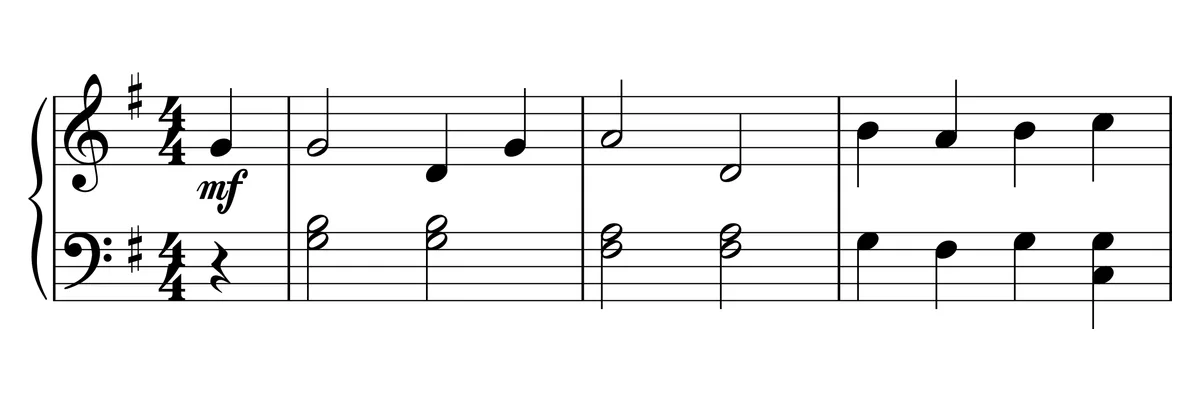
Free easy piano · Christmas
Joy to the World, easy piano
Joy to the World in four free piano versions: an easy version in D major with at most two notes in the left hand, a beginner version in C major, Lowell Mason's hymnal setting with the left hand cut to the bass line, and the hymnal setting as printed. Play each one here, slow it down or loop a bar, then print the PDF or download the MIDI.
- Lowell Mason
- Beginner to intermediate, plus the original
- 19 bars · 4/4
- Free: play, print, MIDI
Versions of Joy to the World. Each version is a request typed into PlayableNotes. Pick one to hear and print it.
Typed into PlayableNotes“Make this hymn an easy piano solo for my second-year student. Keep the melody exactly, in D major, with no sixteenth notes. Two notes at most in the left hand, keep the hymn's chords, and keep the place where the left hand stops at "and heaven and nature sing".”

What changed
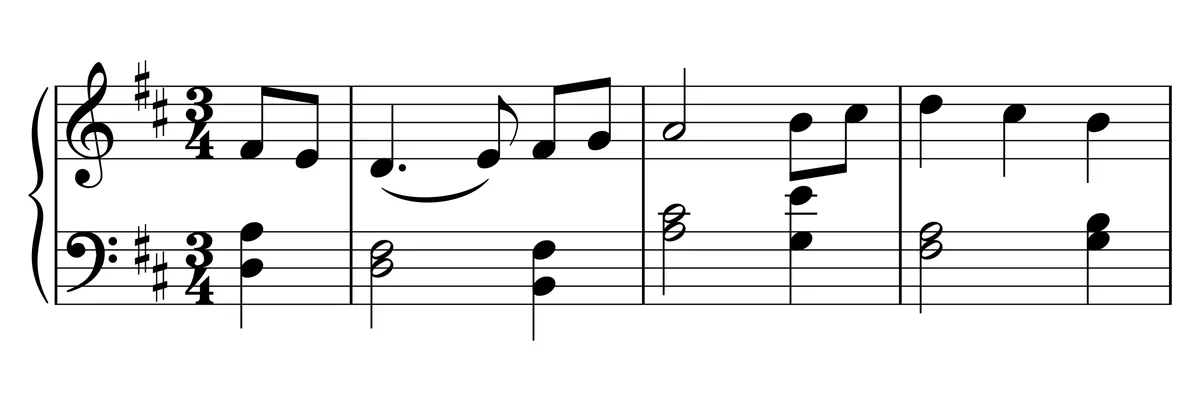
The melody in the right hand, with the alto under it in bars 1, 3, 11 to 16 and 18, over a left hand of at most two notes: the hymn's bass with a chord note above it, often the tenor's.
- Written in 4/4 with every note value doubled, so the 19 bars line up with the hymn's 2/4 bars and the quickest notes are eighths (bars 1, 9, 11 to 15 and 17).
- Right hand: the melody, unchanged. The alto joins it on the first note (F-sharp under the D), in thirds in bars 3, 11 to 15 and 18, and on the last beat of bar 16 (G under the B, the hymn's passing G chord). Elsewhere the melody is alone, so the scale passages stay one note at a time.
- Left hand: the hymn's bass with a chord note above it, often the tenor's, never more than two notes and never wider than an octave; bars 6 and 14 have single notes. Bar 16 keeps the tenor's climb F-sharp, A, D.
- Bars 8 and 10, beats 3 and 4: the left hand plays D–G, then D–F-sharp, so the hymn's passing G chord under the B is heard and the inner line falls with the melody.
- Bars 11 to 13: the left hand rests from beat 4 of bar 11 and comes back on beat 4 of bar 12, as the tenors and basses do, then repeats D–A in quarter notes.
- Bars 3 and 18: the left hand's G comes on beat 3, one beat earlier than the tenor's G in the hymn, so the A7 chord sounds a beat sooner.
- Left out: the rest of the alto, and the tenor's sixteenth notes in bar 15; on the last beat of that bar the left hand takes the tenor's A instead.
For teachers: For a student who reads eighth notes and can play two notes in one hand. Learn bars 11 to 15 hands separately first: the thirds in the right hand and the left hand's rests need the most care. In bars 3 and 18 the hand moves down after the scale: play the thirds D–F-sharp and C-sharp–E with 1 and 3. Then look ahead to the octave jump in bar 16.
Typed into PlayableNotes“Now make a beginner version in C major, so there are no sharps or flats. Keep the whole tune in the right hand, and give the left hand single notes or open fifths, mostly long ones, that hardly move.”


What changed
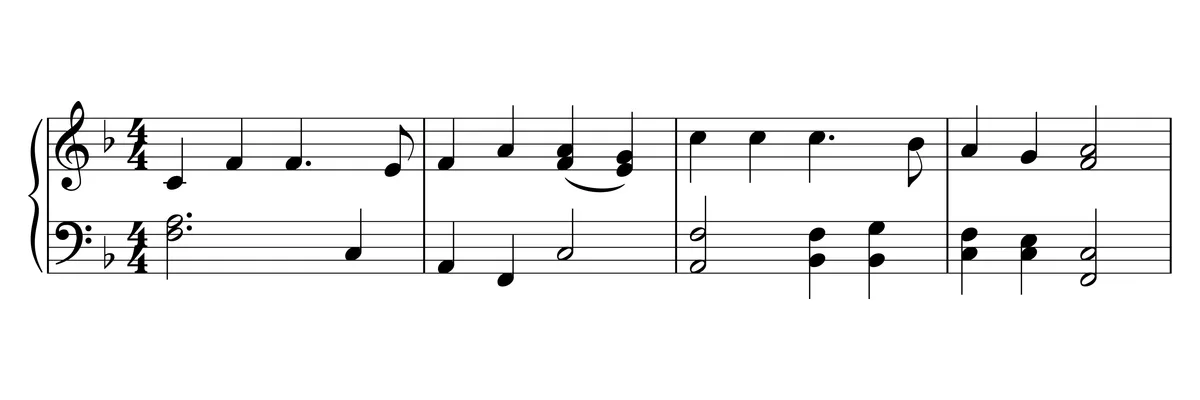
The tune in C major with no key signature, over bass notes on C, F and G, mostly whole and half notes, played one at a time until the open fifth C–G at the end.
- In C major, a whole step below the hymnal's D major: no sharps or flats anywhere.
- Written in 4/4 with doubled note values, like the easy version, so the quickest notes are the eighths in bars 1, 9, 11 to 15 and 17.
- Right hand: the melody alone, every note, from middle C up to the C an octave above. The hymn's alto is left out, so the thirds in bars 12 and 14 become single notes.
- Left hand: the hymn's bass notes, one at a time, in one five-finger position from the low F to the C below middle C: C for the C chord, F in bars 2, 5 and 17, G in bars 3, 6, 14, 15 and 18. To keep the hand in that position, bars 5 and 6 sit an octave below the hymn's bass, bar 14 holds the low G for the whole bar, and bar 4 keeps its C instead of moving up to E on the last beat. The tenor is left out.
- Most bars have one whole note in the left hand, and bars 2, 11 and 17 start with a dotted half. It rests in bars 11 and 12, as the hymn's tenors and basses do, and repeats its note in quarter notes in bars 13 and 15, C then G, as the hymn's bass does.
- Bar 19: the left hand moves up for its only two-note chord, the open fifth C–G.
For teachers: For a first-year student who reads in C. The left hand stays on F, G and C (fingers 5, 4 and 1) until the last bar. The tune spans an octave, so the right hand uses two positions. F position, 5 on the high C: bars 1 and 2, bars 5 to 10, and from the jump in bar 16 to the F in bar 17. Middle C position, thumb on C: bars 3 and 4, bars 11 to 15, and from the E in bar 17 to the end. The moves: cross 3 over the thumb onto E in bars 3 and 17; at the end of bar 4, let go of the C and play the G with 2, so the hand is back in F position for bar 5; take the first G of bar 9 with 3, so the thumb lands on E and 5 can reach up a sixth to the high C; take the first G of bar 11 with 5. Practise the octave jump in bar 16, middle C to high C, on its own.
Typed into PlayableNotes“I play this for church from the hymnal. Keep the treble staff exactly as written, in D major and in 2/4, so it still matches the singers, but give my left hand only the bass line, one note at a time.”

What changed
The hymnal's treble staff as written, melody and alto together, over the bass line alone.
- Right hand: the hymnal's treble staff exactly, soprano and alto together, with the dotted rhythms, the sixteenth notes and the slur in bar 16.
- Left hand: the bass line alone, single notes from G2 to A3. The tenor part is left out.
- Repeated bass notes become one held note in bars 1, 3, 5 to 10, 16 and 18 (in bar 1, D, D, D becomes one half note).
- Kept as written: the moving bass in bars 2, 4, 14 and 17, the repeated eighth notes in bars 13 and 15, and the left hand's rest and re-entry in bars 11 and 12.
- Without the tenor, the A7 chords in bars 3 and 18 lose their G, and bars 4 and 19 start on a bare D octave; add the F-sharp above the bass in bar 19 if you want a fuller last chord.
For teachers: For a church pianist, or a student who can read two notes in the right hand but finds the hymn's left hand, with its two voices and stretches up to a tenth, too much. It lines up bar for bar with the hymnal, so it works for accompanying singers; add the tenor back later, one phrase at a time.
The piece as published: Open Hymnal Project, 2005 revision (setting: Lowell Mason, 1836).
Hymnal setting
What changed
What changed
Lowell Mason's four-part setting in D major and 2/4, as transcribed by the Open Hymnal Project: soprano and alto in the right hand, tenor and bass in the left.
- Nothing in the notes: this is the source setting, checked against the Open Hymnal ABC, MIDI and PDF.
- Barred in 2/4 with half the note values of the easy and beginner versions; the bar numbers are the same in every version.
- Not shown: the Open Hymnal's bracket marking bars 17 to 19 as the introduction.
For teachers: Play it as a hymn, all four parts legato, at the printed quarter note = 80. The left hand has two voices and, on the last eighth of bars 2 and 17, a tenth from the low G to B; roll it, or take the B with the right hand. In bar 4 the alto and tenor share the last D: play it once, with the right hand. In bars 9, 11 and 17 the tenor holds D from the downbeat and the alto comes to the same D on beat 2: lift the left hand's D there so the right hand can play it.
Want it different? Just ask.
Open this version in PlayableNotes and ask for a change in words: simpler, another key, shorter, bigger notes. The result is a new version you can play, print and share with your student.
Free account. Changes, playback and printing are free; 50 free credits to read your own sheet music.
Watch how to ask for your own version · 1 min video
Make your own version
A real request in PlayableNotes, on Für Elise from the free library: say who it’s for and what to keep, and the AI writes a new version beside the original. It shows how to ask for a version of your own; its result is not one of the versions on this page.
About Joy to the World
Isaac Watts wrote the words in 1719 as a paraphrase of Psalm 98. Lowell Mason first printed the tune with these words, under the name Antioch, in his Occasional Psalm and Hymn Tunes (1836), marked "from Handel". Its opening and its "and heaven and nature sing" line recall passages in Messiah, which Handel scholars regard as coincidence, and a very similar English tune, Comfort, had been printed a few years earlier, so Mason most likely adapted the tune rather than composed it. Most American hymnals print Mason's four-part setting in D major, and that setting is the source for every version on this page.
The melody is easy to read: it opens with a full D major scale from the top D down to the bottom one, one note per syllable, and most of what follows moves by step. The hymn setting is harder than it looks. It is four voices on two staves in 2/4, with dotted rhythms and sixteenth notes, left-hand stretches up to a tenth, and a passage in bars 11 to 13 where the tenor and bass drop out and come back in with repeated notes under "and heaven and nature sing".
The easy version keeps the melody exactly, in D, writes it in 4/4 with doubled note values so there are no sixteenths, and gives the left hand at most two notes at a time: the hymn's bass with a chord note above it, often the tenor's. The beginner version is the same tune a whole step lower, in C major with no sharps or flats, over bass notes, mostly long ones, that follow the hymn's chords. For church pianists, one version keeps the hymnal's whole treble staff over the bass line alone, and the four-part setting is here as printed.
Practice tips
- Play the opening scale on its own first: D down to D (C down to C in the beginner version), slowly, until the hand moves without a gap in the middle. Most of the tune is this scale or pieces of it.
- Bars 5 to 7 climb B, C-sharp, D with each note repeated (A, B, C in the beginner version). Hold the long note for its full value (three beats in the easy and beginner versions, a dotted quarter in the hymnal versions) before the short one.
- Loop bars 11 to 13. In every version the left hand stops at the end of bar 11 and comes back for the last note of bar 12, just before its repeated notes in bar 13. Count the rests out loud the first few times.
- Bars 12 and 14 are repeated thirds in the right hand (single notes in the beginner version). Keep the fingers on the keys, play lightly, and let the two quick notes at the end of each bar lead into the next one.
- Bar 16 jumps up an octave from the low D to the high D (C to C in the beginner version). Look at the high note before you start the bar, and move the hand as soon as the low note is played.
Questions about Joy to the World
Did Handel write Joy to the World?
No. Lowell Mason printed the tune, under the name Antioch, in 1836, marked "from Handel". Its opening and its "and heaven and nature sing" line recall passages in Messiah, but no work of Handel's contains the tune, and a very similar English tune, Comfort, was in print a few years before Mason's, so Mason most likely adapted it. The words are by Isaac Watts, from 1719.
What key is Joy to the World in?
Most hymnals print it in D major, with two sharps, F-sharp and C-sharp, and three versions on this page are in D. The beginner version is in C major, a whole step lower, so it has no sharps or flats.
Is Joy to the World easy to play on piano?
The melody is one of the easier carols: it starts with a descending scale and mostly moves by step, though it covers a full octave, so the right hand has to change position. The hymnal setting is harder, with two voices in each hand, sixteenth notes and stretches up to a tenth. The easy version keeps the melody and harmony with at most two notes in the left hand, and the beginner version has the melody alone over bass notes, mostly long ones.
Can I play these versions while people sing?
Yes. The hymnal setting and the version with an easier left hand are Mason's setting in D major and 2/4, bar for bar as many hymnals print it; the Open Hymnal edition marks bars 17 to 19 as the introduction, so play those three bars before the singers come in. The easy version is in D too, and its 4/4 bars line up with the hymn's bars, but to keep up with singers it has to be played at about 160, the hymnal's 80 in 2/4, rather than its practice tempo of 120. The beginner version is in C, a step below most hymnals, so it suits playing alone more than accompanying.
How fast should Joy to the World be played?
The Open Hymnal edition marks 80 quarter notes per minute in 2/4. The easy and beginner versions write the same music in 4/4 with doubled note values, so the same speed reads as 160 there. Start them around 100 to 120 and raise the tempo slider as the piece settles.
Can I download Joy to the World as a PDF or MIDI file?
Yes, free and without an account. Every version has a Letter-size PDF to print and a MIDI file with the right and left hands on separate tracks.
Source and credits
- Composer
- Lowell Mason
- License
- Public domain
- Arranger
- PlayableNotes
All 19 bars and all four voices were checked note for note against the Open Hymnal's own MIDI and PDF and against an independent edition of Mason's setting; no notes needed correcting. The Open Hymnal transcribed the setting from Lutheran Worship (1982). The setting is credited to Lowell Mason (the Open Hymnal dates it 1836); the form hymnals print today settled in his later books. Other hymnals differ in a few inner-voice notes. The words are not included.
Arrangements and facts checked