Free easy piano · Christmas
Silent Night, easy piano
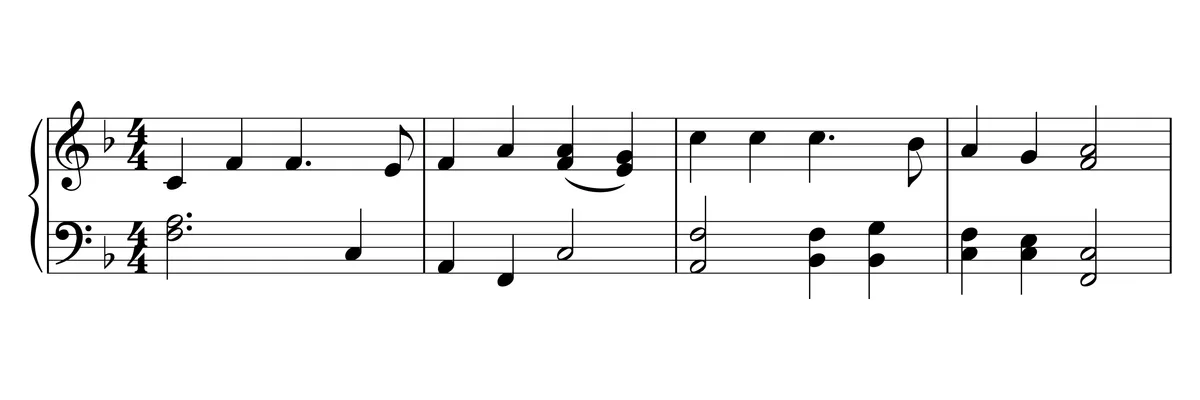
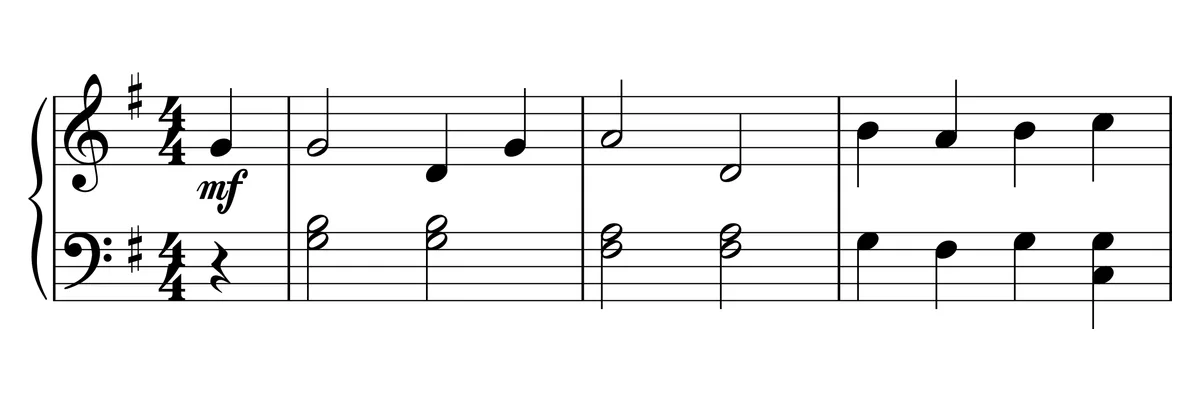
Gruber's Silent Night in five free piano versions: a beginner version in C major, an easy version in the hymnal key of B-flat, a lullaby with a rocking left hand, an accompaniment for carol singing and the 1908 hymnal setting. Play each one here, slow it down or loop a bar, then print the PDF or download the MIDI.
- Franz Xaver Gruber
- Beginner to late beginner, plus the original
- 24 bars · 3/4
- Free: play, print, MIDI
Versions of Silent Night. Each version is a request typed into PlayableNotes. Pick one to hear and print it.
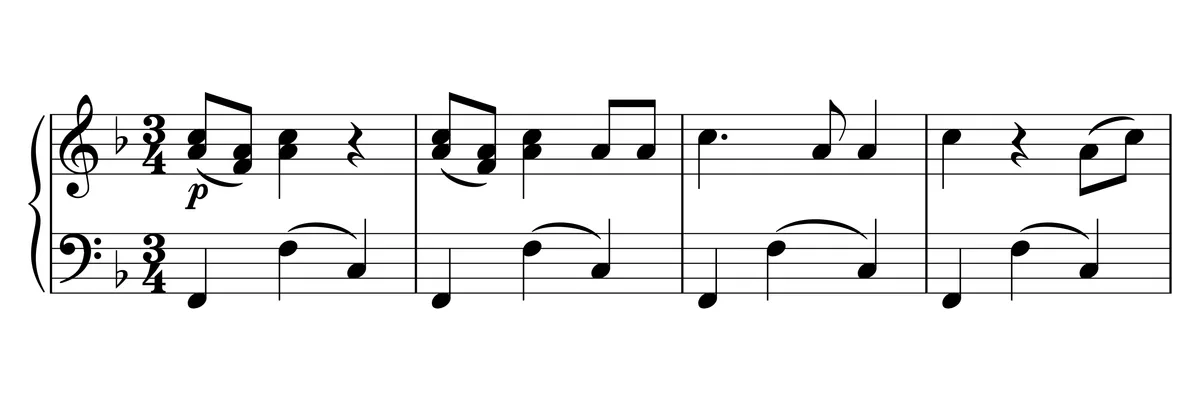
Typed into PlayableNotes“Make Silent Night easy for my second-year student. Keep the hymnal key of B-flat and every note of the melody, no sixteenth notes, and give the left hand simple held chords that keep the hymn's harmony.”

What changed
The whole melody in the hymnal key, over held two-note chords from the hymn's tenor and bass, mostly one per bar.
- Written in 3/4 with every note value doubled, as most piano books print it: 24 bars instead of the hymnal's 12, no sixteenth notes, and the music sounds the same.
- Right hand: the melody alone, note for note. The hymn's alto is added in four bars only: E-flat under the A in bar 6 (the F7 chord), D under B-flat in bar 7, and F under B-flat and D in bars 19 and 20, so the thumb stays on F for both bars.
- Bar 21, "Sleep in": the dotted rhythm most people know and many hymnals print (B-flat for a beat and a half, then F, D). The 1908 setting, in the hymnal tab, has two even notes there.
- Left hand: the hymnal's tenor and bass as held chords instead of repeating the melody's rhythm: B-flat–F or the B-flat octave for the B-flat chord, E-flat–B-flat for the E-flat chord, F–A, F–C or the F octave for the F chord.
- Bar 5 leaves out the hymn's E-flat (the hymn has F7 there) and plays a plain F chord; the E-flat comes in under the A in bar 6. In bar 18 the melody's own E-flat makes the F7.
- Bar 20: the left hand climbs B-flat–F–B-flat under the high D, from the low B-flat (the hymnal setting, as transcribed, has only the higher one there).
- Bars 21 and 22 keep the hymn's bass line, D, B-flat, then low F. Bars 23 and 24 end on an open fifth, B-flat–F, instead of the hymnal's low B-flat–D, which sounds muddy on the piano.
For teachers: For a student who reads two flats and can count a dotted quarter and eighth. Learn the right hand first, then add the left-hand chords two bars at a time: they change only every two bars or so, mostly where the hymn's chords change.
Typed into PlayableNotes“Make a beginner version in C major, no sharps or flats. Just the melody in the right hand, and a left hand of single notes and open fifths that hardly moves.”

What changed
The melody in C with no key signature, over a left hand that plays one note or one open fifth per bar (two in bar 21).
- In C major, a whole step above the hymnal's B-flat: no sharps or flats anywhere.
- Written in 3/4 with doubled note values (24 bars): the fastest notes are the eighths in the dotted rhythm of "Si-lent" and "Sleep in".
- Right hand: the melody only, every note, from middle C up to the F at the top of the staff.
- Bar 21, "Sleep in": the dotted rhythm most people know (C for a beat and a half, then G, E). The 1908 hymnal setting has two even notes there.
- Left hand: one sound per bar (two in bar 21), held for three beats. C–G for the C chord, F for the F chord, G for the G7 chord, all with the hand resting on C to G.
- Bars 5 and 6 play the G chord without its seventh (F); the melody brings in the F in bars 18 and 22.
- Bar 21 follows the hymn's bass, E then C; bar 22 drops to the low G for the last cadence, the left hand's only move. The piece ends on the open fifth C–G.
For teachers: The left hand barely moves, so the work is in the right hand, which changes position to follow the tune (the full plan is in the practice tips below). Two spots need practice on their own: the leaps from E up to D (bars 4 to 5 and 16 to 17), and the last line, where "Sleep in" is C, G, E on 5-2-1 and the hand then moves down to C position for the last three bars. That move comes right after a quarter-note E, so it has to be quick: as the thumb plays E, let the hand drift down so finger 5 lands on G on the next beat.
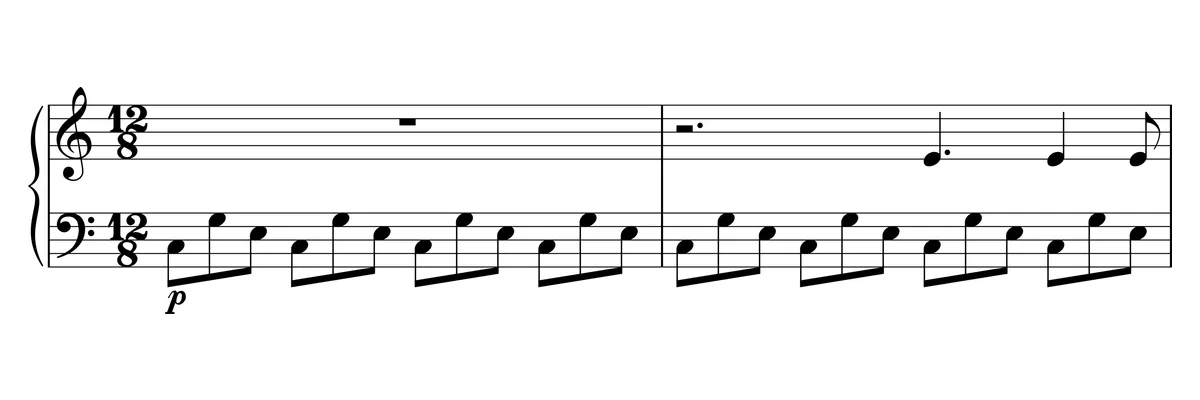
Typed into PlayableNotes“Keep the beginner melody in C, but give the left hand a gentle rocking pattern in quarter notes, like a lullaby. Nothing wider than a fifth.”


What changed
The beginner melody over a left hand that rocks in steady quarter notes, low–high–middle, like a lullaby.
- Right hand: the same as the beginner version, including the dotted "Sleep in" in bar 21 (the 1908 hymnal setting has two even notes there).
- Left hand: three quarter notes in every bar, root, fifth, then third: C–G–E for the C chord, F–C–A for the F chord, G–D–B for the G chord. The bass keeps moving under the melody's long notes.
- Bars 6 and 18 turn the G pattern upward, G–B–D, so it steps down to C on the next downbeat.
- Bar 21 starts on E (E–G–C), keeping the hymn's E in the bass at the start of the last line.
- The left hand uses three five-finger positions, on C, F and G, and never stretches wider than a fifth. The last bar is a C major chord.
- As in the beginner version, the G7 chord's seventh (F) is heard only in the melody, in bars 18 and 22.
For teachers: The next step after the beginner version. Practice the left hand alone until the pattern runs by itself, then put the hands together slowly: in every bar with the dotted rhythm ("Si-lent" in bar 1, "Sleep in" in bar 21) the melody's eighth note falls between the left hand's second and third beats. Play it without pedal, or change the pedal every bar: the low F and G patterns blur if it is held longer.
Typed into PlayableNotes“I'm playing this for carol singing on Christmas Eve. Use the easy version in B-flat, add a short introduction so everyone knows when to come in, and put repeat signs around the verse.”


What changed
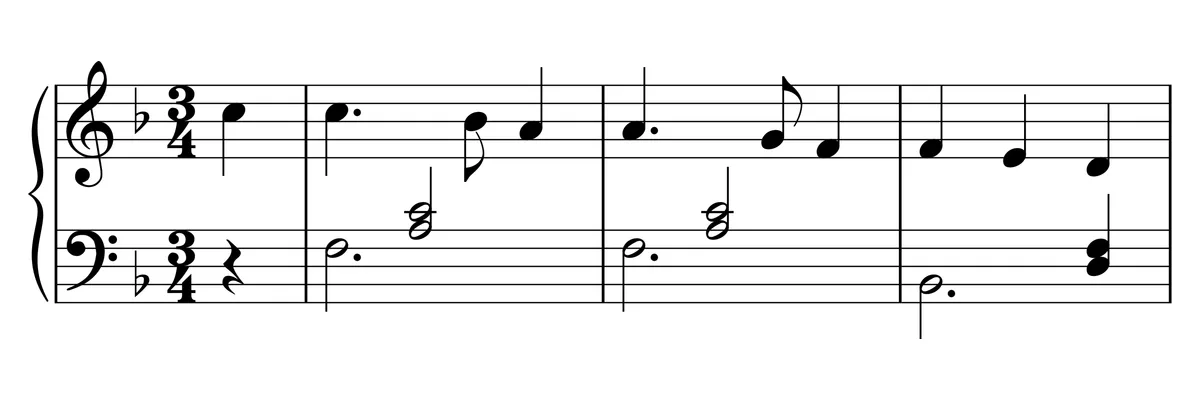
The easy version inside repeat signs, after a four-bar introduction: the hymn's closing "Sleep in heavenly peace", which the Open Hymnal score marks as the organist's introduction.
- Bars 1 to 4: introduction, the hymn's closing phrase ("Sleep in heavenly peace"), the same as the easy version's last four bars. The Open Hymnal score of the 1908 setting marks this phrase as the organist's introduction.
- Bars 5 to 28: the easy version, unchanged, between repeat signs. Play it once for each verse; the player here plays it twice.
- In B-flat, the key of the 1908 setting and of many hymnals, so the melody matches the singers' books with one spot to check: "Sleep in" (bars 1 and 25) is dotted here, as most people sing it. The 1908 setting has two even notes there; if your hymnal prints it that way, play two even quarters.
For teachers: Keep the tempo steady, slower than you would play it alone, and play the melody a little louder than the left hand so the singers can follow it. The last note of each verse lasts six beats: count them, and that is where everyone breathes.
The piece as published: Open Hymnal Project (setting from Concordia Kinderchöre, 1908).
Hymnal setting
What changed
What changed
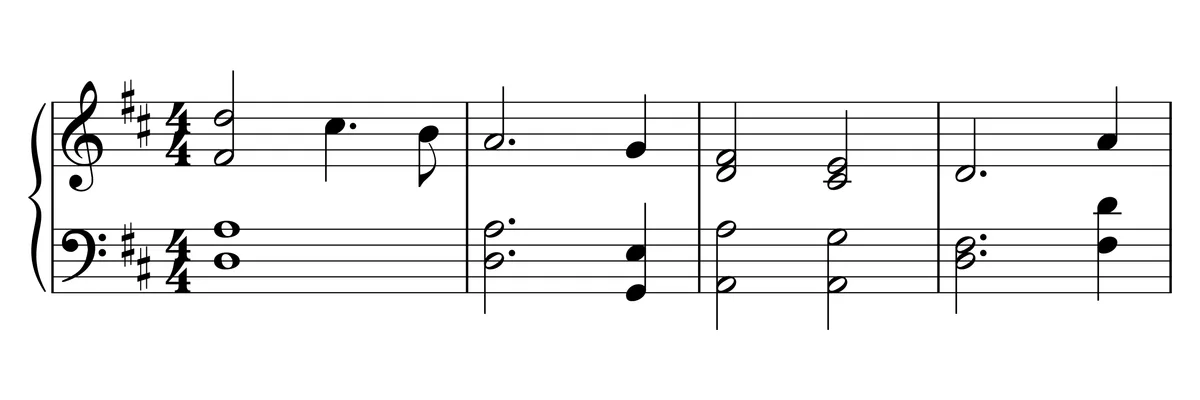
The 1908 four-part setting in B-flat, as transcribed by the Open Hymnal Project: soprano and alto in the right hand, tenor and bass in the left.
- Nothing: this is the source setting, checked note by note against the Open Hymnal ABC, MIDI and PDF.
- Barred in 3/4 with half the note values of the other versions, so each of its 12 bars holds what the other versions spread over two.
- Bar 10: the bass B-flat is an octave higher in this transcription than in an independent hymnal harmonization (Mutopia, from the Cyber Hymnal), so it may be a slip in the transcription; it is kept as printed.
- Bar 11: "Sleep in" is two even eighths in this setting; many hymnals dot the first one, and the arrangements on this page do too.
For teachers: Play it as a hymn, with all four parts legato. Read it at the printed tempo, a quarter note at 60, and feel each bar as two slow beats rather than three.
Want it different? Just ask.
Open this version in PlayableNotes and ask for a change in words: simpler, another key, shorter, bigger notes. The result is a new version you can play, print and share with your student.
Free account. Changes, playback and printing are free; 50 free credits to read your own sheet music.
Watch how to ask for your own version · 1 min video
Make your own version
A real request in PlayableNotes, on Für Elise from the free library: say who it’s for and what to keep, and the AI writes a new version beside the original. It shows how to ask for a version of your own; its result is not one of the versions on this page.
About Silent Night
Franz Xaver Gruber, the schoolteacher in nearby Arnsdorf and organist at St. Nicholas Church in Oberndorf, near Salzburg, wrote the tune in 1818 for a poem by Joseph Mohr, the church's assistant priest. They first sang it there on Christmas Eve 1818, with Mohr playing the guitar. It is a lullaby: a slow, rocking melody built on just three chords, the home chord and the chords a fourth and a fifth above it.
The notes are simple; the rhythm and the range are what trip students up. The dotted figure that opens the tune comes back all through it and has to be counted, not guessed. The tune also spans an eleventh, and its last line walks down an octave to the lowest note, so the right hand has to change position several times; the versions here place most of those moves on long notes.
The beginner and rocking versions are in C major, with no sharps or flats. The easy and carol-singing versions stay in B-flat, the key of the 1908 setting and of most American hymnals, so they fit alongside people singing from one.
Practice tips
- Count the dotted rhythm before you play it: in the 24-bar versions the first bar, "Si-lent", is a dotted quarter, an eighth and a quarter, "one, two-and, three", with the eighth on the "and". "Sleep in", at the start of the last line, has the same rhythm.
- Feel each pair of bars as one long swing, like rocking a cradle, rather than six even beats. Hold every long note for its full three beats; in the held-chord versions, the left hand's next chord tells you when the bar is over.
- Plan the right-hand moves (bar numbers are for the 24-bar versions). In C: thumb on E for bars 1 to 4 and on G for bars 5 to 8; back on E for bars 9 to 16, with the hand opened a little (E, G, A, B, C on fingers 1 to 5) so finger 5 reaches the C in bars 10 and 14; then thumb on B for bars 17 to 20. Make each of these moves during the long note before it. In B-flat everything is a step lower (thumb on D, F, D, then A), and in the easy version the thumb also drops for the added lower notes: E-flat in bar 6, D in bar 7, and F for bars 19 and 20 (fingers 1 and 4, then 1 and 5).
- Loop the last line, bars 21 to 24 (bars 25 to 28 in the carol-singing version), with the player's Right button so you hear the right hand alone: it walks down an octave to the last note. In C, play "Sleep in" C, G, E with fingers 5-2-1, then move the hand down to C position for G, F, D and middle C (5-4-2-1). That move follows a quarter note, so it is quick: practice just those two notes, E and G, until the hand lands without looking. In B-flat it is the same a step lower.
- Bars 17 to 20 are the high point. Let them sing out, then soften for the last line.
Questions about Silent Night
Is Silent Night easy to play on the piano?
Yes, it is one of the easiest carols. The melody moves slowly and uses only three chords. The two things to learn are the dotted rhythm that opens the tune and the last line, which walks down an octave. The beginner version on this page keeps the left hand to single notes and open fifths, mostly one per bar.
What key is Silent Night in?
Most American hymnals print it in B-flat major, and easy piano books usually put it in C major, with no sharps or flats. The earliest surviving manuscript, in Mohr's hand from about 1820, is in D major. This page has versions in C and in B-flat; if a singer needs another key, open any version in PlayableNotes (free account) and ask for it.
Who wrote Silent Night?
Joseph Mohr wrote the words in 1816. Franz Xaver Gruber, the schoolteacher in nearby Arnsdorf and organist at St. Nicholas, set them to music in 1818, and they first sang it at St. Nicholas Church in Oberndorf, near Salzburg, on Christmas Eve 1818, with Mohr, by then the church's assistant priest, playing the guitar. Both the music and the 1908 hymnal setting used here are in the public domain.
Is Silent Night in 3/4 or 6/8 time?
It has a lilting six-beat feel, and many hymnals write it in 6/8. The Open Hymnal's transcription of the 1908 setting bars the same rhythm in 3/4 with sixteenth notes. The easier versions here use 3/4 with the note values doubled, which reads more easily and sounds the same.
What are the notes of Silent Night on piano?
In C major, starting on the G above middle C: G A G E, G A G E, D D B, C C G, A A C B A, G A G E, A A C B A, G A G E, D D F D B, C E, C G E G F D C, ending on middle C. The beginner version on this page has exactly these notes in the right hand, with the rhythm written out; in B-flat every note is a step lower.
Can I download Silent Night as a PDF or MIDI file?
Yes, free and without an account. Every version has a Letter-size PDF to print and a MIDI file with the right and left hands on separate tracks.
Source and credits
- Composer
- Franz Xaver Gruber
- License
- Public domain
- Arranger
- PlayableNotes
All 172 notes of the four-part setting were checked against the Open Hymnal ABC, MIDI and PDF, and the melody against an independent hymnal harmonization (Mutopia, from the Cyber Hymnal); no notes needed correcting. That harmonization has the low B-flat in the bass in bar 10, where this transcription has the B-flat an octave higher, so this may be a slip in the transcription. The hymnal setting keeps it as printed; the arrangements use the low B-flat.
Arrangements and facts checked