Original music for piano lessons
One rhythm needs work. Make that the piece.
An eight-bar study built around a dotted-eighth/sixteenth rhythm. Keep the right hand within five notes and let the bass hold.
An original, AI-assisted teaching example.
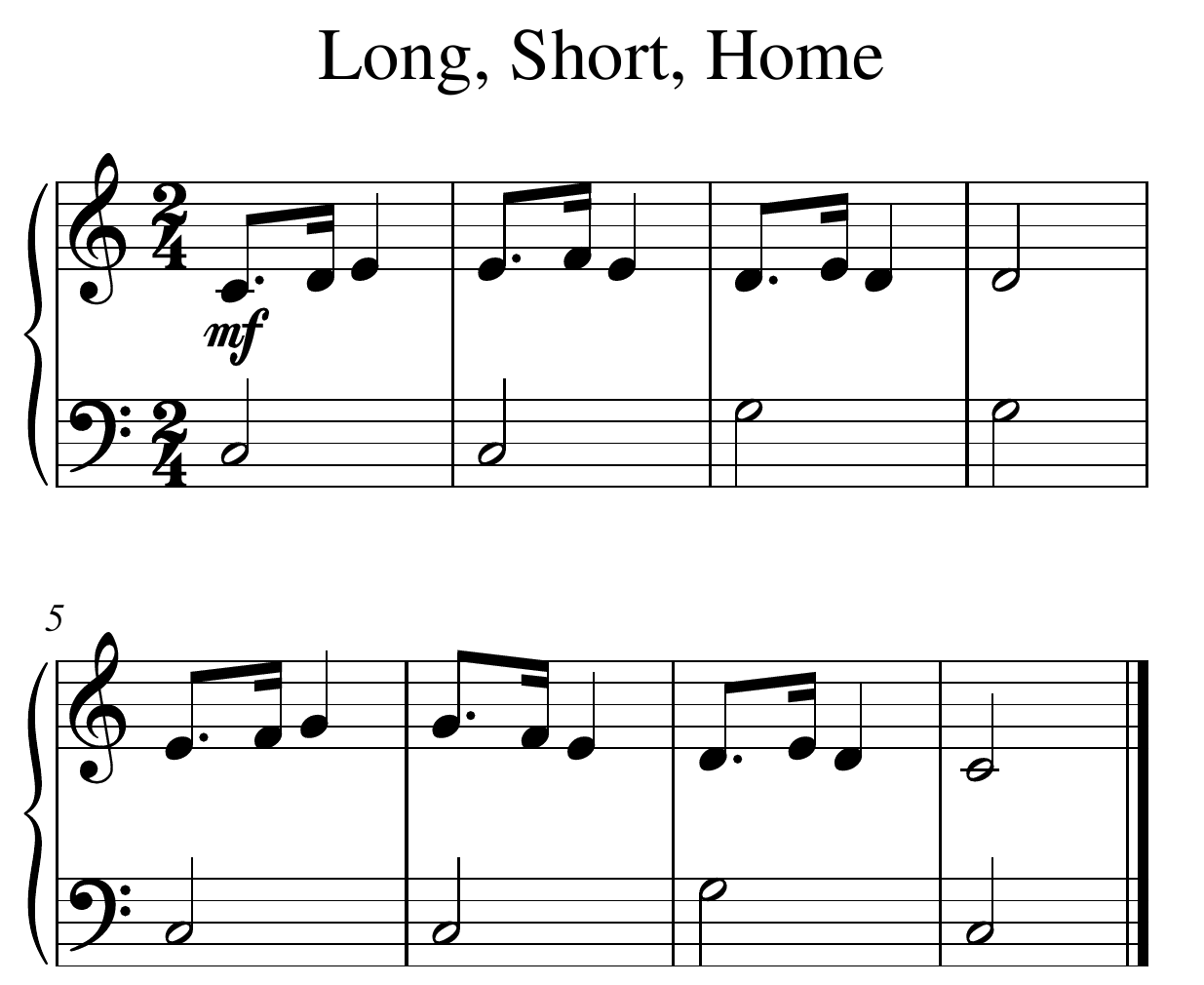
Quarter note = 60. The PDF omits this mark; add it to your printout.
Open the complete practice copy · Download the PDF
Repeat the rhythm. Give it somewhere to go.
The dotted-eighth/sixteenth cell returns in bars 1, 2, 3, 5, 6 and 7. The right hand stays within C4–G4, with one C3 or G3 half note in each bass bar. Four bars ask a question; four answer on C.
Name the constraint. Then check the music.
Requires PlayableNotes connected in ChatGPT. Use this composition brief:
Using the PlayableNotes app, compose an original eight-bar piano study in C major, 2/4, at quarter note = 60. Keep the right hand within C4–G4, using only repeated notes or steps. In bars 1, 2, 3, 5, 6 and 7, use dotted eighth + sixteenth + quarter. Use a half note in bars 4 and 8. Give the left hand one held C3 or G3 half note per bar. Make a four-bar question and a four-bar answer that ends on C. No chords, pedal or repeats. Check the pitches, rhythm and bar lengths, then save the score and make a practice link and PDF. Flag anything I should check before teaching it.
Creating music, editing, playback and exports are free. Reading a new PDF uses credits.
Keep the complete example.
How this example was made and checked
An assistant composed the notation and saved it through PlayableNotes. The creation request included the complete notation. All eight bars and 28 note events match the saved score and exports; this was a notation review, not a listening or teaching trial. PDF and MusicXML omit tempo 60; MIDI and the practice player retain it. The phone practice score reflows as 3 + 4 + 1 bars; the print shown here keeps 4 + 4.