Free easy piano · Christmas
Deck the Halls, easy piano
Deck the Halls for piano in three free versions: an easy arrangement with the tune around middle C, chords in F for carol singing, and the simple arrangement they come from. Play each one here, slow it down or loop a bar, then print the PDF or download the MIDI.
- Traditional Welsh
- Easy to intermediate, plus the original
- 16 bars · 4/4
- Free: play, print, MIDI
Versions of Deck the Halls. Each version is a request typed into PlayableNotes. Pick one to hear and print it.
Typed into PlayableNotes“Make this easy for a student in their second year: move the melody down an octave so it sits around middle C, keep every note of it, and give the left hand two-note chords on the original harmony. Nothing wider than an octave.”

What changed
Every note of the tune an octave lower, around middle C, over two-note left-hand chords and the original's walking bass.
- Right hand: the melody note for note, an octave lower than the original, from the B below middle C up to the C an octave above middle C (bar 11). No ledger lines above the staff.
- Left hand: mostly two-note chords on the original's chords instead of single bass notes. The widest is a seventh, G to F.
- Bars 1, 5 and 13: beat 4 is G with B in the bass instead of a low G, so the bass steps down C, B, A, G into the next bar. Bar 10 ends on the same G over B.
- Bars 2, 6 and 14: the G on beat 2 becomes G and F (a G7), which resolves to C and E on beat 3.
- Bars 3 and 7 keep the original's walking eighths, C D E F. Bars 4 and 8 keep its G and F under the cadence, then end on C and E instead of a three-note chord.
- Bar 9: the left hand outlines the G chord, G D B G. Bar 12: D and F-sharp under the B and A, then G, with no drop to the low D.
- Bars 15 and 16: F and C under the four A's, C over E, then a G–C, G–F, C–E cadence in place of the original's low F, G and C.
For teachers: For a student who plays hands together and reads eighth notes. Learn the right hand first, then add the left hand a phrase at a time. Bars 3 and 7, where the left hand walks in eighths under a held E, are the ones to loop.
Typed into PlayableNotes“Put it in F so a group can sing along, and give me full chords to lead the singing: melody on top, a bass line that moves, and nothing wider than an octave in either hand.”


What changed
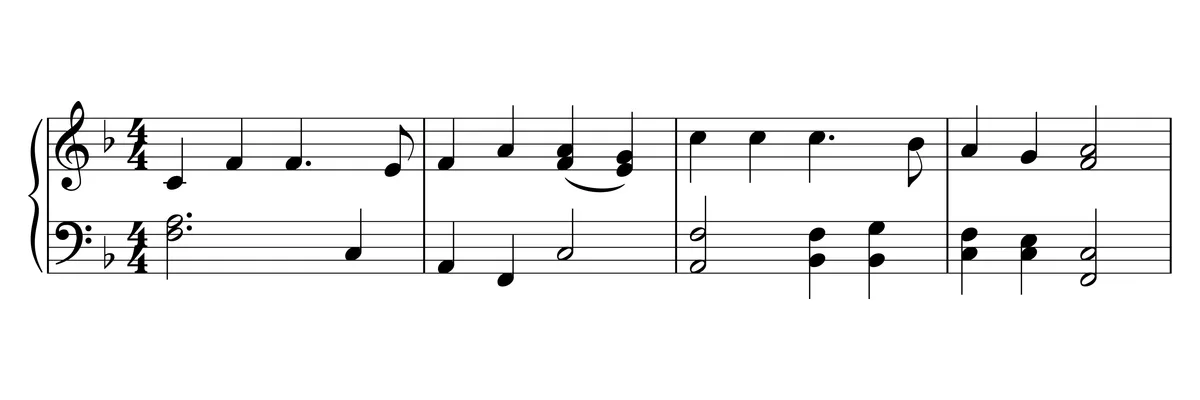
The tune at singing pitch in F major, with chords in both hands to lead a group.
- Key: F major. The tune sounds a fifth lower than the original arrangement and a fourth higher than the easy version, from the E above middle C to the F at the top of the treble staff. Bar 11 has a B-natural where the C versions have an F-sharp.
- Right hand: the melody with one harmony note a third or fourth below it (a fifth and a sixth in bar 15, and a single G at the end of bar 10), moving with every eighth note. Three-note chords in bars 1, 5 and 13 and on the last chord.
- Left hand: a bass note with one note above it, never wider than an octave, except the single-note walking bass in bars 3 and 7: F, G, A, B-flat, where the original walks C, D, E, F.
- Harmony: the original's chords, with a seventh (B-flat) added to the C chords in bars 1, 2, 5, 6, 13, 14 and 16, a G7 with B-natural in bar 12, and a G-minor chord on the last eighth of bar 15.
- Bars 4, 8 and 16 close with F over C, then C (C7 in bar 16), then F. Bar 16 starts on F over C instead of the original's IV chord (B-flat in this key), for a firmer ending.
For teachers: For a pianist who reads two-note chords in both hands. Play bars 15 and 16 as an introduction so the singers hear the key and the speed, then start at bar 1. Keep the repeated chords in bar 15 light so the words come through; play the right hand's B♭ and D there with 2–4, then F and C, and D and B♭, with 1–5.
The piece as published: Two-staff piano arrangement by MuseScore user mb79, from the PDMX dataset (score 5366525).
Source arrangement in C
What changed
What changed
The simple CC0 piano arrangement the other versions start from, shared on MuseScore: the tune high in the treble over a mostly single-note bass.
- Checked bar by bar against the source's own engraving and its MIDI file.
- Bars 15 and 16, right hand: written an octave higher than in the source file, which dropped the last "fa la la" instead of leaping up a sixth as other editions do.
- Bars 6 and 8: two tied eighth notes written as one quarter note; it sounds the same.
For teachers: The tune sits high, up to the C two ledger lines above the staff in bar 11, so it is harder to read than the easy version, although the left hand is mostly single notes. The walking eighths in bars 3 and 7, the passing eighths in bar 15 and the octave drop in bar 12 are the spots to practice.
Want it different? Just ask.
Open this version in PlayableNotes and ask for a change in words: simpler, another key, shorter, bigger notes. The result is a new version you can play, print and share with your student.
Free account. Changes, playback and printing are free; 50 free credits to read your own sheet music.
Watch how to ask for your own version · 1 min video
Make your own version
A real request in PlayableNotes, on Für Elise from the free library: say who it’s for and what to keep, and the AI writes a new version beside the original. It shows how to ask for a version of your own; its result is not one of the versions on this page.
About Deck the Halls
The tune is Welsh: Nos Galan, a song for New Year's Eve. The English words were written by the Scottish musician and writer Thomas Oliphant and printed in 1862 in John Thomas's collection Welsh Melodies; they begin "Deck the hall", singular, though most people now sing and title it "Deck the Halls". The music is 16 bars in four phrases: the first phrase is played twice, the third climbs to the highest note of the tune, and the last ends with the "fa la la" that leaps up a sixth.
On the piano the tune is friendly: mostly steps, one accidental (F-sharp in C), and one rhythm to learn, the dotted quarter and eighth that opens most phrases. The harder part is the hand position. Most phrases cover six notes and the third covers seven, so the right hand cannot stay under five fingers: in the easy version the first two phrases run from the B below middle C up to G, and the third from D up to C. Bar 11 climbs step by step from E to C. The arrangement this page starts from writes the tune an octave higher, up to the C two ledger lines above the staff.
The easy version suits a student who plays hands together and reads eighth notes. The F major version is for a pianist leading a group of singers. The original is here too, so you can hear what each version changed.
Practice tips
- Count the opening rhythm as "one, two-and": the first note lasts until the "and" of two, where the short note falls, just before beat 3. Bars 1, 5, 9, 10 and 13 all start this way.
- Learn bars 1 to 4 first. Bars 5 to 8 are the same, and bars 13 and 14 start the same way, so that is ten of the sixteen bars.
- Plan the right hand's moves in the C versions. In bars 3 and 4 put finger 3 on D, so that C–B–C in bar 4 is 2–1–2. In bar 11, with the thumb on the D that ends bar 10, play E–F♯ with 2–3, pass the thumb under to G, and play A–B–C with 2–3–4, so that B–A–G in bar 12 is 3–2–1. A student who has not yet learned to pass the thumb under can play G with 4 and move the hand while it sounds, coming down with 2 on A.
- Bar 11 is the tune's only long climb (a rising scale) and has its only accidental: F-sharp in the C versions, B-natural in the F version. Loop bars 11 and 12 slowly, hands separately with the player's Right and Left buttons, then together.
- The tune jumps up a sixth into bar 15. Look ahead to that first note while you play the end of bar 14, put finger 5 on it, and keep the four repeated notes light and even. Play G–F with 4–3, then shift the hand down so that E–D–C in bar 16 is 3–2–1.
Questions about Deck the Halls
Is Deck the Halls easy to play on piano?
It is one of the easier carols: 16 bars in 4/4, mostly steps, with one accidental. Two things take practice: the dotted rhythm that opens most phrases, and the right hand's position, since each phrase covers six or seven notes and the hand has to move. The easy version on this page keeps every note of the tune, around middle C, over mostly two-note chords in the left hand.
Who wrote Deck the Halls?
The tune is a traditional Welsh melody, Nos Galan, first sung on New Year's Eve rather than at Christmas, and its composer is unknown. The English words are by Thomas Oliphant, a Scottish musician and writer, and were published in 1862 in Welsh Melodies, a collection arranged by the harpist John Thomas.
What are the notes for Deck the Halls on piano?
In C major the tune is: G F E D C D E C, D E F D E D C B C, played twice; then D E F D, E F G D, E F♯ G A B C, B A G; then G F E D C D E C, A A A A G F E D C. The first G is the G above middle C, and the B in the first phrase is the B just below middle C. The easy version on this page uses these notes; the original plays them an octave higher, and the carol-singing version has the same tune in F.
What key is Deck the Halls in?
It has no fixed key: editions print it in C, D, E-flat, F, G and others. The arrangement this page starts from is in C major, where the only sharp is the F-sharp in bar 11. F major is a common key for group singing: the tune runs from the E above middle C to the F at the top of the treble staff, within reach of most groups. The carol-singing version is in F.
Can I download Deck the Halls as a PDF or MIDI file?
Yes, free and without an account. Every version has a Letter-size PDF to print and a MIDI file with the right and left hands on separate tracks.
Can I get it in another key, or easier still?
The versions on this page are fixed, but you can open any of them in PlayableNotes with a free account and ask for a change in words: another key, a simpler left hand, block chords, bigger notes. The result is a new version you can play, print or send to a student as a practice link. Editing is free, within a daily fair-use limit.
Source and credits
- Composer
- Traditional Welsh
- Source edition
- Two-staff piano arrangement by MuseScore user mb79, from the PDMX dataset (score 5366525)
- License
- CC0
- Arranger
- PlayableNotes
All 16 bars were compared with the score's own engraving and its MIDI file. Two corrections: in bars 15 and 16 the right hand is written an octave higher, because the file drops the last "fa la la" an octave; the three other public-domain editions we compared, including Charles Wood's choral setting, all leap up a sixth there. And two tied eighth notes in bars 6 and 8 are written as one quarter note.
Arrangements and facts checked