A worked example from PlayableNotes
One piece. Two ways to make it fit.
A piano PDF, a checked reading, a simpler left hand and a different key. Follow the complete Petzold Minuet from the printed page to music you can play, edit and print.
Try this with your page · Start with 50 free reading credits. Editing, playback and exports are free.
Listen to what changed
All three are complete 32-bar scores. The checked original preserves the moving bass. The G arrangement keeps the entire right hand and reduces left-hand attacks. The C arrangement moves that version down a perfect fifth. All are played at 84 quarter notes per minute.
Digital piano audio rendered from the exported MIDI.
Keep the tune. Give the left hand less to do.
The first teaching brief is for a student who can read the melody, eighth notes and ornaments but struggles with a moving left hand. Preserve the right hand and the harmony while reducing accompaniment activity. The second brief uses the same adaptation in C for a different reading goal. A different key does not automatically make every passage easy.
1. Read the actual piano PDF
We uploaded the complete one-page Mutopia edition. The product counted six lines of piano music and quoted six reading credits before starting. A credit reads one line of music, not one page.
2. Check every measure
The reading returned 32 measures without structural warnings. Comparison with the source covered notes, durations, repeats, ornaments, the grace note and overlapping voices. No note corrections were needed for this clean page. The composer label was shortened to Christian Petzold. Your reading may need corrections: always compare with your own original.
3. Adapt and review
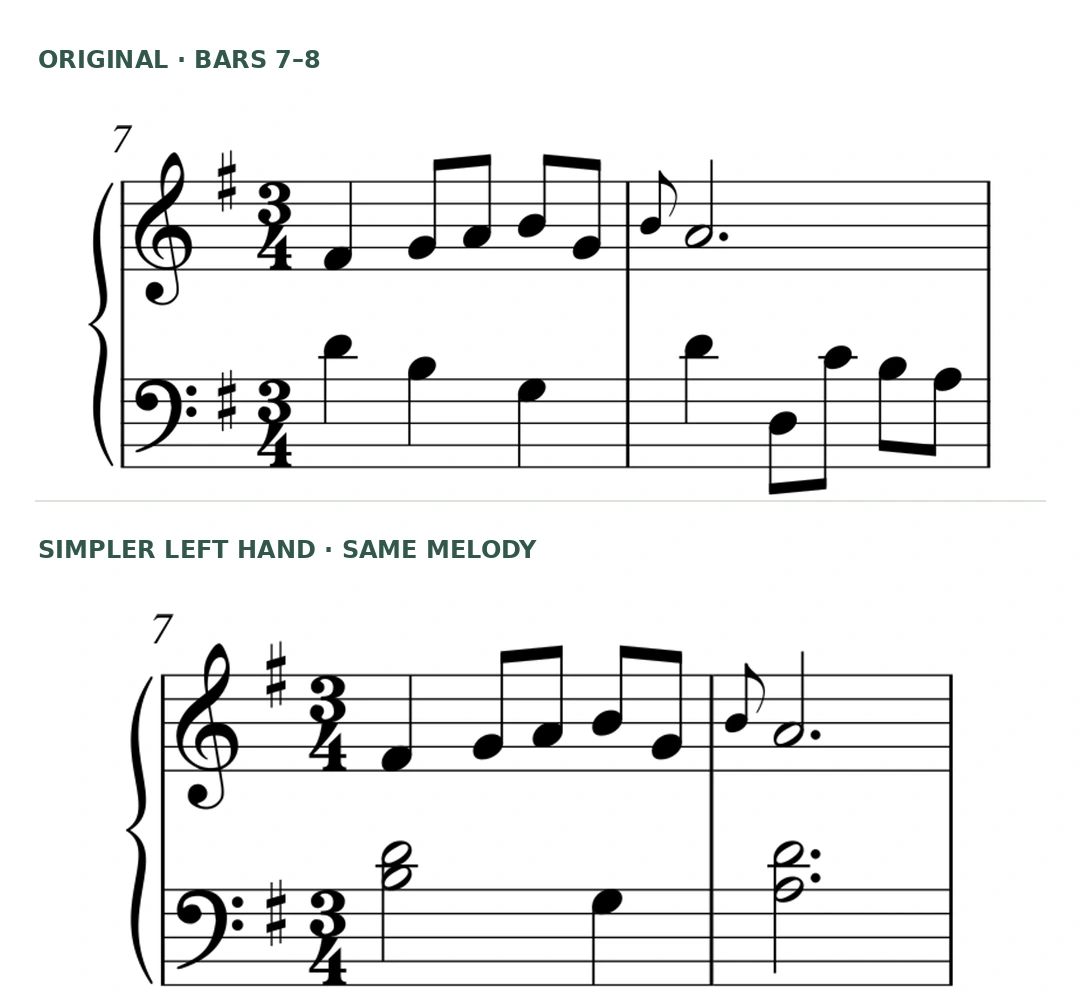
The actual editor request preserved the whole right hand and both repeats while reducing left-hand attacks, eliminating left-hand eighth notes and limiting simultaneous left-hand spans to a fifth. During review, the first note in bar 23 was restored to the original D so the preceding C-sharp resolves up a semitone instead of dropping a major seventh. This correction is saved in the finished score.
The final left hand has 49 attack moments across the written score, compared with 73 in the original. It retains quarter-note motion where the harmony needs it. The accompaniment texture changes; this is a teaching version, not a replacement for the original edition.
Watch the walkthrough
Edited walkthrough; waits shortened. Audio rendered from the exported MIDI. Read the transcript
Inspect the complete outputs
Simpler left hand in G
Simpler left hand in C
Source, musical checks and production notes
Bring the next piece
Start with a piano photo or PDF you use for teaching. Check the reading, make the changes your student needs and keep every version. The 50 free reading credits cover your first reads; more new pages use credits. Copies, changes, playback and exports are free. Library pieces and existing MusicXML imports are also free.