Free easy piano · Christmas
Jingle Bells, easy piano
Four free versions of Jingle Bells for piano, from a beginner chorus where the right hand never leaves C position to a recital version with the last chorus in octaves. Play each one here at any tempo, loop a bar, then print the PDF or download the MIDI.
- James Lord Pierpont
- Beginner to intermediate
- 32 bars · 4/4
- Free: play, print, MIDI
Versions of Jingle Bells. Each version is a request typed into PlayableNotes. Pick one to hear and print it.
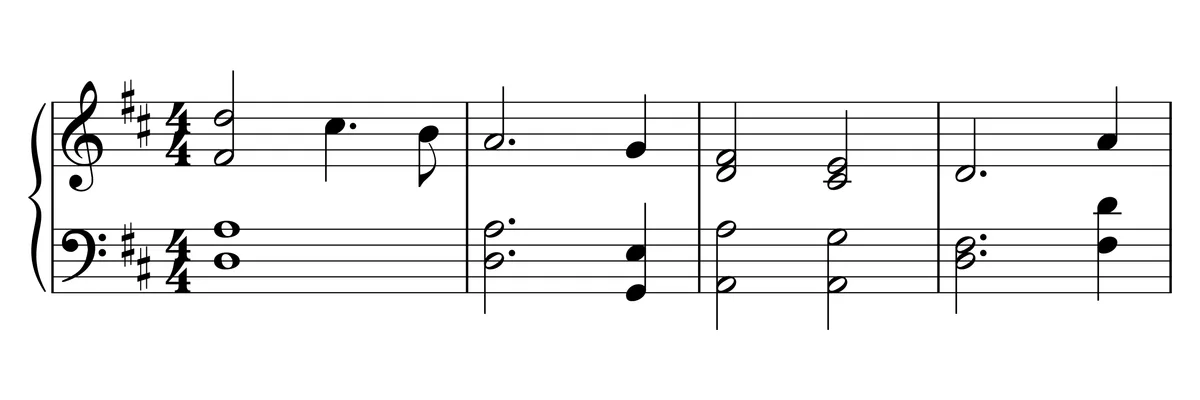
Typed into PlayableNotes“Make Jingle Bells easy for a second-year student: the verse and then the chorus, in G, with the tune in quarter notes so there are no sixteenths. Give the left hand something simple that still sounds like sleigh bells in the chorus, and keep the chords.”


What changed
The whole song in song order, verse then chorus: the tune alone in the right hand, root and fifth in the verse, a bouncing bass and chord in the chorus.
- Quarter-note values instead of the source's eighth-note values: each source bar is two bars here, so there are no sixteenths. The fastest notes are eighths: "in a" in bars 2, 22 and 30, and the short note after each dotted quarter in bars 19, 21, 27 and 29.
- Song order: the verse (bars 1–16), then the chorus written out twice (bars 17–32). The source plays the chorus first and last.
- Right hand: the tune alone, one note at a time, in the source's key of G, from the D above middle C to the E at the top of the staff.
- Verse left hand (bars 1–14): root and fifth in half notes (G–D, A–E, D–A), the bottom of the source's rolling broken chords. Bar 15 holds a single D and bar 16 a G–D fifth, so the bass does not move in octaves with the tune into the chorus.
- Chorus left hand: the figure from the source's own last chorus, a bass note on beats 1 and 3 and a two-note chord on 2 and 4: G with B–D; G with C–E in bars 21 and 29; A with D–F♯ in bars 23, 24 and 31, turning to C–F♯ (D7) on the last beat of bars 24 and 31. It ends on a G major chord.
- The source plays both halves of the verse from one passage, with the same pickups each time. Here they follow the standard tune: pickups on "in a" (bar 2) and "what" (bar 12), and "sleigh" (bar 4) and "ring" (bar 10) held.
For teachers: For a second-year student who can keep a left hand going on every beat. Learn the chorus left hand on its own first: the little finger stays on G for whole lines and only moves to A for "one-horse open sleigh".
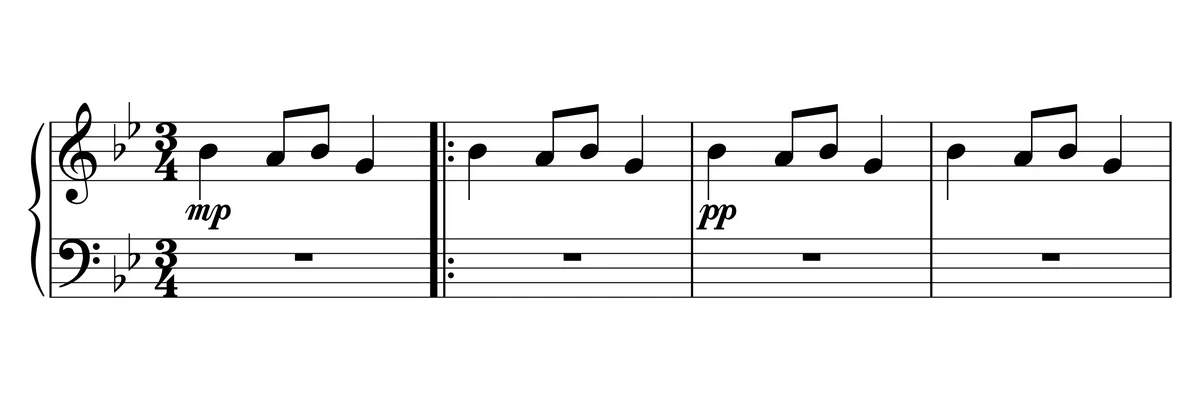
Typed into PlayableNotes“Make a beginner version of just the chorus for my student: put it in C so the right hand stays in C position, middle C to G, the whole time. Left hand single notes or open fifths, long notes only.”

What changed
The chorus twice, in C major: the right hand never moves from middle C position, the left hand plays half and whole notes.
- Chorus only, played twice (16 bars). The verse is left out because it needs more than an octave.
- Moved from G to C major: the right hand sits on C–D–E–F–G with the thumb on middle C and never moves, so the chorus starts E E E.
- Quarter-note values: the only quick notes are the dotted rhythms in bars 3, 5, 11 and 13 and the pairs of eighths in bars 6 and 14.
- Left hand in C position an octave lower, using only C, D, F and G: C and G in half notes for most bars, a held F for "oh what fun" (bars 5 and 13), G and D for "one-horse open" (bar 7), and C with G to finish.
- Same chords as the source, moved to C: C, F and G where the source has G, C and D.
For teachers: For a first-year student who knows middle C position. Clap bar 3 (E G C. D) before playing it: the dotted quarter is the one new rhythm. Then play the right hand alone until bars 7 and 8 (E D D E, D G) feel easy.
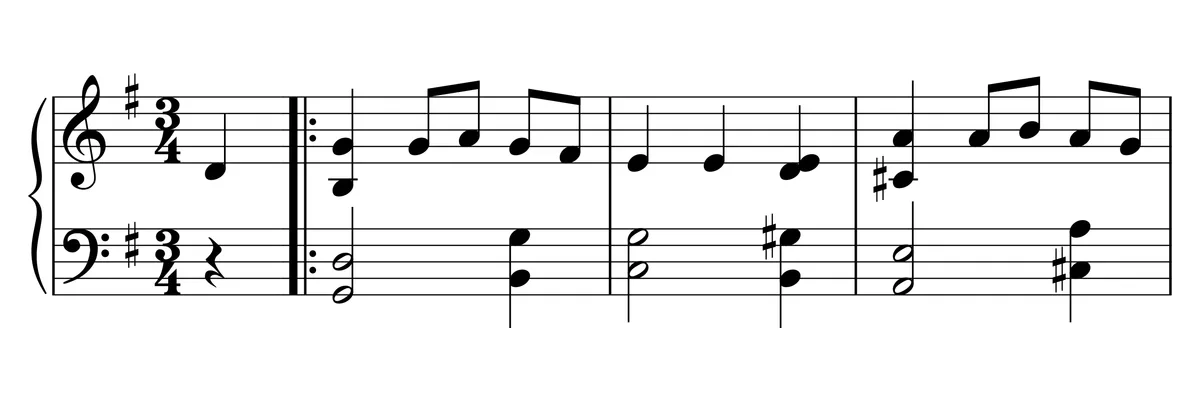
Typed into PlayableNotes“Now give me the whole song, verse and chorus, in C major so there are no sharps. Keep the left hand to two notes a bar.”


What changed
Verse and chorus in C: the chorus has the beginner version's right hand, the verse takes the right hand below middle C, and the left hand plays two notes a bar.
- Moved from G to C major, down a fifth: no sharps or flats. The chorus (bars 17–32) has the same right hand as the beginner version.
- Verse (bars 1–16): the right hand starts most lines on the G below middle C, on ledger lines, and leaps a sixth up to E. The long notes in bars 4, 6, 10 and 12 (A, B, G and A) are below middle C too.
- Quarter-note values throughout, as in the other versions; bars 10 and 12 follow the standard tune ("ring" held, a pickup on "what").
- Left hand: root and fifth in half notes all the way (C–G, D–A, G–D, F–C). Held G's in bars 15 and 24, and G then B in bar 31, so the bass steps up into the final C.
For teachers: The step after the beginner chorus. The new reading is the verse's ledger lines: name the G, A and B below middle C before the first run-through, and practice the leap from G up to E in bar 1 until the hand lands without looking.
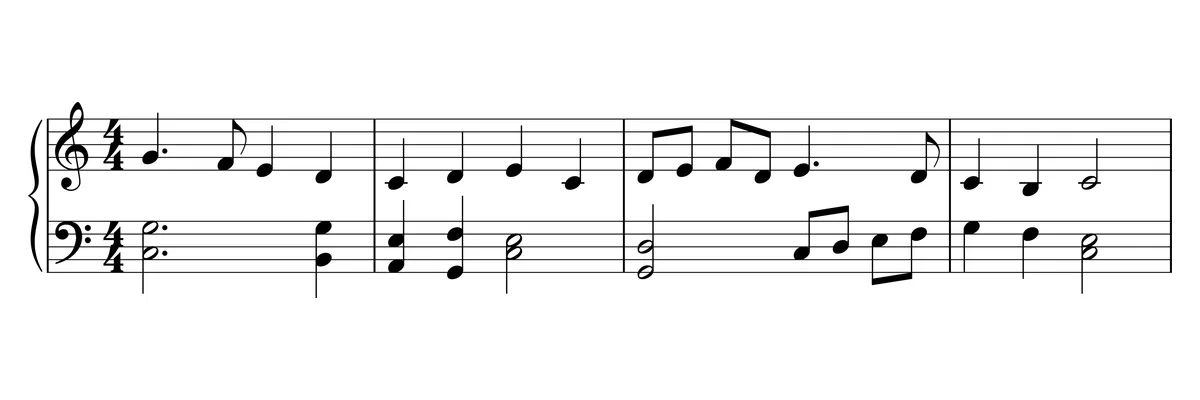
Typed into PlayableNotes“Make a fuller version for my intermediate student's Christmas recital: chorus, verse and chorus again, with harmony in the right hand, a bouncy left hand, and the last chorus in octaves.”


What changed
Chorus, verse and chorus again in G: harmony under the tune, an oom-pah left hand, and a last chorus in octaves.
- The source's plan: the chorus with first and second endings (bars 1–10), the verse (bars 11–26), then the chorus written out again (bars 27–42), 48 bars played. Quarter-note values, as in the other versions.
- First chorus: the right hand adds a note under the tune on long notes and strong beats (G under B, B under D, E or G under C, D under B, and F♯ and A under the tune in the D-chord bars). The left hand plays bass on beats 1 and 3 (G and D, C and G, D and A) and a two-note chord on 2 and 4.
- Verse: the left hand is the source's broken chord in quarter notes (G–D–G–D, A–E–A–E, D–A–D–A), with F♯ on the last beat of bar 25 so the bass rises to G on "tonight". The right hand fills the long notes with thirds (C–E in bars 14 and 22, D–F♯ in bar 16) and adds a note under the tune in bars 17, 18, 24, 25 and 26.
- Last chorus: the tune in octaves, as in the source's last chorus, with a chord tone inside the octave on long notes and strong beats. The left-hand chords grow to three notes (G–B–D, G–C–E, F♯–A–D, F♯–A–C).
- Harmony as in the source, with the C chord in root position under "oh what fun" (bars 5, 31 and 39) so the bass can alternate C and G; the source has C over G.
- Widest stretch: an octave in the right hand. The left hand jumps about an octave from bass note to chord.
For teachers: For a third- or fourth-year student who wants a showpiece. Practice the left hand alone until the jumps from bass note to chord land without looking, then the octaves in bars 27–42 slowly, keeping the thumb light so the top note sings.
Want it different? Just ask.
Open this version in PlayableNotes and ask for a change in words: simpler, another key, shorter, bigger notes. The result is a new version you can play, print and share with your student.
Free account. Changes, playback and printing are free; 50 free credits to read your own sheet music.
Watch how to ask for your own version · 1 min video
Make your own version
A real request in PlayableNotes, on Für Elise from the free library: say who it’s for and what to keep, and the AI writes a new version beside the original. It shows how to ask for a version of your own; its result is not one of the versions on this page.
About Jingle Bells
James Lord Pierpont published the song in Boston in 1857 as "The One Horse Open Sleigh". It was a sleighing song with no mention of Christmas, and it took the title "Jingle Bells" in an 1859 reprint. The verse ("Dashing through the snow") is close to what Pierpont wrote, but the chorus everyone knows is a later, simpler tune: nobody knows who changed it, and it is already on the oldest surviving recording, from 1898. That later chorus is the one used here.
On the piano the tune itself is easy. What trips students up is rhythm and repeated notes: "jingle bells" is three B's, "oh what fun it is to ride in a" is nine C's and B's, and the verse leaps a sixth at the start of most lines. The edition these versions come from writes the song in eighth-note values, which puts sixteenths in almost every bar. Every version here is in quarter-note values, so each of its bars becomes two and the fastest notes are eighths.
Start with the beginner chorus in C, add the verse with the whole song in C, then move to G with the easy version, where the left hand bounces in the chorus. The fuller version follows the source's own plan: chorus, verse and chorus again, the last time with the tune in octaves.
Practice tips
- Say the chorus rhythm before you play it: "jin-gle bells" is two quarters and a half note, and in "jin-gle all the way" the word "all" is a dotted quarter (the G in bar 19 of the easy version, the C in bar 3 of the beginner version).
- The chorus is mostly repeated notes. Keep the finger on the key and let it rise only a little between the repeated B's (E's in C), so they stay even and don't speed up.
- Most verse lines start with a leap of a sixth ("Dash-ing": D up to B in G, G up to E in C). Put the thumb on the low note and have the fourth or fifth finger already over the high one before the bar starts.
- Make the accented D on "Oh!" and "hey!" bright (bars 16 and 24 of the easy version), then come back in softly on "jin-gle".
- Practice each hand with the Right and Left buttons at about 90, then hands together, and raise the tempo a few beats at a time: the song should trot.
Questions about Jingle Bells
Who wrote Jingle Bells?
James Lord Pierpont. It was published in Boston in 1857 as "The One Horse Open Sleigh" and reissued in 1859 as "Jingle Bells; or, The One Horse Open Sleigh". The chorus sung today is not the one Pierpont wrote: it is a simpler tune of unknown origin, already in use on the oldest surviving recording, from 1898.
What are the piano notes for Jingle Bells?
In C major the chorus goes E E E, E E E, E G C D E; F F F F, F E E E E, E D D E, D G; and the second time ends G G F D, C. In G major (the easy version) the same chorus starts B B B, B B B, B D G A B. The beginner version on this page has the C major notes with their rhythm and a left hand.
Is Jingle Bells easy to play on piano?
The chorus is one of the easiest real tunes there is: in C it uses only the five notes from C to G, so the right hand never moves. The verse is harder, because it spans more than an octave and leaps a sixth at the start of most lines. Start with the beginner chorus, then add the verse with the whole song in C.
Is Jingle Bells a Christmas song?
Not originally. Pierpont wrote a winter sleighing song, and the words never mention Christmas. It became linked with winter and Christmas in the 1860s and 1870s, and a Christmas favorite in the early 1900s. The popular story that Pierpont wrote it for a Thanksgiving program has never been proven.
How fast should Jingle Bells be played?
In performance it goes in a brisk two, about half note = 120 in the quarter-note values used here. Learn it at the practice tempos set on this page (100 to 132 quarter notes a minute) and speed up only when the repeated notes stay even.
Can I download Jingle Bells as a PDF or MIDI file?
Yes, free and without an account. Every version has a Letter-size PDF to print and a MIDI file with the right and left hands on separate tracks.
Source and credits
- Composer
- James Lord Pierpont
- Source edition
- PDMX 3115306, a piano setting uploaded to MuseScore by user vlince (no arranger credited)
- License
- Public Domain Mark 1.0
- Arranger
- PlayableNotes
The setting gets the tune wrong in places, so every version follows the standard songbook melody, checked against two other uploads: PDMX 4718662 (Public Domain Mark) and PDMX 5883422 (CC0). Restored: the verse lines "o'er the fields we go" and "laughing all the way", which the setting skips; the held notes on "sleigh" and "ring" (the setting plays both halves of the verse from one passage, so each has a pickup the tune does not have there); and the usual rhythms of "jingle all the way", "oh what fun it is to ride in a" and "in a one-horse". Harmony follows the setting's left hand, not its printed chord symbols.
Arrangements and facts checked