Free easy piano · Christmas
Carol of the Bells, easy piano
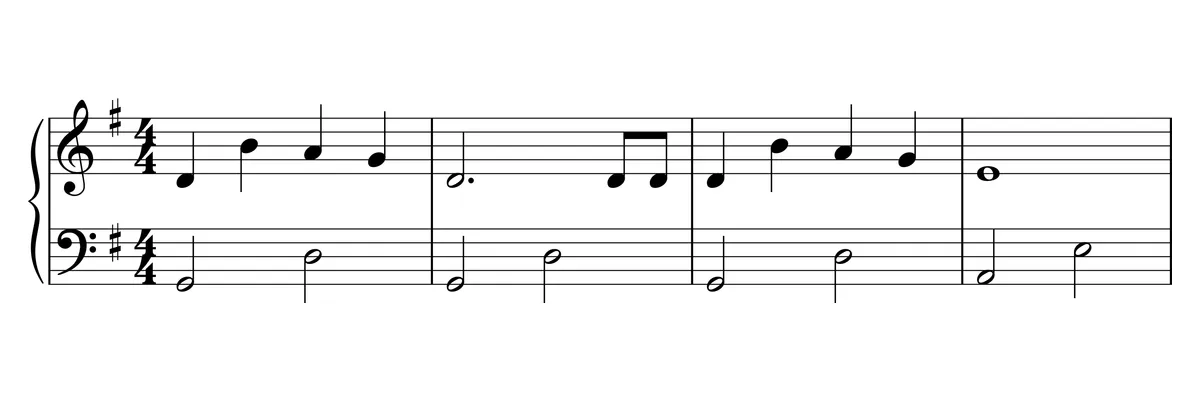
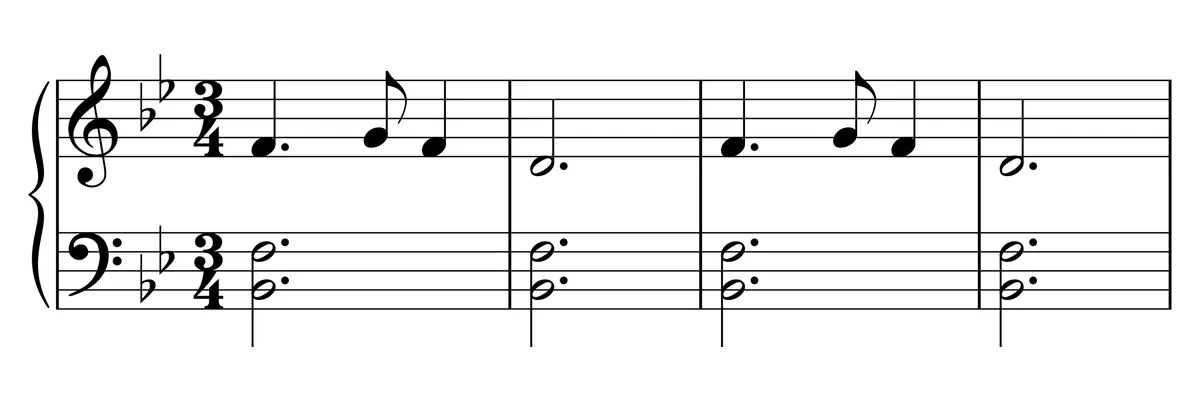
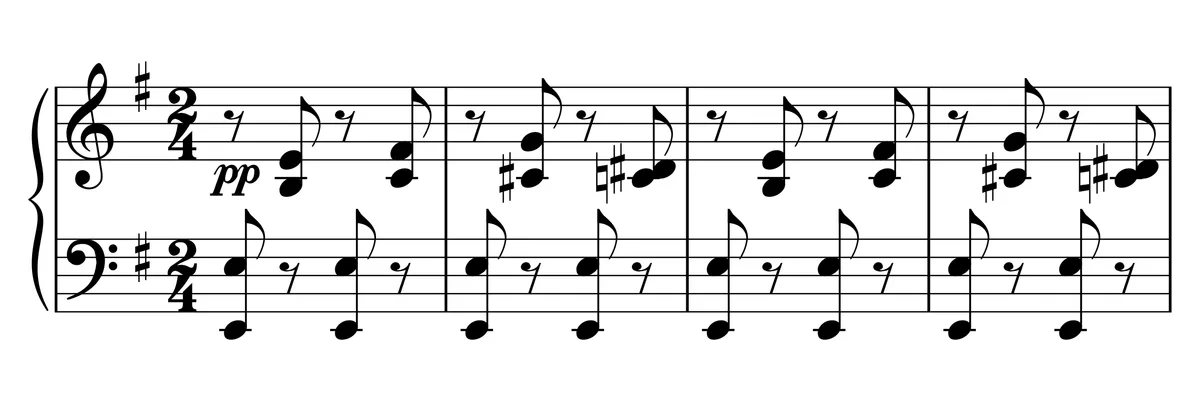
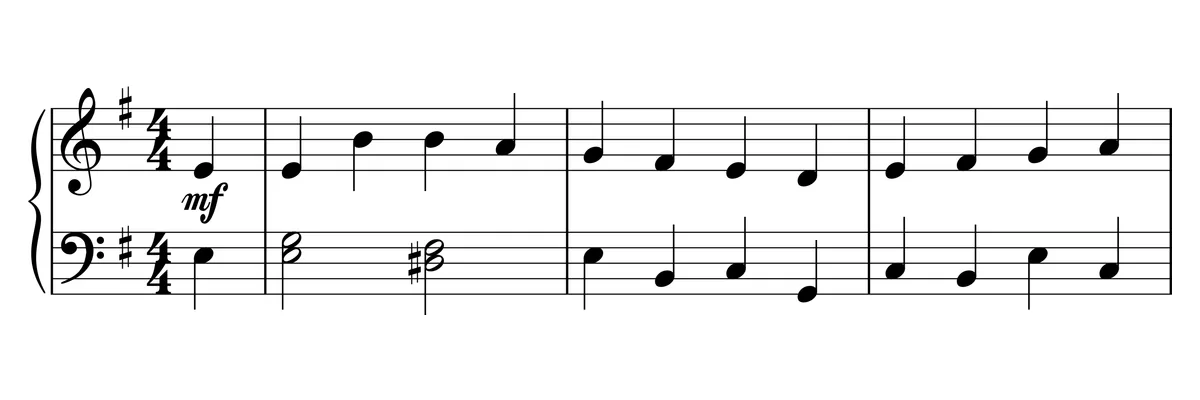
Carol of the Bells in four free piano versions: an easy version in G minor with the whole tune and the bell figure, a beginner version in D minor with the right hand in one position for all but one bar, a fuller intermediate solo and Leontovych's original choir setting (Shchedryk). Play each one here, slow it down or loop a bar, then print the PDF or download the MIDI.
- Mykola Leontovych
- Beginner to intermediate, plus the original
- 37 bars · 3/4
- Free: play, print, MIDI
Versions of Carol of the Bells. Each version is a request typed into PlayableNotes. Pick one to hear and print it.
Typed into PlayableNotes“Make Carol of the Bells easy for my second-year student. Keep G minor, the repeat and the whole tune, keep the bell figure going all the way through, and give each hand no more than two notes at a time, nothing wider than an octave.”


What changed
The sopranos' tune in G minor, with the bell figure always in one hand or the other and never more than two notes at a time in either hand.
- Right hand: the sopranos' line on top, as Leontovych wrote it, in bars 1 to 33 and in the last bar, with the repeat and both endings. The ending (bars 34 to 36) is described below.
- Bars 5 to 12: the left hand plays the altos' slow line, G, F, E-flat, D, an octave lower, then from bar 9 adds the tenors' line under it (E-flat, D, C, G), also an octave lower. In bar 11 it plays the C alone: the altos' E-flat is left out, because C and E-flat that low sound muddy.
- Bars 13 to 16: the left hand plays the basses' and tenors' notes at pitch in the figure's rhythm, as the choir sings them: E-flat and C, G and D, C and E-flat, G and D. The altos' repeated G is left out.
- Bars 17 to 20: the right hand plays the sopranos and altos together, the figure in thirds (D over B-flat, C over A, D over B-flat, B-flat over G), in the same five-finger position as the opening. The left hand holds the basses' G through each bar instead of repeating it in the figure's rhythm, with the tenors' line above it: D, then E-natural in bar 18, each held for the bar, then F, E-flat, D, one per beat, in bars 19 and 20. Bar 20 leaves out the tenors' first note, G, so it is the same as bar 19.
- Bars 21 to 24 (forte): the right hand plays the new tune alone. The left hand has the basses' bell figure, B-flat, A, B-flat, G, with the tenors' first note (D, or E-flat in bar 23) above the B-flat on each downbeat. The altos' repeated G and the rest of the tenors' line are left out.
- Bars 25 to 28: the right hand plays the rising scale; the altos' held D is left out, since the scale starts on the same note. The left hand plays the tenors' bell figure while it holds the basses' low D through each bar, and steps up to the basses' E-flat on the last beat of bar 28. In bars 26 and 28 the right hand adds the altos' F-sharp and G under the tune on beats 2 and 3, so the D7 chord still resolves to G minor; the altos' E-natural on beat 1 is left out.
- Bars 29 to 33: the left hand plays the basses' falling line, F, E-flat, D, C, under the tenors' G, which the thumb holds from bar 29 to bar 32, then low G with the G above it in the first ending. The altos' line in these bars is left out.
- Ending (bars 34 to 36) and last bar: Leontovych has the tenors sing the figure under the sopranos' held G and the altos' held D. Here the left hand holds the low G and D for three bars and the right hand plays the figure an octave above the tenors, in place of the sopranos' held G, at the pitch of the opening, with the fermata on its last G. The last bar is the sopranos and altos in thirds, closing on a unison G, as written.
- The mezzo-piano at bar 1 is ours; the other dynamics follow the editions.
For teachers: For a second-year student who reads two flats and plays eighth notes evenly. The right hand stays in G position (thumb on G) for most of the piece, so learn the figure first, then the thirds in bars 17 to 20 with the same five fingers; under them the left hand holds G with finger 5 while 1-2-3 play F, E-flat, D in bars 19 and 20. Three spots need practice on their own: the tune in bars 21 to 24 (the hand moves up for the high G, then back to G position at bar 22 with D on finger 5), the scale in bars 25 and 27 (1-2-3, thumb under to G, 1-2-3, then 4 and 5 on C and D in the next bar; on beat 2 the thumb slips down to F-sharp under C on 4, fingers 1-4, and beat 3 is G and B-flat on 1 and 3), and the left hand in bars 25 to 28, which holds the low D with finger 5 while 1-2-1-3 play the figure.
Typed into PlayableNotes“Make a beginner version for my first-year student, in a key with no more than one flat. Keep the right hand in one five-finger position as much as you can, give the left hand single notes and two-note chords in long notes, and leave out the repeat.”


What changed
The tune a fourth lower, in D minor, with the right hand in one five-finger position for all but one bar, over a left hand of long single notes and two-note chords, mostly one per bar.
- Moved down a fourth, from G minor to D minor: one flat instead of two. The bell figure becomes F, E, F, D, fingers 3-2-3-1 with the thumb on D.
- Played once through, without the repeat: bars 1 to 32 of the original, then its ending (bars 34 to 37 there, 33 to 36 here), 36 bars in all.
- Right hand: one note at a time, in D position (D to A) in every bar except bar 21, where the tune climbs to the high D (fingers 5, 4, 3 on D, C, B-flat) and comes straight back. It plays the sopranos' line except in bars 25, 27 and 33 to 35, described below.
- Bars 5 to 12: the left hand plays the altos' line, D, C, B-flat, A, an octave lower, then the tenors' line, B-flat, A, G an octave lower and D at pitch, one note per bar. The altos' line in bars 9 to 12, which repeats bars 5 to 8, is left out.
- Bars 13 to 16: two-note chords at the basses' and tenors' own pitches, B-flat and G, D and A, G and B-flat, D and A, held for the bar instead of repeated in the figure's rhythm. The altos' repeated D is left out.
- Bars 17 to 20: the right hand plays the sopranos' A, G, A, F; the altos' bell figure a third below it (F, E, F, D) is left out. The left hand holds the basses' D with the tenors' A, or B-natural in bar 18; the tenors' moving line in bars 19 and 20 is left out.
- Bars 21 to 24: the left hand plays the first and last notes of the basses' bell figure, F as a half note and D as a quarter, with the tenors' A (B-flat in bar 23) above the F. The rest of the figure, the altos' repeated D and the tenors' moving notes are left out.
- Bars 25 to 28: the right hand rests for a dotted quarter and plays only the last three notes of the rising scale, D, E, F (the first three, A, B-natural and C-sharp, are left out), then the tune in bars 26 and 28. The left hand holds the basses' low A, stepping up to B-flat on the last beat of bar 28. The tenors' bell figure and the altos' line, with the C-sharp of the A7 chord, are left out.
- Bars 29 to 32: the left hand plays the basses' falling line, C, B-flat, A, G, one note per bar; the tenors' held D and the altos' line are left out.
- Ending (bars 33 to 36): Leontovych has the tenors sing the figure under held notes. Here the left hand holds D and A for three bars and the right hand plays the figure, with the fermata on its last D. The last bar is the sopranos' A, G, A, D; the altos' figure under it is left out.
- The only accidental is the B-natural in bar 18. The mezzo-piano at bar 1 is ours; the other dynamics follow the editions.
For teachers: For a first-year student who plays eighth notes evenly and can count a rest. The right hand learns one shape, the figure on D, E, F, and everything else in it lies under the same five fingers apart from bar 21. The left hand changes notes at most once a beat, mostly once a bar, and never stretches wider than a sixth. Two spots need practice on their own: bar 21, where the right hand moves up for the high D and comes back for bar 22 (A on finger 5), and bars 25 and 27, where the right hand waits and comes in on the "and" of beat 2. Count "1, 2 and" over the left hand's A and play the D on "and".
Typed into PlayableNotes“Turn the choir version into a piano solo for an intermediate student. Keep G minor, the repeat and all four voices wherever two hands can reach them, and simplify only what doesn't fit under the hands.”


What changed
Leontovych's four voices at the piano, as written in bars 1 to 16 and most of the rest, with the few spots that don't fit the hands held, shared or moved by an octave.
- Bars 1 to 16: as written. The right hand holds the altos' slow line under the bell figure, and the left hand plays the tenors and basses at their own pitch.
- Bars 17 to 20: the basses' G is held instead of repeated in the figure's rhythm.
- Bars 21 to 23: the right hand holds the altos' G under the tune instead of repeating it.
- Bars 25 and 27: the altos' held D is left out, since the right hand's scale starts on the same note.
- Bars 34 to 36: the left hand holds the low G and D for all three bars, and the right hand plays the tenors' bell figure at pitch under its held G. The altos' held D is the left hand's D, an octave lower.
- The mezzo-piano at bar 1 is ours; the other dynamics follow the editions.
For teachers: For a student around grade 3 or 4. The new skills are holding one note while playing others in the same hand (bars 5 to 12, 21 to 23, 29 to 33 and the ending) and keeping the bell figure quiet under a louder tune. In bars 5 and 9 the held G is struck again with the figure's last note. Practice the left hand of bars 21 to 24 alone: it has two voices. The ending is a stretch: the right hand holds G with finger 5 while 2-1-2-1 play B-flat, A, B-flat, G below it, down to the G an octave under the held one. Small hands can let the held G go and keep it sounding with the pedal.
The piece as published: Leontovych's choral setting, MuseScore score 37381 (uploaded by affenkaraffe), from the PDMX collection.
Original
What changed


What changed
Leontovych's setting for unaccompanied choir, soprano and alto on the upper staff, tenor and bass on the lower, played at the piano.
- Nothing changed in the notes: this is Leontovych's four-part setting, checked bar by bar against two independent editions. The dynamics are the ones both editions print; the upload has none, and the editions differ at bar 1, so there is no marking there.
- It is written for voices, not for piano. Bars 34 to 36 hold a low G under the tenors' bell figure, a tenth apart, which most hands can only manage with the pedal, and in bars 25 and 27 the altos hold D while the sopranos' scale starts on the same D.
For teachers: Useful for hearing how the choir version is built: the bell figure never stops, and a new voice enters every four bars until all four are singing at bar 13. Students who want to play the full texture should start from the intermediate version.
Want it different? Just ask.
Open this version in PlayableNotes and ask for a change in words: simpler, another key, shorter, bigger notes. The result is a new version you can play, print and share with your student.
Free account. Changes, playback and printing are free; 50 free credits to read your own sheet music.
Watch how to ask for your own version · 1 min video
Make your own version
A real request in PlayableNotes, on Für Elise from the free library: say who it’s for and what to keep, and the AI writes a new version beside the original. It shows how to ask for a version of your own; its result is not one of the versions on this page.
About Carol of the Bells
Carol of the Bells is Shchedryk, Mykola Leontovych's setting of a Ukrainian New Year song for unaccompanied choir, first performed in Kyiv in 1916. The whole piece grows from one four-note figure, B-flat, A, B-flat, G, sung over and over while the other voices enter one by one beneath it. At bar 17 the altos take the figure while the sopranos sing it a third higher; at bar 21 a new tune breaks out above it, and the figure passes to the basses and then the tenors. In the last bar the two top voices sing it together in thirds, closing on a unison G.
On the piano the notes are not the hard part: the right hand plays the same figure for most of the piece. What is hard is keeping that figure light and even while the other hand does something different, and following it when it moves to another voice (the altos in bars 17 to 20, the basses in 21 to 24, the tenors in 25 to 28 and in the ending). The easy version handles those hand-offs with no more than two notes in either hand: the right hand plays the figure in thirds in bars 17 to 20, the left hand takes it under the new tune in bars 21 to 28, and the right hand has it again from bar 29 to the end, over a held low G and D in the last bars.
The easy version is in G minor, with two flats, the key of both editions the notes were checked against. The beginner version is a fourth lower, in D minor with one flat, where the figure is F, E, F, D; it is played once through without the repeat, and its left hand plays long single notes and two-note chords, mostly one per bar. The intermediate version keeps Leontovych's four voices wherever two hands can reach them, and the original is here too, checked bar by bar against two editions, so you can hear what each version changed.
Practice tips
- Learn the bell figure first: quarter, two eighths, quarter, with fingers 3, 2, 3, 1 where the right hand plays the figure alone (B-flat, A, B-flat, G in G minor; F, E, F, D in the beginner version). From bar 3 it is pianissimo, so play it light and perfectly even before adding anything under it.
- Count all three beats of every bar. The last note of the figure is a full quarter note; cutting it short makes the bells rush.
- Loop bars 17 to 24 (click bar 17, then bar 24) and play each hand alone with the Right and Left buttons. In the easy and intermediate versions the right hand plays the figure in thirds in bars 17 to 20, and from bar 21 the left hand takes it over under the forte tune: that hand-off is the main thing to learn.
- Follow the dynamics: pianissimo from bar 3, mezzo-piano from bar 13, forte where the new tune starts in bar 21, and back to mezzo-piano at bar 29. The three arrangements also mark mezzo-piano for the first two bars; the original has no marking there.
- In the ending of the easy and beginner versions the right hand plays the figure over the left hand's held fifth; in the intermediate version it plays it under a held G, and in the original the tenors have it over a low G that needs the pedal. Wait out the fermata before the last bar.
Questions about Carol of the Bells
Who wrote Carol of the Bells?
The music is Mykola Leontovych's Shchedryk, his setting for unaccompanied choir of a Ukrainian New Year song in which a swallow promises the household a rich year. It was first performed in Kyiv in 1916. The English Christmas words and the title Carol of the Bells came later, from Peter J. Wilhousky in 1936.
Is Carol of the Bells public domain?
Leontovych's music is: he died in 1921, and Shchedryk was published long before 1931, the US cut-off for this year. Wilhousky's 1936 English words and his choral arrangement are still under copyright in the United States, so every version on this page is instrumental and comes from Leontovych's own setting.
Is Carol of the Bells hard to play on piano?
The notes are simple; the work is in keeping the bell figure light and even while another part plays with it. In the easy and intermediate versions the hardest bars are 21 to 28, where the left hand takes over the bell figure under the forte tune; the beginner version leaves the figure out of the left hand there and gives it one or two notes a bar. On this page the beginner version suits a first-year student, the easy version a second-year student and the intermediate version a student around grade 3 or 4. The original choir setting needs the pedal for the low G under the ending, and bars 25 and 27 are awkward under the hands, where the altos hold the D that starts the sopranos' scale.
Is Carol of the Bells Ukrainian?
Yes. Shchedryk is a shchedrivka, a Ukrainian song for Shchedryi Vechir, the eve of the New Year in the old Julian calendar, when singers went from house to house wishing each family a good year. In Ukrainian it is a New Year song; it became a Christmas carol in English through Wilhousky's 1936 words, which this page does not use.
How fast should Carol of the Bells be played?
Drew Weymouth's edition on IMSLP marks it Allegretto, and choirs sing it quickly, with each bar felt almost as one beat. The versions here start slower: 72 quarter notes per minute for the beginner version, 84 for the easy version, 100 for the intermediate and 104 for the original. If the bell figure is not yet even, start below that, then raise the speed with the tempo slider on this page.
Can I download Carol of the Bells as a PDF or MIDI file?
Yes, free and without an account. Every version has a Letter-size PDF to print and a MIDI file with the right and left hands on separate tracks.
Source and credits
- Composer
- Mykola Leontovych
- Source edition
- Leontovych's choral setting, MuseScore score 37381 (uploaded by affenkaraffe), from the PDMX collection
- License
- Public Domain Mark 1.0
- Arranger
- PlayableNotes
Checked bar by bar against two independent editions on IMSLP (Drew Weymouth and Ben Kwong), both in G minor, which were used only to check the notes and to take the dynamics they agree on. The upload is in F-sharp minor and has been moved up a semitone to G minor, the key of both editions. Sustained tenor notes in bars 17 to 20 and 29 to 33, note lengths in bars 21 to 23 and 33 to 37, and the alto C in bar 30 were corrected to match both editions. In bars 29 to 33 the bass follows Kwong and the upload (F, E-flat, D, C); Weymouth holds a G. The upload has no dynamics: the pp, mp and f markings are the ones both editions print, and the mp at bar 1 in the three arrangements is ours. Instrumental only: no words, and nothing from later English-language arrangements.
Arrangements and facts checked