Free easy piano · Classical
Brahms Lullaby, easy piano
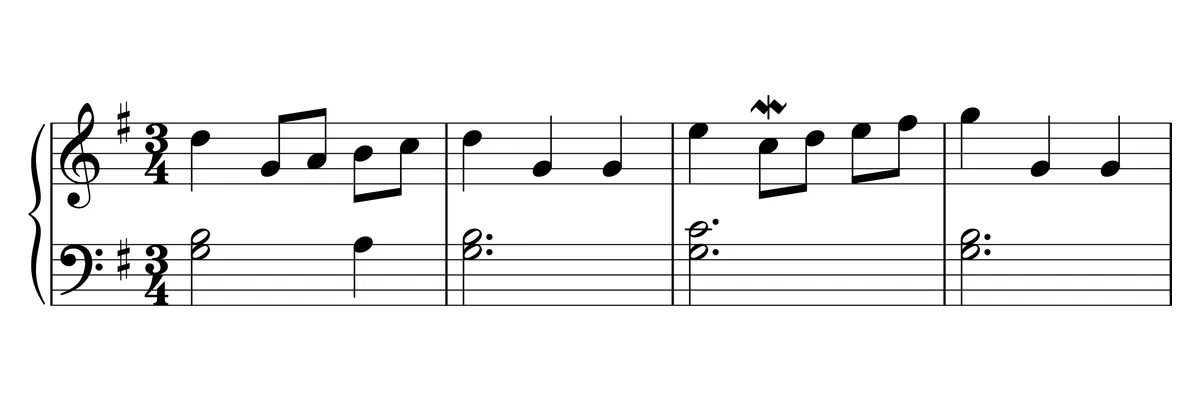
Brahms's Lullaby (Wiegenlied, Op. 49 No. 4) in five free piano versions: an easy version in F, a beginner version in C, the same tune over a rocking left hand, an intermediate solo in Brahms's key of E-flat, and the original. Play each one here, slow it down or loop a bar, then print the PDF or download the MIDI.
- Johannes Brahms
- Beginner to intermediate, plus the original
- 18 bars · 3/4
- Free: play, print, MIDI
Versions of Lullaby (Wiegenlied). Each version is a request typed into PlayableNotes. Pick one to hear and print it.
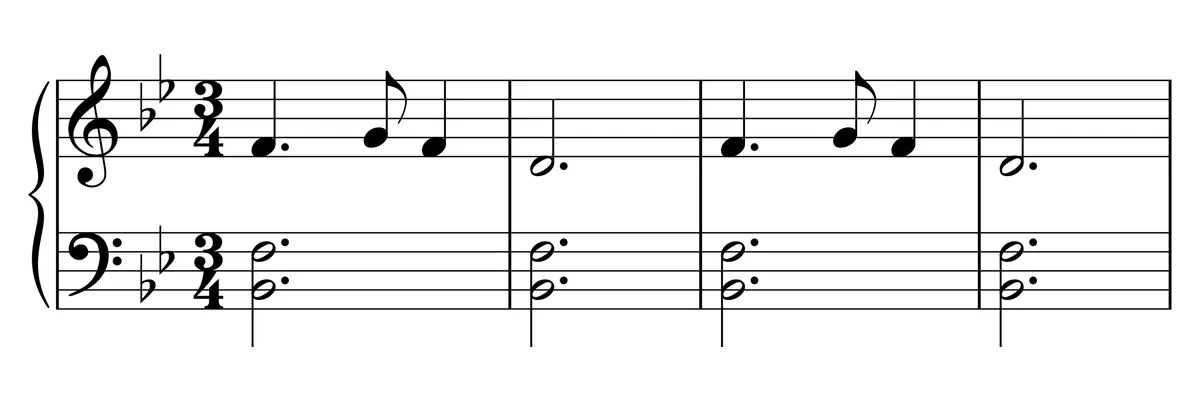
Typed into PlayableNotes“Make this easy for a second-year student. Put it in F major, keep every note of the tune and Brahms's two-bar introduction, and keep his rocking left hand but inside one octave instead of his wide leaps.”

What changed
The whole tune in F, after a short introduction, over a left hand that rocks like Brahms's without leaving one octave.
- Key: F major (one flat), a whole step above Brahms's E-flat (three flats). The tune is note for note, without the small grace notes in bars 14 and 17.
- Bars 1 and 2: Brahms's introduction as soft right-hand thirds (A–C, F–A, A–C), starting on the downbeat instead of half a beat early, and without his ties over the barline.
- Left hand: Brahms's rocking figure (a low note on beat 1, then up, then back) in quarter notes, kept between low F and the F above instead of his leaps of a ninth to a twelfth. The low F on every downbeat is his E-flat pedal, a step higher.
- Bars 6 to 9 and 13: E and C over the low F carry the dominant harmony, where Brahms holds his pedal under the dominant chord.
- Bars 10 and 14: E-flat on beat 3, Brahms's seventh chord leading into the next bar.
- Bar 17: the left hand moves from low F to C and holds it under the tune's A and G, as Brahms's bass moves to B-flat for the closing cadence.
- Bars 11, 12 and 14 to 16: the right hand adds one note under the tune's half notes (D–F, A–C), taken from Brahms's chords.
- Played once, ending on a held F major chord over the low F and C. Brahms's repeat is left out.
For teachers: For a student in their second year who reads eighth notes and can play hands together. Practice the left hand alone first: little finger on the low F, thumb near the F above. The hand stays in one place, but most bars stretch it a seventh or a full octave (low F up to E or F), so a student with small hands can lift the little finger off the low F as the thumb reaches up.
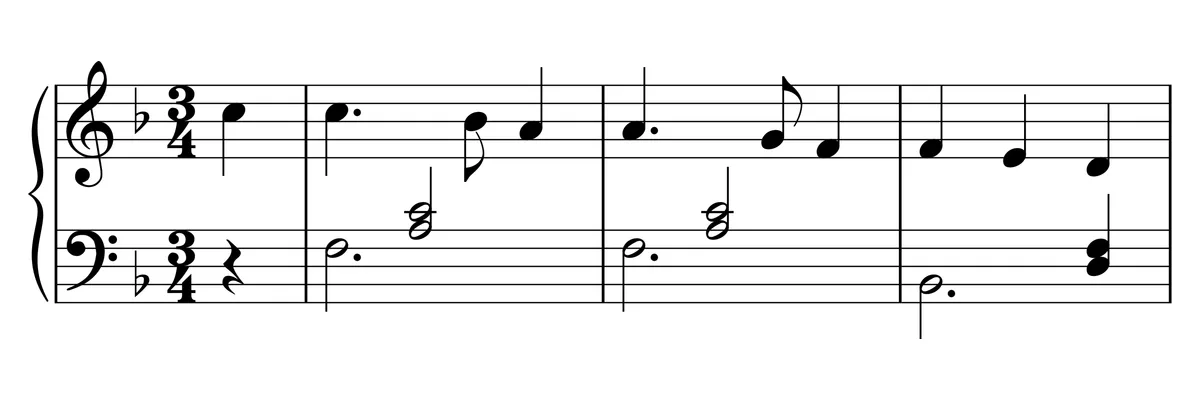
Typed into PlayableNotes“Make a beginner version in C major: the tune in the right hand, held two-note chords in the left hand, mostly one per bar, no introduction and no repeat.”

What changed
The tune in C with no sharps or flats, over held left-hand chords, mostly one per bar.
- Key: C major, a minor third below Brahms's E-flat. The tune is note for note from its two eighth-note pickups, without the grace notes.
- No introduction and no repeat: just the 16 bars of tune.
- Left hand: held two-note chords, mostly one per bar, instead of Brahms's leaping bass: C–G for the home chord, B–G for the dominant (bar 5 from beat 2 to bar 8, then bars 12 and 16), C–A for the subdominant (bars 10 and 14).
- Bar 8, beat 3: D–G, so the bass steps down to C while the tune climbs from B to C.
- Brahms keeps a low E-flat under his dominant bars; here the left hand plays the dominant chord itself, which is easier to hear and to read.
For teachers: For a first-year student who knows C position. The right hand moves up out of C position in bars 4 and 8 and back down in bars 5 and 9. In the second half it jumps from middle C to the C above in bars 9–10 and 13–14 and comes back down in bars 10–11 and 14–15. Show those moves before the first run-through.
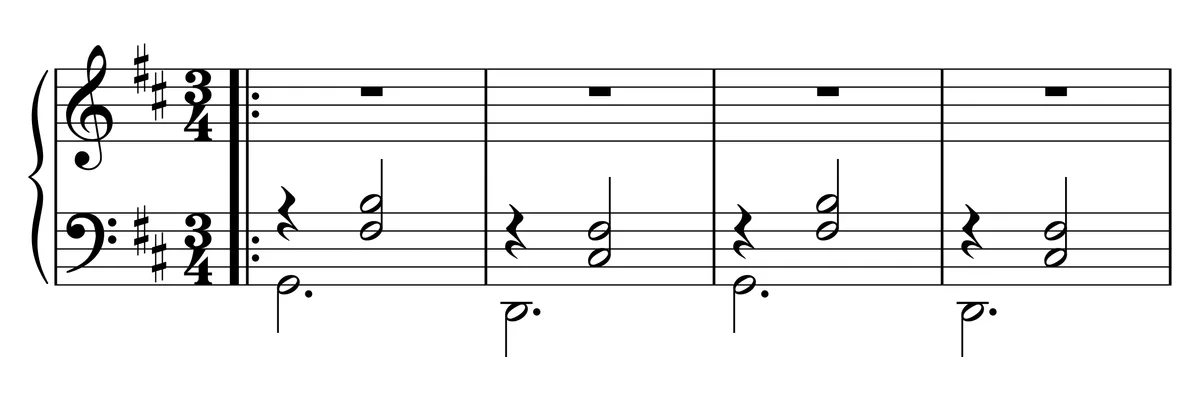
Typed into PlayableNotes“Keep this beginner version, but let the left hand rock in quarter notes like Brahms's accompaniment, staying close to C position.”

What changed
The beginner version's tune over a left hand that rocks in quarter notes, like Brahms's bass.
- Right hand: the beginner version's tune in C, unchanged, after one bar of left hand alone.
- Left hand: Brahms's rocking figure in quarter notes, kept between B and A: C–G–C in bars 1 to 4, so the bass does not double the tune's E an octave below, then C–G–E for the home chord, C–G–B for the dominant (bars 6 to 8, 13 and 17) and C–A–F for the subdominant (bars 11 and 15). The C on every downbeat stands for Brahms's low E-flat pedal.
- Bars 12 and 16: C–E–G rising, against the falling tune.
- Bar 9 ends on D, so the bass does not move in octaves with the tune into bar 10.
- No repeat. The last bar is a held C–G.
For teachers: The next step after the beginner version: the right hand is the same, so all the new work is in the left. Play the left hand alone until it rocks evenly, with beat 1 a little deeper than beats 2 and 3.
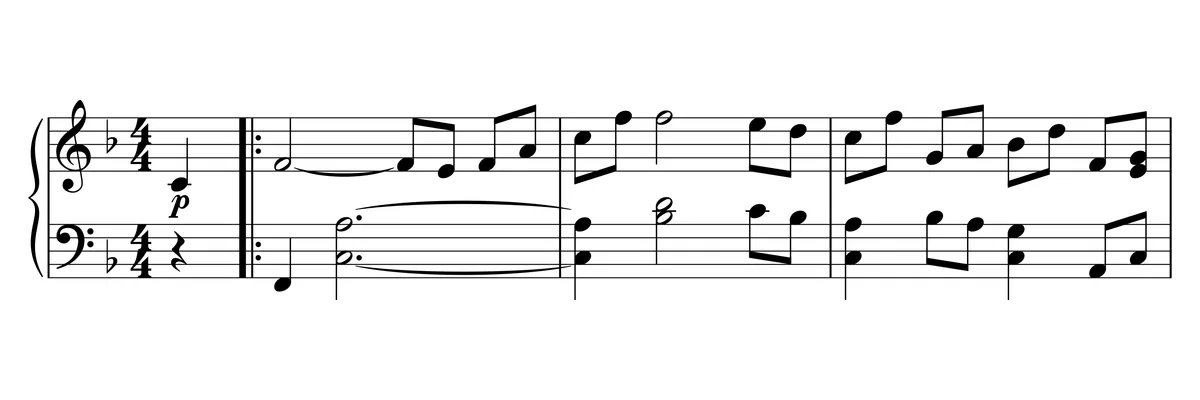
Typed into PlayableNotes“Turn this song into a piano solo for an intermediate student: keep the original key, Brahms's left hand and his off-beat chords, and put the tune on top of the right hand.”


What changed
Brahms's key, bass and off-beat chords with the tune on top, arranged for one pianist.
- Key, introduction, left hand and repeat as Brahms wrote them.
- Right hand: the tune is the top voice, with Brahms's off-beat chords under it in the same hand. Where his chords lie above the voice or double its note (bars 4 to 13 and 15 to 17), they are moved under the tune with the same harmony. In bar 6 his E-flat–G still rubs against the tune's D, and in bars 8 and 9 the last eighth keeps his A-flat–C, the ninth over the dominant.
- From bar 3 on, the off-beat chords are not tied over the barline: each one is played on the 'and' and lifted at the next downbeat, where the bass comes in.
- Bar 7: on the 'and' of beat 2 the right hand plays D alone, without Brahms's A-flat (it has just sounded in the chord before), so the hand can hold the tune's B-flat without stretching a ninth.
- Bars 11 and 15: Brahms's D-flat (the seventh chord that leads to A-flat) is played above the tune's last E-flat, as in his score.
- Bars 12 and 16: on beat 2 the right hand plays E-flat–A-flat under the tune's held E-flat instead of Brahms's C–E-flat, so the tune's C on beat 3 is not struck twice before it arrives.
- Bar 14: Brahms's first three eighth-note chords are kept. His last three (A-flat–C, D–F, G–B-flat) are replaced by B-flat–D, F–A-flat and D–F so the hand can hold the tune's B-flat and C above them; his falling inner line (B-flat, A-flat, G) is lost.
- Bar 15: the right hand holds E-flat alone under the tune's B-flat, without Brahms's G, so the grace note G rises cleanly to B-flat; the left hand's G on beat 2 supplies the third.
- Bar 18: Brahms's eighth-note figure (a chord on each beat, then a rising B-flat, C, D above the tune) becomes three quarter-note chords under the tune: D–F, E-flat, A-flat–D. The seventh chord on beat 3 is kept; his C on the 'and' of beat 2 is left out. The grace notes in bars 15 and 18 are kept.
For teachers: For a student around grade 3 or 4 who can voice a melody over chords in one hand. Play the tune alone with the upper fingers first, then add the off-beat chords very softly with the thumb and lower fingers. The left hand's leap from the low E-flat is the same as in the original, so give it its own practice.
The piece as published: OpenScore Lieder Corpus: Brahms, 5 Lieder Op. 49 No. 4, Wiegenlied (voice and piano, transcribed from the Breitkopf & Härtel Sämtliche Werke, vol. 24, 1926–27, IMSLP #81909).
Original
What changed

What changed
Brahms's piano part note for note, with the song's vocal line written on the right-hand staff.
- Nothing in the notes: Brahms's accompaniment as printed, with the vocal line (without words) folded onto the right-hand staff.
- Bar 11 as numbered here (measure 10 in the OpenScore file), left hand: the third note is E-flat, as in the 1868 first edition; the OpenScore file has B-flat.
For teachers: This is a song folded onto two staves, not piano writing: Brahms's off-beat chords lie above the tune for most of bars 6, 7, 11 and 18, in the second half of bar 10 and on the last eighth of many other bars (8, 9 and 15, for example), and many tune notes are doubled in the chords. To play it as a solo, start from the intermediate version.
Want it different? Just ask.
Open this version in PlayableNotes and ask for a change in words: simpler, another key, shorter, bigger notes. The result is a new version you can play, print and share with your student.
Free account. Changes, playback and printing are free; 50 free credits to read your own sheet music.
Watch how to ask for your own version · 1 min video
Make your own version
A real request in PlayableNotes, on Für Elise from the free library: say who it’s for and what to keep, and the AI writes a new version beside the original. It shows how to ask for a version of your own; its result is not one of the versions on this page.
About Lullaby (Wiegenlied)
Brahms wrote the Wiegenlied in 1868 for his friend Bertha Faber after the birth of her second son, and it was published that year as the fourth of his Five Songs, Op. 49. It is a song for voice and piano, not a piano piece: the singer has the tune, and the piano rocks underneath it, with a low E-flat on every downbeat and soft chords on the off-beats. Brahms worked into that accompaniment an echo of a song by the Viennese composer Alexander Baumann that Bertha used to sing to him.
The tune is short and fits within one octave: four phrases over 16 bars in 3/4, starting on two eighth-note pickups. What makes the printed score hard for students is everything around it: three flats, a left hand that leaps from the low E-flat up a ninth or more in bar after bar, and right-hand chords that land between the beats and tie over the barlines. In the original on this page the vocal line is folded onto Brahms's right-hand staff, since in his score it belongs to the singer.
The easy version, in F, keeps Brahms's two-bar introduction and the whole tune over a left hand that rocks inside one octave. The beginner version puts the tune in C over held left-hand chords, mostly one per bar, and the rocking version keeps that right hand while the left hand moves in quarter notes like Brahms's bass. The intermediate solo keeps his key, bass line and off-beat chords, rearranged so one pianist can play the tune and the accompaniment together.
Practice tips
- Count before you start: the tune begins on beat 3 with two eighth notes. Count one bar aloud, '1, 2, 3 and', and play the two eighth notes on 3 and 'and'.
- The one big move in the tune is the jump in the second half: two low notes, then the same note an octave higher (F, F, high F in bars 10–11 and 14–15 of the easy version; C, C, high C in bars 9–10 and 13–14 of the beginner version). Move the hand during the second low note and look ahead to the high one.
- Keep the left hand softer than the tune. Brahms marks the song p from start to finish, with only small swells in bars 6, 7, 14 and 15 of the original on this page.
- In every version except the beginner one the left hand rocks: let beat 1 sound a little deeper and beats 2 and 3 lighter, like a cradle swinging, and keep the three beats even.
- Practice each hand with the Right and Left buttons at about 60, then play hands together and raise the tempo a few beats at a time. A gentle pace of around 70 suits the piece.
Questions about Lullaby (Wiegenlied)
What are the notes of Brahms's Lullaby on piano?
In C major, as in the beginner version: E E G, E E G, E G C B A A G; then D E F D, D E F, D F B A G B C; then C C C A F G, E C F G A G; and to finish, C C C A F G, E C F E D C. In the last two lines the first two Cs are middle C and the third is the C above.
What key is Brahms's Lullaby in?
Brahms wrote it in E-flat major, with three flats. On this page the beginner and rocking versions are in C major, the easy version is in F major, and the intermediate solo and the original are in E-flat.
Is Brahms's Lullaby good for beginners?
The tune is: it is slow, in 3/4, and stays within an octave. The original accompaniment is not, because of its three flats, its leaping left hand and its off-beat chords. The beginner version keeps the whole tune in C over held left-hand chords, mostly one per bar, so a student in their first year can play it hands together.
How fast should Brahms's Lullaby be played?
Brahms marked it 'Zart bewegt', tenderly moving, with no metronome mark. Around 70 quarter notes per minute sounds gentle without dragging. Learn it slower and use the tempo slider on this page to speed up as it settles.
What are the words to Brahms's Lullaby?
The German song begins 'Guten Abend, gut' Nacht'. The first verse is a folk text from the collection Des Knaben Wunderhorn; Brahms added a second verse later, adapted from an 1849 poem by Georg Scherer. The 1868 first edition has only the first. The familiar English words, 'Lullaby and good night', are a later English version sung to the same tune. The scores on this page are for piano alone and carry no words.
Can I download Brahms's Lullaby as a PDF or MIDI file?
Yes, free and without an account. Every version has a Letter-size PDF to print and a MIDI file with the right and left hands on separate tracks.
Source and credits
- Composer
- Johannes Brahms
- License
- CC0
- Arranger
- PlayableNotes
Every bar of the voice and both piano staves was compared with the 1868 Simrock first edition and with Mutopia no. 1037. One correction to the OpenScore file: in bar 11 as numbered here (measure 10 in the OpenScore file) the left hand's third note is E-flat, which follows the first edition and Mutopia; the OpenScore file has B-flat. The voice line is folded into the right hand; the words are not included.
Arrangements and facts checked