Free easy piano · Christmas
Away in a Manger, easy piano
James R. Murray's Away in a Manger in five free versions: an easy version in F, a simpler version in C, an accompaniment for singing three verses, a lullaby solo and the 1919 hymnal setting. Play each one here, slow it down or loop a bar, then print the PDF or download the MIDI.
- James R. Murray
- Easy to intermediate, plus the original
- 17 bars · 3/4
- Free: play, print, MIDI
Versions of Away in a Manger. Each version is a request typed into PlayableNotes. Pick one to hear and print it.
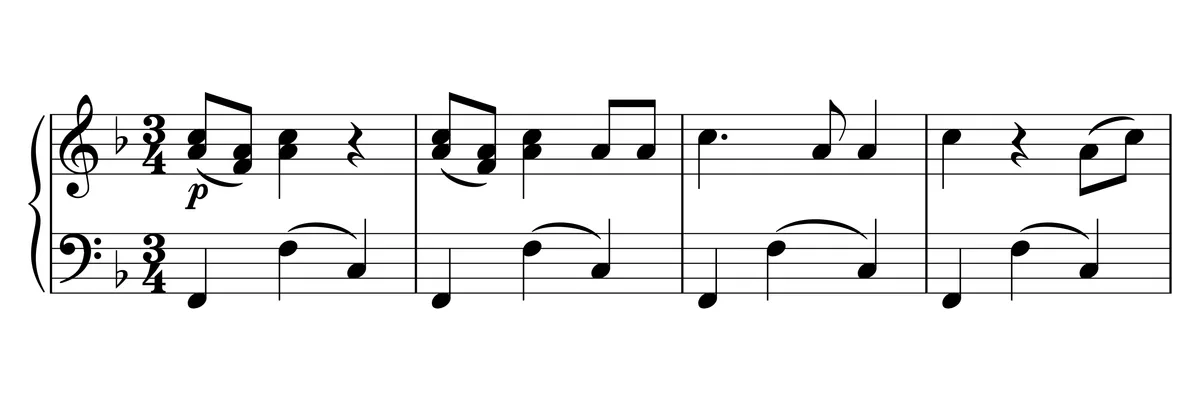
Typed into PlayableNotes“Make this easy for a second-year student. Keep the melody exactly as it is in F major, single notes in the right hand. Take out the low octaves and give the left hand something simple that still sounds full, nothing wider than an octave.”

What changed
Murray's melody note for note in single notes, over a left hand that holds the bass and adds a soft two-note chord where the melody holds.
- Right hand: the melody alone, single notes throughout, in the original key with the dotted rhythms as written.
- Left hand: no octaves. In most bars it holds the bass note for the whole bar and adds a two-note chord on beat 2, where the melody is holding: A–C (or A alone in bars 5 and 13) over F, E–G or G–B-flat over C.
- Bars 4 and 12: B-flat held for the whole bar, with D–F added on beat 3 under the melody's D, so the passing E on beat 2 sounds only over B-flat, as in the hymnal. Bar 8 keeps the hymnal's B-flat moving to A, over a held F.
- Bar 6 is a plain C chord where the hymnal has C7; the B-flat that makes it C7 comes in bar 7.
- Ending: B-flat–G and then C under bar 16, and a last F over F–C in the left hand.
- Nothing below the bass staff except the F in the last bar, which hangs just under it, and the hands never cross.
For teachers: For a student who reads the treble clef and one flat comfortably and is ready for a left hand that does more than one note per bar. Learn the right hand first, then the left hand alone: holding the bass while adding a chord later in the bar is the only new skill.
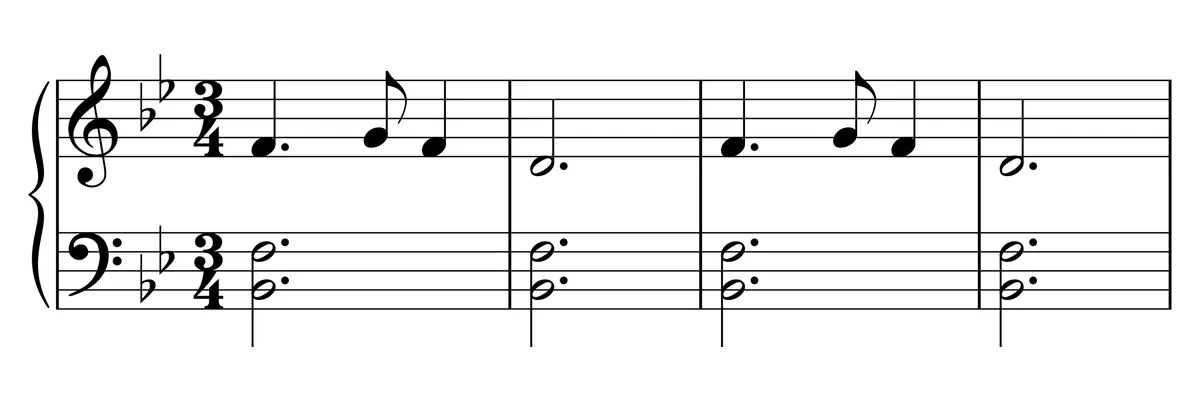
Typed into PlayableNotes“Make a version in C major for a student near the end of their first year: melody only in the right hand, single notes, and keep the left hand in C position with long notes, no flats or sharps.”

What changed
The melody a fifth higher in C major, with a left hand of long notes that never leaves C position.
- Moved up a fifth, from F major to C major: no key signature, and the melody runs from G on the treble staff to the G just above it, with no ledger lines.
- Right hand: the melody alone, single notes, with the same dotted rhythms.
- Left hand: one long note or open fifth per bar, all between C and G below middle C: C–G or C alone for the C chord, F in bars 4 and 12, G in bars 6, 7 and 14, F then G in bar 16.
- The left hand rests in the pickup, so the piece starts with the right hand alone.
For teachers: For a student who knows C position in both hands and is starting to move the right hand. The left hand never moves, but the right hand changes between two five-finger positions (C up to G, and G up to D) five times. Practice the hardest move first: from G in bar 13 up to F at the start of bar 14, a seventh. Then the move from C up to E into bar 9. The others are easier: on the repeated Cs into bars 4 and 12, and from C up to D into bar 16.
Typed into PlayableNotes“Make this playable for accompanying children singing at our Christmas program. Keep the tune on top so they can follow it, take the low octaves out of the left hand, add a short introduction, and set it up for three verses.”


What changed
The hymnal's harmony with the tune always on top, a four-bar introduction, and repeats for three verses.
- Bars 1 to 5: an introduction from the hymn's last line ("the little Lord Jesus asleep on the hay"). It ends on beat 3 of bar 5 with the first note of the verse, so the singers come in on the tune.
- Repeat signs with endings: bar 21 is played for verses 1 and 2 and leads back to bar 6; bar 22 ends verse 3 on a held chord with the third (A) added.
- Right hand: the 1919 hymnal's melody and alto, except bars 10 and 11, where the alto B-flat under middle C is left out (it sat a step below the tune and blurred it). The B-flat comes back under G and E in bar 11.
- Left hand: no octaves, and nothing lower than the F just below the bass staff. Open fifths F–C on the F chords, C–E for C7, and a moving bass where the hymnal holds: F–A–B-flat in bars 7 and 8 (and 15 and 16), B-flat–D–C in bars 4 and 20.
For teachers: For a student or parent playing for a class or a children's choir. Play the introduction at the tempo you want the children to sing, and give a small breath before beat 3 of bar 5 so they hear where to start.
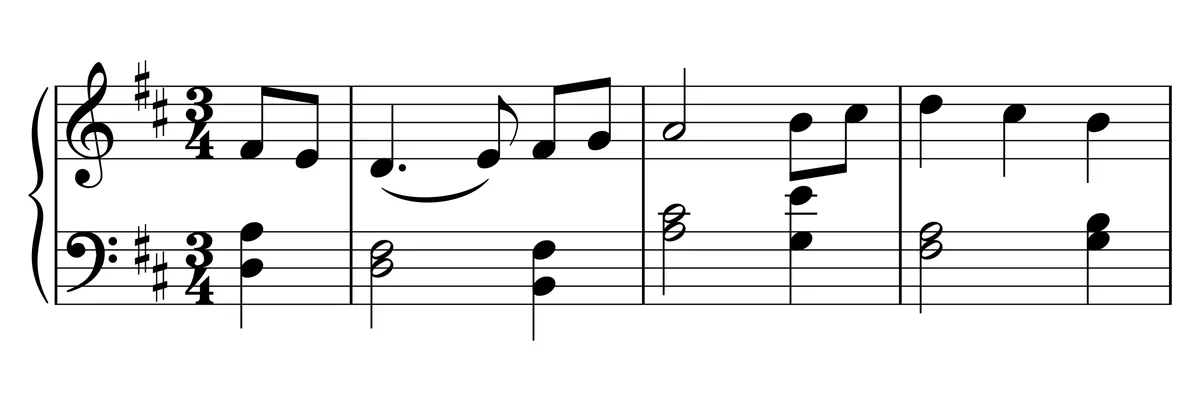
Typed into PlayableNotes“Turn this into a gentle piano solo, like a lullaby. Keep the hymn's melody and harmony, give the left hand a rocking pattern that stays within an octave, and add a short introduction and a quiet ending.”


What changed
The hymnal's two-note right hand over a rocking eighth-note left hand, with two beats of the left-hand pattern before the pickup and an echo of the last line.
- Bar 1: two beats of the left-hand pattern alone; the melody's pickup comes in on beat 3.
- Left hand: the bass held for the whole bar, with a rocking eighth-note figure above it that starts on the second eighth (C–F over F, G–E over C). The B-flat bars (4, 12, 16, 18) are broken chords without a held bass: B-flat under beats 1 and 2 in bars 4 and 12, as in the hymnal, then D. Nothing wider than an octave.
- Right hand: the 1919 hymnal's melody and alto, except that the alto B-flat under middle C is left out in bar 6 and on beat 1 of bar 7. Bar 6 is therefore a plain C chord where the hymnal has C7; the B-flat comes back under G and E in bar 7.
- Bar 8: over the held F, the figure starts with B-flat under the hymnal's B-flat chord, then rocks on C–F as the harmony returns to F.
- Ending: the hymnal's last two-beat bar becomes a full bar (bar 17), with A added under the C–F chord and the melody's F an octave higher on beat 3 as a pickup. From there "asleep on the hay" is echoed an octave higher in bars 17 to 19, closing on a held high F chord.
- Dynamics: p from the start, pp for the echo.
For teachers: For a student who plays hands together comfortably and is ready to hold a bass note with the fifth finger while the other fingers keep moving. Practice the left hand alone until the eighths are even and quiet. Change the pedal with the harmony: once per bar, on beat 1, in most bars; on every beat in bars 4, 8, 12, 16 and 18; and on beat 3 of the dotted-rhythm bars (2, 3, 6, 10, 11 and 14), so the short passing note does not blur into the next chord. The held bass keeps the sound full when you change.
The piece as published: Open Hymnal Project (setting from Hymnal for American Youth, 1919).
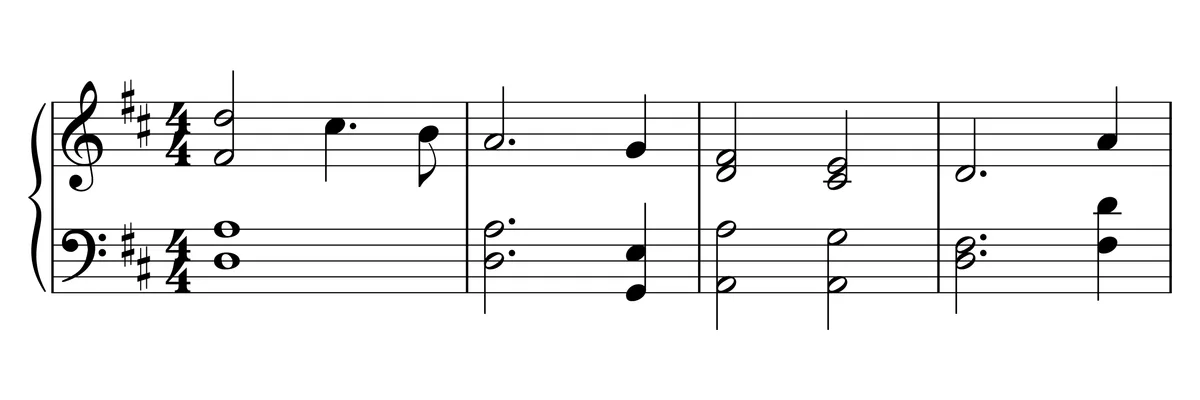
Original
What changed
What changed
Murray's tune in the 1919 Hymnal for American Youth setting: melody and alto in the right hand, bass octaves in the left.
- Nothing: this is the source edition, checked note for note.
- The right hand plays melody and alto together almost throughout; the left hand plays octaves, mostly a held F, down to B-flat and C two ledger lines below the bass staff in bars 4, 12, 14 and 16.
For teachers: The original is playable as written once the easy version is secure. The new skills are the right hand's two-note chords in the dotted rhythm and the left-hand octaves; practice bars 12 to 16 hands separately first.
Want it different? Just ask.
Open this version in PlayableNotes and ask for a change in words: simpler, another key, shorter, bigger notes. The result is a new version you can play, print and share with your student.
Free account. Changes, playback and printing are free; 50 free credits to read your own sheet music.
Watch how to ask for your own version · 1 min video
Make your own version
A real request in PlayableNotes, on Für Elise from the free library: say who it’s for and what to keep, and the AI writes a new version beside the original. It shows how to ask for a version of your own; its result is not one of the versions on this page.
About Away in a Manger
The Away in a Manger most Americans sing is a lullaby in 3/4 by James R. Murray (1841–1905): 17 bars counting the one-note pickup. He published it in 1887 in Dainty Songs for Little Lads and Lasses as "Luther's Cradle Hymn", which helped spread the story that Martin Luther wrote the carol. He did not: the first two verses are anonymous, probably American, and were in print in American papers by the early 1880s. In Britain the same words are usually sung to a different tune, William J. Kirkpatrick's Cradle Song (1895).
The tune is short and gentle, but it asks for three things: the long-short dotted rhythm that opens most phrases, a melody that falls a full octave from the C above middle C down to middle C in the first phrase, and a jump from middle C up to B-flat at the start of the last line (bars 13 to 14). The 1919 hymnal setting adds a second note under almost every melody note and bass octaves that go two ledger lines below the staff.
The easy version keeps every note of the melody in F major, as single notes, over a left hand that holds a bass note in most bars. The version in C moves the tune up to C major, with a left hand that never leaves C position. The accompaniment adds an introduction and repeats for three verses, the lullaby solo gives the left hand a rocking eighth-note pattern, and the 1919 original is here to compare.
Practice tips
- Count 1, 2 and come in on 3: the tune begins with a single pickup note. In the easy, C major and original versions the last bar has only two beats to make up for it; the accompaniment and lullaby end on full bars.
- Tap the long-short rhythm of bar 2 (dotted quarter, eighth, quarter) before you play it. The same rhythm comes back in bars 3, 6, 10, 11 and 14 (bars 2, 6, 7, 10, 14, 15 and 18 in the accompaniment), so loop bar 2 (bar 6 in the accompaniment) until it feels like rocking rather than limping.
- In the F major versions the melody sits around middle C in bars 5 to 8 (9 to 12 in the accompaniment), only a few keys above the left hand. Keep both hands relaxed and close to the keys, and let the right-hand thumb rest on middle C.
- Bar 13 is a half-note C and then a quarter-note C; bar 14 starts on B-flat, nearly an octave higher (G up to F in the C major version, bars 17 to 18 in the accompaniment). In the single-note versions play the quarter note on beat 3 with the thumb; where it is the chord A–C, play A with the thumb and C with 2. Then move the hand straight to B-flat, and loop bars 13 and 14 until the jump is easy.
- Practice each hand with the Right and Left buttons at about 70, then play hands together and raise the tempo a few beats at a time.
Questions about Away in a Manger
Who wrote the music for Away in a Manger?
In the United States it is usually sung to a tune by James R. Murray, published in 1887; that is the tune on this page. Murray printed it as "Luther's Cradle Hymn", but Martin Luther did not write the carol or the tune. The first two verses are anonymous and were in print by the early 1880s; they were first printed with music in 1885, in a Lutheran Sunday-school book from Philadelphia.
Why does Away in a Manger sound different in England?
British churches and schools usually sing the same words to another tune, William J. Kirkpatrick's Cradle Song from 1895. Both are in three beats to a bar, but the melodies are different. The music on this page is Murray's tune, the one most American hymnals use.
What key is Away in a Manger in?
The 1919 hymnal setting on this page is in F major, as in many American hymnals. The version in C on this page has no flats. If your singers need another key, a free PlayableNotes account lets you ask for one.
Is Away in a Manger good for beginners?
Yes. It is 17 bars counting the one-note pickup, in 3/4, and the tune covers one octave. The parts that need care are the dotted rhythm and the jump at the start of the last line. The version in C keeps the left hand in one position for the whole piece and suits a student near the end of the first year.
Is Away in a Manger public domain?
Yes, in the United States: Murray's tune (1887), the words and the 1919 hymnal setting used here are all in the public domain. Modern arrangements can still be under copyright. The versions on this page were arranged by PlayableNotes from the 1919 setting and are free to play, print and download, so you can print copies for a school or church program.
Can I download Away in a Manger as a PDF or MIDI file?
Yes, free and without an account. Every version has a Letter-size PDF to print and a MIDI file with the right and left hands on separate tracks.
Source and credits
- Composer
- James R. Murray
- License
- Public domain in the United States
- Arranger
- PlayableNotes
Transcribed from the Open Hymnal ABC file (hymn 84 of Hymnal for American Youth, ed. H. Augustine Smith, 1919) and checked against Open Hymnal's PDF of the same setting; its MIDI is generated from the same file, so it confirms the transcription, not the source. The melody also matches an independent edition. No notes needed correcting. Lyrics and the organist's introduction bracket are left out. Some editions print bars 3 and 11 as three even quarter notes; this setting has the dotted rhythm there, and every version here follows it.
Arrangements and facts checked