Free easy piano · Christmas
O Come, All Ye Faithful, easy piano
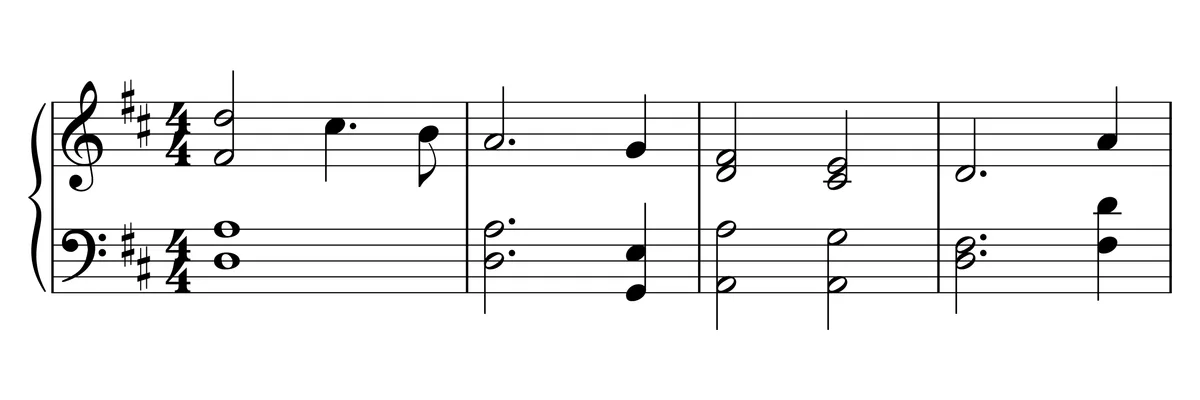
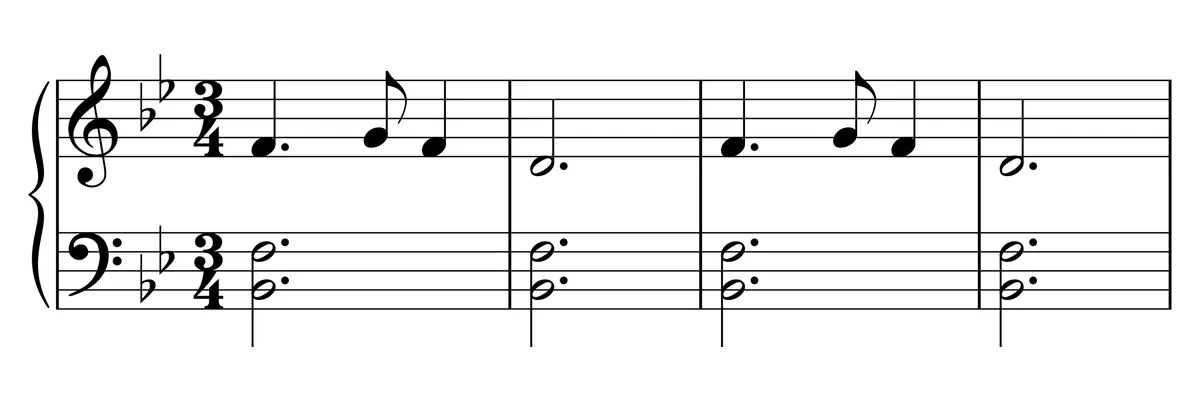
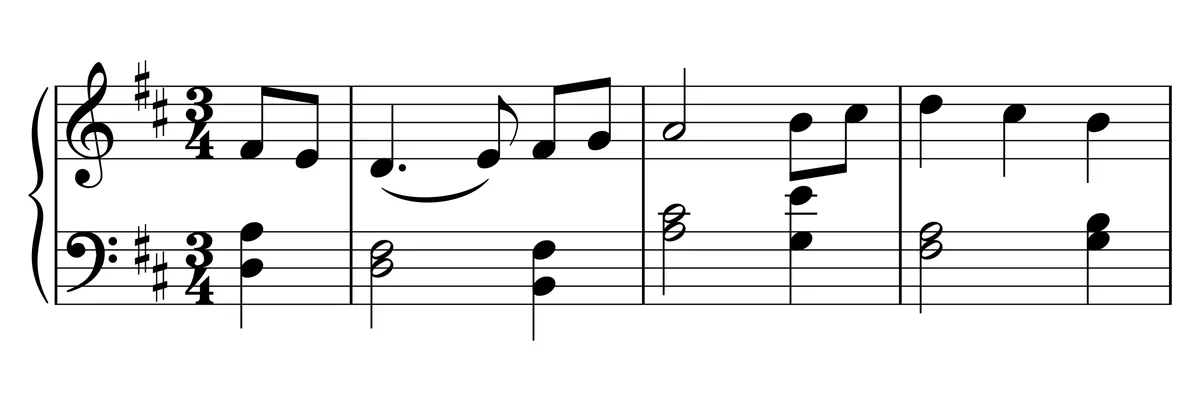
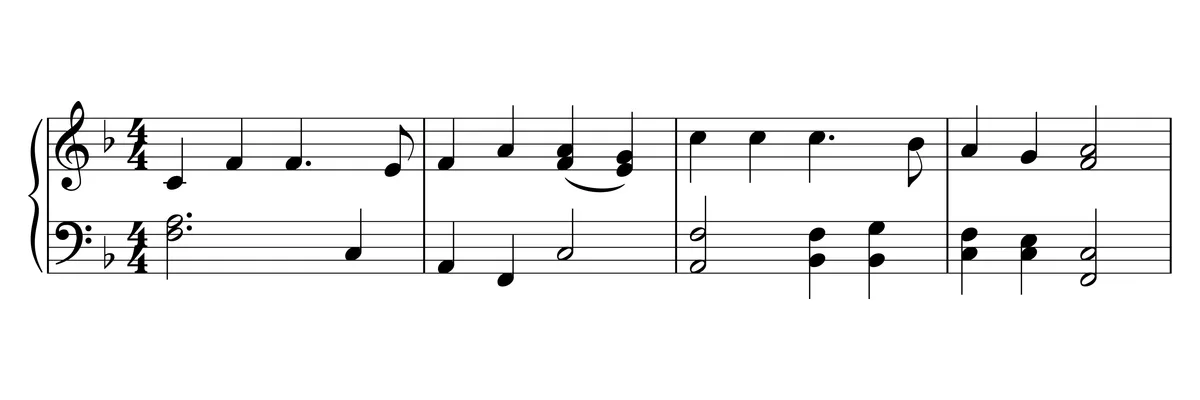
Five free piano versions of O Come, All Ye Faithful: an easy version in G, a simpler late-beginner version in G and the same in C major, a Christmas solo with an introduction, and the four-part hymnal setting they all come from. Play each one here at any tempo, then print the PDF or download the MIDI.
- John Francis Wade
- Easy to intermediate, plus the original
- 21 bars · 4/4
- Free: play, print, MIDI
Versions of O Come, All Ye Faithful. Each version is a request typed into PlayableNotes. Pick one to hear and print it.
Typed into PlayableNotes“Make this easy for my student: keep the whole melody in G, as people sing it, leave out the inner voices, and give the left hand no more than two notes at a time from the hymn's own harmony.”


What changed
The whole melody in the right hand, over a left hand of single notes and two-note chords taken from the hymnal harmony.
- Right hand: the melody alone, note for note, with the dotted rhythms in bars 8, 13 and 20. The alto part is left out; the last chord keeps its B.
- Left hand: the hymn's tenor and bass, at most two notes at a time and never wider than a seventh (A to G in bar 8).
- Bars 7 and 12: the bass line alone in quarter notes, D, B, F-sharp, G and F-sharp, G, E, C.
- From the end of bar 13 to bar 17: the left hand plays only the tenor line under the first two "O come, let us adore Him", as the 1916 hymnal does; bass and tenor come back together for the third, from the end of bar 17.
- Bar 6 leaves out the passing C-sharp chord on beat 2, and bar 18 the alto's C-sharp.
- Dynamics added: mp, mf and f on the three "O come, let us adore Him", so the refrain grows.
For teachers: For a student in the second or third year who reads both clefs. Learn the right hand first, since it is the whole tune, then the left hand in bars 18 and 19, where it changes on every beat.
Typed into PlayableNotes“Make a simpler version: keep the melody exactly, in G, and give the left hand one note at a time, mostly long notes, without the hand ever moving.”


What changed
The melody as written, over a left hand that never leaves five notes, G to D.
- Right hand: the melody alone, note for note, in G major (one sharp, F-sharp).
- Left hand: one note at a time, apart from an open fifth, G and D, in the first full bar and the last. Every note is G, A, B, C or D, from the bottom line of the bass staff to the middle line, so the hand stays in one place.
- Left-hand rhythm: whole, dotted-half and half notes, with a quarter note at the end of many bars. Bar 7 walks down D, B, A, G in quarters under the rising melody (the hymnal has D, B, F-sharp, G).
- Bars 5 and 6: B and A take the place of the hymn's E and D in the bass, which keeps the hand in position; the harmony there is lighter than in the hymnal.
- No ledger lines in either hand.
For teachers: Learn the left hand first: five notes, one finger each, with finger 5 on G. The right hand keeps the whole tune, so it moves more than the left: mark its new positions before the first play-through, at bar 4 (up to B), bars 6 and 7 (down to E, then up through F-sharp to B), bar 10 (the leap after the rest to the high D), bar 13, the leap from D up to B in bar 15, bar 16, and the F-sharp, G, C in bar 19.
Typed into PlayableNotes“Now put this simpler version in C major, so there are no sharps at all. Change nothing else.”


What changed
The simpler version a fourth higher, in C major: no key signature and not a single sharp or flat.
- Every note moved up a perfect fourth, from G major to C major.
- Right hand: from the G above middle C to the G just above the treble staff, with no sharps or flats anywhere.
- Left hand: the same five-note position, now C to G.
- Rhythms, dynamics and hand shapes are the same as the simpler version in G.
For teachers: Choose it for a student who has not met F-sharp yet. As in G, the right hand moves to a new position in several bars: mark bar 4 (up to E), bars 6 and 7 (down to A, then up through B to E), bar 10 (the leap after the rest to the high G), bar 13, the leap from G up to E in bar 15, bar 16, and the B, C, F in bar 19. To accompany singing, use a version in G: in C the tune sits a fourth higher, above most voices.
Typed into PlayableNotes“Turn the hymn into a short piano solo for a Christmas service: start with the last line as an introduction, keep the hymnal harmony in the verse, make the refrain grow from quiet to full, and finish with an Amen.”


What changed
The hymnal setting with a four-bar introduction, a refrain that builds from two voices to full chords over octaves, and a quiet Amen.
- Bars 1 to 5: an introduction from the hymn's last line, the line the Open Hymnal marks for introducing the hymn, played mp.
- Bars 5 to 17: the verse as in the hymnal setting, all four voices.
- First "O come, let us adore Him" (end of bar 17 to bar 19): melody and tenor only, p. The 1916 hymnal also leaves the bass out here.
- Second (end of bar 19 to bar 21): the melody over the alto's repeated D, with the tenor in the left hand, mp.
- Third (end of bar 21 to bar 23): f, mostly three-note chords in the right hand and left-hand octaves stepping down A, G, F-sharp, E in bar 22. Beat 4 of bar 22 is one A7 chord instead of the alto's two eighth notes.
- Bars 25 and 26: a breath after the last chord, then the Amen printed in the 1916 hymnal (C major to G major), p, with a fermata.
For teachers: For a pianist who already reads four-part hymns. Practice the octaves in bar 22 alone first, and keep the first refrain really quiet so the third has room to grow.
The piece as published: Open Hymnal Project, 2007 revision (setting from The New Hymnal, Episcopal Church, 1916).
Hymnal setting
What changed

What changed
The four-part hymn as the Open Hymnal prints it: soprano and alto in the right hand, tenor and bass in the left.
- Nothing: this is the source edition, checked bar by bar against the Open Hymnal's PDF and MIDI and the 1916 printing.
For teachers: This is the four-part hymn as a hymnal prints it, so it is the version to play with singers. Each hand plays two voices: loop bars 8, 13 and 20, where one voice holds while another moves.
Want it different? Just ask.
Open this version in PlayableNotes and ask for a change in words: simpler, another key, shorter, bigger notes. The result is a new version you can play, print and share with your student.
Free account. Changes, playback and printing are free; 50 free credits to read your own sheet music.
Watch how to ask for your own version · 1 min video
Make your own version
A real request in PlayableNotes, on Für Elise from the free library: say who it’s for and what to keep, and the AI writes a new version beside the original. It shows how to ask for a version of your own; its result is not one of the versions on this page.
About O Come, All Ye Faithful
O Come, All Ye Faithful is the English form of the Latin carol Adeste Fideles. The earliest known copies, from the 1740s, are in the hand of John Francis Wade, an English Catholic music copyist, who is usually credited with the tune; the English words most people sing are Frederick Oakeley's translation of 1841. The hymn tune is called Adeste Fideles, and also the Portuguese Hymn.
The tune itself is friendly: it stays within one octave, from the D above middle C to the D an octave higher, and moves mostly in quarter notes, with a dotted figure in bars 8, 13 and 20. The refrain sings "O come, let us adore Him" three times, each a little higher, from G up to the C above, before "Christ the Lord" closes it. What makes the hymnal setting harder on piano is the four voices: each hand plays two parts, and in many bars, such as 8, 10, 13 and 20, those parts move in different rhythms.
The easy version keeps every note of the melody and gives the left hand the hymn's own bass and tenor, never more than two notes at a time. The simpler version keeps the melody too and leaves the left hand on five notes, G to D, for the whole carol; the right hand still moves to a new position in several bars, so it suits a late beginner. It is also here in C major. The Christmas solo goes the other way, for a pianist who plays hymns already: an introduction, a refrain that grows from two voices to full chords, and an Amen. The hymnal setting is here too, so you can hear what each version changed.
Practice tips
- Count the pickup: the verse starts on beat 4 with G in the melody, and in the 21-bar versions the last bar has only three beats to make up for it. Bar numbers in these tips are for the 21-bar versions; in the Christmas solo, add four.
- Three bars have a dotted quarter followed by an eighth: 8, 13 and 20. Count in eighths ("1 and 2 and"): in bars 8 and 20 the short note falls on the "and" of 4, in bar 13 on the "and" of 2.
- Bar 10 is the high point of the verse, a leap up to the D on the fourth line of the treble staff. Use the rest at the end of bar 9 to move the hand there.
- Loop bar 7 with the left hand alone: the bass drops D, B, F-sharp and rises to G (in the hymnal the left hand also walks down the tenor, A, G, F-sharp, E) while the right hand climbs F-sharp, G, A, B.
- Shape the refrain: play the first "O come, let us adore Him" (end of bar 13) softly, the second (end of bar 15) a little louder and the third (end of bar 17) full, then broaden the last two bars.
Questions about O Come, All Ye Faithful
Who wrote O Come, All Ye Faithful?
The Latin original, Adeste Fideles, survives in manuscripts copied by John Francis Wade in the 1740s, and he is usually credited with both the words and the tune, although other composers were suggested in the past. The English words most people sing are Frederick Oakeley's translation of 1841.
What key is O Come, All Ye Faithful in?
Many hymnals print it in G major, like the versions on this page; some use A major, including the 1916 Episcopal hymnal this setting comes from. The simpler version is also here in C major. For any other key, open a version in PlayableNotes with a free account and ask for the key you need; changes are free.
Is O Come, All Ye Faithful hard to play on piano?
The tune is not: it stays within one octave and moves mostly in quarter notes. The hymnal setting is harder than it looks, because each hand plays two voices that sometimes move in different rhythms. The easy and simpler versions keep the whole tune and give the left hand less to do.
Which version should I play for people to sing along?
One in G: the hymnal setting if you read four-part hymns, otherwise the easy version, which has the same melody and harmony in a lighter texture. The C major version puts the tune a fourth higher, which is too high for most groups of singers.
Can I play these in church or print copies for my students?
Yes. The tune, Oakeley's English words and the 1916 setting are all in the public domain. Every version here has a free Letter-size PDF to print, with no account needed, and a MIDI file with the right and left hands on separate tracks for practice.
Why is it called the Portuguese Hymn?
Because of where it was heard in London: in the late 1700s it was sung at the chapel of the Portuguese embassy, and it became known by that name. Hymnals still list the tune as Adeste Fideles or Portuguese Hymn.
Source and credits
- Composer
- John Francis Wade
- Source edition
- Open Hymnal Project, 2007 revision (setting from The New Hymnal, Episcopal Church, 1916)
- License
- Public domain
- Arranger
- PlayableNotes
Transcribed from the Open Hymnal ABC file and checked note by note against its PDF and MIDI and against a scan of The New Hymnal (1916), hymn 72. The Open Hymnal prints the hymn in G (the 1916 book has it in A) and makes small changes: a passing E in the melody of bar 13, one tenor note in bar 12, and a bass that doubles the tenor in the first two refrain lines, where the 1916 bass is silent. The hymnal tab follows the Open Hymnal. No corrections were needed.
Arrangements and facts checked