Free easy piano · Christmas
O Little Town of Bethlehem, easy piano
Lewis Redner's tune for O Little Town of Bethlehem in four free versions, all in F major: an easy arrangement with two-note left-hand chords, a beginner version with one note at a time in each hand, a flowing broken-chord version for a Christmas recital, and the hymnal original. Play each one here, slow it down or loop a bar, then print the PDF or download the MIDI.
- Lewis H. Redner
- Easy to late beginner, plus the original
- 17 bars · 4/4
- Free: play, print, MIDI
Versions of O Little Town of Bethlehem. Each version is a request typed into PlayableNotes. Pick one to hear and print it.
Typed into PlayableNotes“Make this easy for a student in their second year of lessons. Keep the melody exactly as it is and keep it in F major. Give the left hand two-note chords that never stretch past an octave, and keep Redner's harmony, including the chromatic notes.”


What changed
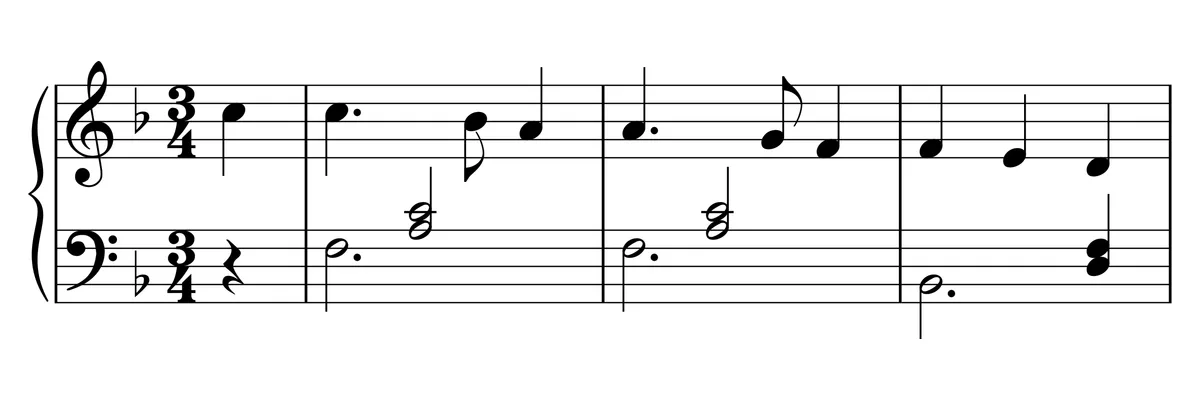
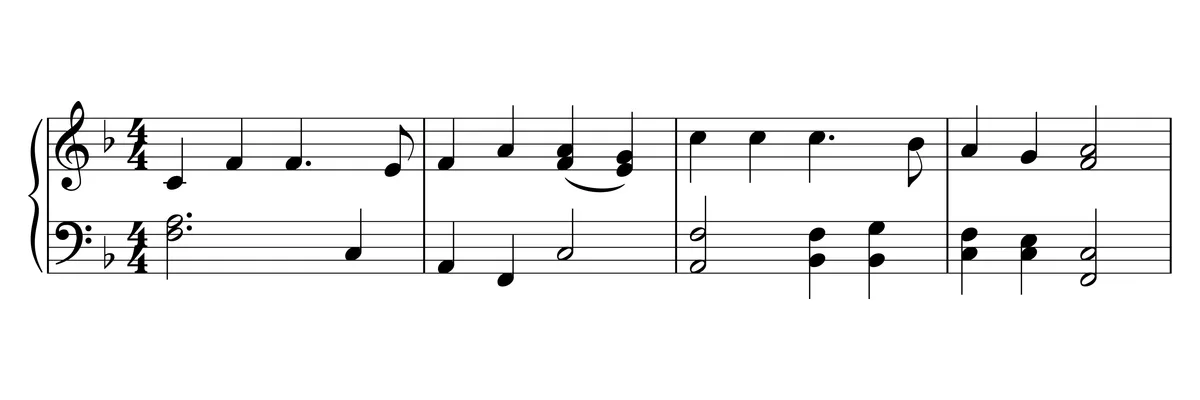
The whole melody over two-note left-hand chords that follow Redner's harmony, with a second right-hand note where the harmony needs it.
- Right hand: the melody note for note. A second note joins it only where it carries the harmony: the alto's E-flat under the high C and D under the B-flat in bar 3, D under C and B-flat in bar 15, F under the second A and then F-sharp under D and C in bar 6, E under the G in bar 10, C-sharp under the repeated Es in bar 11, the inner notes of the long chords in bars 5, 13 and 17, and single beats in bars 12 and 16.
- Left hand: two-note chords in place of the hymnal's tenor and bass, never wider than a seventh (C to B-flat in bars 4, 8 and 16). The tenth in bar 5 and the twelfth in bar 7 are gone.
- Kept from the hymnal: the B-natural under the G-sharp in bars 2 and 14, F-sharp moving to G over B-flat in bars 3 and 15, the tenor's A, G, B-flat over C in bar 4, the bass stepping down F, E-flat, D in bar 6, G-sharp leading to A major in bars 10 and 11, C-sharp to C-natural in bar 13, and the B-natural in bar 16.
- Bar 12: both hands play the rising line D, E, F in octaves, as all four voices do in the hymnal.
- Simplified: the augmented chord on beat 2 of bar 8 is left out, the alto's D under the F in bar 10 is left out, and the alto's passing E in bar 15 is gone.
For teachers: For a student who plays hands together and reads two-note chords in both hands. The left hand has accidentals in about half the bars, so learn bars 2 and 3, 10, and 13 to 16 hands separately first. In bar 3 the right hand plays two sixths in a row; in bar 15 the thumb stays on D while the top note moves from C to B-flat.
Typed into PlayableNotes“Make a beginner version: the melody in the right hand, and only one note at a time in the left hand, mostly whole and half notes. Keep it in F major and keep the tune exactly as it is.”


What changed
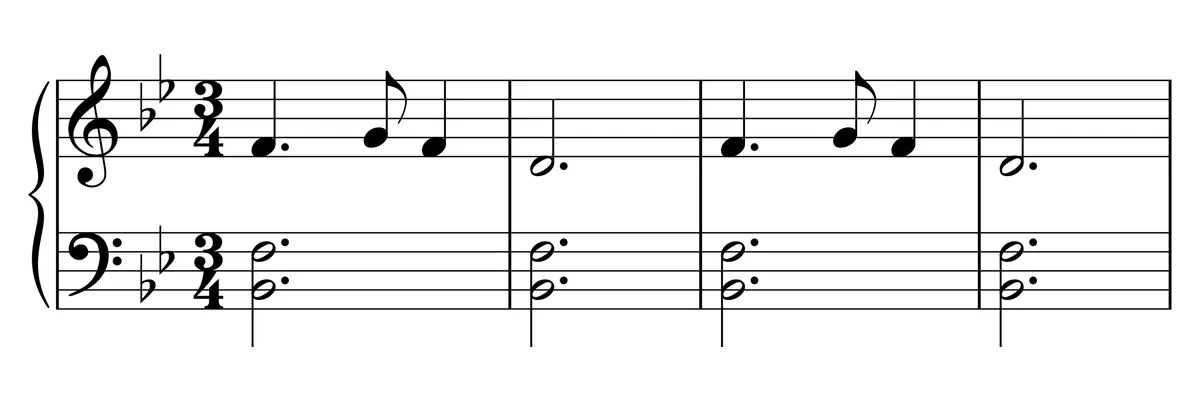
The full melody in the right hand over a slow left hand of single bass notes, mostly one per bar.
- Right hand: the melody alone, note for note, including the G-sharps in bars 2 and 14 and the dotted rhythm in bar 16.
- Left hand: one note at a time, 22 notes in all, taken from Redner's bass line. Most bars are a single whole note on Redner's bass note: F, B-flat, C, F in the first phrase.
- Bars 6 and 10: two half notes (F then D, F then G), so the bass changes where the harmony does.
- Bar 12: the left hand walks up D, E, F with the right hand, then plays B-flat, Redner's bass note under the G.
- Left out: the alto and tenor parts, every chromatic note below the melody (including the bass's E-flat in bar 6 and G-sharp in bar 10) and the low bass notes of bars 5, 7 and 11. The only accidentals are the melody's two G-sharps.
For teachers: The tune does not fit one five-finger position, so plan the moves. The right hand starts with finger 3 on A (G-sharp is finger 2). In bars 3, 7 and 15 it drops from B-flat to the D below. In bar 3 take that D with finger 2, so middle C in bar 4 falls under the thumb; in bar 7 take it with the thumb, so the A in bar 8 falls under finger 5. Practice the drop on its own, and the octave jump from D to D in bar 15.
Typed into PlayableNotes“Arrange this for my student's Christmas recital. Keep the right hand from the easy version, but give the left hand gentle broken chords in steady eighth notes, nothing wider than an octave, following Redner's harmony.”


What changed
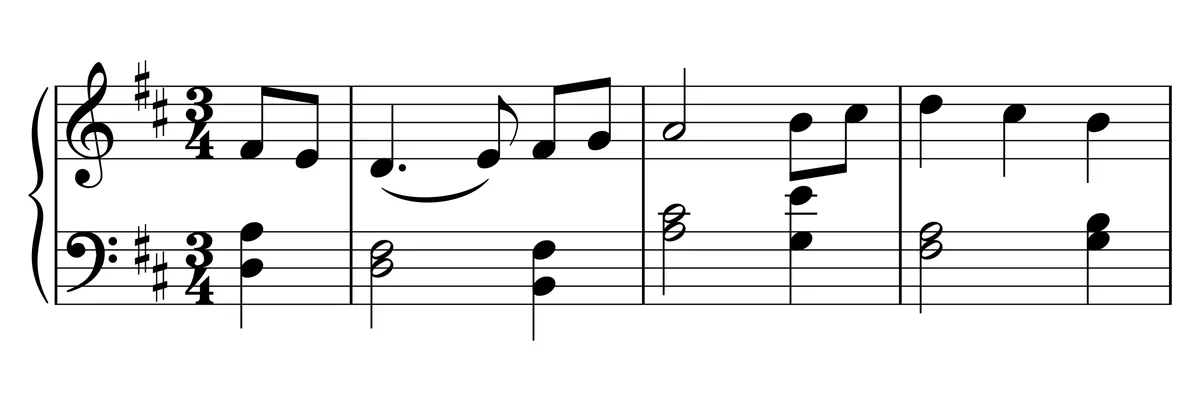
The easy version's right hand over a left hand of steady eighth-note broken chords, with a pause in the flow for the unison line in bar 12.
- Right hand: the same as the easy version, except bar 13, which holds C-sharp under the A so the A-major chord stays complete.
- Left hand: eight eighth notes in every bar except bars 1, 12 and 17, never wider than an octave, in two repeating shapes. Where a chord lasts half a bar the hand plays bass, middle, top, middle (F, A, C, A in bar 2); where the harmony or its bass moves on every beat (bars 6, 10 and 16, and the second half of bars 7 and 13) it plays the bass and one chord note on each beat.
- The hymnal's inner lines are woven into the pattern: F-sharp to G over B-flat in bars 3 and 15, the bass stepping down F, E-flat, D in bar 6, B-flat, B-natural and G-sharp leading to A in bars 10 and 11, B-natural in bars 2, 14 and 16, and the B-flat at the end of bar 16 that falls to A in the last chord.
- Simplified: the augmented chord on beat 2 of bar 8 is left out, as in the easy version.
- Bar 12: the left hand stops flowing and plays D, E, F in quarter notes an octave below the right hand, then a low B-flat.
- Last bar: the left hand steps down F, C to the low F under the right hand's held chord.
For teachers: The hardest of the three arrangements, though the left hand keeps to two shapes: bass, middle, top, middle where a chord lasts half a bar, and the bass plus one chord note on each beat where the harmony moves faster (bars 6, 10 and 16). Learn it after the easy version: the right hand is nearly the same, so all the new work is in the left hand. Play the left hand alone until each bar runs by itself, with special care for the move down to the low G at the start of bar 7, then add the melody slowly. Keep the eighths even and quieter than the tune.
The piece as published: The Chapel Hymnal (1898), via the Open Hymnal Project.
Hymnal setting
What changed

What changed
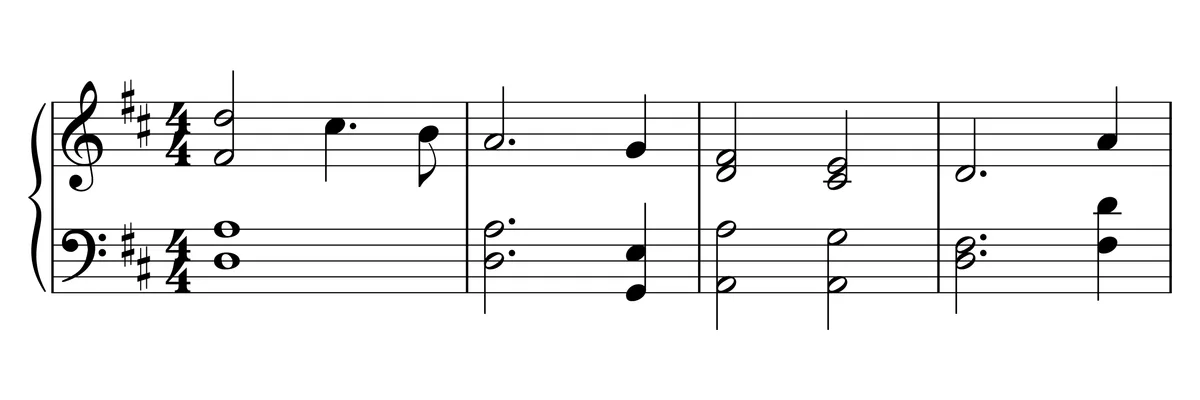
Redner's four-part harmony as printed in The Chapel Hymnal (1898): soprano and alto in the right hand, tenor and bass in the left.
- Only the key changed: Redner's harmony as The Chapel Hymnal printed it in 1898, moved down a whole step to F major, the key most American hymnals use. The organist's introduction marks and the Amen are left out. Checked bar by bar against a scan of the 1898 page.
For teachers: This is how a church pianist plays it from the hymnal. Two left-hand stretches are too wide for most hands: the tenth in bar 5 (F under A) and the twelfth on beat 3 of bar 7 (G under D). Take the A in bar 5 with the right hand, and leave out the left hand's D in bar 7, since the melody plays the same D.
Want it different? Just ask.
Open this version in PlayableNotes and ask for a change in words: simpler, another key, shorter, bigger notes. The result is a new version you can play, print and share with your student.
Free account. Changes, playback and printing are free; 50 free credits to read your own sheet music.
Watch how to ask for your own version · 1 min video
Make your own version
A real request in PlayableNotes, on Für Elise from the free library: say who it’s for and what to keep, and the AI writes a new version beside the original. It shows how to ask for a version of your own; its result is not one of the versions on this page.
About O Little Town of Bethlehem
Phillips Brooks wrote the words in 1868, when he was rector of Holy Trinity Church in Philadelphia, and the church's organist, Lewis H. Redner, wrote the music for the Sunday school's Christmas service that year. Hymnals call Redner's tune ST. LOUIS. It is the tune most American churches sing; in Britain the same words usually go to a different tune, the English folk melody FOREST GREEN.
The melody is short and gentle, but it is not a five-finger tune. It spans a ninth, from middle C up to the D a ninth above, drops a sixth from B-flat to D in bars 3, 7 and 15, and jumps an octave from D to D in bar 15. Redner's harmony is richer than most carols': an F-sharp over a B-flat bass under the high C in bars 3 and 15, the chromatic G-sharp in the melody of bars 2 and 14, a turn toward D minor that closes on an A-major chord in bar 13, and a bar (12) where all four voices rise together in octaves, D, E, F. In the hymnal the left hand plays both tenor and bass, with stretches of a tenth in bar 5 and a twelfth in bar 7.
Every version keeps the melody note for note and follows Redner's harmony, the beginner version through its bass notes. The easy version gives the left hand two-note chords and keeps his chromatic inner notes; the beginner version is the melody over single slow bass notes; the flowing version turns the same harmony into eighth-note broken chords. The hymnal setting is here too, so you can hear what each version kept.
Practice tips
- Each phrase starts on beat 4: bars 5, 9 and 13 hold a long note for three beats, and the next phrase begins on the last beat of the same bar. Count all four beats so the pickup does not come early.
- Loop bar 3 (it comes back in bars 7 and 15) and play the right hand alone until the drop from B-flat to D feels sure. In bars 3 and 15 of the easy and flowing versions the thumb is already on that D from beat 2, so it only has to stay there.
- Play bars 12 and 13 hands together on their own: both hands rise D, E, F together, then settle on A in bar 13. Let the rising line grow slightly louder, then soften into bar 13.
- In bar 16, hold the A for a beat and a half and play the G on the last half beat. Count "3 and 4 and" and put the G on the final "and".
- Practice each hand with the Right hand and Left hand buttons at about 60, then play hands together and raise the tempo a few beats at a time.
Questions about O Little Town of Bethlehem
Who wrote O Little Town of Bethlehem?
Phillips Brooks wrote the words in 1868, when he was rector of Holy Trinity Church in Philadelphia, a few years after visiting Bethlehem. The church's organist, Lewis H. Redner, wrote the music for the Sunday school's Christmas service that year. Both the words and the music are in the public domain.
Why does O Little Town of Bethlehem have a different tune in England?
British churches usually sing Brooks's words to FOREST GREEN, an English folk melody that Ralph Vaughan Williams arranged for The English Hymnal in 1906. The tune on this page is Redner's ST. LOUIS, the one most American hymnals use.
What key is O Little Town of Bethlehem in?
Most American hymnals print it in F major, with one flat, and every version on this page is in F. Some older books, such as The Chapel Hymnal (1898) that our original comes from, print it a step higher, in G. With a free account you can open any version in PlayableNotes and ask for another key.
Is O Little Town of Bethlehem easy to play on piano?
Yes, in the beginner and easy versions. The melody is gentle and short, but it spans more than an octave and has a few chromatic notes, so the hand has to move. The beginner version keeps the left hand to slow single notes, the easy version adds two-note chords, and the hymnal setting is a full four-part hymn with two stretches wider than an octave.
How fast should O Little Town of Bethlehem be played?
As a hymn it goes at a calm walking pace, roughly 80 to 100 quarter notes per minute; the Open Hymnal file is marked 100. Learn it around 60 to 70 and use the tempo slider on this page to step up as it settles.
Can I print O Little Town of Bethlehem or download it as MIDI?
Yes, free and without an account. Every version has a Letter-size PDF to print and a MIDI file with the right and left hands on separate tracks.
Source and credits
- Composer
- Lewis H. Redner
- Source edition
- The Chapel Hymnal (1898), via the Open Hymnal Project
- License
- Public domain
- Arranger
- PlayableNotes
Open Hymnal's file has a later reharmonization in bars 12 to 14. Those bars were restored from a scan of The Chapel Hymnal (1898), hymn 76 (https://hymnary.org/hymn/CH1898/page/58), including Redner's unison line in bar 12; two independent public-domain editions agree with the 1898 print there. Everything else matches the 1898 print note for note, a whole step lower (F major; the 1898 book prints it in G). The organist's introduction marks and the closing Amen are left out.
Arrangements and facts checked