Free easy piano · Classical
Debussy Arabesque No. 1, easy piano
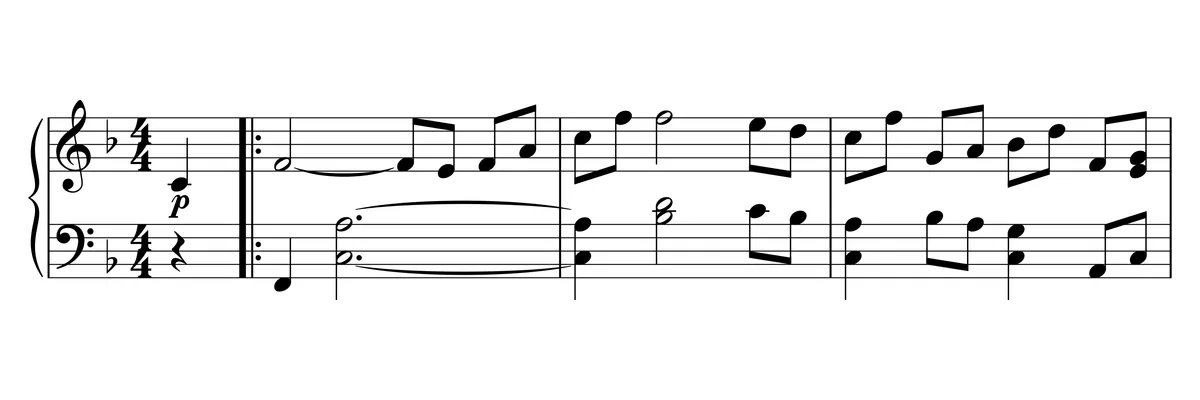
Claude Debussy's Arabesque No. 1 in four free versions: an easy version of the whole first section in D major, a shorter late-beginner version of the famous opening in C major, an intermediate version of the complete piece in E major, and the original. Play each one here, slow it down or loop a bar, then print the PDF or download the MIDI.
- Claude Debussy
- Easy to intermediate, plus the original
- 38 bars · 4/4
- Free: play, print, MIDI
Versions of Arabesque No. 1. Each version is a request typed into PlayableNotes. Pick one to hear and print it.
Typed into PlayableNotes“Make the first section of Debussy's Arabesque No. 1 easy for my third-year student, who reads triplets but isn't ready for two against three. Put it in D major, keep Debussy's melody and harmony, keep the left hand to single notes, two-note chords and short broken chords no wider than an octave, and end it where the section ends.”


What changed
Debussy's first section, bars 1 to 38, a step lower in D major: his melody and triplets, over a left hand that never stretches past an octave.
- Key: D major, a whole step below Debussy's E major, so two sharps instead of four.
- Length: Debussy's bars 1–38, the opening section with both of its tunes. It ends on the long D of bar 38 (E in the original), with a low D and A added under it and a pause sign.
- Right hand: Debussy's melody throughout, and his triplet figures except where noted below. The inner triplets under the tune in bars 3–4 are left out; bars 17–18 keep the tune over the opening arpeggio, as written.
- Bars 3–5, left hand: Debussy's held bass with the triplet figure above it. In the second half of bar 4 the figure is D–G above the low B, instead of G–D, which reaches a tenth above it. Bar 5: the low A, then a short arpeggio (G, B, C-sharp, E and back) instead of the sweep over two octaves.
- Bars 6–14: the left hand's eighth-note broken chords become quarter and half notes, so they never run against the right hand's triplets. Bars 6–12: a bass note, a second note and a two-note chord held for two beats (in bars 7 and 9, the low D and then B–F-sharp held for three beats). Bars 13–14: a bass note and a two-note chord on alternate beats.
- Bars 15–16: the left hand keeps Debussy's eighth notes, but each four-note broken chord turns back on its last note (G-sharp, D, F-sharp, D and B, E, G-sharp, E) instead of climbing to B and D, so the hand stays inside an octave.
- Bars 19–25: under the right hand's long notes and triplets, the left hand plays Debussy's triplet broken chords with the same notes in a closer order, inside an octave (for example E-sharp, G-sharp, B, C-sharp in bar 19). Under the right hand's eighth notes (beat 4 of bar 19 and the second half of bars 20, 21 and 23) it plays quarter notes: a single note, or a bass note and a two-note chord. The hands never play two against three.
- Bar 25: in the second half the left hand plays the low D, then D major as a short triplet (A, D, F-sharp), instead of Debussy's sweep from D up to A.
- Bars 26–28: the left hand plays the low G at the start of bar 26 without holding it, then Debussy's inner triplets (D, F-natural, G, A), which he gives to the right hand. In bar 27 it holds G and F-natural; in bar 28 it plays one C-natural (instead of his low C, G and E), then the inner triplets G, A, B. The right hand plays only the tune, in the treble clef.
- Bars 29–30: the right hand plays only the tune. Its inner line (B, C-sharp, D) is left out, except the C-sharp and D, which the left hand holds at the top of its two-note chords. The left hand's broken chords leave out Debussy's lowest notes (the low A and F-sharp), and bar 30's goes F-sharp, A, D, F-sharp instead of F-sharp, D, F-sharp, A.
- Bars 31 and 33: the left hand's sweep from the low E becomes E, B, E and a held B. The right hand holds B, with G under it for two beats, and plays Debussy's inner triplets in the second half of the bar.
- Bars 32 and 34: the left hand holds a low E with the right hand's held D above it, then plays Debussy's C-sharp and B (bar 32) or C-sharp and D from his triplets (bar 34). The right hand's thirds are played again on the first beat instead of tied.
- Bars 34–36: where Debussy has the tune over triplets, the right hand plays it in thirds: each tune note with the first note of his triplet under it (for example G over E, A over F-sharp, B over G in bar 34). The left hand's staccato climb in bar 36 is an octave lower than Debussy's.
- Bar 37: the left hand's eight-note sweep up from the low D becomes D, A and the fifth D–A. The right hand holds F-sharp and A under the falling E–D, as in the original.
For teachers: For a student in their third year who reads triplets and can hold one note while the same hand plays others (bars 3–4, 17–18, 31 and 33). Learn the right hand of bars 6–9 first: the triplets fall from the D near the top of the staff to the A below middle C, so mark where the hand moves. The left hand reads the treble clef in bar 1 and bars 15–17, and in bars 19–25 it switches between triplets and quarter notes with the right hand, so practice it alone first.
Typed into PlayableNotes“Make a short version of the famous opening of Debussy's Arabesque No. 1 for my second-year student: C major, no triplets or sixteenth notes, the arpeggios as plain eighth notes, and a left hand of long single notes and two-note chords no wider than a sixth. Give it a proper ending.”


What changed
The opening of the Arabesque in C major, 19 bars with no triplets: the arpeggios in plain eighth notes, over a left hand of half and whole notes.
- Key: C major, no key signature. F-sharps appear only in bars 13–16.
- Length: Debussy's bars 1–18, the first statement of the main theme, then a closing C major chord in bar 19.
- Rhythm: no triplets. Each triplet turn in the melody (bars 5, 10, 12, 13 and 14) becomes two eighth notes.
- Bars 1–2: the arpeggio that Debussy passes between the hands is played by the right hand alone in eighth notes, starting from the left hand's top note (F in bar 1, D in bar 2). The left hand plays one bass note on beats 1 and 3 instead of its share of the arpeggio.
- Bars 6–9: the falling figure in bars 6 and 8 is in eighth notes and stops after six notes, leaving out Debussy's last three (E, G, D). In bars 7 and 9 the turn E–C–E before the long B becomes E–C.
- Right hand: bars 10–12 and the first note of bar 13 are an octave higher than Debussy's, so they sit in the treble staff instead of on ledger lines below it.
- Bars 17–18: the melody is played in sixths, without the arpeggios underneath.
- Left hand: half and whole notes only, single notes or two-note chords, nothing wider than a sixth.
For teachers: A first taste of Debussy for a student in their second year who reads eighth notes and dotted rhythms. The right hand moves around more than in most early pieces, so mark the hand positions in bars 6–9, and the left hand's jump down to the low F-sharp at bar 13, before the first play-through. Point out the F-sharps in bars 13–16, and count the eighth–quarter–eighth rhythm in bar 16 out loud.
Typed into PlayableNotes“My student is ready for the real Arabesque but not for two against three. Keep the whole piece in E major with Debussy's textures, but line the left hand up with the right hand's triplets, bring the left hand's tenth-wide broken chords in bars 19 to 25 inside an octave but keep his sweep at the end of bar 25, take the lowest notes out of the big left-hand sweeps, and make the right hand simpler where it plays the tune over triplets at the end of the first section.”


What changed
All 107 bars in Debussy's key and textures, with no two against three, narrower left-hand broken chords in bars 19–25, smaller sweeps and a simpler right hand in bars 34–36.
- Bars 6–14, 39, 43, 59, 76–84 and 99–102: where the right hand has triplets, the left hand's eighth notes are written in the triplet rhythm (a quarter and an eighth under one triplet bracket), so the hands never play two against three. The notes are Debussy's.
- Bars 19–23 and 89–94: where the right hand has plain eighth notes, the left hand's triplets become eighth notes. In bars 89, 91 and 93 each half-bar plays the three notes of the broken chord once, after the held bass note, in the order that keeps Debussy's note on the beat (for example E, C-sharp, A in bar 89 instead of E, A, C-sharp, A, E).
- Bars 19–25: the left hand's broken chords, which reach a tenth above the bass, are folded inside an octave. The top note is played an octave lower, as the second note (for example F-double-sharp, A-sharp, C-sharp, D-sharp instead of F-double-sharp, C-sharp, D-sharp, A-sharp). In the eighth-note halves of bars 19, 20, 21 and 23 the four notes go straight up from the bass (G-sharp, B, C-sharp, E in bar 19). The rising sweep at the end of bar 25 is Debussy's.
- Bars 4 and 74: the left hand's held tenth (C-sharp to E) is played as a broken chord, C-sharp, A, E, so the hand doesn't have to hold the stretch; let the pedal hold the bass.
- Bars 5 and 75: the left-hand arpeggio turns at A4 instead of climbing to D-sharp 5.
- Bars 26, 31, 33, 37, 66, 97 and 98: the lowest note of the left-hand sweep or bass is left out. In bar 26 the A an octave higher is played on the beat; in the other bars the next note is held in its place, so the rest of the sweep keeps Debussy's rhythm. In bar 66 the sweep stops on D instead of the F-natural the right hand is holding.
- Bars 31 and 33: the right hand holds only the top C-sharp through the bar; the A under it lasts two beats, so it can be played again in the triplets.
- Bars 34–36: the melody and the triplets under it become one line. Each beat starts on the melody note and continues with two notes of Debussy's triplet.
- Bars 42 and 58: the right hand's inner chord lasts one beat instead of three, so the hand is free for the leap to B5.
- Bars 97 and 98: the left hand also takes the D that starts the right hand's arpeggio and holds it; the right hand's long note lasts two beats and its arpeggio starts on beat 3.
- Bar 103: the right hand plays both notes of each pair, as in bars 104–105, instead of sharing them with the left hand.
For teachers: A late-intermediate version, one step below the original, for a student who can play the opening of the original slowly but trips over two against three. It keeps Debussy's leaps and runs: the jump down to the bass at bar 37, the middle section's arpeggios in the right hand's bass clef (bars 47 and 51) and the run in bar 96. Once it is secure, the step to the original is mostly rhythmic: loop bars 6–7 of the original and practice the left hand's even eighth notes against the triplets.
The piece as published: MuseScore transcription by fattypikachu (PDMX collection), checked note by note against the Durand edition (Paris, 1904, plate D. & F. 4395) and Mutopia no. 1777 (Keith OHara).
Original
What changed


What changed
Debussy's Arabesque No. 1 as Durand printed it in 1904, all 107 bars.
- The notes are Durand's: the transcription was checked note by note against the Durand print and the Mutopia edition, and one wrong accidental in it was corrected (bar 23, left hand: D natural).
For teachers: The hard part is rhythm: eighth notes against triplets in bars 6–14, 76–84 and 99–102 (and for one beat at the start of bars 39, 43 and 59), and triplets against eighth notes in bars 19–23 and 89–94. Learn those bars hands separately with a slow, steady beat before putting them together.
Want it different? Just ask.
Open this version in PlayableNotes and ask for a change in words: simpler, another key, shorter, bigger notes. The result is a new version you can play, print and share with your student.
Free account. Changes, playback and printing are free; 50 free credits to read your own sheet music.
Watch how to ask for your own version · 1 min video
Make your own version
A real request in PlayableNotes, on Für Elise from the free library: say who it’s for and what to keep, and the AI writes a new version beside the original. It shows how to ask for a version of your own; its result is not one of the versions on this page.
About Arabesque No. 1
Arabesque No. 1 is the first of Debussy's Deux arabesques (L. 66), written between 1888 and 1891, when he was in his twenties. It is in E major and marked Andantino con moto. It is built from triplet arpeggios passed from hand to hand and a melody that falls through them, with a middle section in A major and a return of the opening that ends on a soft high chord and a low E. The whole piece is 107 bars.
What makes it hard is less the notes than the rhythm and the reach. Throughout the opening section and its return, one hand often plays triplets while the other plays plain eighth notes, two against three; the left hand's broken chords span a tenth or more; and the key has four sharps.
The easy version is Debussy's first section, bars 1 to 38, a step lower in D major: his melody and triplets stay, the left hand plays bass notes, two-note chords and broken chords inside an octave, and the hands never play two against three. The late-beginner version is the famous opening alone, bars 1 to 18, in C major and without triplets. The intermediate version is the whole piece in E major, close to Debussy's text but without two against three and with narrower left-hand chords where they are hardest. The original is here too, so you can hear exactly what each version changed.
Practice tips
- In bars 1–2 the arpeggio is one line passed between the hands: left, right, right, left (in the late-beginner version the right hand plays it alone). Play it slowly until you can't hear where one hand takes over from the other.
- In bars 3–5 the melody notes fall on the beats. Play them a little louder than everything around them and keep the accompaniment soft underneath.
- Loop bars 6 and 7 (click bar 6, then bar 7) and play the right hand alone, three notes to each beat (in the late-beginner version, two to a beat in bar 6), until the falling figure is even and relaxed.
- Bar 38 ends the first section on a long note, and the easy version ends there. In the intermediate version and the original, let it ring before the middle section starts in bar 39: the key signature drops to three sharps for A major, so D is natural from here.
- Start with the tempo slider around 50, keep the eighth notes and triplets even, and raise the tempo a few beats at a time. Debussy's marking, Andantino con moto, asks for a flowing walking pace, not speed.
Questions about Arabesque No. 1
Is Debussy's Arabesque No. 1 hard to play?
The original is a late-intermediate to early-advanced piece: four sharps, left-hand arpeggios that span a tenth or more, and long passages of two against three. The easy version on this page is the first section in D major, for a student in their third year who reads triplets; the late-beginner version is the opening only, in C major with no triplets; the intermediate version is the whole piece without two against three.
What key is Arabesque No. 1 in?
E major, with a middle section in A major. On this page the easy version is in D major, the late-beginner version in C major, and the intermediate version in E major, like the original.
How long is Arabesque No. 1?
107 bars. Most performances take about four minutes. The easy version on this page is 38 bars, a little over two minutes at its suggested tempo, and the late-beginner version is 19 bars, about a minute.
Where is the two against three in the Arabesque?
In the original, the left hand plays eighth notes against the right hand's triplets in bars 6 to 14, 76 to 84 and 99 to 102, and on the first beat of bars 39, 43 and 59; the hands swap roles in bars 19 to 23 and 89 to 94. The easy, late-beginner and intermediate versions on this page are written so the hands never play two against three.
Is Arabesque No. 1 the same as the Première Arabesque?
Yes. Debussy's title is Première Arabesque, the first of his Deux arabesques; English editions call it Arabesque No. 1. This page has the first one only. Arabesque No. 2 is a different, quicker piece in G major.
Can I download Arabesque No. 1 as a PDF or MIDI file?
Yes, free and without an account. Debussy's music is in the public domain, and every version on this page has a Letter-size PDF to print and a MIDI file with the right and left hands on separate tracks.
Source and credits
- Composer
- Claude Debussy
- License
- Public Domain Mark 1.0
- Arranger
- PlayableNotes
All 107 bars were compared note by note with the Mutopia Project's engraving of the Durand text (no. 1777, typeset by Keith OHara), and every place they differed was settled against a scan of the 1904 Durand print. One wrong accidental was corrected (bar 23, left hand: D natural, not D sharp). The PDMX collection is distributed under CC BY 4.0 (Phillip Long, Zachary Novack, Julian McAuley, Taylor Berg-Kirkpatrick).
The full edition is also in the library: Arabesque No. 1, ready to play and edit.
Arrangements and facts checked