Free easy piano · Classical
Träumerei, easy piano
Schumann's Träumerei in three free versions: an easy version that keeps his melody and harmony, a version close to the original for small hands, and the original. Play each one here, slow it down or loop a bar, then print the PDF or download the MIDI.
- Robert Schumann
- Easy to intermediate, plus the original
- 25 bars · 4/4
- Free: play, print, MIDI
Versions of Träumerei. Each version is a request typed into PlayableNotes. Pick one to hear and print it.
Typed into PlayableNotes“Make Träumerei easier for my second-year student. Keep Schumann's melody, his harmony and the repeat. Give the left hand one part, single notes and two-note chords with nothing wider than a seventh, and leave out the inner voices and most of the grace notes.”


What changed
Schumann's melody over a one-part left hand of single notes and two-note chords that keeps his bass, his harmony and the tenor's answers.
- Right hand: Schumann's melody with the repeat, without the inner voices. A lower note is added only where the original has one under the hand: two-note chords in bars 4, 5, 9, 17, 20, 21, 24 and 25, the D under the high A in bar 23, and the closing chord A–C–F.
- Left hand: one part, single notes and two-note chords, never wider than a seventh and never above the D over middle C. It keeps the tenor's answers: D–C–B♭ in bars 3 and 19, A–B♭–A–G in bars 4, 20 and 24.
- Bars 2, 6, 10, 18 and 22: the low F is a quarter note, then the left hand holds C–A; the original holds the F under the chord with the pedal. Bars 3 and 19: the grace notes B♭–F are left out, and the left hand plays B♭–D on beat 2.
- Bars 4, 20 and 24: the bass C is played on beats 1 and 3 instead of held under the tenor, and beat 4 is the bass alone (A–C, or B♭–D in bar 24). The C7 chord has no E on beats 2 and 3, since the right hand's inner voice is left out.
- Bars 5 and 21: the bass C–D–C–B♭ becomes C–G held under the melody's G. Bar 7: the grace-note C♯ becomes a C♯ on beat 2, so the bass rises C–C♯–D into bar 8. Bar 8: on the 'and' of beat 2 the left hand plays the right hand's inner A♭, an octave lower, instead of the original's F–C, and strikes the C on beat 3 instead of tying it over; the tenor D above the opening D–A is left out.
- Bar 9: the right hand plays F under the D and the left hand holds G–B♮, then plays Schumann's bass, C–D–B♭–G. The melody's C is a dotted quarter instead of a half note, so the same hand can play the upbeat C an octave lower; the grace note before it is left out.
- Bars 11 to 17: the tenor line that crosses between the hands in the original stays in the left hand, mostly without the bass under it. Bar 15 plays it an octave lower than the original, D–C♯–E to C♯–A, so it stays on the staff and leaves out the G of the G minor chord. Bar 12 has chords only on beats 1 and 3, with F♯ and E♭ between them; bar 16 starts on D alone, the original's lowest note there, and its C♯ stands for the original's diminished chord.
- Bar 13: the left hand plays the bass D under B♭, then again under A; the tenor's D and G between them (B♭–D–G–A in the original) and the right hand's inner C–B♭ are left out. Bar 14: the bass B♭ is an octave higher, on the staff instead of below two ledger lines. Bar 17: on beat 4 the left hand plays C with B♭ above it; in the original the B♭ comes half a beat earlier and the bass C half a beat later.
- Bar 18: the grace-note C, the upbeat into the return, stays. It is the only grace note left.
- Bar 23: under the high A with the fermata, the right hand plays D and the left hand holds B♮–G; the F of the chord follows in the melody. The original spreads the chord over a tenth in each hand. Last bar: on beat 2 the left hand plays C with B♭ above it instead of C–G and the low C; the final chords are the original's.
For teachers: For a student who reads eighth notes and plays two-note chords in the left hand. The left hand never holds one key while another finger moves, but it changes position often, so learn bars 2 to 5 alone first. Its quiet tenor answers are half of what makes Träumerei sound like Träumerei. Once the notes are secure, in bars 2, 6, 10, 14, 18 and 22 press the pedal just after the low F (B♭ in bar 14), so it keeps sounding under the chord as it does in the original.
Typed into PlayableNotes“Keep Träumerei as close to Schumann's original as you can, with the inner voices, the grace notes and the low bass, but for small hands: nothing wider than an octave in either hand, and no parts crossing between the hands.”


What changed
Schumann's four-part texture almost note for note, with the chords no small hand can reach and the crossed parts redistributed.
- Bars not listed here keep the original's notes, including the grace notes, the low B♭ in bar 14 and both fermatas. The widest stretch in either hand is an octave; the original needs a tenth.
- Bars 2, 6, 10, 18 and 22: the low F is a quarter note, since holding it under the chord needs a tenth; hold it with the pedal. The F of the right hand's F–C, written below the left hand's A, moves into the left hand (C–F–A), so the hands no longer cross.
- Bars 3, 7 and 19: each two-note grace figure is one grace note (B♭, or C♯), because its second note is the key the left hand plays next.
- Bar 7: the G under the right hand's high A is left out, since it needs a ninth; the melody's G later in the bar supplies it.
- Bar 9: the left hand's high G, which sits above the right hand's F, is left out; B♮ is held instead.
- Bars 11 and 15: the lone F♯ and C♯ of a third voice join the right hand's second voice, and the tenor line is written as one voice in the left hand.
- Bars 12 and 16: the right hand's inner voice starts with a quarter note, so the melody's G and D are not struck while the same key is held.
- Bar 14: the right hand's B♭ moves into the left-hand chord (F–B♭–D), so the right hand no longer stretches a tenth from B♭ to D.
- Bar 23: the fermata chord is G–B♮–F in the left hand with D under the high A in the right hand; the original spreads it over a tenth in each hand.
- Last bar: the left hand lets go of G before the low C, so nothing is wider than an octave.
For teachers: For an intermediate student, or an adult with small hands, who wants the real texture. The work is in the balance: the melody on top, the left hand's tenor line singing too, the inner notes softer. In bars 15 and 16 the tenor climbs to the A above middle C, on ledger lines, as in the original. Add the pedal once the notes are secure, changing it with each harmony.
The piece as published: Mutopia Project no. 504, typeset by Ying-Chun Liu from Leichte Stücke (1900).
Original
What changed


What changed
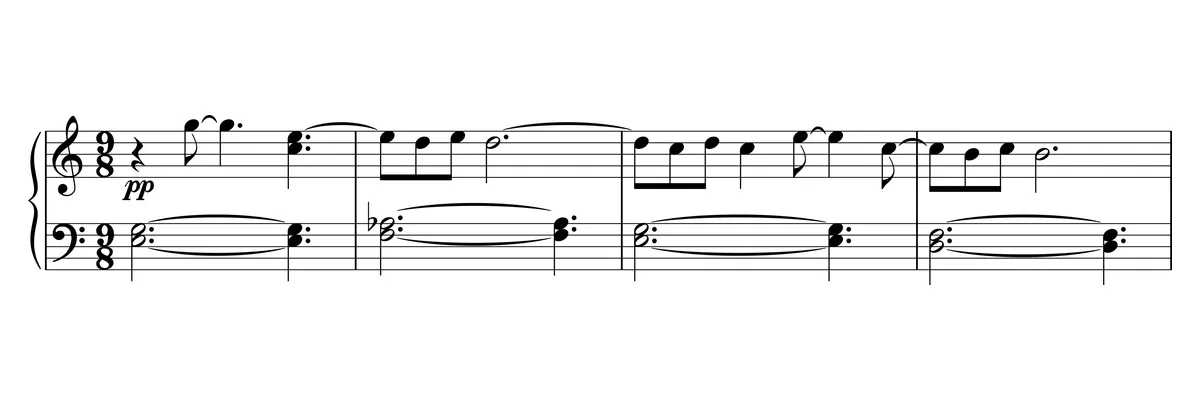
Träumerei as printed in the Mutopia edition, with its four voices, grace notes and fermatas.
- Nothing beyond the one correction listed under the source: the melody's C in bar 9 is a half note, as printed.
- The edition's pedal marks, fingering, slurs and its ritard. and a tempo markings are not shown.
For teachers: The difficulties are balance and reach, not speed: the inner voices cross between the hands, bars 14 and 23 need tenths or the pedal, and the tenor line in bars 11 to 17 moves between the staves. The small-hands version rewrites exactly those places.
Want it different? Just ask.
Open this version in PlayableNotes and ask for a change in words: simpler, another key, shorter, bigger notes. The result is a new version you can play, print and share with your student.
Free account. Changes, playback and printing are free; 50 free credits to read your own sheet music.
Watch how to ask for your own version · 1 min video
Make your own version
A real request in PlayableNotes, on Für Elise from the free library: say who it’s for and what to keep, and the AI writes a new version beside the original. It shows how to ask for a version of your own; its result is not one of the versions on this page.
About Träumerei
Träumerei, often spelled Traumerei, means “Dreaming”. It is No. 7 of Kinderszenen (Scenes from Childhood), Op. 15, the thirteen short piano pieces Schumann wrote in 1838. It is 24 bars plus an upbeat, in F major; bar numbers on this page count the upbeat as bar 1, so they run to 25, one more than in most printed editions. An eight-bar opening repeats, a middle section turns toward G minor and D minor, and the return stops on a high A before the close.
It is slow and the tune is easy to sing, but the original is not an easy piece. Schumann writes it in four parts, like a small choir: the inner voices cross between the hands, the left hand relies on the pedal to hold a low bass under its chords, and bars 14 and 23 need a stretch of a tenth.
The easy version keeps the melody and Schumann's harmony, and gives the left hand the bass and the tenor's answers as one part: single notes and two-note chords, nothing wider than a seventh. The small-hands version is the original with only the out-of-reach chords and the crossed parts rewritten, and the original is here to compare.
Practice tips
- Count four slow beats and listen for how the phrases open: a rising leap into a long note (C up to F at the start, C up to A in bar 7), then a climb. Give the long note its full length before the eighth notes move on.
- Play the melody louder than everything else. In every version, the left hand's answers in bars 3 and 4 (D–C–B♭, then A–B♭–A–G) are a second tune: shape them, but under the melody.
- The middle section changes key twice: E♭ and F♯ in bars 11 and 12 lead to G minor, C♯ in bars 15 to 17 to D minor. Loop bars 11 to 13 (click bar 11, then bar 13) and play each hand with the Right and Left buttons, then do the same with bars 15 to 17, before playing hands together.
- Bar 23 is the high point: hold the high A as long as feels natural, then let G–F–D fall slowly into the last phrase, and slow down through the last two bars.
- None of the versions here print pedal marks. Once the notes are secure, add the sustain pedal and change it with each new harmony: once a bar in bars 2, 6, 10, 14, 18 and 22, and on almost every beat in bars 4, 8, 12 and 16.
Questions about Träumerei
What does Träumerei mean?
Dreaming, or reverie. Träumerei is No. 7 of Schumann's Kinderszenen (Scenes from Childhood), Op. 15, a set of thirteen short piano pieces from 1838.
Is Träumerei hard to play on piano?
Harder than it sounds. It is slow, but the original is written in four voices: the inner parts cross between the hands, two chords need a stretch of a tenth, and the pedal has to hold the bass. It is usually graded intermediate to late intermediate. The easy version on this page keeps the melody and harmony and takes those problems away.
How fast should Träumerei be played?
The metronome mark printed in Schumann's lifetime, which he let stand, is a quarter note at 100, quicker than most pianists play it; Clara Schumann's later edition gives 80. The edition used here prints no tempo. The versions on this page start at 63 or 66; move the tempo slider to wherever the long notes still sing.
Is Träumerei a piece for children?
Both. In an 1848 letter Schumann called the set an older person's reflections, written for older people, but he also wanted children to play them. The original is harder than it sounds; the easy version here makes it playable for young students.
Can I download Träumerei as a PDF or MIDI file?
Yes, free and without an account. Every version has a PDF to print and a MIDI file.
Can I make my own easier version?
Yes. Open any version on this page in PlayableNotes with a free account and ask for a change in words, such as another key, an easier left hand or bigger notation, then print it or share it with a student as a practice link.
Source and credits
- Composer
- Robert Schumann
- License
- Public domain
- Arranger
- PlayableNotes
Checked note by note against the edition's own MIDI and PDF, and against a second public-domain engraving, no. 1189536 in the PDMX collection of MuseScore files: every melody and bass note agrees. One correction: the melody's C in bar 9 is a half note, as both engravings print it; the LilyPond file gives it the length of a quarter note. The edition's header dates the piece to the 18th century and spells the title Traümerei; Schumann wrote it in 1838.
Arrangements and facts checked