Free easy piano · Classical
Gymnopédie No. 1, easy piano
Erik Satie's Gymnopédie No. 1 in four free versions: the whole piece with an easier left hand, a short beginner version in C major, the original for small hands, and the original as Satie wrote it. Play each one here, slow it down or loop a bar, then print the PDF or download the MIDI.
- Erik Satie
- Easy to intermediate, plus the original
- 47 bars · 3/4
- Free: play, print, MIDI
Versions of Gymnopédie No. 1. Each version is a request typed into PlayableNotes. Pick one to hear and print it.
Typed into PlayableNotes“Make Gymnopédie No. 1 easier for my second-year student. Keep Satie's melody, the low bass notes, the repeat and both endings, but make the left-hand jump smaller: two-note chords close above the bass, nothing wider than a seventh.”


What changed
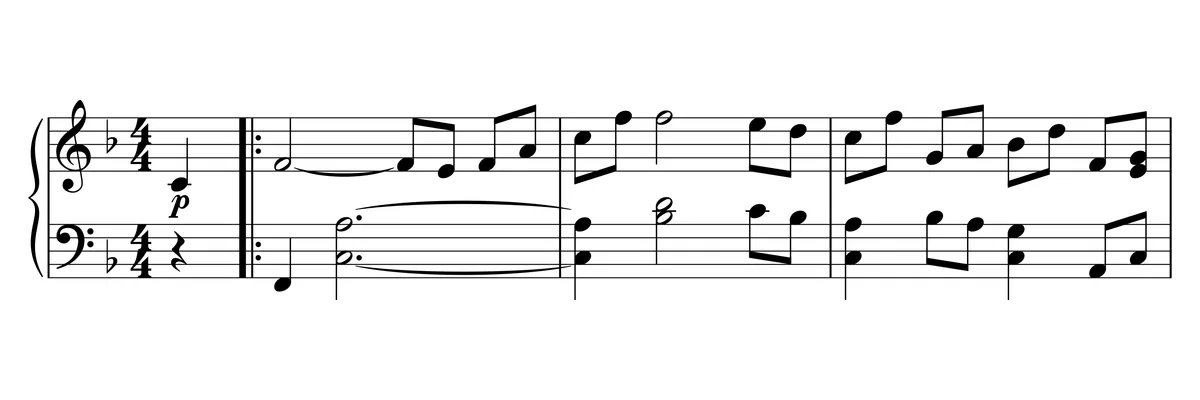
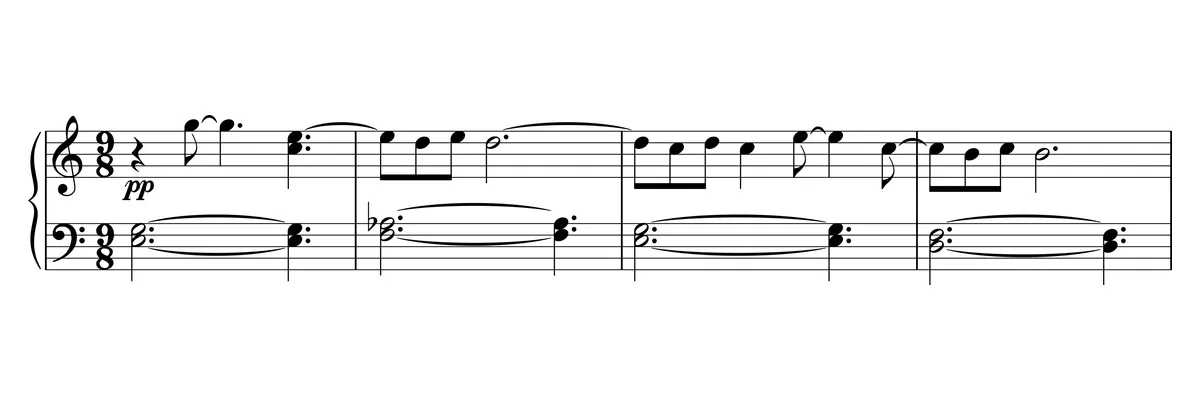
Satie's melody and bass notes in D major, with two-note chords close above the bass instead of the big left-hand jump.
- Right hand: Satie's melody note for note, with its ties, the repeat and both endings.
- Left hand: Satie's bass note on beat 1 of every bar, then a two-note chord on beat 2 instead of his fuller chord, which usually sits more than an octave higher. The jump from bass to chord is a seventh or less.
- Bars 1 to 16: F♯–B over G and C♯–F♯ over D, the seventh and third of each chord, so G major 7 and D major 7 keep their sound.
- Bars 9 to 12: the chord sits below the right hand's held F♯ instead of sharing it, so the hands never meet.
- Bars 19 to 31 and the second ending: two notes from each of Satie's chords, with his C naturals and F naturals kept. In bars 23, 24 and 29, B–E over the low D keeps his E minor 7 sound.
- Bar 22: the low A is an octave higher, in the staff instead of on the third ledger line below it.
- Bars 37 and 45: the left hand plays D–A, then D–G, in place of the notes Satie divides between the hands.
- Last two bars of each ending: three-note right-hand chords instead of four; in bars 39 and 47 the left hand plays D–A instead of D–A–D.
- Dynamics: Satie's pp and p and all his hairpins. The forte in bar 9 and the pp that takes it back in bar 13 are left out, so the piece stays quiet throughout.
For teachers: For a student who plays hands together, reads two sharps and has started using the damper pedal. Learn the left hand alone first: bass, chord, back to the bass, with the pedal changed on each downbeat. The jump back down (from the F♯–B chord to the low D) is the one to practice; the right hand is Satie's and the easiest part of the piece.
Typed into PlayableNotes“Make a short beginner version of the famous part of Gymnopédie No. 1 in C major. Keep Satie's melody, give the left hand held open fifths, nothing wider than a sixth, no pedal, and a proper ending. Leave out the middle section.”

What changed
The famous opening a step lower, in C major, over held open fifths, with the close of Satie's first ending.
- In C major, a whole step lower than Satie's D major: no key signature, and the two chords become F major 7 and C major 7. The only accidental is one B♭ in bar 26.
- 27 bars: two bars of introduction (Satie has four), the opening tune (Satie's bars 5 to 21), then his first ending (bars 32 to 39), which ends on C. The darker middle section and the repeat are left out.
- Right hand: Satie's melody, a step lower. In bars 8 to 10, where the melody holds one note while Satie's chords repeat it, the right hand plays the top two notes of those chords (B–E and C–E), as in the introduction.
- Left hand: one open fifth per bar (F–C, C–G and so on), held for the whole bar, instead of a low bass note and a chord. Bar 19 has a single C, and bars 23 and 24 a single D.
- Last two bars: D–B♭, then E–C, in the right hand over the open fifths G–D and C–G: Satie's closing chords a step lower, with fewer notes.
- No stretch wider than a sixth in either hand, and every note can be held by the fingers, so no pedal is needed.
For teachers: For a student near the end of the first year who reads in C and can hold a left-hand fifth while the right hand moves. The left hand is easy; the right hand is not a five-finger piece. It moves from the dyads around middle C (bars 1, 2 and 8 to 10) up to E–G (bars 3 and 11), down to G–A–B–C (bars 5 and 6, 13 and 14), to the low E and D (bars 7, 17 to 19 and 25), up to F and E (bars 20 and 21), back to G–A–B–C–D (bars 22 to 24) and down to the closing dyads. Most of these moves come during a long note or a rest, but three come straight after a quarter note in the middle of a slur. In bars 4 to 5 and 12 to 13, play F–E–B with 3-2-1, then cross 2 over the thumb for A–B–C (2-3-4), so G in the next bar falls under the thumb. In bars 24 to 25 the melody drops a seventh from D to E: take the E with 2, so the thumb is ready for the D in bar 26. Show these three spots before the first run-through.
Typed into PlayableNotes“My student has small hands and can't reach the wide chords in Gymnopédie No. 1. Keep the original as it is, every note where possible, but no chord wider than a seventh in either hand.”


What changed
Satie's score with the widest chords thinned, so nothing is wider than a seventh; the melody, bass and left-hand jumps are as he wrote them.
- Every note is Satie's; a few are left out so that no chord is wider than a seventh. Most are a sixth or less.
- Bars 24 to 26 and 29 to 31, where the left-hand chords are a ninth wide, the widest reach in the original: G–B–E without the low D in bars 24 and 29, and C–E–A and C–F♯–A without the top D in the others. The bass and the melody still carry the D.
- Bars 36, 41 and 44: the octave-wide chords lose their bottom A.
- Bars 38, 39, 46 and 47: three-note chords in the right hand instead of four, and D–A in the left instead of the octave D–A–D.
- Bars 9 to 12: the chord leaves out the F♯ that the right hand is holding, so the hands don't share a key.
For teachers: For a student who can play the original's notes but cannot reach a ninth or an octave. The left-hand jump from bass to chord is unchanged and is still the main work: practice it with your eyes on the chord, letting the pedal hold the bass.
The piece as published: Mutopia Project no. 37, typeset by Evin Robertson from the Dover edition.
Original
What changed


What changed
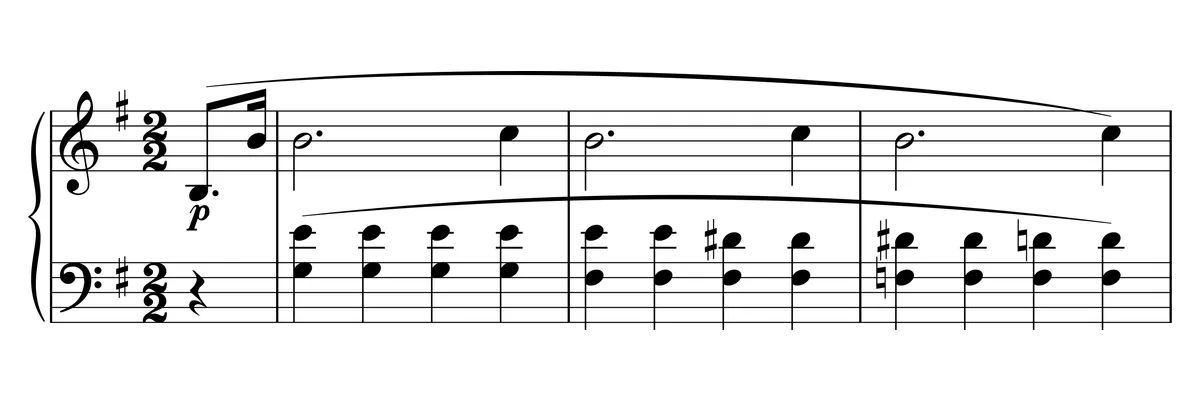
Satie's score as published in the Mutopia edition: the melody, the low bass and the chords in between, with the repeat and both endings.
- Nothing: this is the source edition, checked bar by bar.
For teachers: The chords on the treble staff in bars 1 to 18 and 32 to 47 are played by the left hand, as are those on the bass staff in bars 19 to 31. The right hand plays only the melody, apart from the chords in bars 37 and 45 and the final chords of each ending.
Want it different? Just ask.
Open this version in PlayableNotes and ask for a change in words: simpler, another key, shorter, bigger notes. The result is a new version you can play, print and share with your student.
Free account. Changes, playback and printing are free; 50 free credits to read your own sheet music.
Watch how to ask for your own version · 1 min video
Make your own version
A real request in PlayableNotes, on Für Elise from the free library: say who it’s for and what to keep, and the AI writes a new version beside the original. It shows how to ask for a version of your own; its result is not one of the versions on this page.
About Gymnopédie No. 1
Gymnopédie No. 1 is the first of three slow piano pieces Erik Satie wrote in 1888, marked Lent et douloureux (slow and sorrowful). For its first sixteen bars the left hand rocks between two chords, G major 7 and D major 7, while the right hand plays a quiet melody in long notes. A second section turns darker with C naturals and F naturals. Then the whole piece repeats: the first ending closes in D major, the second in D minor.
The right hand is the easy part: quarter, half and dotted-half notes, never higher than the A just above the staff. The left hand is the hard part. In almost every bar it plays a low bass note, jumps up to a chord on beat 2, usually more than an octave away, and relies on the pedal to hold the bass. In bars 24 to 26 and 29 to 31 the chord itself is a ninth wide. The easy version keeps Satie's melody and bass notes and puts a two-note chord close above the bass, so the jump is much smaller and the left hand stays in the bass clef.
The short beginner version is the famous opening in C major, where the two chords become F major 7 and C major 7. The left hand holds open fifths, and it can be played without the pedal. The small-hands version is the original with its widest chords thinned. The original is here too, so you can hear exactly what each version changed.
Practice tips
- Learn the left hand alone first. Play the bass on beat 1, move to the chord during beat 1, and move back to the next bass during beat 3, so neither jump is rushed.
- Change the pedal on each downbeat: lift as you play the new bass note and press again just after it. Listen for the old chord to stop and the new bass to ring.
- The melody starts on beat 2 of bar 5. Count the rest, and keep counting through the long held notes in bars 9 to 12 and 19 to 21 (bar numbers as in the easy version and the original).
- Before the second section, mark the C naturals and F naturals in bars 21 to 31 and in the second ending. Loop bars 22 to 24 until the C natural in the right hand is automatic. The short C major version leaves this section out.
- Keep it slow and quiet, around 60 to start. Satie marks it Lent et douloureux; raise the tempo only when the left hand lands each chord without looking.
Questions about Gymnopédie No. 1
Is Gymnopédie No. 1 hard to play on piano?
The notes are slow and the melody is easy, but the original asks the left hand to jump more than an octave in most bars and to use the pedal to hold the bass, which makes it an intermediate piece. The easy version on this page keeps the melody and bass and makes the jump much smaller; the short beginner version needs no jump and no pedal.
What key is Gymnopédie No. 1 in?
It has a key signature of two sharps (D major). The opening rocks between G major 7 and D major 7, the second section adds C naturals and F naturals, and the piece ends in D minor after the repeat. The short beginner version on this page is in C major, where the opening chords are F major 7 and C major 7.
How fast should Gymnopédie No. 1 be played?
Satie marks it Lent et douloureux, slow and sorrowful, with no metronome mark. A quarter note around 66 to 72 keeps it slow without dragging. Learn it nearer 60 with the tempo slider on this page.
Do I need the pedal for Gymnopédie No. 1?
For the original, yes: the bass is written to last the whole bar while the left hand is already playing the chord. Change the pedal on each downbeat. The easy version needs it too. The short beginner version can be played without it, since the left hand simply holds its fifths.
What does Gymnopédie mean?
The word comes from the gymnopaedia, a festival in ancient Sparta at which young men danced. Satie used it as the title of three slow piano pieces, all written in 1888.
Is Gymnopédie No. 1 free to download?
Yes. Satie wrote it in 1888 and it is in the public domain, and the edition used here was placed in the public domain by its typesetter. Every version on this page has a PDF to print and a MIDI file, free and without an account.
Source and credits
- Composer
- Erik Satie
- License
- Public domain
- Arranger
- PlayableNotes
All 47 bars were compared with the Mutopia PDF and MIDI and with two user transcriptions; no notes needed correcting. Mutopia writes Satie's repeat with a repeat sign and first and second endings, as here, where the original edition prints it out in full. Mutopia prints a forte in bar 9; the original version keeps it.
Arrangements and facts checked