Free easy piano · Classical
Burgmüller's Arabesque, easy piano
Burgmüller's Arabesque (Op. 100 No. 2) in four free versions: an easy version in eighth notes, a late-beginner version, the original right hand over an easier left hand, and the complete original. Play each one here, slow it down or loop a bar, then print the PDF or download the MIDI.
- Friedrich Burgmüller
- Easy to intermediate, plus the original
- 33 bars · 4/4
- Free: play, print, MIDI
Versions of Arabesque, Op. 100 No. 2. Each version is a request typed into PlayableNotes. Pick one to hear and print it.
Typed into PlayableNotes“Make Burgmüller's Arabesque easier for my second-year student. Write it in 4/4 with eighth notes instead of sixteenths, keep the whole melody, both repeats and the middle section's moving left hand, and give the left hand two-note chords instead of three.”


What changed
The whole piece with both repeats, written in 4/4 with eighth notes, over two-note left-hand chords and Burgmüller's running left hand in the middle section.
- Written in 4/4 instead of 2/4, with every note value doubled: sixteenths become eighths and eighths become quarters. Each bar of the original is one bar here, with the same notes and rhythm. At twice the metronome number it moves at the original's speed, so at the page's tempo it is slower.
- Right hand: Burgmüller's notes, with the repeats and both endings. The runs that climb above the staff in bars 6, 23, 30 and 31 are printed an octave lower under an 8va sign, so they stay on the staff or just above it.
- Bar 32: the right hand's closing run, E down to A, is an octave higher than written, so the hand stays near the final chord instead of dropping below middle C. The left hand plays the run at its own pitch.
- Left-hand chords: two notes instead of three. A–C–E becomes A–E where the right hand plays the C, and A–C where it does not (the opening bars 1 and 2, and bars 25 and 27), so the opening already sounds minor. A–D–F becomes A–F, and A–D–E in bars 24 and 26 becomes A–D, so the D still falls to C in bars 25 and 27. Bars 10 and 11 are two notes in the original already.
- Bars 7 to 9: G–C in bar 7 and G–F in bars 8 and 9, instead of G–C–E and G–B–F. The bass G stays, the C in bar 7 keeps Burgmüller's C-over-G chord before the G7, and the seventh, F, falls to E in bar 10. That seventh, G up to F, is the widest stretch in the left hand.
- Middle section (bars 12 to 19): every note of Burgmüller's left hand at double length, including the three bars in the treble clef (17 to 19).
- In all, 135 left-hand notes instead of 177.
For teachers: For a second-year student who reads eighth notes and plays hands together. Learn the five-note runs hands separately first, then the middle section's left hand alone: it carries the motion while the right hand holds long notes, and bars 17 to 19 are read in the treble clef. Point out the four 8va signs before the first run-through.
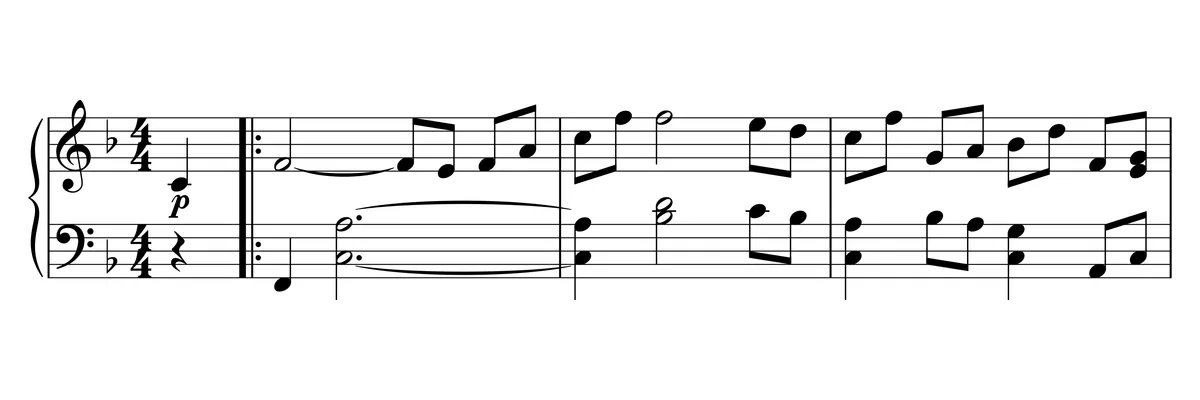
Typed into PlayableNotes“Make a late-beginner version of the Arabesque: eighth notes in 4/4, nothing higher than the A above the staff, and a left hand that plays two-note chords or single notes and never stretches more than a fifth. Keep the whole tune and the repeats.”


What changed
The whole tune in eighth notes over two-note chords and single notes in half notes, with the high passages brought down.
- Written in 4/4 with eighth notes, like the easy version: 33 bars, with both repeats.
- Right hand: the whole tune, so it still changes position several times, mostly at rests.
- Left hand in the opening and its returns: two half-note chords per bar (A–C, A–E, A–D, C–E or B–D), all inside the five notes from A up to E, so the hand never moves. Bars 1 and 2 play A–C, so the opening sounds minor before the right hand comes in. In bars 7 to 9 the chords are C–E and B–D, without Burgmüller's low G. Bars 24 and 26 play A–D under the right hand's B and C, and the D falls to C in bars 25 and 27, as in the original.
- Middle section: the left hand's running figures become two half notes per bar, each figure's first note and then a note of its chord (G♯–E, A–E, C♯–E, D–A). Bar 18 is F, then D and D♯ in quarter notes, where Burgmüller's figure has them, and bar 19 is a whole-note E. Bars 16 to 19 are an octave lower than Burgmüller's, so the left hand stays in the bass clef.
- Bars 6 and 23: the run that climbs to the high E is played an octave lower, A up to E as in bar 4. Bars 30 and 31 are an octave lower too, so the coda repeats bars 28 and 29 instead of climbing to the top A.
- Bar 11: the C is held, without the jump to the high C. Bar 15: a rest instead of the A that leads into bar 16, so the right hand has time to move up to the high A.
- Bar 32: the closing run is an octave higher (E down to the A above middle C) and the left hand plays A–E under it.
For teachers: For a student near the end of the first year who plays eighth notes hands together. The left hand is easy; the right hand plays the whole tune and moves to a new position often, mostly at rests: look at bars 5, 6 and 7 and at the move to the high A in bar 16 before the first run-through. In bar 18, put the fifth finger on D, so D, C, B, A and the G♯ in bar 19 fall under fingers 5-4-3-2-1 without a shift; then move up to the E. The left-hand chords sit around middle C, with E on the second ledger line above the bass staff, so name them once before playing.
Typed into PlayableNotes“Keep the right hand of the Arabesque exactly as Burgmüller wrote it, sixteenths and all, but make the left hand easier: two notes instead of three in the chords, and no sixteenth notes in the middle section or the last run.”


What changed
Burgmüller's right hand note for note, over lighter chords and a left hand with no sixteenths.
- Right hand: unchanged from the original, with every sixteenth, staccato, repeat and ending.
- Left-hand chords: two notes instead of three, as in the easy version. A–C–E becomes A–E, or A–C in bars 1, 2, 25 and 27, where the right hand has no C; A–D–F becomes A–F; A–D–E in bars 24 and 26 becomes A–D, and the D falls to C in bars 25 and 27; and in bars 7 to 9, G–C–E becomes G–C and G–B–F becomes G–F.
- Bars 12 to 17: each group of sixteenths becomes three eighth notes on the notes of the chord: G♯–B–G♯, A–C–E, C♯–E–C♯, and D–F–A before the G. Bars 18 and 19 are eighth notes in the original and stay as written, in the treble clef.
- Bar 32: the left hand's run E–D–C–B–A becomes E–C–A in eighth notes, each one an octave under the right hand.
- In all, 121 left-hand notes instead of 177, and none faster than an eighth note.
For teachers: For a student who plays the right hand of the original at speed but loses time when the left hand starts running in bar 12. It is badged Intermediate because the right hand is Burgmüller's at full speed; the left hand is easier than his. Once this is secure, the original adds the third note of each chord and the left-hand sixteenths in bars 12 to 17 and 32.
The piece as published: Mutopia Project no. 203, typeset by Bas Wassink from the Collection Litolff edition.
Original
What changed

What changed
The complete study in A minor, from the Mutopia edition of the Litolff text.
- Nothing: this is the source edition, checked bar by bar.
- Bar 25 follows Litolff: A, then E tied into bar 26.
For teachers: Allegro scherzando: quick, light and playful. The hardest moments are the left-hand sixteenths under the long right-hand notes in bars 12 to 17, and the coda, where the right hand climbs to the top A in bar 31 and drops more than two octaves for the final run.
Want it different? Just ask.
Open this version in PlayableNotes and ask for a change in words: simpler, another key, shorter, bigger notes. The result is a new version you can play, print and share with your student.
Free account. Changes, playback and printing are free; 50 free credits to read your own sheet music.
Watch how to ask for your own version · 1 min video
Make your own version
A real request in PlayableNotes, on Für Elise from the free library: say who it’s for and what to keep, and the AI writes a new version beside the original. It shows how to ask for a version of your own; its result is not one of the versions on this page.
About Arabesque, Op. 100 No. 2
Arabesque is No. 2 of Friedrich Burgmüller's 25 Easy and Progressive Studies, Op. 100: short teaching pieces, each with a descriptive title, published in Paris in 1851. It is in A minor and 2/4, marked Allegro scherzando, and with its repeats it lasts under a minute. Two bars of left-hand chords open it; then come a first section built on quick five-note runs, a middle section where the right hand sings long notes over running sixteenths in the left hand, the opening again, and a coda that climbs to the top A and ends with a run down in both hands.
The notes lie under the hand; what makes it hard is speed and lightness. Every run is sixteenth notes ending on a short staccato note, the left-hand chords have to stay soft underneath, and from bar 12 the hands swap roles. The easy and late-beginner versions write the music in 4/4 with eighth notes, so a student in the first or second year can read it, and give the left hand two-note chords instead of three. The late-beginner version also brings the high runs down an octave and turns the middle section's running left hand into held notes.
The easier-left-hand version is for a student who can already play the runs: Burgmüller's right hand note for note, over two-note chords and a middle section without sixteenths. The complete original is the last tab; play it after any version to hear which notes that version left out.
Practice tips
- Play each run as one gesture: drop into the first note, keep the five notes smooth, and lift off the staccato last note. Practice it slowly with a small bounce of the wrist on that last note before you speed up.
- Keep the left-hand chords lighter than the runs. The piece starts piano and is marked leggieremente (lightly; usually spelled leggiermente): the runs should be bright and the chords only mark the beat.
- From bar 12 the roles swap. Hold the right hand's long notes for their full value and let the left hand carry the motion; play the left hand alone first with the Left button.
- Count through bars 7 to 9: the right hand starts bar 7 after a rest, and the accented D in bar 8 is tied into bar 9. Loop them (click bar 7, then bar 9) until the rhythm is steady.
- Practice each hand at a slow tempo, then put them together and raise the tempo a few beats at a time. Speed comes last: the runs sound quicker when they are even and light than when they are rushed.
Questions about Arabesque, Op. 100 No. 2
Is Burgmüller's Arabesque the same as Debussy's Arabesque?
No. Burgmüller's Arabesque is a short study in A minor from his Op. 100, published in 1851. Debussy's two Arabesques are separate, longer piano pieces from around 1890; the first, in E major, is the one most people know. It has its own easy-piano page.
What level is Burgmüller's Arabesque?
The original is usually taught at late-elementary to early-intermediate level. None of the notes is a stretch; the challenge is playing the sixteenth-note runs quickly, evenly and lightly. The easy version on this page suits a second-year student, and the late-beginner version a student near the end of the first year who can play eighth notes hands together.
What key is Burgmüller's Arabesque in?
A minor, with no sharps or flats in the key signature. The accidentals come in the middle section, which leans on E major and passes through D minor before the opening returns. Every version on this page stays in A minor.
How fast should the Arabesque be played?
Burgmüller marks it Allegro scherzando, fast and playful; many editions print ♩ = 152, which is also the tempo of the Mutopia MIDI file. The Mutopia edition used here prints no metronome mark. Learn it much slower, with the tempo slider on this page, and speed up only while the runs stay even. In the easy and late-beginner versions every note value is doubled, so the same number on the slider plays them at half the speed of the original.
Why is the easy version in 4/4 instead of 2/4?
Every note value is doubled: sixteenths become eighth notes and eighths become quarters, so each 2/4 bar of the original becomes a 4/4 bar with the original's rhythm. Played at twice the metronome number it moves at the original's speed; at the page's tempo it is a slower practice speed. Either way it is easier to read, especially for a student who has not met sixteenth notes yet.
Who was Friedrich Burgmüller?
A German pianist and composer (1806–1874) who settled in Paris in 1832 and is remembered for his teaching pieces. His three sets of studies, Op. 100, Op. 105 and Op. 109, are still standard repertoire for students; Op. 100, which includes Arabesque, is the easiest of them.
Can I download Arabesque as a PDF or MIDI file?
Yes, free and without an account. Every version has a Letter-size PDF to print and a MIDI file with the right and left hands on separate tracks.
Source and credits
- Composer
- Friedrich Burgmüller
- License
- Public domain
- Arranger
- PlayableNotes
Compared note for note with the MIDI file LilyPond made from the same source and with an independent CC0 edition from MuseScore (PDMX 5849868), and bar by bar with the Mutopia PDF; no notes needed correcting. The text markings (leggieremente, as this edition spells it, cresc., dim. e poco rall., a tempo, dolce, risoluto) and the fingerings are not shown. In bar 25 Litolff has A, then E tied into bar 26; some editions, the MuseScore one among them, print the A short with a rest before an accented E, as in bar 8.
Arrangements and facts checked