Free easy piano · Classical
Bach's Prelude in C major, easy piano
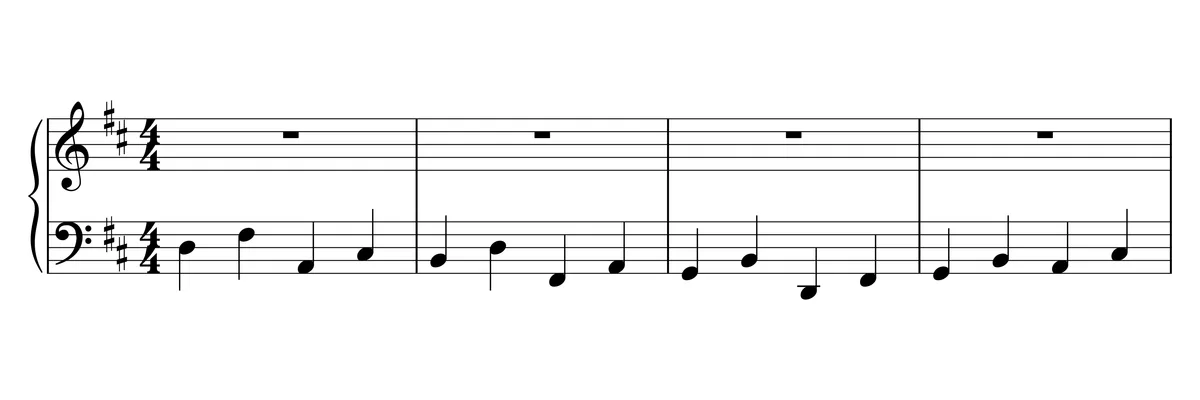
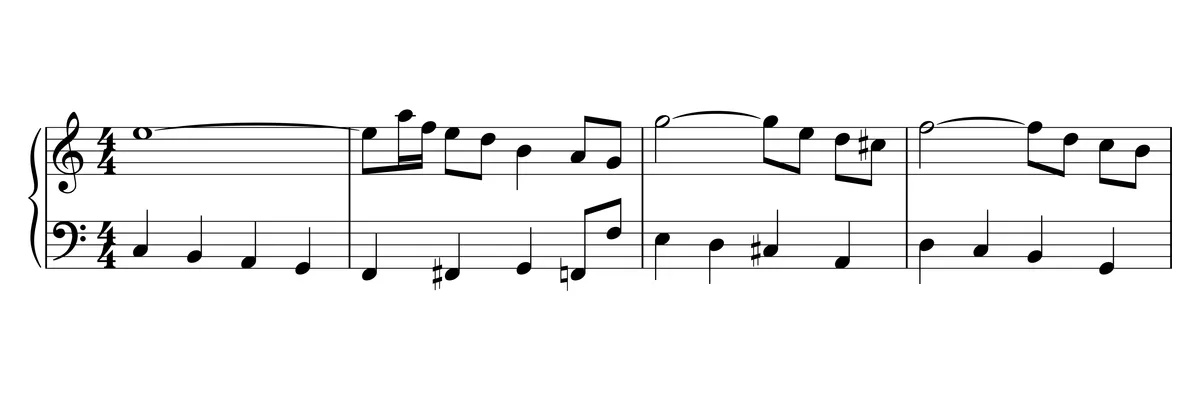
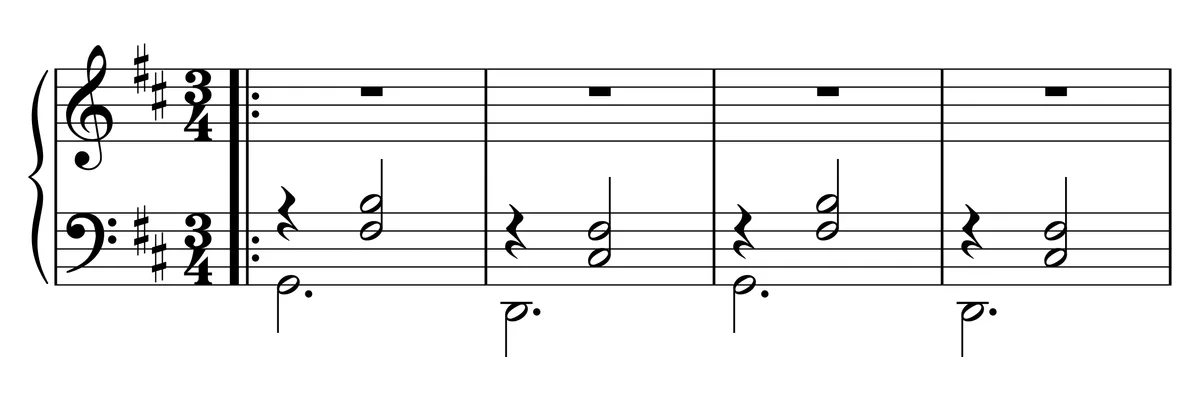
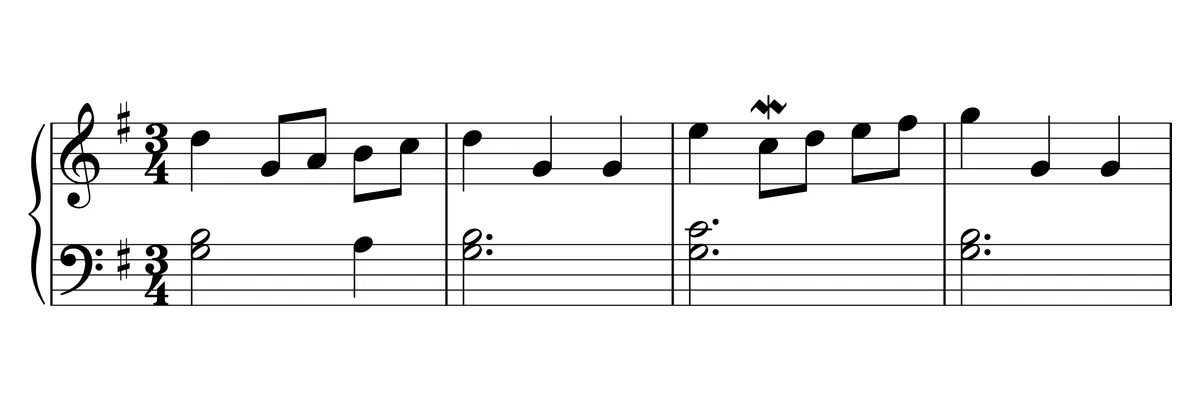
Bach's Prelude in C major (BWV 846) in four free versions: an easy version in eighth notes, a simpler one with one left-hand note per bar, the chords as block chords, and the original. Play each one here, slow it down or loop a bar, then print the PDF or download the MIDI.
- Johann Sebastian Bach
- Easy to late beginner, plus the original
- 35 bars · 4/4
- Free: play, print, MIDI
Versions of Prelude in C major. Each version is a request typed into PlayableNotes. Pick one to hear and print it.
Typed into PlayableNotes“Make Bach's Prelude in C easier for my second-year student. Use eighth notes instead of sixteenths and play each bar's pattern once instead of twice, but keep every chord, the left hand's held notes and all 35 bars. Keep the right hand in the treble clef.”


What changed
All 35 bars and every chord, with Bach's broken-chord pattern played once per bar in eighth notes.
- Bars 1 to 32: each bar plays Bach's figure once in eighth notes instead of twice in sixteenths. The notes are Bach's, in his octaves: the left hand holds the bass and adds its second note half a beat later, and the right hand plays its three notes twice.
- No sixteenth notes, and about half as many notes as the original: 277 instead of 549.
- Bar 33: the run that the original writes in the bass clef becomes F–A–C–A–F–D, an octave higher in the treble staff, so the right hand never changes clef.
- Bar 34: the run up to the high F becomes G–B–D–F–D–B, ending on the B that leads into the last chord; the rest of Bach's run, down to its closing F–E–D, is left out.
- Bar 35: the last chord, as written.
For teachers: For a student who reads eighth notes and can hold a note in the left hand while the right hand moves. The right hand reaches an octave in bars 5, 7, 13, 15 and 29: learn those shapes as chords first (the block-chord tab has them). Both hands read ledger lines, as in the original: the left hand above the bass staff in bars 1 to 9, and the right hand below the treble staff from bar 15 to bar 32, down to the G below middle C.
Typed into PlayableNotes“Make Bach's Prelude in C simpler still: one held note per bar in the left hand, the right hand in eighth notes with nothing wider than a sixth, and keep Bach's chord in every bar and, as far as possible, his top note.”


What changed
One held left-hand note per bar under a three-note right-hand pattern in eighth notes. Every bar keeps Bach's chord, and every bar but 24 keeps his top note.
- Left hand: one whole note per bar (Bach's bass line) instead of two notes. It stays between the F just below the bass staff and the G in its top space: bars 1 to 9 are an octave lower than written and bars 32 to 35 an octave higher, with no low octave at the end.
- Bar 3: the left hand plays G instead of B, so the bar still sounds as a G7 chord.
- Right hand: Bach's three-note figure, played twice per bar in eighth notes, never wider than a sixth. Where Bach's figure is wider (bars 3, 5, 7, 10, 13, 15, 18, 26, 27, 29, 30 and 31) its lower notes change; the top note never does.
- Bars 12 and 14: the right hand takes over the B-flat and A-flat the left hand used to play (E–B♭–C♯ and D–A♭–B), so the diminished chords keep their sound.
- Bar 28: C–E♭–F♯ instead of A–C–F♯, for the same reason.
- Bar 23: the right hand plays Bach's B–C–D over the A-flat, but the left hand's F is gone, so the diminished chord is thinner than Bach's.
- Bar 24: the right hand plays B–D–F instead of G–B–D, as in bars 27 and 31, taking over the F from the left hand so the long low G starts under a G7 chord as in Bach. The top note becomes F instead of D.
- Bars 33 and 34: the runs become two more bars of the pattern over a held C. Bar 33 plays A–C–F, the top of Bach's run in its register, and bar 34 plays B–D–F up to the high F where Bach's run peaks.
For teachers: For a late beginner who plays eighth notes and can hold a whole note in the left hand. The right hand moves to a new three-note shape almost every bar, usually by a step, and many shapes have accidentals (bars 6, 10, 12, 14, 20, 22, 28 and 32), so learn the shapes as chords first. From bar 16 to bar 33 the right hand sits around middle C and reads ledger lines below the treble staff, down to the G below middle C in bars 19, 25 and 32; in bar 34 it moves up to the high F, then back down for the last chord.
Typed into PlayableNotes“Write Bach's Prelude in C as block chords, so my student can learn the chord changes before the broken chords: Bach's notes in each bar played together, the right hand in half notes and the left hand held for the whole bar.”


What changed
Each bar's notes played together: the prelude's chord progression, bar by bar, in Bach's own voicing.
- Bars 1 to 32: the five notes of each bar sound together. The left hand holds Bach's two notes for the whole bar; the right hand plays its three notes as a chord twice, in half notes.
- Bar 33: the run becomes two chords over the held C's, A–C–F and then A–D–F.
- Bar 34: the run becomes B–D–F and then F–G–B, over C and B in the left hand, leading into the last chord.
- Bar 35: as written.
For teachers: Use it before the easy version or the original: once the hands know each chord, the broken-chord pattern is a matter of playing the same notes one at a time. The right hand reaches an octave in bars 5, 7, 13, 15 and 29, and the left hand in bars 21, 32, 33 and 35, so it suits a hand that can already stretch an octave.
The piece as published: Mutopia Project no. 5, entered by Shay Rojansky, edited by Han-Wen Nienhuys and Tobias Erbsland.
Original
What changed


What changed
Bach's 35 bars as published in the Mutopia edition: sixteenth notes throughout, and the free run in bars 33 and 34.
- Nothing: this is the source edition, checked bar by bar. The arpeggio sign on the last chord is not shown.
For teachers: When the easy version is secure, the new skill here is evenness at speed: twice as many notes, in sixteenths, with the left hand holding its notes through each half bar. Loop bars 33 and 34 on their own first; they are the only bars that break the pattern, and bar 33 puts the right hand in the bass clef.
Want it different? Just ask.
Open this version in PlayableNotes and ask for a change in words: simpler, another key, shorter, bigger notes. The result is a new version you can play, print and share with your student.
Free account. Changes, playback and printing are free; 50 free credits to read your own sheet music.
Watch how to ask for your own version · 1 min video
Make your own version
A real request in PlayableNotes, on Für Elise from the free library: say who it’s for and what to keep, and the AI writes a new version beside the original. It shows how to ask for a version of your own; its result is not one of the versions on this page.
About Prelude in C major
The Prelude in C major opens Book 1 of The Well-Tempered Clavier, the 24 preludes and fugues in every major and minor key that Bach completed in 1722. An earlier, shorter version is in the keyboard book he began for his son Wilhelm Friedemann in 1720. It has no tune in the usual sense: each of the first 32 bars is one chord, broken into the same figure and played twice, over a bass line that drifts downward, settles on a low G for eight bars (24 to 31) and ends on a low C held for the last four.
No single bar is hard. What takes work is playing about 550 notes, most of them sixteenths, evenly and calmly while the left hand holds its notes. The right hand's figure also spans an octave in bars 5, 7, 13, 15 and 29, and the pattern breaks only in bars 33 and 34, where a free run opens with an F-major arpeggio (F–A–C–F) and takes the right hand into the bass clef.
The easy version keeps every chord and, through bar 32, every pitch of each bar, but plays each bar's figure once in eighth notes instead of twice in sixteenths, so the chords change at the same pace with half as many notes. The simpler version goes further and gives the left hand one note per bar. The block-chord version shows the harmony that the other versions break up.
Practice tips
- Learn the chords before the pattern: play each bar as one chord (the block-chord tab does this) until you can move from bar to bar without stopping to find the next shape.
- Hold the left hand's notes for their full length while the right hand plays. Those held notes carry the harmony; if the left hand lets go early, the prelude sounds like a finger exercise.
- Keep the figure even and quiet, with no accent on the top note. Let the louder moments come from the harmony: the tense chords in bars 22 and 23, and the long low G from bar 24.
- Loop bars 21 to 24 (click bar 21, then bar 24), where the bass climbs F, F-sharp, A-flat before falling to G: the sharps and flats in these bars are easy to misread.
- Practice each hand with the Right and Left buttons at a slow tempo, then hands together, raising the tempo a few beats at a time. The prelude sounds best calm and steady, so speed comes last.
Questions about Prelude in C major
Is Bach's Prelude in C good for beginners?
In its simplified forms, yes, once a student has a year or so of lessons. The original is usually taught to intermediate students, because of its steady sixteenth notes, octave reaches and the free run near the end. Its pattern and harmony are simple, though, so it simplifies well: the simplest version on this page has one left-hand note per bar and a three-note right-hand pattern in eighth notes.
Is this the music of the Bach–Gounod Ave Maria?
Yes. In 1853 Charles Gounod published a melody to be played over this prelude; in 1859 it was set to the Latin words of the Ave Maria and became the Bach–Gounod Ave Maria. The versions on this page are Bach's prelude on its own, without Gounod's melody.
Why does my copy have 36 bars?
Some 19th-century editions, and the Bach–Gounod Ave Maria, add an extra bar between bars 22 and 23. It is usually traced to the Hamburg musician Christian Friedrich Gottlieb Schwencke and is not in Bach's manuscripts. The versions on this page follow Bach's 35 bars, so the bar numbers match Urtext editions.
What chords are in Bach's Prelude in C?
One per bar. The first 19 bars are C, Dm7/C, G7/B, C, Am/C, D7/C, G/B, Cmaj7/B, Am7, D7, G, C♯dim7/G, Dm/F, Bdim7/F, C/E, Fmaj7/E, Dm7, G7 and C. The rest of the piece moves through C7, Fmaj7 and diminished chords to a long G in the bass, then ends over a low C. The block-chord version on this page plays each bar's chord so you can hear and see them.
How fast should the Prelude in C be played?
Bach gave no tempo marking, and performances range from slow and meditative to brisk. Around 60 to 70 quarter notes a minute is a calm, common choice. Learn it slower, and use the tempo slider on this page to step up as the sixteenths even out.
Can I download Bach's Prelude in C as a PDF or MIDI file?
Yes, free and without an account. Every version has a Letter-size PDF to print and a MIDI file with the right and left hands on separate tracks.
Source and credits
- Composer
- Johann Sebastian Bach
- Source edition
- Mutopia Project no. 5, entered by Shay Rojansky, edited by Han-Wen Nienhuys and Tobias Erbsland
- License
- Public domain
- Arranger
- PlayableNotes
All 35 bars were checked against the Mutopia PDF and MIDI and against MuseScore user Lizak3's edition (PDMX, Public Domain Mark); no notes needed correcting. That MuseScore edition (musescore.com/user/26816747/scores/5062514) is the library copy linked here; the other library copy of the prelude has only 34 bars, with bar 26 missing, so it was not used. This is Bach's 35-bar text, without the extra bar some 19th-century editions add after bar 22. The arpeggio sign on the last chord is not shown.
The full edition is also in the library: Prelude in C major, ready to play and edit.
Arrangements and facts checked