Free easy piano · Hymns
Rock of Ages, easy piano
Rock of Ages for piano in five free versions: an easy arrangement in the hymnal's key of B-flat major, a beginner version in C major, a hymn accompaniment with an introduction and a repeat for the verses, an offertory solo, and the 1854 hymnal setting. Play each one here, slow it down or loop a bar, then print the PDF or download the MIDI.
- Thomas Hastings
- Beginner to intermediate, plus the original
- 13 bars · 6/4
- Free: play, print, MIDI
Versions of Rock of Ages. Each version is a request typed into PlayableNotes. Pick one to hear and print it.
Typed into PlayableNotes“Make this hymn easier for a second-year student. Keep it in B-flat major and keep the melody exactly as written. Give the left hand one- or two-note chords from the hymnal's harmony instead of octaves, with nothing wider than a sixth in either hand.”

What changed
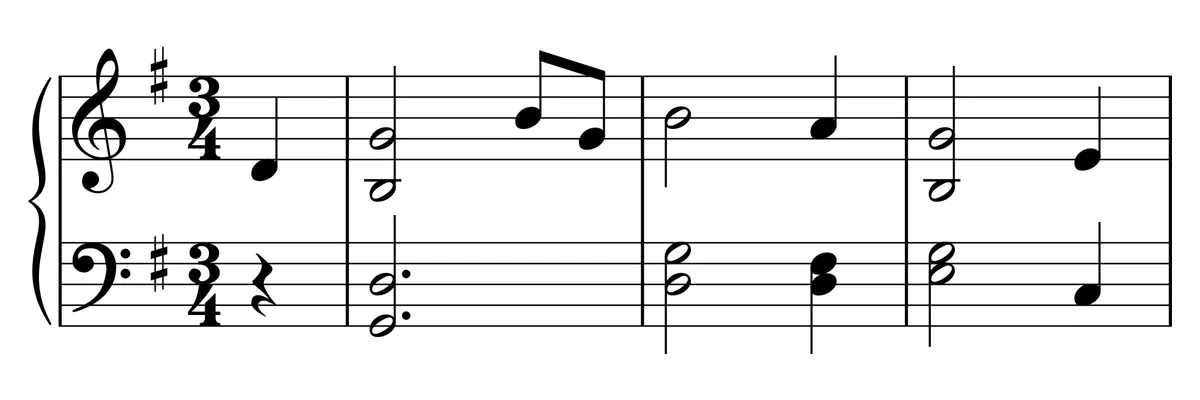
The whole melody in the hymnal's key, with the alto under the long notes and simple one- and two-note left-hand chords that follow the 1854 harmony.
- Right hand: the melody unchanged in all 13 bars. The hymnal's alto stays under the long notes, under the whole of bars 6 and 8 (the held E-flat), and in the pickups into bars 2, 3, 10 and 11. The other moving notes are the melody alone: the pickups into bars 4, 6, 8 and 12, the C, B-flat, A in bars 4 and 12, and the D on beat 3 of bars 2 and 10.
- Left hand: one or two notes at a time, nothing wider than a sixth, in place of the hymnal's octaves. B-flat–F is held under the first and last lines, and in bars 3 and 11 the bass walks up through D and E-flat into the cadence, as the hymnal's bass does.
- Bars 4 and 12: F–B-flat for three beats, then F–A under the C on beat 4 and a low F for the last two beats. The hymnal has F7 on beat 4; here it is a plain F major chord.
- Bars 6 and 8: F–C for three beats, then A–F from beat 4 under the right hand's E-flat, so the chord is F7 with A in the bass and the bass steps up from A to B-flat into the next bar. The hymnal keeps F in the bass and moves to B-flat with the melody, in octaves.
- Bar 1: the left hand holds a low B-flat under the pickup.
For teachers: For a second- or third-year student who can read two flats. E-flat comes in bars 1, 2, 6, 8, 9 and 10 in the right hand and bars 3 and 11 in the left, so circle them before the first play-through. Learn the left hand first: it changes chord only once or twice a bar. The melody and key are the hymnal's, so it works for singing.
Typed into PlayableNotes“Make a beginner version for a first-year student: put it in C major so there are no flats, keep the melody alone in the right hand, and give the left hand single notes, mostly long ones.”

What changed
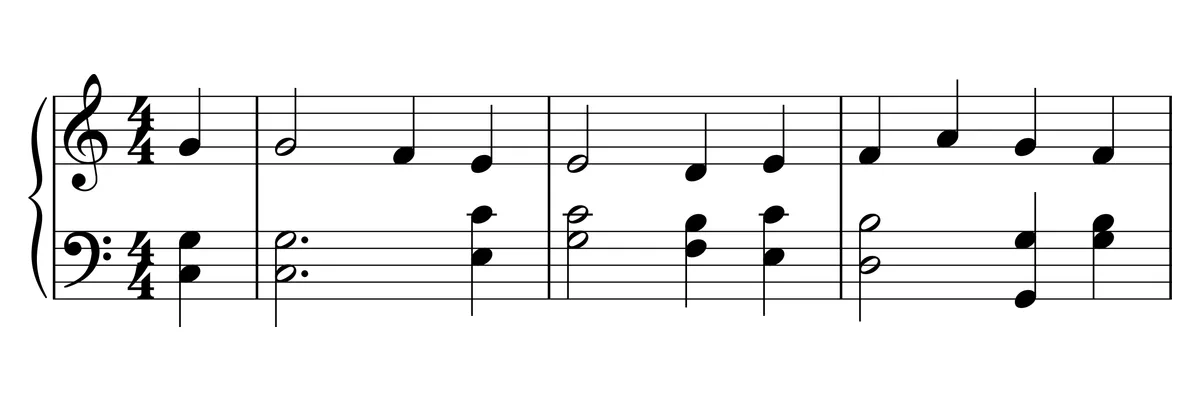
The melody alone in C major, a whole step above the hymnal, over single left-hand notes, with no sharps or flats.
- Moved up a whole step, from B-flat major to C major: no key signature. The melody runs from the E above middle C to the E in the top space of the treble staff, with no ledger lines in either hand.
- Right hand: the melody alone, one note at a time, with the hymnal's rhythms, including the dotted quarter and eighth that lead into most bars.
- Left hand: one note at a time, mostly whole, dotted whole and half notes, from the hymnal's bass: C under most of the first and last lines, C and G in turn under the middle line. An open fifth (C–G) only on the final chord, bar 13.
- Bars 2, 9 and 10: C for four beats, then C again on beat 5, as the hymnal keeps B-flat in the bass all bar.
- Bars 3 and 11: C for four beats, then E and F with the melody's C and D, in the same dotted rhythm, so the bass walks E–F–G into the cadence as the hymnal's bass does.
- Bars 4 and 12: one G held for the whole bar. Bars 6 and 8: G for five beats, then B on beat 6, which steps up to C in the next bar. The hymnal's seventh chord is left out, so the bass carries the move home.
For teachers: For a first-year student who reads in C. The right hand sits mostly between G and D, with two reaches: down to E in bars 2 and 10, and up to the E in the top space in bars 4 and 12. Practice those bars alone before the first run-through. This version is a whole step higher than a hymnal in B-flat, so don't use it to accompany singing from the hymnal.
Typed into PlayableNotes“I play this for congregational singing. Add a short introduction from the hymn itself, write a repeat for the verses with a final ending, and make the harmony sound a little fuller on piano. Keep the hymnal's key and chords.”


What changed
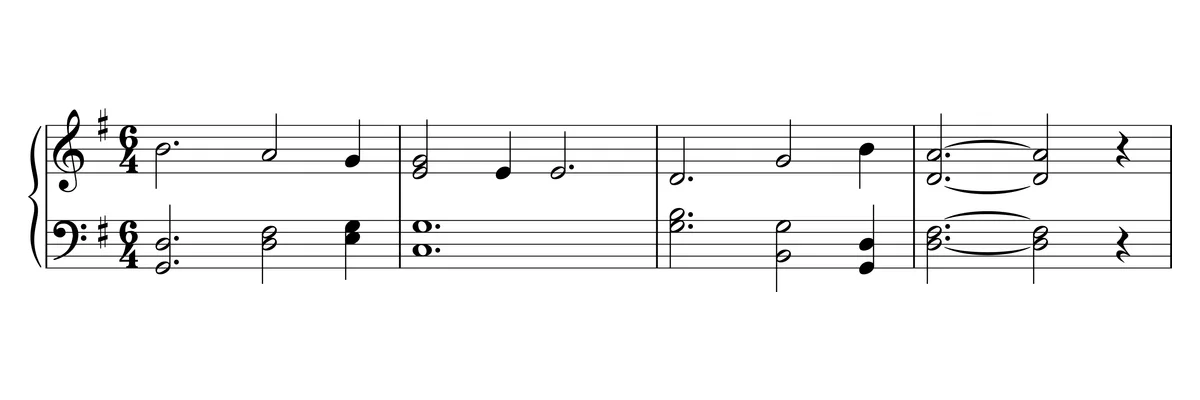
The hymn's last phrase as an introduction, then the hymn in B-flat with a repeat for each verse, fuller chords in the right hand and an octave bass.
- Bars 1 to 3: an introduction made from the end of the hymn (the pickup into bar 12, bar 12 and the final chord), the phrase the Open Hymnal edition marks for the organist's introduction. Bar 3 ends with the pickup into the first verse.
- Bars 4 to 15: the hymn between repeat signs. The first ending (bar 15) holds the last chord and gives the pickup into the next verse; the second ending (bar 16) is the final chord with a fermata.
- Right hand: a third chord note added to the hymnal's soprano and alto wherever the melody is on A or higher, so most chords have three notes. Where the melody is lower (the F, D and G in bars 4, 5, 12 and 13, the F–G pickups into the first and last lines in bars 3, 11 and 15, and the F on beat 6 of bars 8 and 10) it keeps the hymnal's two notes.
- Left hand: the hymnal's bass, with B-flat–F–B-flat under the long B-flat chords and octave F's in bars 2, 6, 8, 10 and 14, held three beats at a time where the hymnal repeats the bass in quarter notes. In bars 8 and 10 the second octave lasts two beats and the bass steps F–A–B-flat into the next bar, so the F7 on beat 6 has A in the bass where the hymnal keeps F.
- Harmony: the hymnal's chords on the same beats throughout; only the inversion on beat 6 of bars 8 and 10 differs, as above.
For teachers: For a church pianist or an intermediate student. Play the introduction at the tempo you want the congregation to sing, and hold the whole note in bar 3 long enough for them to breathe before the pickup. Take the repeat once for each verse and go to the second ending after the last. The left hand's B-flat chord spans a full octave; if that is a stretch, leave out the upper B-flat.
Typed into PlayableNotes“Turn this into a quiet piano solo for the offertory: a flowing left hand, the last line in octaves, and a short ending. Keep the key and the hymn's harmony, and keep each hand within an octave.”


What changed
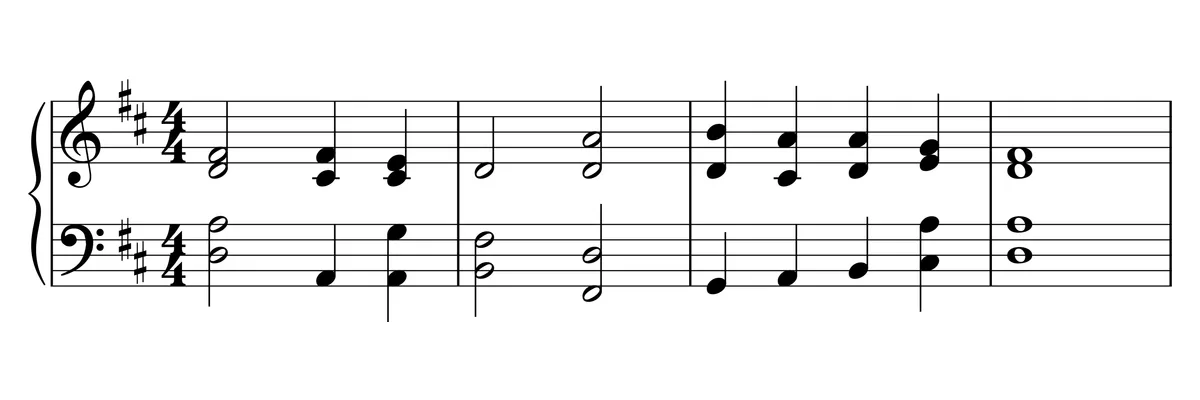
A bar of introduction, the hymn over steady eighth notes in the left hand, the last line in octaves, and a soft ending that repeats the closing phrase.
- Bar 1: added. The left hand's broken B-flat chord plays alone for four beats, then the melody enters on the pickup.
- Left hand: eighth notes throughout, broken chords from the hymnal's harmony, each group within an octave: B-flat–F–B-flat for the B-flat chords, F–B-flat–D at the cadences in bars 4, 12 and 14, F–A–C and F–C for the F7 bars.
- Right hand, bars 1 to 9: the melody with the hymnal's alto under it, including the held E-flat in bars 6 and 8. Only the B-flat under the D in bar 2 is left out.
- Bars 9 to 13: the last line an octave higher, in octaves with a chord note between, marked mf. It reaches the high D, two ledger lines above the staff, in bar 12.
- Bars 13 to 15: an added ending. The closing phrase comes back softly at the original pitch, then an E-flat chord over the B-flat bass resolves to B-flat, like an Amen, with a fermata.
For teachers: For an intermediate player, or a church pianist who wants about a minute of music before or after the hymn. Use the sustain pedal and change it with each chord, every two or three beats. Practice the left hand alone first: it uses only a handful of shapes. In bars 9 to 13 keep the octaves light and let the top note sing.
The piece as published: Open Hymnal Project, 2010 revision: the four-part setting from Congregational Church Music with 150 Psalms and Hymns (1854), hymn 188.
Original hymnal setting
What changed
What changed
Hastings's tune in the four-part setting from Congregational Church Music (1854): soprano and alto on the treble staff, tenor and bass on the bass staff.
- Nothing: this is the source edition, checked note by note against the Open Hymnal's MIDI and PDF.
- It is written for singers, but it lies well under the hands: two notes in the right hand throughout, and open fifths or octaves in the left. The widest stretch is the left hand's octave B-flat.
For teachers: Use it to hear the hymnal's harmony or to play for singing as printed. For a service, the accompaniment version adds an introduction and a repeat for the verses with the same chords.
Want it different? Just ask.
Open this version in PlayableNotes and ask for a change in words: simpler, another key, shorter, bigger notes. The result is a new version you can play, print and share with your student.
Free account. Changes, playback and printing are free; 50 free credits to read your own sheet music.
Watch how to ask for your own version · 1 min video
Make your own version
A real request in PlayableNotes, on Für Elise from the free library: say who it’s for and what to keep, and the AI writes a new version beside the original. It shows how to ask for a version of your own; its result is not one of the versions on this page.
About Rock of Ages
Augustus Montague Toplady's words were printed in 1776. In the United States they are sung to TOPLADY, the tune Thomas Hastings wrote in 1830, and that is the tune on this page. The source is the four-part setting printed in Congregational Church Music in 1854, as edited by the Open Hymnal Project. Its harmony differs a little from Hastings's own arrangement and from some modern hymnals. The melody is the same.
The hymn is 13 bars of 6/4 in B-flat major, counting the two-beat pickup. The first and last lines are the same music, and the middle line is one two-bar phrase sung twice. The melody stays within an octave, from the D above middle C to the D an octave higher. The harmony hardly moves: the outer lines stay on a B-flat chord until their cadence, and the middle line rocks between F7 and B-flat. What takes practice is the counting: six beats to a bar, whole notes and dotted halves to hold, and a dotted quarter and eighth leading into most bars.
The easy version keeps every note of the melody in B-flat, over simple one- and two-note left-hand chords from the hymnal's harmony. The beginner version moves to C major, with no flats, and gives each hand one note at a time until the final chord. For church there are three more: an accompaniment with an introduction and a repeat for the verses, a quiet offertory solo with a flowing left hand, and the 1854 setting as printed.
Practice tips
- Count six quarter beats in every bar and know which pattern is coming (these are the hymnal's bar numbers; in the accompaniment, add two): bars 2 and 10 start with two half notes, bars 3, 5, 7, 9 and 11 start with a whole note, and bars 4, 6, 8 and 12 start with a dotted half and then move in quarters.
- The dotted quarter and eighth at the end of most bars is the hymn's signature rhythm. Hold the dotted quarter its full length and play the eighth late and light, so it leads into the next bar instead of becoming a triplet.
- There are fewer bars to learn than it looks: bars 10 to 12 are bars 2 to 4 again, and bar 8 is bar 6 again. Learn bars 1 to 7 well and the rest follows.
- Bars 2 and 10 leap up a sixth, from D to B-flat (E to C in the beginner version). Keep the thumb on the low note and let the hand open, rather than looking down.
- For singing, hold each whole note its full four beats: bars 3, 5, 7, 9 and 11 each end a line of the text. Lift both hands together for a breath just before the pickup, a full breath in bars 5 and 9 and a shorter one in bars 3, 7 and 11.
Questions about Rock of Ages
Who wrote the music for Rock of Ages?
Thomas Hastings (1784–1872), an American composer and church musician, wrote the tune, called TOPLADY, in 1830. The words are by Augustus Montague Toplady, an English clergyman, and were printed in 1776.
What key is Rock of Ages in?
The hymnal setting on this page is in B-flat major, with two flats, a common key for it in American hymnals. The easy version, the accompaniment and the solo are in B-flat too. The beginner version is in C major, a whole step higher, with no flats.
Is Rock of Ages hard to play on piano?
Not very. The melody stays within one octave and moves mostly by step, with one leap of a sixth in bars 2 and 10, and the harmony rests on two chords most of the way. The things that take practice are counting six beats to a bar and the dotted rhythm before each bar. The easy and beginner versions give the left hand fewer notes than the hymnal's octaves.
Why do some hymnals use a different tune for Rock of Ages?
Toplady's words were written before Hastings's tune and have been sung to several. In the United States they are almost always sung to TOPLADY, the tune on this page. Many British hymnals use Richard Redhead's tune, often called PETRA or REDHEAD 76. Check which one your congregation knows before you play.
Can I use these versions to accompany singing at church?
Yes. The accompaniment version is in the hymnal's key of B-flat, with a short introduction taken from the hymn, a repeat for each verse and a final ending. The easy version is in B-flat as well, with the melody on top. The beginner version is in C, a whole step higher than the hymnal, so it won't match singers reading from a hymnal in B-flat.
Can I download Rock of Ages as a PDF or MIDI file?
Yes, free and without an account. Every version has a Letter-size PDF to print and a MIDI file with the right and left hands on separate tracks.
Source and credits
- Composer
- Thomas Hastings
- License
- Public domain
- Arranger
- PlayableNotes
All 13 bars were checked note by note against the Open Hymnal's own MIDI and PDF of the same file; nothing needed correcting. Where tenor and bass share a note it is written once. The edition notes that this setting differs somewhat from Hastings's own arrangement in Spiritual Songs for Social Worship. No words are included.
Arrangements and facts checked