Free easy piano · Hymns
Blessed Assurance, easy piano
Blessed Assurance for piano in five free versions: an easy one in the hymnal's key of D major, a late-beginner one in C, a flowing left hand, the hymn with an intro for church, and the hymnal original. Play each one here, slow it down or loop a bar, then print the PDF or download the MIDI.
- Phoebe Palmer Knapp
- Easy to intermediate, plus the original
- 17 bars · 9/8
- Free: play, print, MIDI
Versions of Blessed Assurance. Each version is a request typed into PlayableNotes. Pick one to hear and print it.
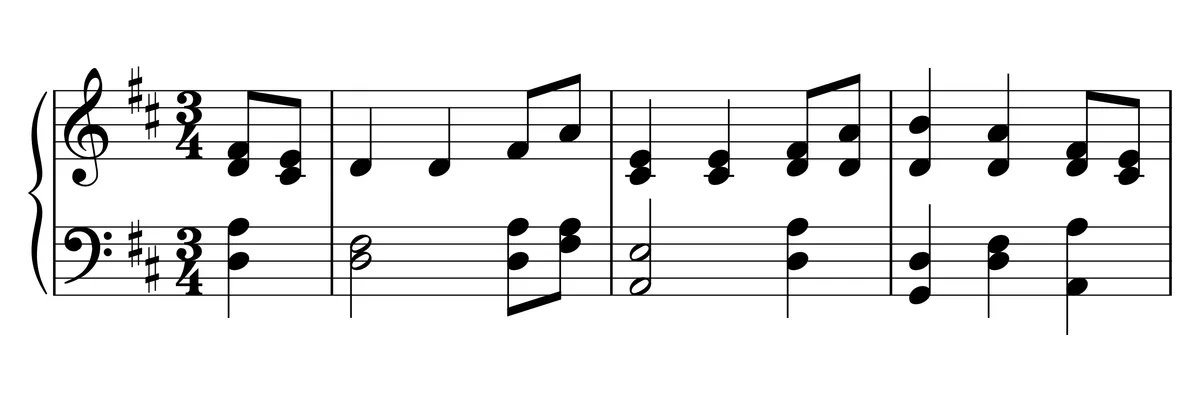
Typed into PlayableNotes“Make this hymn easier for a second-year student. Keep it in D major and keep the melody exactly as written; instead of a chord on every melody note, give the left hand held two-note chords from the hymnal's harmony, nothing wider than an octave.”

What changed
The whole melody, note for note, in the hymnal's key of D, over held two-note left-hand chords that follow the hymn's harmony.
- Right hand: the melody unchanged in all 17 bars, including the dotted eighth and sixteenth in bar 16.
- Right hand: a second note from the hymnal's alto under most long notes and in the refrain's repeated chords (bars 9, 12 and 13, with the G natural in bar 13). The eighth notes of bars 1 to 8 are the melody alone.
- Bars 3 and 7: F-sharp under the long A, where the hymnal's alto has D, so the chord is complete over the left hand's open fifth. Bar 5: C-sharp under the A, taken from the tenor.
- Left hand: not a chord on every melody note but one held two-note chord per beat or per bar, mostly the open fifth D–A, so it plays 68 notes where the hymnal has 145.
- Bars 5, 8 and 16: the hymnal's tenths in the left hand (A–C-sharp, G–B) become a fifth (A–E) and a sixth (G–E). The widest stretch left is the octave E–E in bar 12.
- Bars 8 and 16, last beat: the left hand holds A–E under the melody's D, E, C-sharp, where the hymnal moves through F-sharp and G. Bar 15 keeps the hymnal's bass F-sharp, E, D in eighth notes.
For teachers: For a second-year student who reads two-note chords and knows the F-sharp and C-sharp of D major. Learn the left hand alone first: it changes only on the beats. The right hand is the hymn's melody in the hymnal's key, so it works with singers.
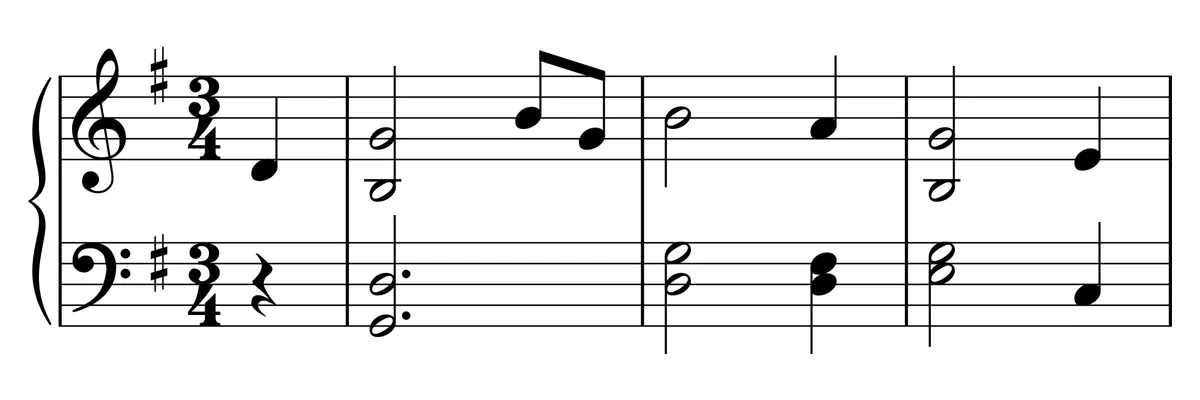
Typed into PlayableNotes“Make a simpler version for a late first-year student: put it in C major so there's no key signature, keep the melody alone in the right hand, and give the left hand one long note, an open fifth or a fourth at a time.”


What changed
The melody in C major over long left-hand notes and open fifths, with one sharp in the whole piece.
- Moved down a whole step, from D major to C major: no key signature. The melody runs from the B below middle C to the D on the fourth line of the treble staff.
- Right hand: the melody alone, one note at a time, with the hymnal's rhythms. The dotted eighth and sixteenth in bar 16 become even eighth notes, as in bar 8.
- One accidental: the F-sharp at the end of bar 4 (the hymnal's G-sharp), which leads the melody back up to G.
- Left hand: open fifths (C–G, G–D), the fourth C–F at the end of bars 2, 6 and 14, and single notes, in dotted half and dotted quarter notes, following the hymnal's bass: C under most of the verse and refrain, D under the last two beats of bar 4 (the hymnal's E), G in bars 5 and 13, F then G before the cadences in bars 8 and 16, F under the repeated A's at the end of bar 10, and F, E, D in bar 12. One added note: the E at the end of bar 11, a passing bass where the hymnal stays on its D (C in this key). It never moves more than a fifth.
- Left out: the hymnal's alto and tenor, its chord on every melody note, and the seventh chord with the natural sign in bar 13. The left hand rests in the opening pickup.
For teachers: For a student late in the first year who reads in C and can count three beats of three. The melody spans a tenth, from the B below middle C to the D on the fourth line, so the right hand changes position several times, each on a long note or a repeated one; pencil in the fingering first. Pickup: E, D, C with 3, 2, 1. Bars 2 and 6: G with 4, F with 3, G with 4 and A with 5, the hand stretched open from the pickup's C. Bar 3: hold the long G with 4, then play the next G with 2, the E with the thumb and the last G with 2, so the hand is already in place for bar 4: C with 5, both B's with 4, A with 3, G with 2, F-sharp with the thumb, and G with 2 on the downbeat of bar 5. During the long G in bars 5 and 7 the hand moves down: E, D, C in bar 5 with 3, 2, 1; C, D, E in bar 7 with 2, 3, 4. That puts the thumb on the B, so bars 8 and 9 need no move: F with 5, D with 3, C with 2, D with 3, B with the thumb, C with 2. During the long C in bar 9 the hand moves up to G position (G with the thumb to D with 5) for the whole refrain, and on the long G in bar 15 it moves back down: C, D, E with 2, 3, 4, then bars 16 and 17 as 8 and 9.
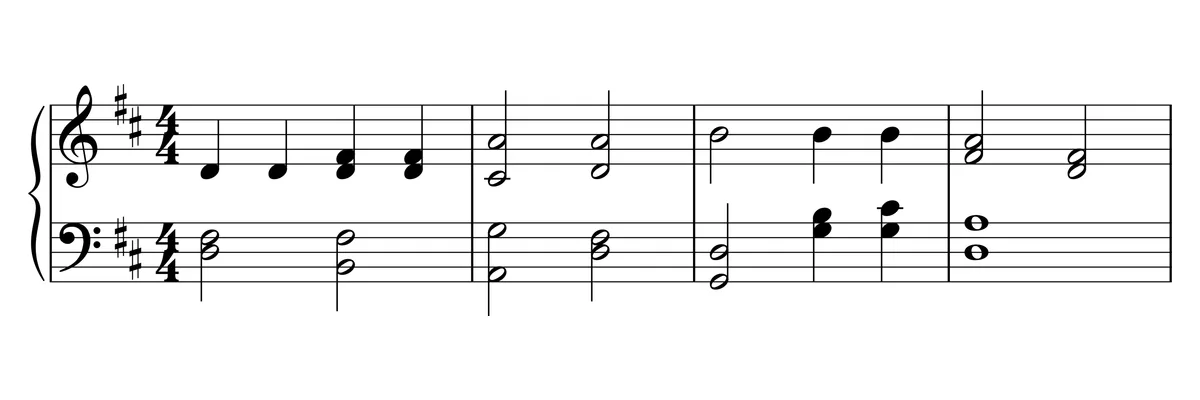
Typed into PlayableNotes“Keep the melody and the key, but give the left hand a flowing broken-chord pattern in eighth notes, the way a church pianist plays this hymn. Follow the hymnal's chords and keep it within an octave.”


What changed
The easy version's right hand over a left hand of broken chords in steady eighth notes, following the hymnal's harmony beat by beat.
- Right hand: as in the easy version (the melody unchanged, a second note under many long notes), except bar 3, which keeps the hymnal's D under the A, and bars 9 and 17, where the melody's D is played alone because the left hand has the chord.
- Left hand: three eighth notes on every beat, mostly root, fifth and octave (D–A–D), one pattern per chord of the hymnal: D–G–B for the passing G chords at the end of bars 2, 6 and 14, G–D–G for the G chords in bars 10 and 12, A–E–A for the A chords in bars 5 and 13.
- Left hand below middle C, D–A–F-sharp or D–F-sharp–A: in the pickups of bars 1 and 5 and the first two beats of bars 3 and 9, so the left hand never plays the D the right hand is holding, and on the beat before the low G in bars 8, 10 and 12, so the hand moves down to it without a jump.
- Bars 4 and 12, last beat: E–C-sharp–E (the hymnal's bass E and tenor C-sharp) under the move from A major to E, ending on the low E so the hand is close to the low A of the next bar. Before it, bar 4 has E–A–C-sharp and bar 12 F-sharp–A–D, on the hymnal's bass. Bar 8: G–E–G, then A–E–G before the cadence. Bar 16 is the same except the last beat, where the left hand holds A–E under the melody's dotted eighth and sixteenth.
- Bar 15: the hymnal's bass F-sharp, E, D under the melody's D, E, F-sharp. Bar 17: a held D major chord.
- No left-hand chord wider than a fifth; the broken chords stretch an octave at most.
For teachers: The next step after the easy version, for a student who can play broken chords in one hand while the other holds. Learn the left hand alone first, bar by bar: most bars play one shape on the first two beats and change on the last. Bar 13 keeps one shape all through, and bars 4, 10 and 12 change shape on every beat. The left hand never jumps more than an octave: before each low G or A the pattern ends low (D–A–F-sharp before G, E–C-sharp–E before A), so the hand shifts a fourth at most.
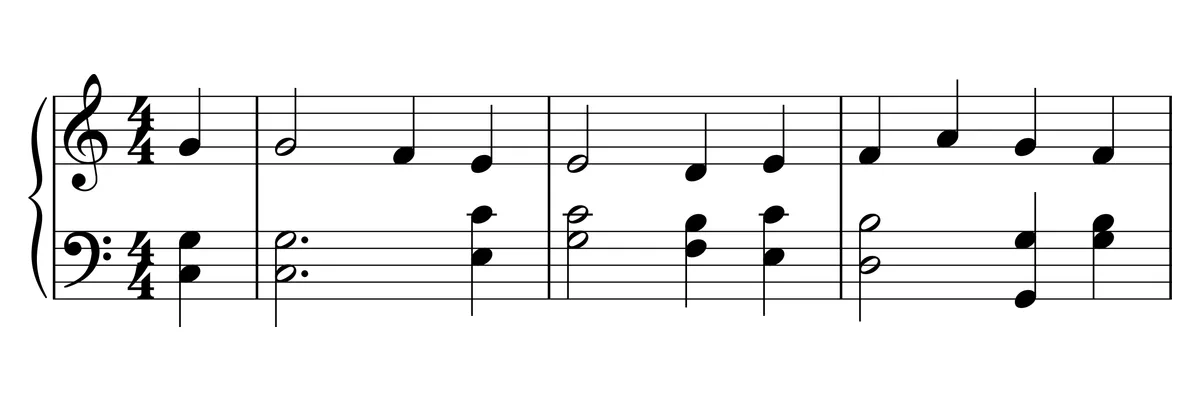
Typed into PlayableNotes“This is the four-part hymn from our hymnal. Make it playable on piano for Sunday: keep all four parts, the key and the harmony, with nothing wider than an octave in either hand, and add the intro the hymnal marks, with repeats for three verses.”


What changed
The hymnal's four-part harmony in D major with every part kept, rearranged so each hand stays within an octave, with the hymnal's intro and three verses written out with repeats.
- Bars 1 to 3: the intro, the hymnal's last phrase from the pickup at the end of bar 15 to the end (the passage it marks for the introduction), followed by the pickup into the verse.
- Bars 4 to 19: the verse and refrain with the hymnal's notes and rhythms in all four parts, played three times. The first and second endings lead back with the pickup; the third ending holds the last chord.
- Bar 7 (bar 5 of the other versions): the tenor's C-sharp moves to the right hand, under the alto's E, and the left hand plays A–E instead of the tenth A–C-sharp.
- Bars 2, 10 and 18 (bars 8 and 16 of the other versions): the tenor's B moves to the right hand, so the right hand plays B–E–G and the left hand the octave G–G instead of a tenth.
- No stretch wider than an octave in either hand. The right hand plays three notes at once only in those four bars.
For teachers: For a church pianist or an intermediate student who wants the hymn as the congregation sings it. The chord on every melody note is the hymnal's; keep the repeated ones light. Hold the dotted half notes at the ends of phrases their full length, then lift briefly before the pickup so the singers can breathe.
The piece as published: Open Hymnal Project, 2008 revision (the four-part setting attributed to Knapp in The Lesser Hymnal, 1875).
Original hymnal setting
What changed

What changed
The four-part setting as printed in the Open Hymnal edition: soprano and alto on the treble staff, tenor and bass on the bass staff.
- Nothing: this is the source edition, checked note by note against its MIDI and PDF.
- It is written for singers. In bars 5, 8 and 16 the tenor and bass on the lower staff are a tenth apart, wider than most hands reach; pianists roll them or take the tenor in the right hand, which is what the church version does.
For teachers: Use it to hear the full harmony or to check a choir's parts. To play it for singing, start with the church version, which has the same notes with the tenths moved and adds the intro.
Want it different? Just ask.
Open this version in PlayableNotes and ask for a change in words: simpler, another key, shorter, bigger notes. The result is a new version you can play, print and share with your student.
Free account. Changes, playback and printing are free; 50 free credits to read your own sheet music.
Watch how to ask for your own version · 1 min video
Make your own version
A real request in PlayableNotes, on Für Elise from the free library: say who it’s for and what to keep, and the AI writes a new version beside the original. It shows how to ask for a version of your own; its result is not one of the versions on this page.
About Blessed Assurance
Fanny Crosby wrote the words of Blessed Assurance in 1873 to a tune by her friend Phoebe Palmer Knapp. The usual story is that Knapp played the melody for Crosby and asked what it said, and Crosby answered with the first line: "Blessed assurance, Jesus is mine." The tune is called ASSURANCE. The setting on this page is the four-part harmony attributed to Knapp in The Lesser Hymnal (1875).
The hymn is 17 bars in 9/8, counting the opening pickup as bar 1, as every bar number on this page does (hymnals count 16 bars and a pickup). Each bar has three beats, each a dotted quarter split into three eighth notes, which gives it its rocking, gospel-song lilt. The verse is two four-bar phrases, mostly over a D in the bass, the first ending on an A major chord in bar 5 after a G-sharp. The refrain, "This is my story, this is my song," starts higher, climbs to the E at the end of bar 13, and ends with the verse's last phrase. The melody is not hard. The hymnal page is harder: every voice moves with the melody, so each hand plays a two-note chord on every melody note, with repeated eighth-note chords through the refrain, and in bars 5, 8 and 16 the left hand has to hold a tenth.
The easy version keeps the melody in D major over held left-hand chords. The late-beginner version moves to C major, with the melody alone in the right hand. The flowing version keeps the easy right hand and gives the left hand broken chords in eighth notes, the way church pianists often play the hymn. For accompanying, the four-part hymn is here twice: with an intro and three verses, rearranged so each hand reaches it, and as the hymnal prints it.
Practice tips
- Count 9/8 in three big beats, each split in three: "one-and-a, two-and-a, three-and-a." In bars 2, 6, 8, 10, 12 and 14 the two dotted quarter notes each take one big beat, and the three eighth notes after them fill the third. Bar 16 is the same until its last beat. Bar numbers count the opening pickup as bar 1; in the church version, add two.
- Bar 4 is the trickiest bar in the melody: after the high D, the C-sharp comes twice, as a quarter note and then an eighth note, before B, A and G-sharp. Play the second C-sharp again; it isn't tied.
- The verse and the refrain end with the same phrase: bars 7 to 9 and 15 to 17. Learn it once. The only difference is in bar 16, where the D is long and the E short (a dotted eighth and a sixteenth) just before the C-sharp.
- The refrain's pickups (end of bars 9 and 11) are three repeated A's. Keep them even and light, leading into the high D of bar 10 and the B of bar 12.
- Loop bars 12 and 13 (14 and 15 in the church version) at about 60 to the quarter note. In the D major versions the G-sharp in bar 12 and the G natural in bar 13 come within a few notes of each other, and the right hand climbs to the top E.
Questions about Blessed Assurance
Who wrote Blessed Assurance?
The words are by Fanny Crosby, the blind American poet who wrote thousands of hymn texts. The music is by her friend Phoebe Palmer Knapp, a musician in New York. Both date from 1873, and the tune and its harmony are in the public domain.
What key is Blessed Assurance in?
Hymnals usually print it in D major, with two sharps, which is the key of the original, easy, flowing and church versions on this page. The late-beginner version is in C major, a whole step lower, so check the key before playing it with singers who use a hymnal.
How do you count Blessed Assurance in 9/8?
Feel three beats in each bar, each one a dotted quarter note split into three eighth notes: "one-and-a, two-and-a, three-and-a." The hymn starts with a pickup of three eighth notes, so the first downbeat is the A in bar 2. Playing along with this page's player at a slow tempo is the quickest way to feel it.
Is Blessed Assurance hard to play on piano?
The melody isn't: it moves mostly in dotted quarters and eighth notes within a tenth, from C-sharp to the E at the top of the refrain. The hymnal page is harder, because every voice moves with the melody, so each hand plays a chord on every melody note, and the left hand has to reach a tenth in three bars. The easy and late-beginner versions give the left hand held notes, and the church version keeps all four parts within an octave per hand.
Can I use these versions to accompany singing at church?
Yes. The church version is the four-part hymn in D major, with an intro and repeats for three verses, so you can play it straight through for a congregation. The easy and flowing versions are also in D with the melody on top. The late-beginner version is in C, a whole step lower.
Can I download Blessed Assurance as a PDF or MIDI file?
Yes, free and without an account. Every version has a Letter-size PDF to print and a MIDI file with the right and left hands on separate tracks.
Source and credits
- Composer
- Phoebe Palmer Knapp
- Source edition
- Open Hymnal Project, 2008 revision (the four-part setting attributed to Knapp in The Lesser Hymnal, 1875)
- License
- Public domain
- Arranger
- PlayableNotes
All 17 bars were checked note by note against the Open Hymnal's own MIDI and PDF of the same file, and the melody against four other independent copies of the tune; no notes needed correcting. The church version's intro is the passage the hymnal marks for the organist's introduction: the last phrase, from the pickup at the end of bar 15 to the end. No words are included.
Arrangements and facts checked