Free easy piano · Hymns
What a Friend We Have in Jesus, easy piano
What a Friend We Have in Jesus for piano in five free versions, all in the hymnal key of F major: easy, beginner, the hymn with an introduction, a piano solo and the hymnal setting. Play each one here, slow it down or loop a bar, then print the PDF or download the MIDI.
- Charles C. Converse
- Easy to intermediate, plus the original
- 16 bars · 4/4
- Free: play, print, MIDI
Versions of What a Friend We Have in Jesus. Each version is a request typed into PlayableNotes. Pick one to hear and print it.
Typed into PlayableNotes“Make this hymn easy for a second-year student. Keep it in F major and keep the melody exactly as written. No eighth notes in the left hand: give it two-note chords from the hymn's harmony, mostly held, nothing wider than a sixth in either hand.”


What changed
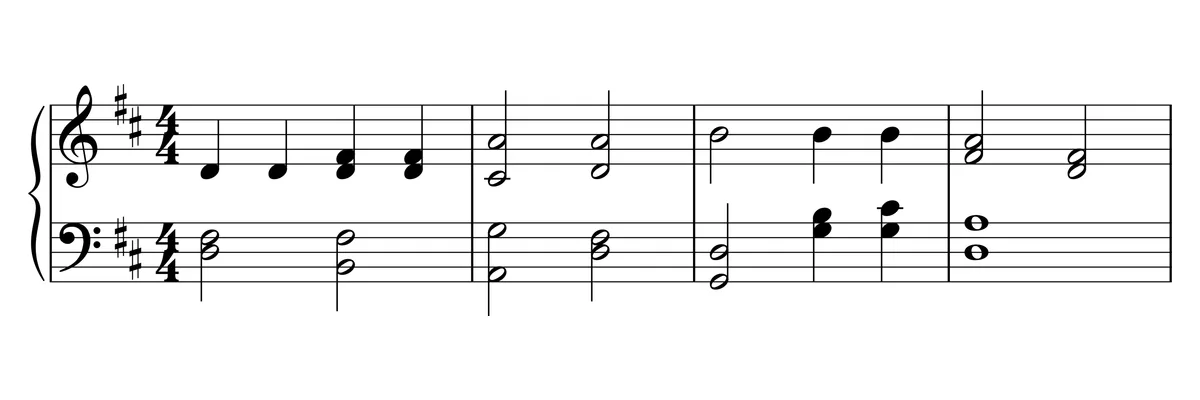
The whole melody, note for note, over mostly held left-hand chords that follow the hymn's harmony, in the hymnal's key.
- Right hand: the melody unchanged in all 16 bars, with its dotted rhythms. A second note from the hymnal's alto on the first beat or the long notes of bars 1, 2, 4, 5, 6, 8, 9, 10, 11, 12, 13, 14 and 16, and an F under the C on beat 3 of bar 11. Everything else is the melody alone.
- Bar 9: the hymnal's right-hand thirds (F-sharp over D-sharp, then A over F) become the melody alone, so the only accidental is the F-sharp.
- Left hand: no eighth notes, 53 notes in all where the hymnal has 118. Mostly two-note chords held for two beats or a whole bar, nothing wider than a sixth; quarter notes in bars 1, 5, 7, 11, 13 and 15, and a single B-flat at the start of bar 11.
- Bars 1, 5 and 13: F and A for two beats, then the hymnal's tenor in quarter notes: F and B-flat under the melody's D on beat 3, back to F and A on beat 4. The B-flat is held through the C that follows the D, where the hymnal already returns to A.
- Bars 2, 6 and 14: B-flat and F held for the whole bar, instead of the low B-flat octave. Bars 4, 9 and 12: C and G instead of the octave C.
- Bars 7 and 15: C and A held for three beats, then C and G on beat 4, in place of the hymnal's moving tenor line over the held C.
- Bar 11: B-flat for two beats, A and C on beat 3, E and C on beat 4: the hymnal's bass line with its eighth notes combined. Because the E and C are held through the last eighth, the melody's A sounds over them for a moment as a passing A-minor chord, where the hymnal goes back to F.
- Bars 2, 6, 10 and 14: the second chord is a half note, as most modern hymnals print it; the 1874 page has a quarter note and a quarter rest.
For teachers: For a second-year student who reads two-note chords in the left hand. The left hand changes at most twice a bar, so learn it alone first, then add the melody a phrase at a time. Bars 1 to 8 teach almost everything: bars 13 to 16 are bars 5 to 8 again.
Typed into PlayableNotes“Make a beginner version for a late first-year student. Keep it in F major so it matches the hymnal, just the melody in the right hand, and give the left hand one long note or an open fifth per bar.”


What changed
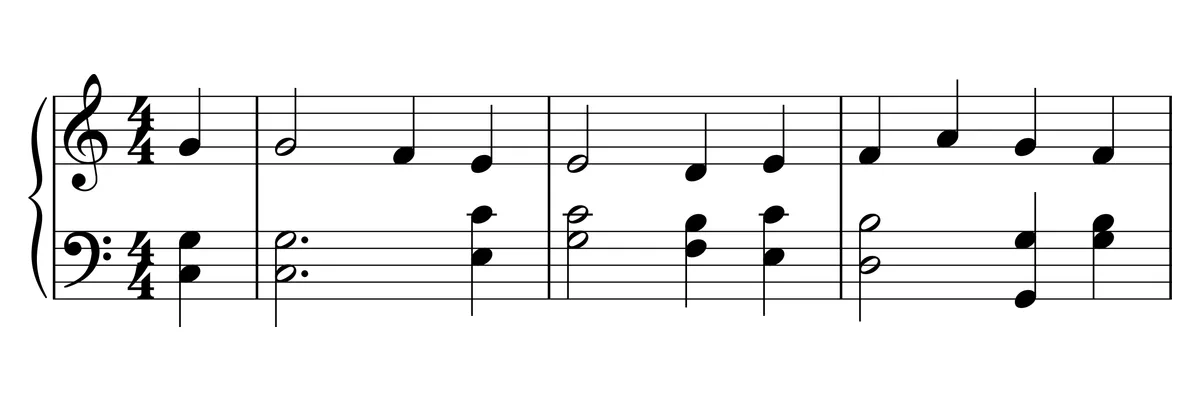
The melody alone in the right hand over one long left-hand note or open fifth per bar, in the hymnal's key.
- Right hand: the melody alone, one note at a time, with the same rhythms. The second note of bars 2, 6, 10 and 14 is a half note, with no rest.
- Left hand: one whole note or dotted half note per bar (two half notes in bar 11). Open fifths F–C in bars 1, 5, 8, 10, 13 and 16, B-flat–F in bars 2, 6 and 14, C–G in bars 4, 9 and 12.
- Bars 3, 7 and 15: a single held F (bar 3) or C (bars 7 and 15), the hymnal's bass note, where the tenor moves in eighth notes.
- Bar 11: B-flat then F, so beats 3 and 4 rest on an F chord where the hymnal's bass moves through A and E.
- Bar 9: the melody's F-sharp is kept, the only accidental; the hymnal's D-sharp under it is left out.
- The B-flat chord under the D in bars 1, 5 and 13 is left out; the left hand holds F–C through it.
For teachers: For a student near the end of the first year who knows the F-major scale with its B-flat. The tune runs from middle C to the D on the fourth line of the treble staff, so the right hand cannot stay in one five-finger position: bars 1 and 2 (and 5 to 6, 13 to 14) come down from the C in the third space to the D just below the staff, bar 3 climbs an octave from middle C, bars 7 and 15 jump from middle C up to F and A, and bars 10 and 11 reach back up to C and D. Mark those moves in pencil. The left hand uses three shapes, F–C, B-flat–F and C–G.
Typed into PlayableNotes“I'm playing this for the congregation on Sunday. Keep the four-part hymnal harmony, add an introduction from the last line, and set it up with repeats so I can play every verse and end cleanly.”


What changed
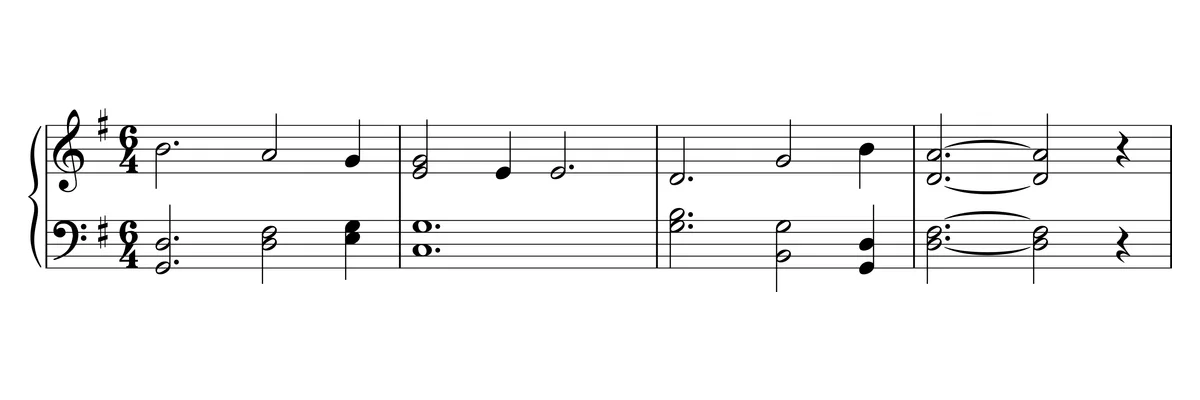
The four-part hymn with the last line as an introduction, repeat signs around the verse, and a held final chord for the last verse.
- Bars 1 to 4: an introduction, the hymn's last line (bars 13 to 16) in full harmony, ending at a double bar.
- Bars 5 to 19: the verse in the hymnal's four parts, soprano and alto in the right hand, tenor and bass in the left. A repeat sign opens bar 5, and the repeat goes back to it from the first ending in bar 20.
- Bar 20, first ending: the last chord with a quarter rest, for a breath before the next verse. Bar 21, second ending: the final chord held for a whole bar under a fermata.
- Bars 6, 10, 14 and 18 (the hymn's bars 2, 6, 10 and 14): the second chord is a half note, as most modern hymnals print it, instead of the 1874 page's quarter note and rest.
- Every other note is as in the hymnal, including the left-hand octaves on low B-flat and C.
For teachers: For a church pianist. Play the introduction at the tempo you want the congregation to sing, lift both hands together at the rest in the first ending, then start the verse. The repeat plays the verse twice; for more verses, go back to bar 5 again and take the second ending on the last one. If the left-hand octaves are a stretch, leave out the upper note.
Typed into PlayableNotes“Turn this hymn into a piano solo for the offertory. Keep the melody and the harmony, put a second voice under the tune in the right hand, give the left hand flowing eighth notes within an octave, and add a short introduction and a held ending.”


What changed
The melody with a second voice under it in the right hand, over a left hand of steady broken chords, with a two-bar introduction and a held final chord.
- Bars 1 and 2: an introduction from the hymn's closing two bars (bars 15 and 16), the same passage the Open Hymnal marks as the organ introduction.
- Left hand: steady eighth notes in every bar except the cadence bars 1, 9 and 17 and the final chord. Broken chords from the hymn's harmony, each group within an octave: mostly F–C–F–C and B-flat–F–B-flat–F, with the third, A, in place of the upper F in bar 12 and at the end of bar 5. The C chords in bars 6, 11 and 14 walk C–G–C–G–C–G–E–C.
- Bars 1, 9 and 17 (the hymn's bars 7 and 15): the hymnal's own left hand. The low C is held for the whole bar while the tenor plays F, then A, C, B-flat, A, G in eighth notes, so the dominant chord at the end of the bar has C in the bass.
- Bars 2, 10 and 18, where those cadences arrive: the left hand starts on the low F.
- Bar 13 (the hymn's bar 11): a broken B-flat chord for two beats, then the hymnal's bass A, F, E, F, with the A an octave lower.
- Right hand: the melody with the hymnal's alto underneath, with three changes. In bars 3, 7 and 15 (the hymn's bars 1, 5 and 13) the second voice is A and B-flat instead of the hymnal's repeated F, so the right hand plays the third of each chord the left hand leaves out. Bar 5 puts an A under the opening middle C, as bars 1, 9 and 17 have. In bars 4, 8 and 16 the D on beat 3 is played alone, without the hymnal's B-flat under it.
- Bar 11 (the hymn's bar 9): the hymnal's chromatic thirds, F-sharp over D-sharp, are kept.
- Bars 2, 10 and 18 end on a three-note chord, A–C–F. In the last bar the right hand holds it under a fermata while the left hand plays low F, C, F, C and settles on a low F–C–F chord.
- Bars 4, 8, 12 and 16 (the hymn's bars 2, 6, 10 and 14): the second chord is a half note.
For teachers: For an intermediate student, or a church pianist who wants something for a prelude or the offertory. Learn the left hand alone first: a few broken-chord shapes cover almost all of it. In bars 1, 9 and 17 hold the low C with finger 5 for the whole bar while the other fingers play the tenor above it, then move the hand down so finger 5 lands on the low F at the start of the next bar. The other big move is from bar 4 into bar 5, where the left hand drops an octave from F to the low F: play the last F with finger 2, then move the whole hand down so finger 5 lands on the low F on the beat, and practice those two notes alone. Use a light pedal, changed with each new chord (once or twice a bar). In bars 1, 9 and 17 the finger holds the C, so change the pedal on each beat, or half-pedal, to keep the B-flat, A, G of the tenor from blurring. Keep the melody louder than the second voice below it.
The piece as published: Book of Hymns and Tunes (Presbyterian, 1874), via the Open Hymnal Project.
Original hymnal setting
What changed
What changed
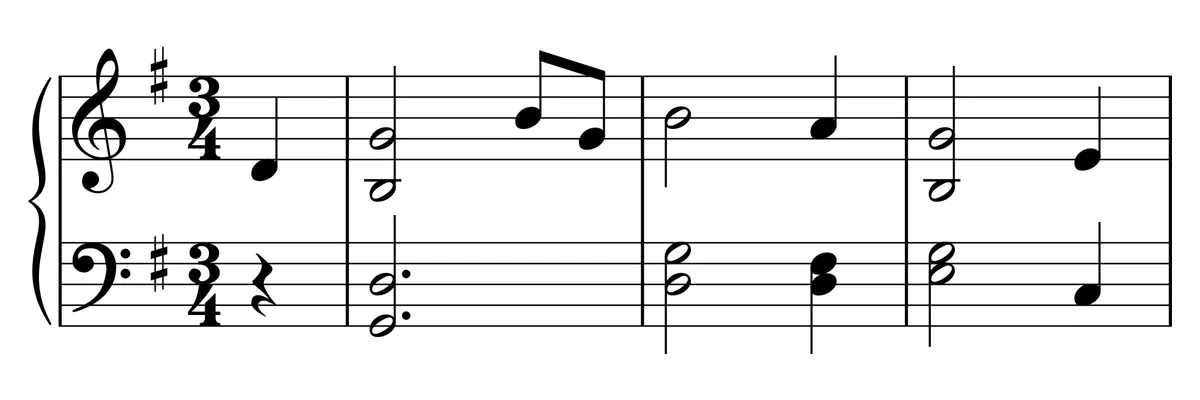
Converse's tune in the four-part setting of the 1874 Book of Hymns and Tunes: soprano and alto on the treble staff, tenor and bass on the bass staff.
- Nothing: the 1874 setting as transcribed by the Open Hymnal Project, checked bar by bar against a scan of the printed page, with the two corrections described under Source.
- The second chord of bars 2, 6, 10 and 14 is a quarter note followed by a quarter rest, as the 1874 page prints it: a breath after the comma in the words. Most modern hymnals hold it as a half note, and the arrangements on this page do too.
- The 1874 page saves space with a repeat, two endings and a D.C.; here the 16 bars are written out in order, as modern hymnals print them.
For teachers: It is playable on piano as printed: two notes in each hand, with octaves in the left hand on low B-flat and C. The hardest bars are 9, with its chromatic thirds in the right hand, and 11, where the bass walks down A, F, E, F in eighth notes under a repeated C.
Want it different? Just ask.
Open this version in PlayableNotes and ask for a change in words: simpler, another key, shorter, bigger notes. The result is a new version you can play, print and share with your student.
Free account. Changes, playback and printing are free; 50 free credits to read your own sheet music.
Watch how to ask for your own version · 1 min video
Make your own version
A real request in PlayableNotes, on Für Elise from the free library: say who it’s for and what to keep, and the AI writes a new version beside the original. It shows how to ask for a version of your own; its result is not one of the versions on this page.
About What a Friend We Have in Jesus
Joseph Scriven, an Irishman who settled in Canada, wrote the words around 1855; he is said to have written them to comfort his mother back in Ireland. The tune, usually dated 1868, is by Charles C. Converse, an American lawyer and composer. Hymnals name the tune CONVERSE or ERIE; the 1874 Presbyterian Book of Hymns and Tunes used here, which Converse edited with E. Thompson Baird, calls it FRIEND.
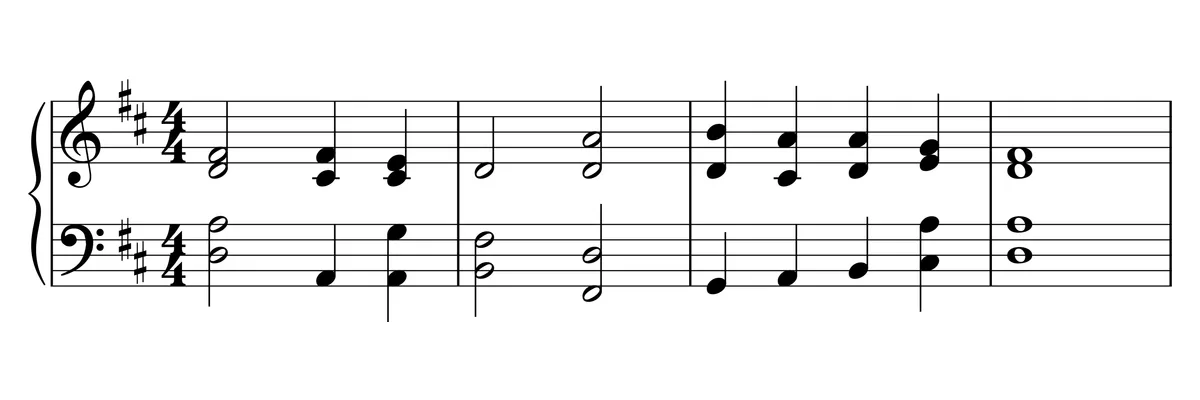
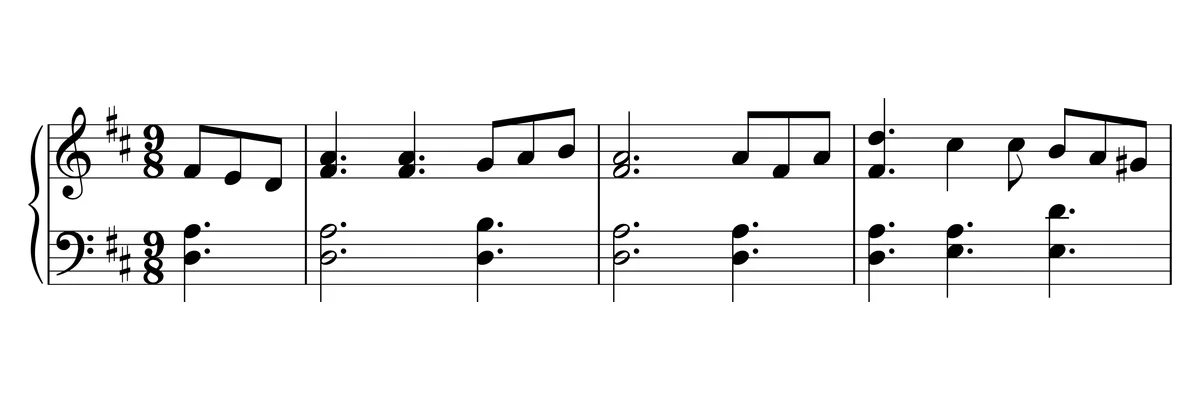
The hymn is 16 bars in 4/4, in four phrases of four bars. Every odd-numbered bar has the same rhythm, a dotted quarter and then five eighth notes, and the phrases share their music: bars 1 and 2 come back as bars 5 and 6, and bars 13 to 16 repeat bars 5 to 8. After bar 8, the one new phrase is bars 9 to 12, which brings the tune's only sharp. The melody stays between middle C and the D on the fourth line of the treble staff. The hymnal page is harder than the tune: both hands play two notes at a time in eighth notes, and the left hand stretches an octave on low B-flat and C.
The easy version keeps every note of the melody over mostly held left-hand chords from the hymn's harmony, with no eighth notes in the left hand. The beginner version, for a student near the end of the first year, is the melody alone over one long note or open fifth per bar; the right hand still moves around, because the tune does. For church pianists there is the hymnal setting with an introduction and repeats for the verses, and a piano solo for a prelude or offertory.
Practice tips
- These tips use the hymn's own bar numbers: in the version with an introduction add 4, and in the solo add 2. Count the dotted rhythm that starts every odd-numbered bar as "one, two-and": hold the first note through beat 2 and play the short note on the "and", just before beat 3. Clap bar 1 before you play it.
- Learn bars 1 to 8 first. Bars 13 to 16 are the same as bars 5 to 8, so after that only bars 9 to 12 are new.
- Loop bar 9 (bar 13 in the version with an introduction, bar 11 in the solo), the only bar with a sharp: G, F-sharp, G, then up A, B-flat and back to G. In the hymnal setting and the solo the right hand plays it in thirds, with a D-sharp under the F-sharp.
- Bars 3, 7 and 15 start on middle C and jump up to F and A in eighth notes; bar 3 goes on to the C an octave above. In the melody of bar 3, play middle C with the thumb, then shift so the thumb takes the F and fingers 3, 1, 5 and 3 play A, F, high C and A; the top C then lands on time. In bars 7 and 15 the hand barely moves. One fingering is C, F, A, G, F, E with 1, 2, 4, 3, 2, 1: the thumb reaches down to middle C, then takes the E at the end.
- For singing, hold the long notes in bars 4, 8, 12 and 16 for three full beats and breathe on the rest, so every line starts together.
Questions about What a Friend We Have in Jesus
Who wrote What a Friend We Have in Jesus?
The words are by Joseph Scriven, an Irishman who settled in Canada, written around 1855. The music is by Charles C. Converse, an American lawyer and composer; the tune is usually dated 1868.
Is What a Friend We Have in Jesus public domain?
Yes. Scriven died in 1886 and Converse in 1918, and the four-part setting on this page comes from a hymnal printed in 1874. Modern arrangements can still be under copyright; the versions on this page were arranged by PlayableNotes from the 1874 setting and are free to play and print.
What key is What a Friend We Have in Jesus in?
Hymnals usually print it in F major, with one flat, and the 1874 setting here is in F. All five versions on this page stay in F, so any of them can go with a congregation singing from a hymnal in that key.
Is What a Friend We Have in Jesus hard to play on piano?
The tune is not: it spans a ninth, from middle C to the D on the fourth line of the treble staff, and repeats most of its music. The hymnal page is a step up, because each hand plays two notes at a time in eighth notes and the left hand reaches octaves. The easy version gives the left hand two-note chords, mostly held, with no eighth notes. The beginner version is the melody over one long note or open fifth per bar; its right hand still changes position most bars, so it suits a student near the end of the first year.
How fast should What a Friend We Have in Jesus be played?
The 1874 hymnal gives no tempo, and the Open Hymnal plays it at 100 quarter notes per minute; the two hymnal settings on this page start at 92. Learn it around 70 and use the tempo control on this page to speed up as it settles.
Can I use these versions to accompany singing at church?
Yes. The version with an introduction is the four-part hymn with the last line as an intro and repeats for the verses. The easy version also keeps the melody on top in F, so a congregation can follow it. Print the PDF, or download the MIDI to rehearse with.
Source and credits
- Composer
- Charles C. Converse
- License
- Public domain
- Arranger
- PlayableNotes
The 1874 book dates the tune 1871 ("C. C. Converse, 1871"). All 16 bars were checked against the Internet Archive scan of the 1874 page (page 369, archive.org/details/bookofhymnstunes00pres) and compared with other editions. Two corrections to the Open Hymnal file: the bass in bar 12 is the C an octave lower, as printed, and the second chord of bars 2, 6, 10 and 14 is a quarter note followed by a quarter rest, as the 1874 page prints it. The 1874 page uses a repeat, two endings and a D.C.; here the 16 bars are written out. No words are included.
Arrangements and facts checked