Free easy piano · Hymns
Amazing Grace, easy piano
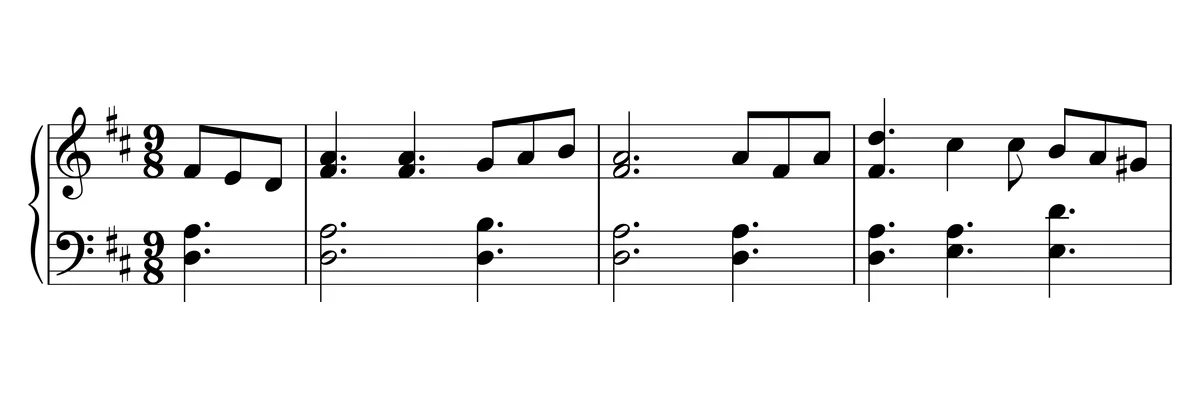
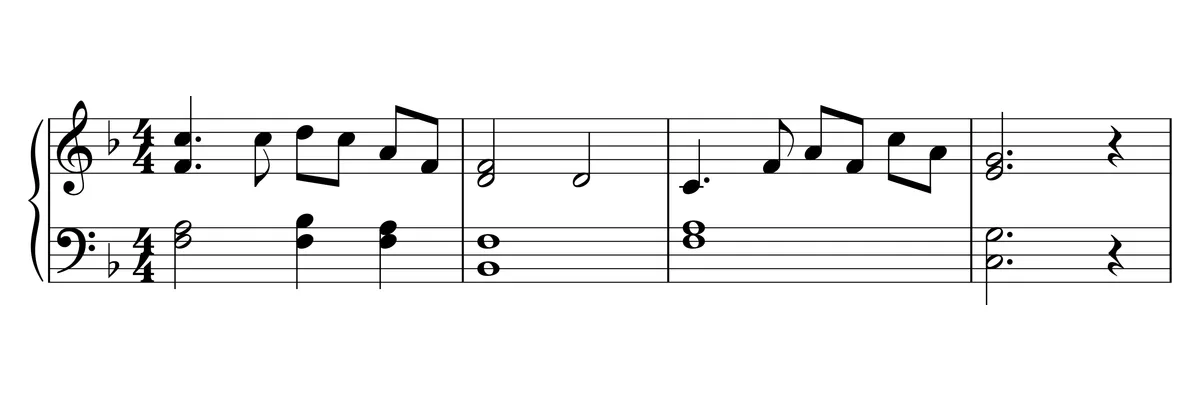
Amazing Grace in four free piano versions: an easy arrangement in G with the whole melody, a beginner version in C, a two-verse solo for a service, and Excell's four-part hymnal setting. Play each one here, slow it down or loop a bar, then print the PDF or download the MIDI.
- Traditional American
- Beginner to intermediate, plus the original
- 17 bars · 3/4
- Free: play, print, MIDI
Versions of Amazing Grace. Each version is a request typed into PlayableNotes. Pick one to hear and print it.
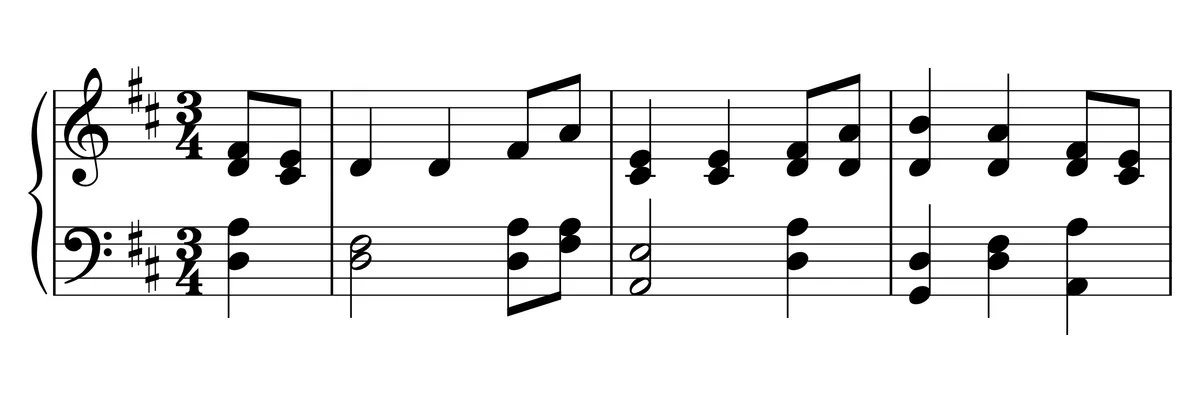
Typed into PlayableNotes“Make this hymn easier for a second-year student. Keep it in G major and keep the melody exactly as written. Give the left hand two-note chords that follow the hymnal's harmony, nothing wider than a sixth, and no moving inner parts.”

What changed
The whole melody, note for note, in G major, the key of Excell's setting, over held two-note left-hand chords taken from his harmony.
- Right hand: the melody unchanged in every bar, including the five-beat holds and the dotted rhythms in bars 10 and 12.
- Right hand: a second note from the hymnal's chords joins the melody in a few places: B under G in bars 2, 4, 6 and 14, B under D in bars 5 and 13, D under the A in bar 7, B under the long D in bars 8 and 9, D under G in bar 11, and G–B–D for the last note.
- Left hand: two notes at a time, nothing wider than a sixth, following the hymnal's bass. Where the hymnal's tenor and bass move in eighth notes (bars 2, 6, 10, 12 and 14), the hand holds one interval instead: G–D in bars 2 and 6; G–B in bar 10, the hymnal's own bass and tenor without the tenor's moving line; C–G, then C alone on beat 3, in bar 12; E–G then D–G in bar 14.
- Bar 4: E–G, then C alone on beat 3, where the hymnal has C–G. Bars 5 and 13, and beat 3 of bar 9: G–D instead of the hymnal's octave G–G. The last two bars: a low G–D instead of the hymnal's G–B near middle C.
- Bars 3 and 15: the dominant chord is D–F-sharp under the melody's A, without the hymnal's C. Bar 7 keeps the hymnal's C in the bass (C–F-sharp under D–A).
- Bar 1: the left hand rests, so the pickup note is played alone.
For teachers: For a student in the second year or so who reads two-note chords in the left hand. Play the left hand alone first, one phrase at a time; its F-sharps are in bars 3, 7 and 15, and its one move up is to G–B in bar 10. The right hand is the hymn tune exactly, in Excell's key, so this version also works for singing along.
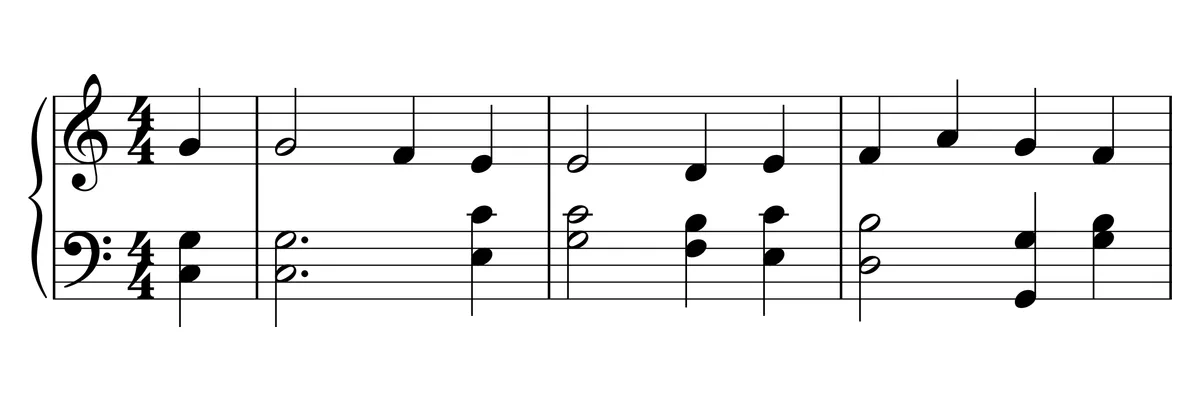
Typed into PlayableNotes“Make a beginner version for a first-year student. Put it in C major so there is no key signature, keep the melody alone in the right hand, and give the left hand one long note or an open fifth at a time, staying near C position.”

What changed
The melody alone in C major over long left-hand notes, with no sharps, flats or ledger lines.
- Moved up a fourth, from G major to C major: no key signature and no accidentals. The melody runs from the G above middle C to the G just above the treble staff, with no ledger lines.
- Right hand: the melody alone, one note at a time, with the same rhythms, including the dotted rhythms in bars 10 and 12.
- Left hand: one note or one open fifth held for most of each bar. The fifth C–G under the C chords; A then F in bar 4; F alone in bar 12; A then G in bar 14.
- Bars 3, 7 and 15: C–G on beat 1 and G on beat 3, where the hymnal has C over G moving to a G seventh chord (over F in bar 7). The harmony is the same; the hand stays in C position.
- Bars 8, 9 and 11: C–G, the C chord in root position, where the hymnal has the same chord with E in the bass. The harmony is the same and the hand stays in C position.
- Bars 12 and 13: the hymnal's passing chord in bar 12 and its change of bass on beat 3 of bar 13 are left out.
- Bar 1: the left hand rests under the pickup note.
For teachers: For a first-year student who reads in C. The tune spans an octave, so the right hand moves twice: up for the high G in bars 8 to 10, and back down for bar 11. Pencil those moves in before the first play-through. The left hand stays in C position on C, F and G, reaching up to A only in bars 4 and 14.
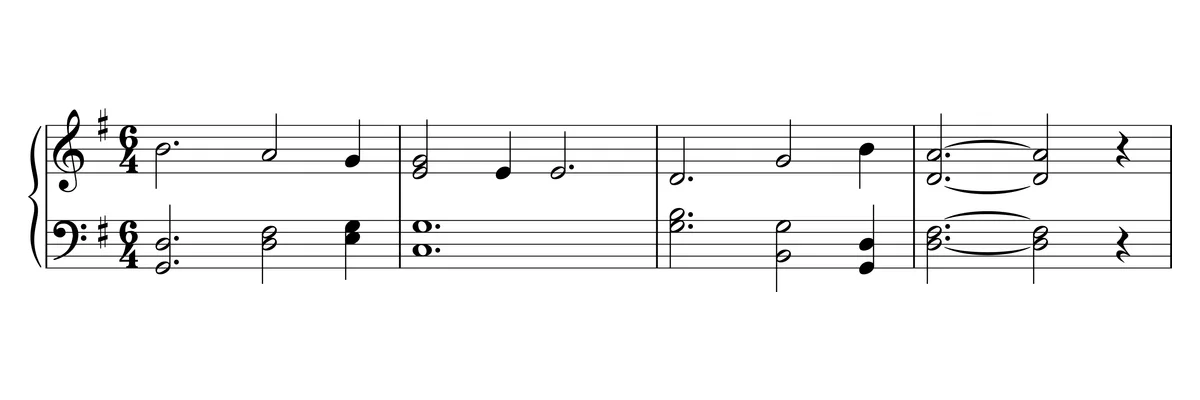
Typed into PlayableNotes“Arrange this as a piano solo for an offertory, about a minute and a half, for an intermediate student. A short intro, the first verse simple with a flowing left hand, the second verse an octave higher in fuller chords, and a quiet ending. Keep the hymn's harmony.”


What changed
A short intro, a first verse with the melody alone over a rolling left hand, a fuller second verse an octave higher, and a quiet Amen ending.
- Bars 1 and 2: a new intro, a G major chord and then a C major chord over the rolling left hand, with a D major chord under the pickup.
- Left hand, all the way through: steady eighth notes rolling up and down each chord from the hymnal's bass note (G–D–G–B–G–D). It changes chord on beat 3 where the hymnal's harmony does: bars 4, 5, 8, 10, 14, 15 and 16, and the same bars in verse 2. The roll spans a tenth over two beats, so play it with the sustain pedal, changing with the chord.
- Verse 1 (bars 3 to 18): the melody alone at the hymnal's pitch, with G under the long D in bars 9 and 10, the hymnal's alto in the cadence of bar 16, and D–G for the last note.
- Verse 2 (bars 19 to 34): the melody an octave higher, on top of three-note chords from the hymnal's harmony. The highest note is the D above the treble staff (two ledger lines) in bars 25 to 27; in bar 27 the hand holds D–G under the melody's dotted rhythm.
- Bars 35 and 36: a quiet ending after the second verse's last note, a C major chord that turns minor with an E-flat, then a held G major chord with a fermata.
- Dynamics: mp from the start, mf from the pickup into verse 2 (bar 18, beat 3), a diminuendo while the last chord of verse 2 is held (bars 33 and 34), and p for the ending.
- The hymnal's passing chord in bar 12 of the hymn (bars 13 and 29 here) is left out; otherwise the chords fall on the same beats as the hymnal.
For teachers: For an intermediate student or a church pianist who wants a solo, not an accompaniment. Learn the left-hand roll alone until it runs by itself, then add verse 1. In verse 2, practice the chord changes in bars 19 to 20 and 25 to 27 slowly, keeping the top note (the melody) louder than the notes under it.
The piece as published: Open Hymnal Project, 2006 revision: Edwin O. Excell's four-part setting of NEW BRITAIN, which the Open Hymnal dates to 1900.
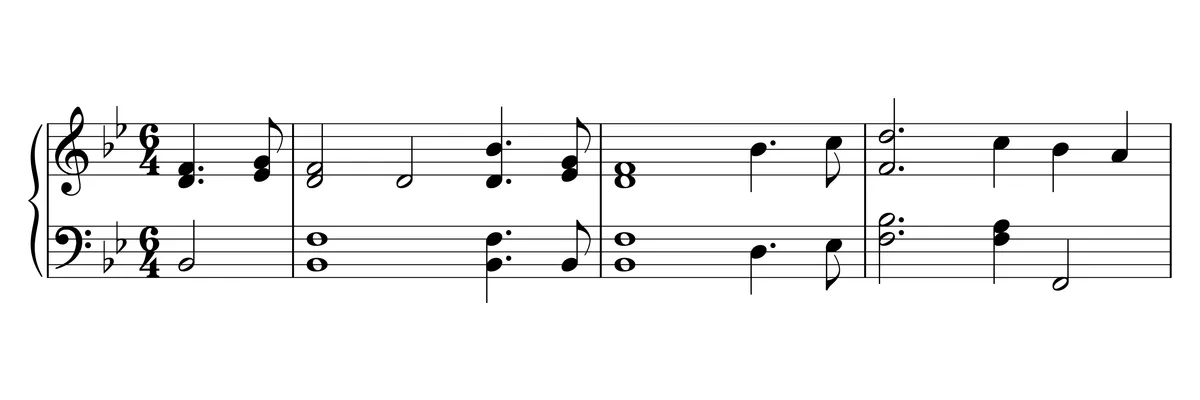
Original hymnal setting
What changed
What changed
Excell's four-part setting as the Open Hymnal prints it: soprano and alto on the treble staff, tenor and bass on the bass staff.
- Nothing: this is the source edition, checked note by note against its MIDI and PDF and against Excell's 1915 printing.
- It is written for four singers. In bars 2, 6, 10, 12 and 14 the alto, tenor or bass moves in its own rhythm, so one hand plays two parts at once, and the left hand moves between low octaves and chords near middle C (bars 10 and 15 to 17).
For teachers: Use it to accompany a choir or a congregation that sings in parts, or to hear the full harmony. To play it with fewer notes but the same chords, start with the easy version.
Want it different? Just ask.
Open this version in PlayableNotes and ask for a change in words: simpler, another key, shorter, bigger notes. The result is a new version you can play, print and share with your student.
Free account. Changes, playback and printing are free; 50 free credits to read your own sheet music.
Watch how to ask for your own version · 1 min video
Make your own version
A real request in PlayableNotes, on Für Elise from the free library: say who it’s for and what to keep, and the AI writes a new version beside the original. It shows how to ask for a version of your own; its result is not one of the versions on this page.
About Amazing Grace
The words of Amazing Grace are by John Newton, a former slave-ship captain who became a Church of England curate at Olney; they were published in Olney Hymns in 1779. The tune they are sung to today is an anonymous American folk melody, first printed in 1829 under other names; it appeared as NEW BRITAIN, set to Newton's words, in William Walker's The Southern Harmony in 1835. Hymnals often credit it to Carrell and Clayton (Virginia Harmony, 1831). The four-part harmony many American hymnals print is Edwin O. Excell's, and every version on this page is built on it.
The hymn is in 3/4: a one-beat pickup, then four phrases of four bars. The melody uses only five notes (D, E, G, A and B in G major) and spans one octave, so it is easy to find on the keys. What needs care is the counting: the notes in bars 8 to 9 and 16 to 17 are held for five beats, and bars 10 and 12 have a dotted rhythm. The hymnal page is harder than the tune, because it is written for four singers: in bars 2, 6, 10, 12 and 14 one hand plays two parts in different rhythms.
Which one to pick: a student who reads both clefs and a few two-note chords should start with the easy version, which keeps every melody note in Excell's key of G, so it also works for singing along. A first-year student who reads in C should start with the beginner version, with the melody alone over one long left-hand note or open fifth at a time. The piano solo is for an intermediate player who wants an offertory or prelude: two verses over a rolling left hand, the second an octave higher. The hymnal setting is for playing with a choir or congregation that sings in parts, and for hearing what each version changed.
Practice tips
- Bar numbers in these tips are the hymn's, as in the easy, beginner and hymnal versions; in the solo's first verse, add 1. Learn bars 1 to 5 first. The melody of bars 6 and 7 repeats bars 2 and 3, and so does the melody of bars 14 and 15, so after the first phrase only bars 8 to 12 and the final held note are new.
- Count the long notes. The high note in bars 8 and 9 and the last note in bars 16 and 17 are held for five beats: count "1 2 3, 1 2". After the high note, the next note comes on beat 3 of bar 9.
- Bars 10 and 12 have a dotted quarter note followed by an eighth. Count "1 and 2 AND" and play the short note on the "and" of beat 2, so it doesn't become two even notes.
- The melody has no F-sharp: it uses only D, E, G, A and B in G major (G, A, C, D and E in the C version). In the G versions the F-sharps are only in the chords under it, on beat 3 of the hymn's bars 3, 7 and 15, and in the solo's intro under the pickup.
- Loop bars 8 to 12, where the tune comes down from its high note to the low D, at a slow tempo on this page's player: hands separately first, then together.
Questions about Amazing Grace
Who wrote Amazing Grace?
John Newton wrote the words; they were published in Olney Hymns in 1779. The tune, NEW BRITAIN, is an anonymous American melody, first set to Newton's words in 1835. The four-part harmony on this page is Edwin O. Excell's.
Is Amazing Grace easy to play on piano?
The melody is: it is in 3/4 and uses only five different notes within one octave. The tricky parts are counting the five-beat holds and the dotted rhythm in bars 10 and 12. The hymnal's four-part page is harder, because each hand plays two parts. The easy and beginner versions here keep the melody and give the left hand notes that are simple to hold. The Open Hymnal edition marks 100 quarter notes per minute; 70 to 80 is comfortable for learning, and the player's tempo control goes slower or faster.
What key is Amazing Grace in?
There is no single key: hymnals print it in different keys, and G major and F major are both common. Excell's setting on this page is in G major, with one sharp, and so are the easy and solo versions; the beginner version is in C major, with no sharps. To play with singers, match the key of the hymnal your congregation sings from; with a free account you can open any version in PlayableNotes and ask for it in another key.
What are the letter notes for Amazing Grace on piano?
In G major, as in the easy version, the four phrases are: D | G B G | B A | G E | D; then D | G B G | B A | high D (held); then B | D B D B | G D | E G G E | D; then D | G B G | B A | G (held). In the beginner version in C major, every letter moves up a fourth: G | C E C | E D | C A | G, and so on. The tune uses only five notes, so in G-flat major it can be played on the black keys alone.
What chords are in Amazing Grace?
In G major, the hymnal harmony uses four chords: G, C, D7 and E minor (in C major: C, F, G7 and A minor). G carries most of the tune; D7 comes on beat 3 of bars 3, 7 and 15; it leads to E minor in bar 4 and to G in bars 8 and 16; E minor starts bars 4 and 14, and C comes on beat 3 of bar 4 and in bar 12. Apart from a quick passing G chord in bar 12, the chords change on beat 1 or beat 3.
Can I download Amazing Grace as a PDF or MIDI file?
Yes, free and without an account. Every version has a Letter-size PDF to print and a MIDI file with the right and left hands on separate tracks.
Source and credits
- Composer
- Traditional American
- Source edition
- Open Hymnal Project, 2006 revision: Edwin O. Excell's four-part setting of NEW BRITAIN, which the Open Hymnal dates to 1900
- License
- Public domain
- Arranger
- PlayableNotes
All 17 bars were checked note by note against the Open Hymnal's own MIDI and PDF of the same file, against an independent engraving of the same setting, and against Excell's 1915 printing in Joy to the World (hymn 209). No notes needed correcting. The 1915 printing writes the first line of the hymn (the first two phrases) once with first and second endings, then the second half straight through; it holds the last notes of the second and fourth phrases ("me", "see") for two beats instead of five, harmonizes bar 4 over a held low G, and voices bar 15 and the last chord differently. No words are included.
Arrangements and facts checked