Free easy piano · Classical
Clair de Lune, easy piano
Debussy's Clair de Lune for easy piano, free: a short version of the famous opening in C major for first-year students, and the original. Play each one here, slow it down or loop a bar, then print the PDF or download the MIDI.
- Claude Debussy
- Late beginner, plus the original
- 19 bars · 9/8
- Free: play, print, MIDI
Versions of Clair de Lune. Each version is a request typed into PlayableNotes. Pick one to hear and print it.
Typed into PlayableNotes“Make a short version of the famous opening of Clair de Lune for my first-year student. C major, the tune as single notes in the right hand, the left hand holding long notes or two-note chords, no sixteenth notes or duplets, and give it a proper ending.”


What changed
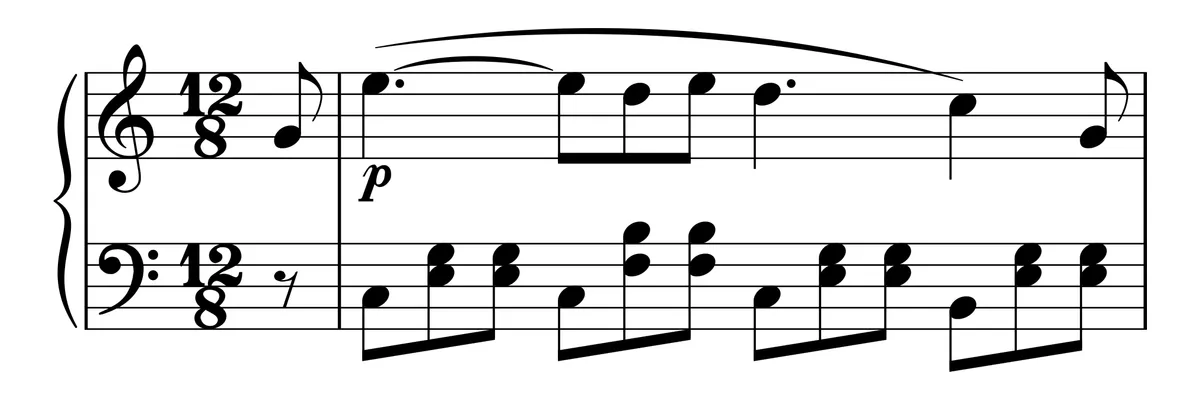
A 19-bar version of the famous opening in C major: the tune, mostly as single notes, over long left-hand notes, with a proper ending.
- 19 bars: Debussy's bars 1 to 14 (the opening theme and its answer), 63 to 65 (the closing phrase before his last bars) and two closing bars based on his last two.
- Right hand: the top note of Debussy's thirds, as a single line, in C major, except for the C–E third at the end of bar 1, so the first bar ends on the home chord. The two-against-three figures in bars 3, 13 and 14 become a quarter note and an eighth note, so every note falls on the eighth-note pulse.
- Left hand, bars 1 to 4: Debussy's held thirds an octave lower, in the bass clef (E–G, F–A-flat held all bar, E–G, D–F), starting on the first beat. Bars 5 to 8: single long notes walking down C, B, A, G-sharp, G, F, E, D at Debussy's pitch, his own bass line, and bar 8 ends on low G, as his bar 8 moves to the dominant before bar 9.
- Bars 9 to 17: the left hand holds open fifths, sixths or single bass notes, most of them for the whole bar. In bar 13 it plays G for one beat, then holds E and B-flat, Debussy's seventh chord (his A-flat bass, F and C-flat). In bars 15 to 17 the right hand adds a second note under some melody notes.
- Bars 18 and 19: the right hand holds E and G while the left hand climbs C, G, C, then both hands play a C major chord. No 8va lines.
For teachers: For a first-year student near the end of the year who can count three groups of three eighths. In bar 5 the left hand moves up to middle C, then walks down through bar 8; bar 9 jumps the right hand back up more than an octave and a half: find the G before you play it. Bars 3, 13 and 14 have an eighth note tied across the beat; clap them while counting before you play. The pedal is optional; if you use it, change it every bar. The player's 60 bpm counts quarter notes, which is 40 dotted-quarter beats a minute.
The piece as published: Mutopia Project no. 1778, engraved by Keith O'Hara from the 1905 E. Fromont edition.
Original
What changed


What changed
Clair de Lune as Debussy published it in 1905: his notes, rhythms and dynamics, from the Mutopia edition checked note by note.
- Debussy's notes, rhythms and dynamics as Fromont printed them in 1905, checked against the Mutopia MIDI and the Fromont scan; bar 22 corrected to C. Slurs, pedal marks, hairpins, arpeggio signs and tempo words are not shown.
- Some left-hand voices and clef changes are laid out differently from Fromont's page, with the same notes and lengths, in bars 5, 6, 9, 16, 18, 26, 33, 34, 36, 47, 48, 55 to 59, 68 and 69; the right hand's two voices are written as one in bars 53, 54, 69 and 70.
- Bars 37 to 39 and 41 are under an 8va line, as in the Mutopia edition, where Fromont prints them at pitch; bars 35 and 36 are spelled with flats, as Mutopia does, where Fromont uses sharps.
- A note shared by a held voice and an arpeggio is printed once, in most bars from 27 to 41, 47 to 58 and 65 to 71, and in bar 44 only the G-flat and B-flat of the last right-hand chord are tied into bar 45.
- In bars 37 to 39 each right-hand voice has its own 8va line; both mean the same octave.
For teachers: What to practice here, before anything else: the hand crossings in bars 9 and 59, the low octaves and full chords of bars 15 to 26, and the arpeggios shared between the hands from bar 27, where the right hand holds the melody while it plays the notes under it. The player's 66 bpm counts quarter notes, which is 44 dotted-quarter beats a minute.
Want it different? Just ask.
Open this version in PlayableNotes and ask for a change in words: simpler, another key, shorter, bigger notes. The result is a new version you can play, print and share with your student.
Free account. Changes, playback and printing are free; 50 free credits to read your own sheet music.
Watch how to ask for your own version · 1 min video
Make your own version
A real request in PlayableNotes, on Für Elise from the free library: say who it’s for and what to keep, and the AI writes a new version beside the original. It shows how to ask for a version of your own; its result is not one of the versions on this page.
About Clair de Lune
Clair de Lune is the third of the four pieces in Debussy's Suite bergamasque. He began the suite around 1890 and published it in 1905. The title means "moonlight" and comes from Paul Verlaine's poem "Clair de lune", whose second line speaks of "masques et bergamasques"; "bergamasques" is usually taken as the source of the suite's name. The piece is 72 bars long, in D-flat major and 9/8, marked Andante très expressif and soft almost throughout: a slow melody in thirds, a passage of repeated chords from bar 15, a middle section from bar 27 where a new tune sits over arpeggios and builds to a short forte climax, and the opening theme again at the end.
The notes are slow, but the original is not easy. It has five flats, and Debussy often puts two even notes against the three eighths of each beat. In bar 9 the left hand crosses over the right to play a third in the treble. Bars 15 to 24 are repeated chords over low octaves, with big jumps in the left hand. From bar 27 the two hands share the arpeggios while the right hand holds the melody above them.
The short version moves the famous opening down a half step to C major, so there are no flats in the key signature. It is 19 bars: Debussy's bars 1 to 14, with the tune mostly as single notes over long left-hand notes and his walking bass in bars 5 to 8, then his closing phrase from bars 63 to 65 and a short ending. The original is here too.
Practice tips
- Count three beats of three eighths in every bar (1-2-3, 4-5-6, 7-8-9). In the original the left hand's third comes on the second eighth and the right hand joins on the third, so count the first eighth's rest; in the short version the left hand starts on the first beat.
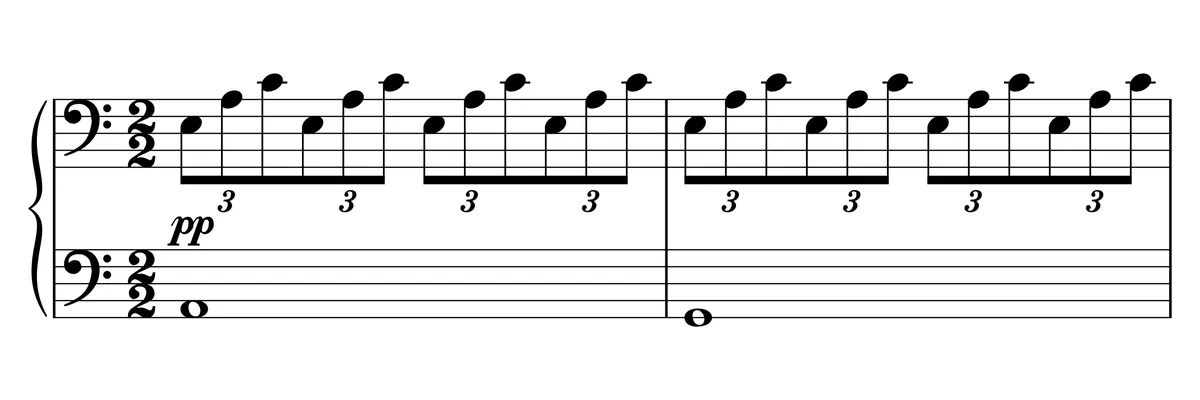
- Debussy often puts two even notes in the time of three eighths, as in bar 3. The short version writes them as a quarter note and an eighth note. In the original, tap the beat and say "one-and" for the two notes before you play them.
- Keep the opening very soft and let the tune come through: in the original, play the top note of each third in bars 1 to 4 a little louder than the lower one; in the short version, keep the left hand's held thirds quieter than the right hand.
- In the short version, loop bars 5 to 8 (click bar 5, then bar 8) and play the left hand alone as it walks down C, B, A, G-sharp, G, F, E, D. In the original, where the hands share the arpeggios from bar 27, practice each hand's share of them alone first.
- Use the sustain pedal and change it when the bass changes: about once a bar in the opening, once a beat in bars 27 to 42 of the original. Practice each hand with the Right and Left buttons first, then hands together.
Questions about Clair de Lune
Is Clair de Lune hard to play?
The original is slow but it is not a beginner piece: five flats, two-against-three rhythms, full chords with big left-hand jumps in bars 15 to 26, and arpeggios shared between the hands while the right hand holds the melody. The short version of the famous opening on this page is for a first-year student.
What grade is Clair de Lune?
It is usually rated around grade 7 to 8, an advanced piece despite the slow tempo. The short version of the opening on this page is for a student near the end of the first year.
Is there an easy version of Clair de Lune?
Yes, on this page, free: a short version of the famous opening in C major, 19 bars, with the tune mostly as single notes over long left-hand notes, Debussy's closing phrase and a short ending. It is not the whole piece; the original is here too.
What key is Clair de Lune in?
D-flat major, with five flats. Bars 37 to 42, in the middle section, are written with four sharps before D-flat returns at bar 43. The short version here is in C major, a half step lower, so it sounds only slightly lower and has no key signature.
How long is Clair de Lune?
72 bars, which usually takes about five minutes. The short version here is 19 bars and takes about a minute and a half at its suggested tempo.
Is Clair de Lune in the public domain?
Yes. Debussy published it in 1905 and died in 1918, so the music is in the public domain in the United States and most other countries. The edition used here was placed in the public domain by its engraver. Both versions on this page are free to play, print as a Letter-size PDF and download as MIDI, with the hands on separate tracks, without an account.
Source and credits
- Composer
- Claude Debussy
- License
- Public domain
- Arranger
- PlayableNotes
Every note was compared with Mutopia's MIDI file, and the whole score with a scan of the 1905 Fromont print. The bass in bar 22 is C, as Fromont prints it (Mutopia's 2010 PDF and MIDI have A-flat; its current LilyPond file has C), and the pp in bars 59 and 66 follows Fromont. Slurs, pedal marks, hairpins, arpeggio signs and tempo words are not shown.
Arrangements and facts checked