Free easy piano · Christmas
Good King Wenceslas, easy piano
Good King Wenceslas for easy piano in four free versions: easy in G and beginner in C, both with the melody note for note, the hymn in G for carol singing, and the 1916 original. Play each one here, slow it down or loop a bar, then print the PDF or download the MIDI.
- Traditional (Piae Cantiones, 1582)
- Beginner to intermediate, plus the original
- 17 bars · 4/4
- Free: play, print, MIDI
Versions of Good King Wenceslas. Each version is a request typed into PlayableNotes. Pick one to hear and print it.
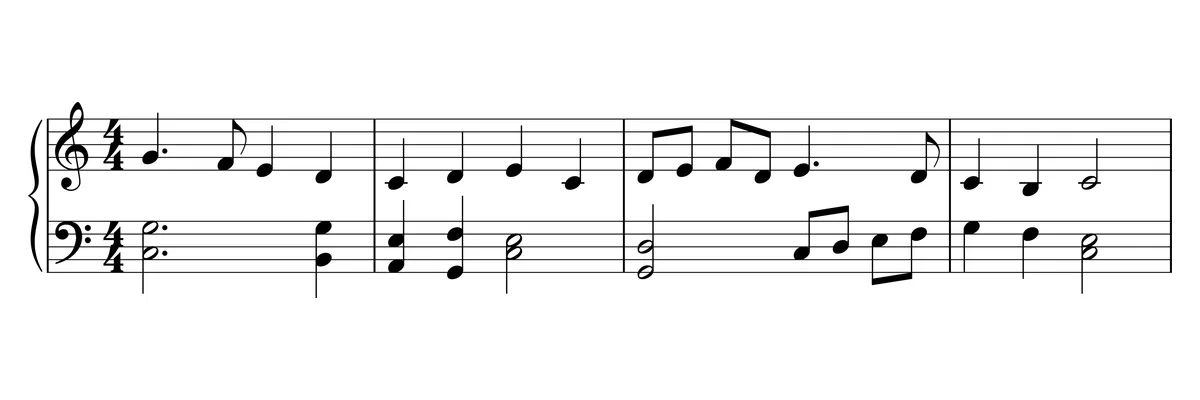
Typed into PlayableNotes“Make this easy for a second-year student: put it in G major, keep every note of the melody, and give the left hand the hymn's bass line with a few two-note chords. Nothing wider than a sixth in either hand.”


What changed
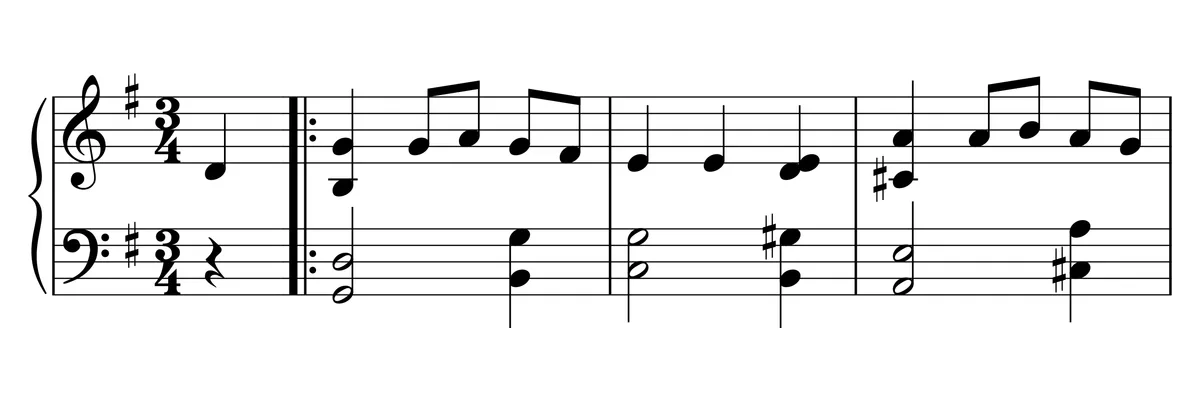
The melody note for note in G major over the hymn's bass line, with a second note under a few long notes.
- Moved down a whole step, from A major to G major, so there is one sharp (F-sharp) instead of three.
- Right hand: the melody note for note, with a second note under some long notes: B, then D, under the two Gs of bars 4, 8 and 12, B under the last G in bar 17, E under G in bar 10, D under A in bar 14, and E under C in bar 16.
- Left hand: the hymn's bass line in quarter notes in bars 3, 7 and 11 (C, B, C, A) and in bars 9 and 15 (B, C, then D held for two beats where the hymn repeats it).
- Bars 1 and 5: an open fifth, G and D, for two beats, then the hymn's bass, E and F-sharp. Bars 2 and 6: G, C, then D with F-sharp, the hymn's bass and tenor.
- Bars 4, 8 and 12: G and D held as a whole note, in place of the hymn's low G with the tenor's B a tenth above it. Bar 17: G and D, with the G an octave below the hymn's bass; the hymn's B is in the right hand, under the melody's G.
- Bar 10: G, D, then E with B. Bar 13: B with G for two beats, then C and A. Bar 14: E with G, then D with F-sharp.
- Bar 16: E with B, then E with G under the melody's C, where the hymn has C in the bass, so the bass and the melody don't fall to the last chord in octaves.
- The rest of the alto and tenor parts are left out. The widest stretch is a sixth in either hand (B to G).
For teachers: For a second-year student who can play a quarter-note bass line under a melody. The right hand has two main positions: thumb on D for bars 1 to 8 and 11 to 14 (reaching down to B for the first chord of bars 4, 8 and 12), and thumb on G for bars 9 and 10 and bar 15, moving down to E for the chord at the end of bar 10. The sixths in bars 16 and 17 (E–C, then B–G) take thumb and little finger. Learn bars 1 to 4 first: they come back as bars 5 to 8, and bars 11 and 12 are the same as bars 3 and 4.
Typed into PlayableNotes“Make a beginner version in C major for a first-year student: no sharps or flats, the melody alone in the right hand in five-finger positions, and single notes in the left hand that stay in one position.”


What changed
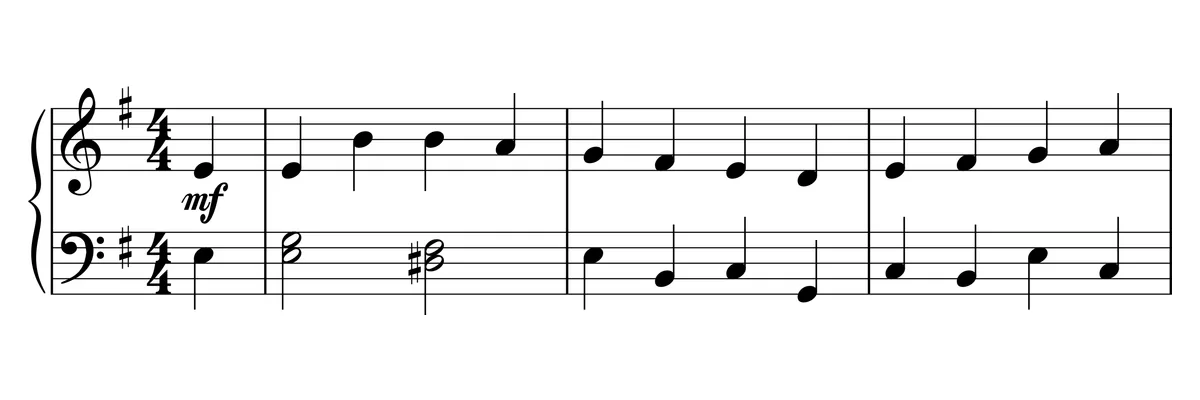
The melody alone in C major, in two five-finger positions, over single left-hand notes in one position.
- Moved up a minor third, from A major to C major, so there are no sharps or flats.
- Right hand: the melody alone, note for note, with the same rhythms. It uses two five-finger positions: thumb on the G above middle C for bars 1 to 8 and 11 to 14, and thumb on the C above that for the high lines in bars 9 and 10 and 15 to 17.
- Left hand: one note at a time, on the five notes from the F just below the bass staff up to the C in its second space (F, G, A, B, C), so the hand never moves. It plays mostly the roots of the hymn's chords (C, F, G and A minor) rather than its bass line: in bars 3, 7 and 11 F, C, F, G where the hymn's bass has F, E, F, D.
- Bars 4, 8, 12 and 17: one whole note C. Bars 9, 13 and 15 start on C where the hymn has E in the bass.
- Bar 14: A, then B where the hymn has G, so the bass climbs to the C of bar 15. Bar 16: A held for the whole bar under the melody's C and F, where the hymn's bass moves from A to F.
For teachers: For a first-year student who reads in five-finger positions and is ready to move the right hand once in a phrase. Mark the two moves before the first play-through: up to C position (thumb on C) at bar 9 and bar 15, back to G position (thumb on G) at bar 11. The left hand sits with the little finger on F and the thumb on C for the whole piece.
Typed into PlayableNotes“Put this hymn a step lower, in G, so a group can sing it, and lay out all four parts so two hands can reach them: nothing wider than an octave in either hand, and change as little as possible.”


What changed
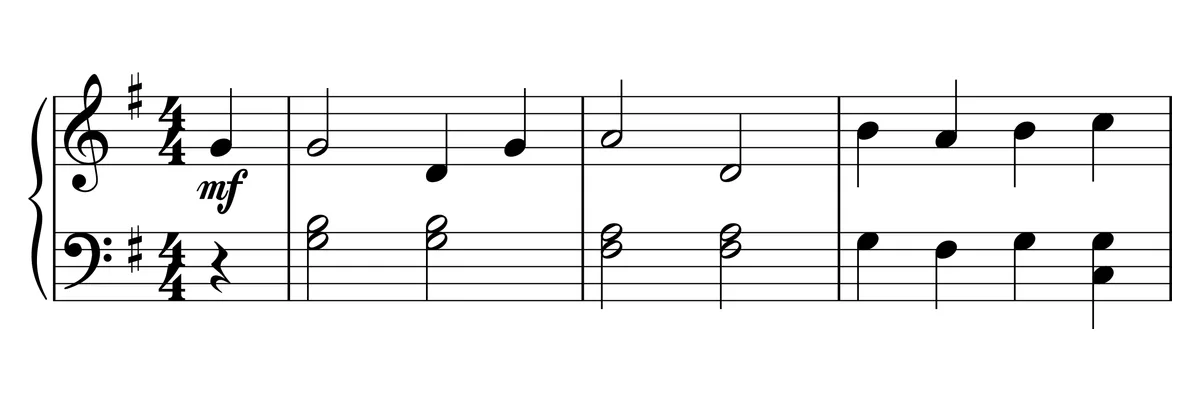
All four parts of the 1916 setting a step lower, in G major, with the tenor notes a left hand can't reach moved to the right hand.
- Moved down a whole step, from A major to G major. The top note is D instead of E, easier for a group of untrained voices.
- Written as piano chords: soprano and alto in the right hand, tenor and bass in the left, instead of two voices on each staff.
- Bars 4, 8 and 12: the tenor's B, a tenth above the bass's low G, moves to the right hand, which plays B, D and G over the low G.
- Bars 9 and 15: the tenor notes a tenth above the bass (D and E on beats 1 and 2 of bar 9, E on beat 2 of bar 15) move to the right hand, which plays the chords D–G–D and E–G–C in bar 9 and E–G–C in bar 15.
- Bar 11, beat 1: the alto's G, which sits below the tenor in the hymnal, is played in the left hand and the tenor's C in the right hand; the notes are the same.
- Otherwise every note and chord of the 1916 setting, on the same beats. The widest stretch is an octave in either hand.
For teachers: For a pianist leading a group of singers who reads chords in both hands. Play bars 13 to 17 as an introduction so the singers hear the key and the speed. Practice bars 9 and 15 first: the right hand opens to an octave and three-note chords while the left hand climbs B, C, D.
The piece as published: Carols Old and Carols New, compiled by Charles L. Hutchins (Boston: The Parish Choir, 1916), carol 415, transcribed by the Open Hymnal Project.
Original
What changed

What changed
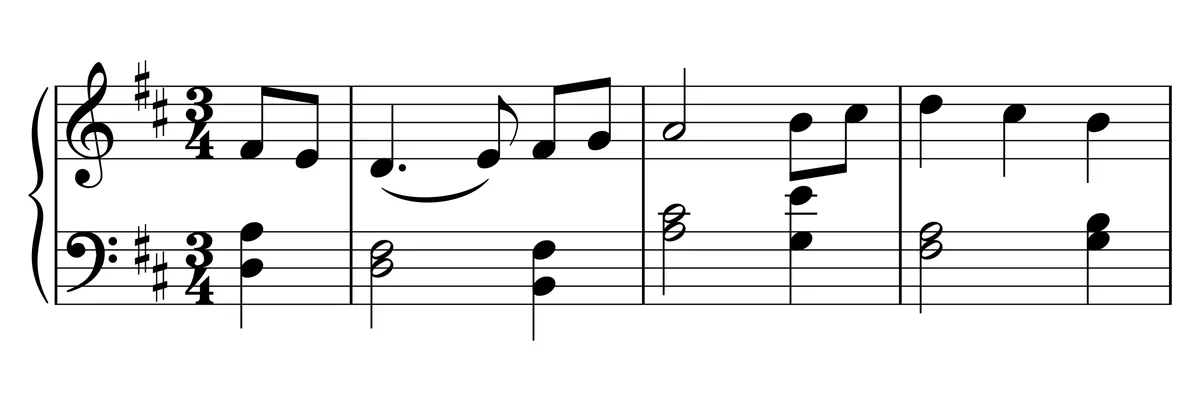
The four-part setting from Carols Old and Carols New (1916), in A major, as printed.
- Nothing: this is the 1916 setting as printed, four voices on two staves, checked bar by bar against a scan of the book.
For teachers: The lower staff is written for tenor and bass singers, not for one hand: in bars 4, 8, 9, 12 and 15 the tenor sits a tenth above the bass. Take those tenor notes in the right hand, leave them out, or use the "Put the hymn in G for carol singing" version, which does this a step lower.
Compare the 4 versions
Level, key, bars, hands
| Version | Level | Key | Bars | Right hand | Left hand |
|---|---|---|---|---|---|
| Easy version in G major | Easy | G major | 17 | Two-note chords to a sixth, spans a tenth | Two-note chords to a sixth, spans a tenth |
| Beginner version in C major | Beginner | C major | 17 | Single notes, spans an octave | Single notes, one five-finger position |
| Hymn for carol singing in G | Intermediate | G major | 17 | Chords to an octave, spans an octave and a fourth | Two-note chords to an octave, spans an octave and a fifth |
| Original | Original | A major | 17 | Two-note chords to an octave, spans an octave and a fifth | Two-note chords to a tenth, spans an octave and a sixth |
Want it different? Just ask.
Open this version in PlayableNotes and ask for a change in words: simpler, another key, shorter, bigger notes. The result is a new version you can play, print and share with your student.
Free account. Changes, playback and printing are free; 50 free credits to read your own sheet music.
Watch how to ask for your own version · 1 min video
Make your own version
A real request in PlayableNotes, on Für Elise from the free library: say who it’s for and what to keep, and the AI writes a new version beside the original. It shows how to ask for a version of your own; its result is not one of the versions on this page.
Transcript
Make piano music easier to play. Start from your own photo or PDF. Reading costs 1 credit per line of music. Or pick a piece from the free library. Open Für Elise and click Edit a copy. Your copy. Each change is a new version. Say what your student needs, in plain words. “Make this easier for a second-year student: keep the melody, one held left-hand note per bar, no leaps bigger than an octave.” The AI writes a new version. Sped up: the real wait was 1 min 43 s. “I simplified the left hand to one held note per bar and reduced right-hand chords to the melody.” Same melody here. One held left-hand note per bar. Saved as Version 2, with your request. The original is still here. Hear it first. Back to Version 2, and press Play. Notes light up as they sound. Try it free: 50 credits. playablenotes.com Library pieces, AI edits and playback are free.
Good King Wenceslas piano notes in letters
Right hand of the Beginner version in C majorBeginnerShow this version
Letter notes phrase by phrase. This is the melody only: the left hand and any chords are in the sheet music. The score above shows another version, the easy version in G major. Use the letters to learn the tune, then read it from the score.
The tune starts on the C above middle C. The small number after a line’s first letter is its octave: middle C is C4, and the C above it starts octave 5. Each next letter is the nearest key with that name, unless an arrow says to jump up or down a fifth or more. Sharps and flats are written on every note that has one.
- C5CCDCCG
- A4GABCC
- C5CCDCCG
- A4GABCC
- G5FEDEDC
- A4GABCC
- G4GABCCD
- G5FEDCFC
About Good King Wenceslas
The tune is much older than the words. It is Tempus adest floridum ("the time of flowering is here"), a Latin spring song printed in 1582 in Piae Cantiones, a book of songs for the schools of Sweden and Finland. John Mason Neale wrote new English words to it about St. Wenceslas, a tenth-century Duke of Bohemia, who goes out in the snow on the Feast of Stephen, December 26, to bring food and firewood to a poor man. Neale and Thomas Helmore published it in Carols for Christmas-tide in 1853.
The tune is 17 bars in 4/4, quarter and half notes ending on a whole note, with no pickup, and it covers exactly one octave. Bars 1 to 4 are played twice, the third line (bars 9 to 12) starts at the top of the octave and comes down to end like bars 3 and 4, and the last line climbs back to that high note. The four-part setting from 1916 is in A major, three sharps, and its lower staff was written for tenor and bass singers: in bars 4, 8, 9, 12 and 15 the tenor sits a tenth above the bass, too far for most left hands.
The easy version moves the carol down a step to G major and puts the hymn's bass line, with a few two-note chords, under the melody. The beginner version is in C major, with no sharps or flats; the right hand uses two five-finger positions and the left hand never moves. For carol singing, the hymn version keeps all four parts of the 1916 setting, a step lower in G, with the few notes a left hand can't reach moved to the right hand. The 1916 setting is here as printed.
Practice tips
- The carol starts on the first beat, with no pickup: count "1, 2, 3, 4" and come in on the next 1. Every melody note is a quarter or a half note except the whole note at the end.
- Learn bars 1 to 4 first. Bars 5 to 8 repeat them, and bars 11 and 12 are the same as bars 3 and 4, so that is 10 of the 17 bars.
- Bars 9 and 15 are the same four notes stepping down from the top of the tune (D, C, B, A in G major). Practice the move up to them: at the end of bars 8 and 14 lift the right hand while the last note sounds, so the little finger lands on the top note.
- Bar 16 skips up a fourth (G to C in G major) and the last note falls back. Hold the C for its full two beats before the final chord.
- Practice each hand with the Right and Left buttons at about 70, then hands together. In the easy version, the left hand of bars 3, 7 and 11 is the same walk, C, B, C, A: learn it once.
Questions about Good King Wenceslas
What are the notes for Good King Wenceslas on piano?
In C major (the beginner version here, with no sharps or flats), the right hand plays: C C C D C C G, A G A B C C, twice; then G F E D E D C, A G A B C C; then G G A B C C D, G F E D C F C. The tune starts on the C above middle C; the two lines that begin "G F E D" start on the G above it, and the line that begins "G G A B" on the G below it.
Is Good King Wenceslas easy to play on piano?
Yes, the tune is. It uses quarter and half notes with a whole note at the end, moves mostly by step or repeated notes, covers one octave from bottom to top, and plays bars 1 to 4 twice. The four-part hymnal setting is harder, with three sharps and tenor notes a tenth above the bass. The beginner version here is in C with no sharps, the right hand in two five-finger positions and the left hand in one; the easy version adds the hymn's bass line in G major.
Who wrote Good King Wenceslas?
John Mason Neale wrote the words, published with Thomas Helmore in Carols for Christmas-tide (1853). The tune is much older: Tempus adest floridum, a Latin spring song printed in Piae Cantiones in 1582. Its composer is unknown. The four-part harmony on this page is from Carols Old and Carols New (Boston, 1916), where it is marked "Traditional".
Who was Good King Wenceslas, and what is the Feast of Stephen?
Wenceslas (Václav) was a real person, Duke of Bohemia in the early tenth century. He was killed in 935 (some accounts say 929), was soon venerated as a saint, and is the patron saint of the Czech Republic; in life he was a duke, and the title of king came after his death. The Feast of Stephen is St. Stephen's Day, December 26, the day after Christmas, which is why the carol is sung at Christmas although it never mentions the Nativity.
What key is Good King Wenceslas in?
The 1916 setting on this page is in A major, with three sharps. The easy version and the hymn for carol singing are a step lower, in G major, with one sharp, and the beginner version is in C major, with none. To get another key, open any version in PlayableNotes with a free account and ask for it.
Can I download Good King Wenceslas as a PDF or MIDI file?
Yes, free and without an account. Every version has a Letter-size PDF to print and a MIDI file with the right and left hands on separate tracks.
Source and credits
- Composer
- Traditional (Piae Cantiones, 1582)
- License
- Public domain
- Arranger
- PlayableNotes
The Open Hymnal transcription was compared note for note with a scan of the 1916 printing (Internet Archive, carolsoldcarolsn00hutc, page 345) and with Open Hymnal's MIDI file; no notes needed correcting. In bar 11 the alto's A sits below the tenor's D, as printed. The words, the lyric slurs and Open Hymnal's tempo mark are left out.
Arrangements and facts checked