Free easy piano · Hymns
Doxology (Old 100th), easy piano
The Doxology, "Praise God, from whom all blessings flow," sung to Old 100th: a free easy piano arrangement in G major, plus beginner, even-note and hymnal versions. Play each one here, slow it down or loop a bar, then print the PDF or download the MIDI.
- Louis Bourgeois
- Beginner to intermediate, plus the original
- 13 bars · 4/4
- Free: play, print, MIDI
Versions of Doxology (Old 100th). Each version is a request typed into PlayableNotes. Pick one to hear and print it.
Typed into PlayableNotes“Make this hymn easier for a second-year student. Keep it in G major and keep the melody exactly as written, put it in 4/4 so it is easier to count, give the left hand two-note chords from the hymn's own harmony, nothing wider than an octave, and add a note from the alto or tenor under the melody where it fits.”

What changed
The whole tune in its long-and-short rhythm, written in 4/4, with an alto or tenor note under the melody in most bars and two-note left-hand chords from the hymnal's harmony.
- Barring: 4/4 with a two-beat pickup, so the hymnal's 8 bars of six and seven beats become 13 bars (the first and last are half bars).
- Melody: every note and every long and short note kept. The last note of each line is a half note with a fermata (bars 4, 7, 10 and 13), where the hymnal holds it for three beats.
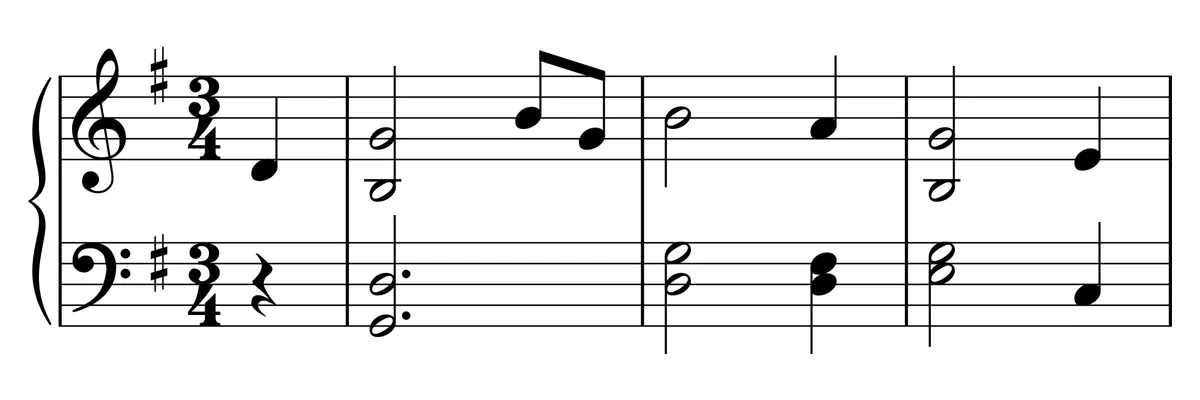
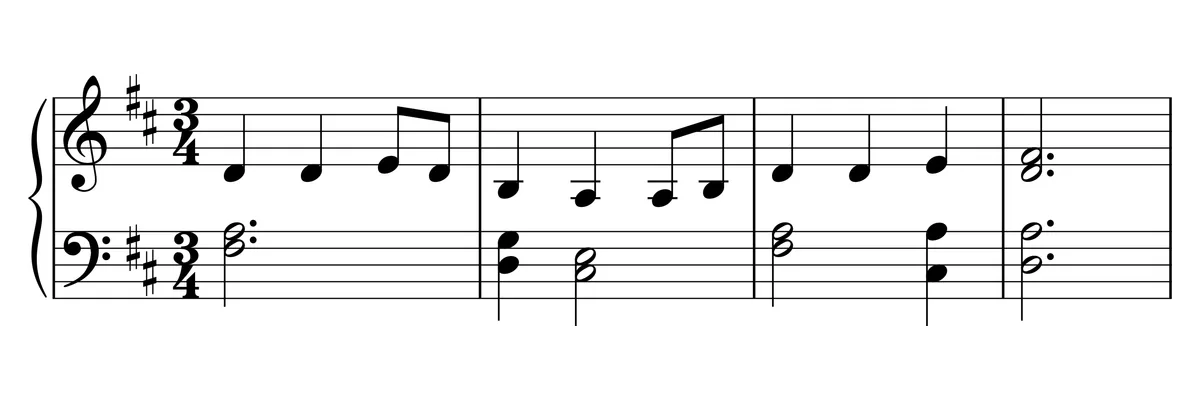
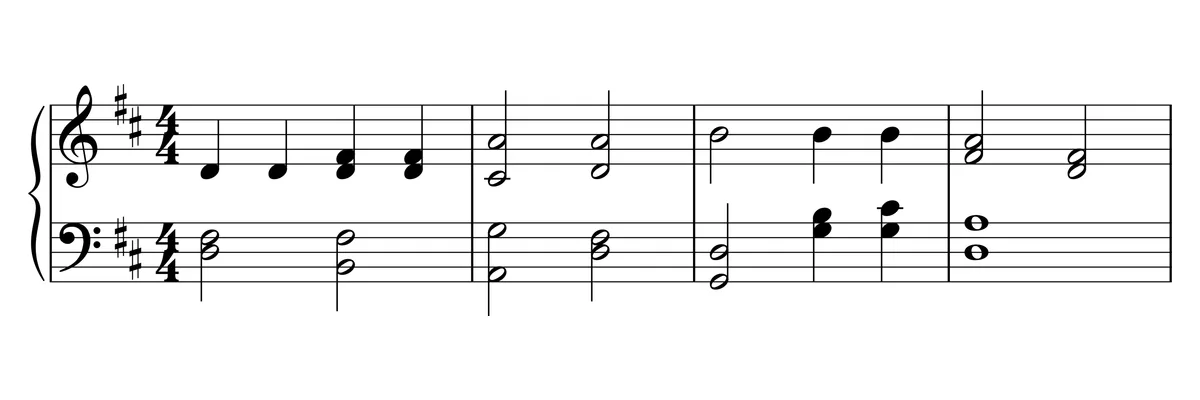
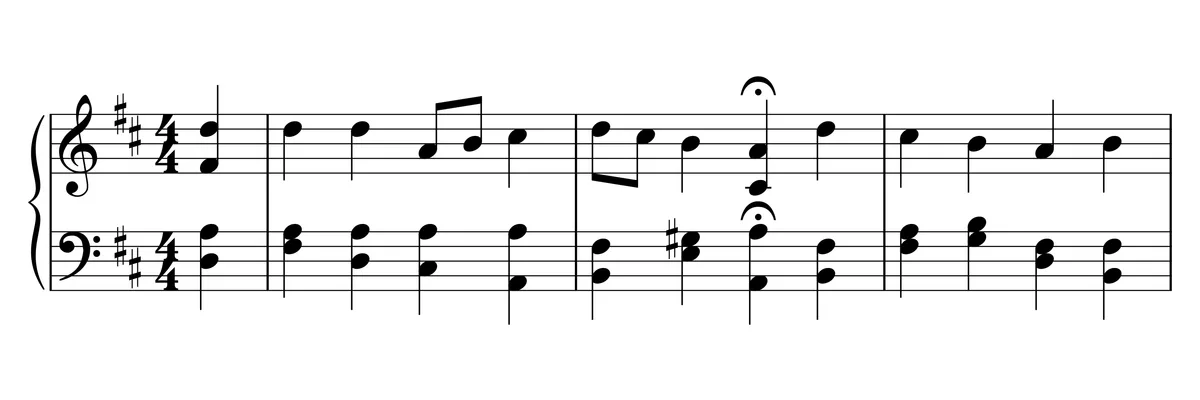
- Right hand: a second note from the hymn's alto or tenor under most long notes and some short ones: D under the first G; B and D under G and A in bar 3; D under the Bs in bar 4; F-sharp under the As in bars 5, 7, 8 and 12; E and D under C and B in bar 6 (the tenor's notes); D under the F-sharp in bar 9; E under the C in bar 11; G under the B in bar 12; and the tenor's B under the held Gs in bars 10 and 13, so the last chord is a G chord with its third. The G after the fermata in bar 7 is a single note, as in the hymnal, where the alto sings it with the tune.
- Left hand: the hymnal's bass line in every bar, with the tenor or another note of the chord above it on the half notes. In bar 12 that upper note is the tenor's C, the seventh of the D chord, which leads to the B in the last chord. Mostly single notes where the bass moves in quarter notes (bars 2, 5, 8, 11 and 12). The widest stretch is an octave (G to G in bars 4, 6, 10 and 13, D to D in bar 7, C to C in bar 9).
- Left out: the tenor's C in bar 5 (the seventh of the D chord), its passing B in bar 9, and the alto's passing F-sharp eighth note in bar 11; the alto's E under the C is held as a quarter note instead.
- Every chord is the hymnal's chord under the same melody note, with the same bass note.
For teachers: For a second-year student who reads two-note chords in the left hand. The piece starts with a two-beat pickup: count "one, two" and play the first G on "three". Learn the left hand alone a line at a time; its only moving bars are 2, 5, 8, 11 and 12, which follow the hymn's bass note for note.
Typed into PlayableNotes“Make a beginner version for a first-year student: keep it in G and in 4/4, the melody alone in the right hand, and single left-hand notes, mostly half and whole notes, with an open fifth at the end.”

What changed
The melody alone over single, mostly long left-hand notes, ending on an open fifth, in 4/4 and in G major.
- Barring and rhythm as in the easy version: 4/4 with a two-beat pickup, the melody's long and short notes kept, and a half note with a fermata at the end of each line.
- Right hand: the melody alone, one note at a time, from the D just below the staff to the D on its fourth line.
- Left hand: one note at a time from the hymnal's bass line, in half notes and whole notes (bars 2 and 8), with quarter notes only at the ends of bars 5 (D, E) and 11 (D, A). The last bar is an open fifth, G and D; the D is added, not from the bass line.
- Bars 2 and 8: one whole note (G, then D) where the hymnal's bass moves in quarter notes.
- Bar 11: G held for two beats where the hymnal's bass moves G, E; then the hymnal's D and A.
- Bar 12: B held for two beats where the hymnal's bass moves B, C; then the hymnal's D.
- The left hand stays between the G on the bottom line of the bass staff and the G in its top space; the held Gs that end lines 1 and 3 (bars 4 and 10) are the upper one, so the hand doesn't jump.
For teachers: For a first-year student who knows G position and the F-sharp. Lines 2 and 4 (from bar 4 and from bar 10) lie in G position, thumb on the G above middle C. Lines 1 and 3 dip lower: in line 1 start with the thumb on D (fourth finger on the first G), then move the thumb to G for the G, A, B at the end of the line; in line 3 the thumb moves down to E for the last three notes. Mark those two moves in pencil.
Typed into PlayableNotes“Our congregation sings the Doxology in even notes. Rewrite the easy version in 4/4 with every melody note a quarter note and a fermata at the end of each line. Keep the key and the harmony.”

What changed
The easy arrangement in the even-note rhythm: every note of the tune a quarter note, with a held note at the end of each line.
- Rhythm: the tune's long notes become quarter notes like the rest, so each line is eight even beats. This is a change from the 1561 rhythm, made because many churches sing it this way.
- Barring: 4/4 with a one-beat pickup, 9 bars. The end of each line has a fermata (bars 3, 5 and 7); the last G is a half note with a fermata.
- Notes: the same melody, the same right-hand second notes and the same chord under each melody note as the easy version, except that the bass's passing C under the B in the last bar is left out.
- Left hand: it now moves on most beats, following the hymnal's bass line, and holds G and B for two beats under the repeated B's in bar 4.
- Widest stretch an octave (G to G in bars 3, 5, 7 and 9, D to D in bar 5, C to C in bar 7).
For teachers: Choose it if your hymnal prints the tune in even notes; check the rhythm in the book your church sings from. It is a little busier than the easy version, because the left hand changes on almost every beat, so take it slower at first and use each fermata to move the left hand to its next chord. Practice bars 2, 6 and 8, where the bass walks in quarter notes, hands separately first.
Typed into PlayableNotes“This is the four-part hymn from our hymnal. Make it playable on piano for Sunday: keep all four parts, the rhythm and the harmony, but nothing wider than an octave in either hand.”

What changed
The Open Hymnal's four-part setting with every part and the hymnal's rhythm, rearranged so each hand stays within an octave.
- Soprano, alto, tenor and bass: the same notes and rhythm as the hymnal, in its own bars of six and seven beats.
- Bar 4: the tenor's E and D move to the right hand (three-note chords E-G-C and D-G-B), because they are a tenth and a twelfth above the bass C and G.
- Bars 6 and 8: the tenor's last B moves to the right hand, into the chord B-D-G, a tenth above the low G. In bar 8 the tenor's first D (beats 1 and 2) moves to the right hand too, over the bass B and C.
- Bar 5, last beat: the tenor's D is left out because the alto sings the same D. Bar 7, last beat: the tenor's E is left out because the alto plays that E just before it moves to F-sharp; leaving it out also avoids the rub of E against F-sharp.
- No stretch wider than an octave in either hand. The right hand plays three notes at once only in bars 4, 6 and 8.
For teachers: For a church pianist or an intermediate student who plays from the hymnal. The 6/4 and 7/4 only make each bar add up: think of each line as one long note, four short ones and three long ones, with the last held a beat longer for a breath. In bar 7 hold the C on the last beat while the alto plays its two eighth notes underneath, and keep them light.
The piece as published: Open Hymnal Project, 2006 revision, which gives its music source as Sternhold and Hopkins' psalter (1561).
Original hymnal setting
What changed
What changed
The four-part setting as the Open Hymnal prints it: soprano and alto on the treble staff, tenor and bass on the bass staff.
- Nothing: this is the source edition, checked note by note against the Open Hymnal's MIDI file and PDF.
- The hymnal prints no time signature. The bars here are the hymnal's own, marked 6/4 and 7/4 so each one adds up.
- It is written for singers: in bars 4 to 8 the tenor is a tenth or more above the bass in places, wider than most hands reach. The piano arrangement in the previous tab moves those notes to the right hand.
For teachers: Use it to hear the full harmony or to check a choir's parts. To play it yourself, start with the piano arrangement in the previous tab: the same harmony and rhythm, with the tenor shared between the hands.
Want it different? Just ask.
Open this version in PlayableNotes and ask for a change in words: simpler, another key, shorter, bigger notes. The result is a new version you can play, print and share with your student.
Free account. Changes, playback and printing are free; 50 free credits to read your own sheet music.
Watch how to ask for your own version · 1 min video
Make your own version
A real request in PlayableNotes, on Für Elise from the free library: say who it’s for and what to keep, and the AI writes a new version beside the original. It shows how to ask for a version of your own; its result is not one of the versions on this page.
About Doxology (Old 100th)
The Doxology is the last verse of Thomas Ken's morning, evening and midnight hymns, and it is sung to the tune Old 100th. The tune first appeared in the Genevan Psalter of 1551, set to Psalm 134, and is usually credited to Louis Bourgeois. Its English name comes from Psalm 100: the English psalter printed in Geneva in 1561 set it to William Kethe's "All people that on earth do dwell." When Tate and Brady's New Version of the Psalms appeared in 1696, the older psalter became the Old Version, and its Psalm 100 tune the Old Hundredth.
The tune is four lines of eight notes, all within one octave, D to D, in G major, with no accidentals. In this setting every line has the same rhythm: one long note, four short ones, then long notes to the end of the line. The hymnal page is a four-part setting for singers. It prints no time signature, so its bars alternate six and seven beats, and in five of its eight bars the tenor sits a tenth or more above the bass, out of reach for most left hands.
The easy and beginner versions keep the melody's long-and-short rhythm but write it in 4/4, so it counts like a method-book piece; the easy one adds two-note chords from the hymn's own harmony. The even-note version is for churches that sing every note the same length. For Sunday there is the four-part setting rearranged so each hand stays within an octave, and the setting exactly as the hymnal prints it.
Practice tips
- Clap the rhythm of one line before you play: one long note, four short ones, then long notes to the end. All four lines have the same rhythm, so once the first line is right, the rest follow.
- In the easy and beginner versions the first G comes on beat 3: count "one, two" in your head and play it on "three". In the even-note version it comes on beat 4: count "one, two, three".
- The highest note is the D that starts the last line (bar 10 in the easy and beginner versions, bar 7 in the even-note and hymnal versions), a fifth above the held G that ends line 3. Use the held G to move the hand up: the melody of the whole last line lies in G position, thumb on G and fifth finger on D.
- In the two hymnal versions, the C at the end of bar 7 is held while the alto plays E and F-sharp as two eighth notes underneath. Hold the C with the fifth finger, play the eighth notes lightly with the thumb and second finger, and don't let them rush.
- Practice each hand with the Right and Left buttons at about 60, then play hands together. For singing, keep the beat steady through the long notes and lift both hands together for a breath at each fermata.
Questions about Doxology (Old 100th)
Who wrote the Doxology?
The words, "Praise God, from whom all blessings flow," are by Thomas Ken, an English clergyman who later became bishop of Bath and Wells. They are the last verse of his morning, evening and midnight hymns, among them "Awake, my soul, and with the sun" and "Glory to thee, my God, this night," written for the scholars of Winchester College, probably by the 1670s. The morning and evening hymns were first printed in 1692, without his permission, and then in his own editions of 1694 and 1695. The tune, Old 100th, first appeared in the Genevan Psalter of 1551 and is usually credited to the French musician Louis Bourgeois.
What are the words to the Doxology?
In the form most hymnals print: "Praise God, from whom all blessings flow; praise him, all creatures here below; praise him above, ye heavenly host; praise Father, Son, and Holy Ghost." Early printings of Ken's hymns have "angelic host" in the third line, and some churches sing newer wordings. Many congregations end with "Amen." The Open Hymnal setting on this page has no Amen, so none of the versions includes one; to add one, open a version in PlayableNotes with a free account and ask for an Amen at the end.
Why do churches sing the Doxology in different rhythms?
In the 1561 English form of the tune used on this page, each line starts with a long note, then four short ones, then long notes; the 1551 Genevan original started its last line with three long notes instead. Later hymnals often print it in even notes, with a held note at the end of each line. This page has both: the easy, beginner and hymnal versions keep the long-and-short rhythm, and the even-note version is in 4/4 quarter notes.
Is the Doxology easy to play on piano?
The tune is: 32 notes within one octave, from D to D, in G major with one sharp. The hymnal page is harder than it looks, because it is written for four singers and the left hand would have to stretch a tenth or more in five of its eight bars. The beginner version on this page keeps the melody alone over single bass notes (an open fifth at the end), and the easy version adds two-note chords.
What key is the Doxology in?
Usually G major, with one sharp, and every version on this page is in G. If your hymnal uses another key, open the version in PlayableNotes with a free account and ask for that key.
Can I download the Doxology as a PDF or MIDI file?
Yes, free and without an account. Every version has a Letter-size PDF to print and a MIDI file with the right and left hands on separate tracks.
Source and credits
- Composer
- Louis Bourgeois
- Source edition
- Open Hymnal Project, 2006 revision, which gives its music source as Sternhold and Hopkins' psalter (1561)
- License
- Public domain
- Arranger
- PlayableNotes
All 8 bars were checked note by note against the Open Hymnal's own MIDI file and PDF of the same setting; nothing needed correcting. The hymnal prints no time signature: its bars alternate six and seven quarter-note beats, written here as 6/4 and 7/4, and the last note of each line is held for three beats. No words are included.
Arrangements and facts checked