Free easy piano · Hymns
A Mighty Fortress Is Our God, easy piano
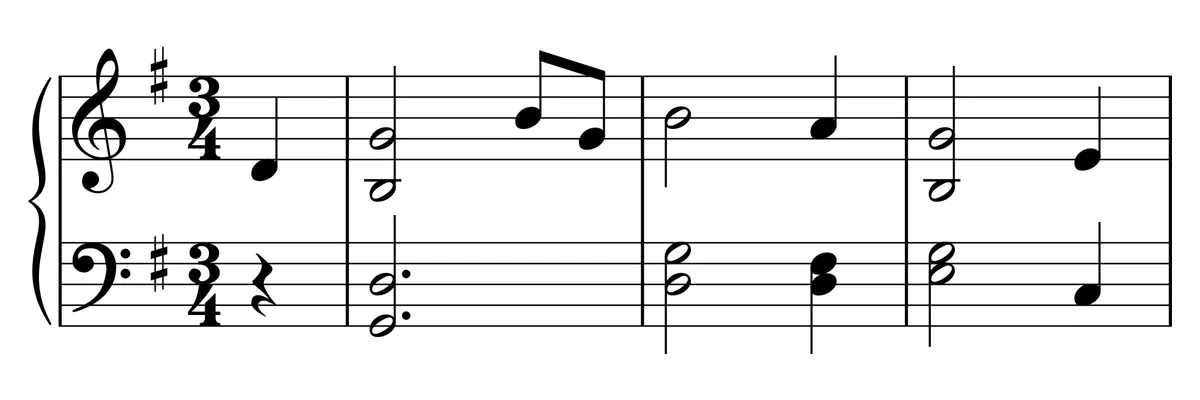
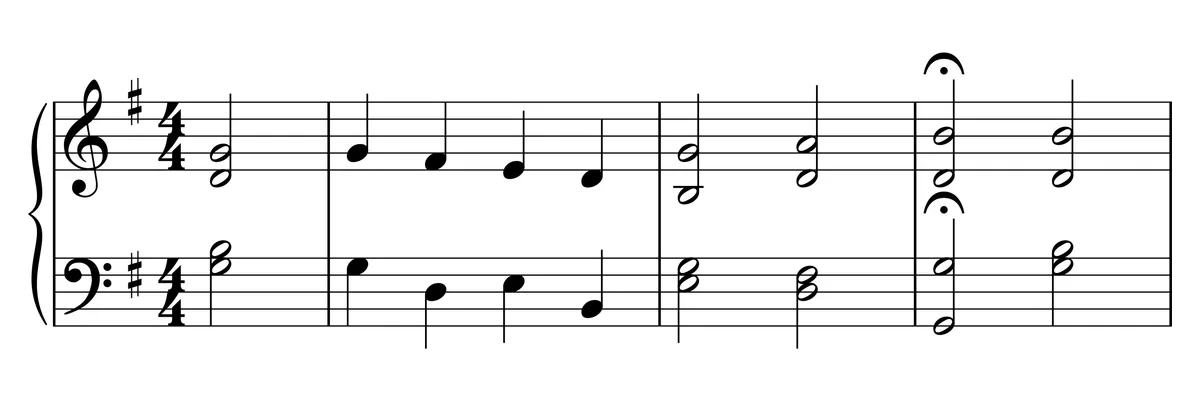
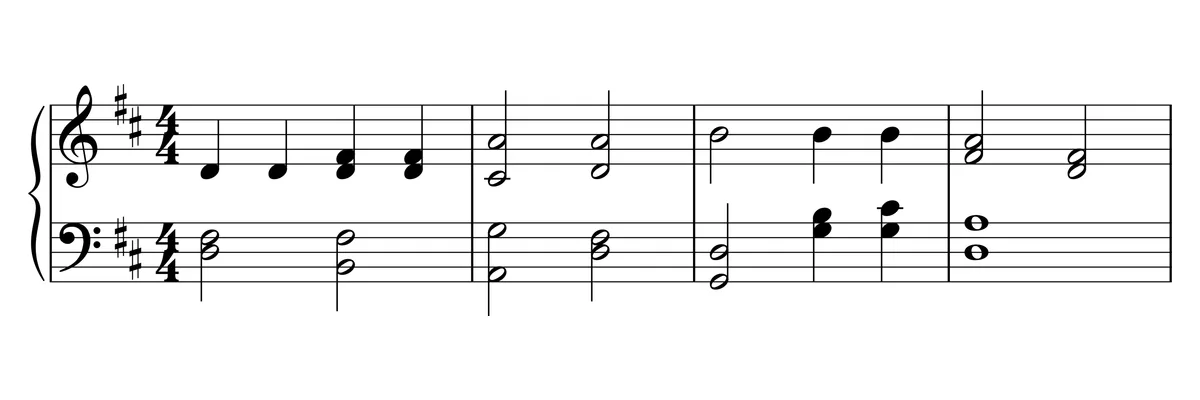
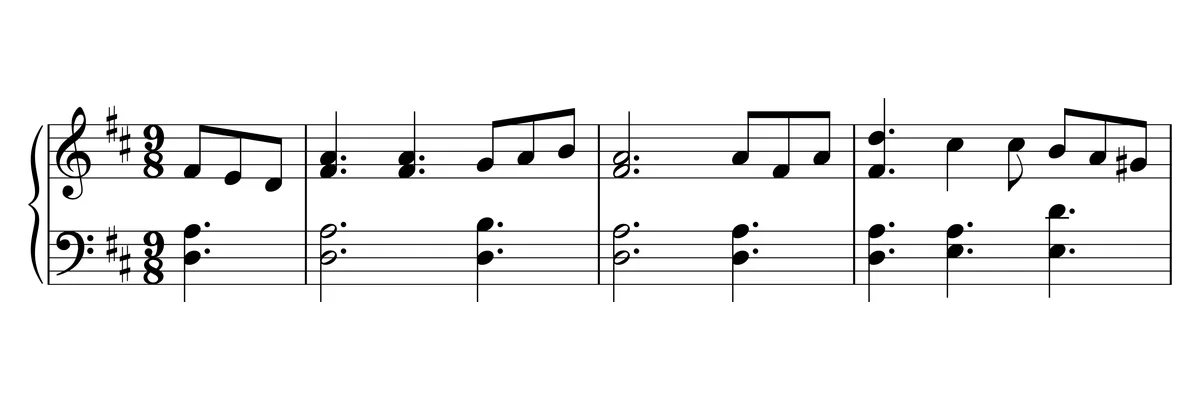
A Mighty Fortress Is Our God for piano in three free versions: an easy arrangement in D major, the 1917 four-part hymn rearranged so both hands can reach it, and the hymnal original. Play each one here, slow it down or loop a bar, then print the PDF or download the MIDI.
- Martin Luther
- Easy to intermediate, plus the original
- 17 bars · 4/4
- Free: play, print, MIDI
Versions of A Mighty Fortress Is Our God. Each version is a request typed into PlayableNotes. Pick one to hear and print it.
Typed into PlayableNotes“Make this hymn easier for a second-year student. Keep it in D major and keep the melody, with the A, B, A, G-sharp in bar 10 that most hymnals have; give the left hand two-note chords that follow the hymnal's harmony, with nothing wider than an octave in either hand.”


What changed
The melody as most hymnals print it, over two-note left-hand chords that follow the hymnal's harmony, in D major, the key of the 1917 setting.
- Bar 10: the melody most hymnals and Bach have, A, B, A, G-sharp, in place of this setting's F-sharp, A, B, G-sharp. The hymnal's chords there are written for its own melody, so the left hand plays F-sharp–A, E–G-sharp, C-sharp–A and E–B, over the main bass notes of Bach's harmonization (BWV 302).
- Right hand: otherwise the melody unchanged, with its eighth-note pairs and all nine fermatas. A second note joins it in 18 places, mostly at the starts and ends of lines. Seventeen are from the hymnal's alto: F-sharp under the melody's D in bars 1, 5, 12, 13 and 15; C-sharp under the fermata notes in bars 3, 7, 14 and 15; C-sharp under the E in bars 5 and 9; bar 11, beats 3 and 4; bar 14, beats 2 and 4; bar 15, beat 2; and the C natural under the E in bar 17. The other is the hymnal's tenor C-sharp under the fermata A in bar 11.
- Left hand: two-note chords from the hymnal's tenor and bass, one per beat and never wider than an octave. In bars 2 and 6, beat 3, it holds C-sharp–A for the whole beat where the hymnal's tenor and bass move in eighths (C-sharp–A, then B–G-sharp), so the A major chord stays under the melody's A–B. In bars 4, 8 and 16, beat 2, where tenor and bass share a G, it plays G–B. In bar 15, beat 4, it plays B–F-sharp in place of the hymnal's octave B.
- Left hand, where it leaves the tenor: bar 11, beat 1, A–A (the tenor's C-sharp is in the right hand); bar 12, G–D an octave lower on beat 1, so the hand stays down, and E–G (the alto's G) on beat 2; bar 14, G–D and B–G on beats 2 and 3, then D with C natural for the whole of beat 4, where the tenor's C natural is an eighth; bar 16, beats 3 and 4, the alto's C natural and B in place of the tenor's F-sharp, with D and C natural for the whole of beat 3, where the alto's C natural is an eighth; bar 17, the alto's B on beat 1 and the tenor's G a half beat early on beat 2.
- Kept: the D-sharp and A-sharp in bar 15, the D-sharp in bar 16 and the A minor chord with C natural in bar 17 that gives the hymn its old-style ending. Left out: the alto's passing D on the last eighth of bar 13.
For teachers: For a second-year student who reads two-note chords in the left hand and knows D major. The left hand is the harder hand: it changes shape on almost every beat, always in quarter notes, and stretches to an octave in places (mostly A to A), so learn it alone first, slowly. Learn bars 1 to 5 first: bars 6 to 9 repeat bars 2 to 5. Bars 10 to 17 bring in C naturals, D-sharps and an A-sharp, and more G-sharps; mark them in pencil before playing.
Typed into PlayableNotes“This is the four-part hymn from our hymnal. Make it playable on piano for Sunday: keep all four parts, the key and the harmony, but nothing wider than an octave in either hand.”


What changed
The 1917 four-part harmony in D major with every part kept, rearranged so each hand stays within an octave.
- Soprano, alto, tenor and bass: every note and rhythm of the hymnal, unchanged. What changes, in bars 10, 11 and 14, is only which hand plays a tenor note.
- Bar 10, beat 3: the tenor's D moves to the right hand (D–F-sharp–B), because the bass B is a tenth below it.
- Bar 11, beat 1: the tenor's C-sharp moves to the right hand (C-sharp–E–A) under the fermata; the left hand holds the bass A alone.
- Bar 14: from beat 2 the tenor (D, D, C natural) moves to the right hand as a lower voice, so the left hand plays the bass alone (G, B, D) instead of reaching a twelfth from G to D.
- No stretch wider than an octave in either hand. The right hand plays three notes at once only in bars 10, 11 and 14.
For teachers: For a church pianist or an intermediate student who wants all four parts of the hymnal setting. Practice bar 14 hands separately first: the right hand plays the melody and alto while its lower voice moves D, D, C natural. The fermatas mark line ends; hold them as long as your singers breathe.
The piece as published: Open Hymnal Project, 2013 revision: the four-part setting from the Common Service Book with Hymnal (United Lutheran Church in America, 1917–1918), hymn 195, alt..
Original hymnal setting
What changed

What changed
The four-part setting as printed in the Open Hymnal edition: soprano and alto on the treble staff, tenor and bass on the bass staff.
- Nothing: this is the source edition, checked bar by bar against its MIDI and PDF, and compared with the 1918 printing.
- It is written for singers. In bars 10, 11 and 14 the tenor and bass are a tenth to a twelfth apart, wider than most hands reach; pianists take the tenor in the right hand, which is what the playable version does.
For teachers: Use it to hear the full harmony or to check a choir's parts. To play it yourself, start with the version made playable on piano, which has the same notes, with a few tenor notes in bars 10, 11 and 14 moved to the right hand.
Want it different? Just ask.
Open this version in PlayableNotes and ask for a change in words: simpler, another key, shorter, bigger notes. The result is a new version you can play, print and share with your student.
Free account. Changes, playback and printing are free; 50 free credits to read your own sheet music.
Watch how to ask for your own version · 1 min video
Make your own version
A real request in PlayableNotes, on Für Elise from the free library: say who it’s for and what to keep, and the AI writes a new version beside the original. It shows how to ask for a version of your own; its result is not one of the versions on this page.
About A Mighty Fortress Is Our God
Martin Luther wrote both the words and the tune of Ein feste Burg ist unser Gott, a paraphrase of Psalm 46, by 1529. Bach built his Cantata No. 80 on it, and Mendelssohn quoted it in the finale of his Reformation Symphony. Most American hymnals outside the Lutheran ones print Frederic Henry Hedge's English translation from the 1850s, and in Lutheran churches it is the traditional hymn for Reformation Sunday at the end of October.
Luther's melody was first sung in a lively, syncopated rhythm; by Bach's time it had been evened out into steady notes, the form Bach harmonized. The setting on this page is that even-note form, in four parts, from the Common Service Book of the United Lutheran Church in America (1917). It is in 4/4 in D major, 17 bars counting the one-beat pickup: the first two lines are played twice, then comes a second half that adds C naturals, D-sharps and an A-sharp, ending on an old-style cadence with an A minor chord before the last D. In this edition nine fermatas mark the ends of the lines.
The melody is easy: quarter notes and a few pairs of eighths, within one octave from D to D. The hymnal page is harder, because it is written for four singers and the left hand has to hold tenor and bass up to a twelfth apart. The easy version keeps the whole melody (with the familiar A, B, A, G-sharp in bar 10) over two-note left-hand chords from the hymnal's harmony, and the playable hymn moves a few tenor notes to the right hand so that all four parts fit.
Practice tips
- Learn bars 1 to 5 first. Bars 6 to 9 repeat bars 2 to 5, ending on the low keynote instead of the high one, so after that only bars 10 to 17 are new.
- Most lines start on the last beat of a bar, right after a fermata (bars 3, 5, 7, 9, 12 and 15); in bars 11 and 14 the fermata is on beat 1 and the next line starts on beat 2. Hold the fermata, lift both hands together, and come in on the beat without rushing.
- The pairs of eighths in bars 2, 3, 5 (and 6, 7, 9) and 17 are the only quick notes in the melody. Count "one-and" on those beats, and keep the eighths even rather than dotted.
- Circle the accidentals in bars 10 to 17 before you play them: the melody's G-sharp in bar 10, the G-sharp in bar 13, the C naturals in bars 14, 16 and 17, the D-sharps in bars 15 and 16 and the A-sharp in bar 15. The C natural in bar 17 is meant: it is the old-style A minor chord before the last D.
- The page's playback holds each fermata for one extra beat. When you accompany singing, agree with the song leader how long to hold them.
Questions about A Mighty Fortress Is Our God
Who wrote A Mighty Fortress Is Our God?
Martin Luther wrote both the words and the melody of Ein feste Burg ist unser Gott, a paraphrase of Psalm 46, by 1529. The tune is named EIN FESTE BURG after its first line. The English words in most American hymnals outside the Lutheran ones are Frederic Henry Hedge's translation from the 1850s. The harmony on this page is from a 1917 Lutheran hymnal.
What key is A Mighty Fortress Is Our God in?
The setting on this page is in D major, the key of the 1917 hymnal and of Bach's chorale settings; many other American hymnals print it in C. All the versions here are in D.
Why does my hymnal have a different rhythm?
Luther's melody was first sung with syncopations; later it was evened out into steady notes, the form Bach used and the one on this page. Some hymnals, especially Lutheran ones, print the older rhythmic form, sometimes alongside the even one. The pitches are nearly the same; the rhythm is what differs.
Why does the line “For still our ancient foe” sound different in my hymnal?
Two readings of that line are in print. Most hymnals, and Bach, have A, B, A, G-sharp in bar 10, and the easy version uses it. The 1917 setting has F-sharp, A, B, G-sharp, and its alto, tenor and bass are written for that, so the hymnal setting and the playable hymn keep it. If your congregation sings the A, B, A, G-sharp reading, play the easy version.
Is A Mighty Fortress Is Our God hard to play on piano?
The melody isn't: it moves in quarter notes with a few pairs of eighths, within one octave. The hymnal page is harder, because the left hand has to hold tenor and bass a tenth to a twelfth apart in three bars, and the second half has several accidentals. Start with the easy version; for Sunday, the playable hymn has every note of the hymnal within an octave per hand.
Can I download A Mighty Fortress Is Our God as a PDF or MIDI file?
Yes, free and without an account. Every version has a Letter-size PDF to print and a MIDI file with the right and left hands on separate tracks.
Source and credits
- Composer
- Martin Luther
- License
- Public domain in the United States
- Arranger
- PlayableNotes
All 17 bars were checked note by note against the Open Hymnal's own MIDI and PDF of the same file, and compared with the 1918 printing (hymn 195), which is in half-note values, with the first line under a repeat sign and no fermatas. The Open Hymnal halves the note values, writes out the repeat and adds fermatas; every pitch matches the 1918 page, and no corrections were needed. Bar 10's melody (F-sharp, A, B, G-sharp) is this setting's reading; most other hymnals have A, B, A, G-sharp there, and the easy version uses that. This is the even-note (isorhythmic) form, not the rhythmic setting. No words are included.
Arrangements and facts checked