Free easy piano · Hymns
Be Thou My Vision, easy piano
Be Thou My Vision for piano in five free versions: an easy arrangement in D major, a beginner version in F, the Open Hymnal's four-part setting with an introduction for church, a flowing piano solo, and that setting as printed. Play each one here, slow it down or loop a bar, then print the PDF or download the MIDI.
- Traditional Irish
- Beginner to intermediate, plus the original
- 16 bars · 3/4
- Free: play, print, MIDI
Versions of Be Thou My Vision. Each version is a request typed into PlayableNotes. Pick one to hear and print it.
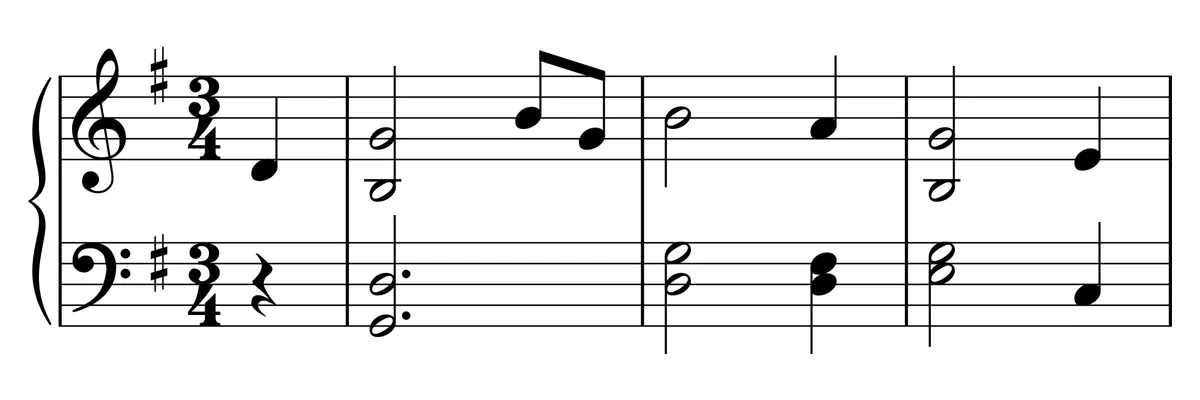
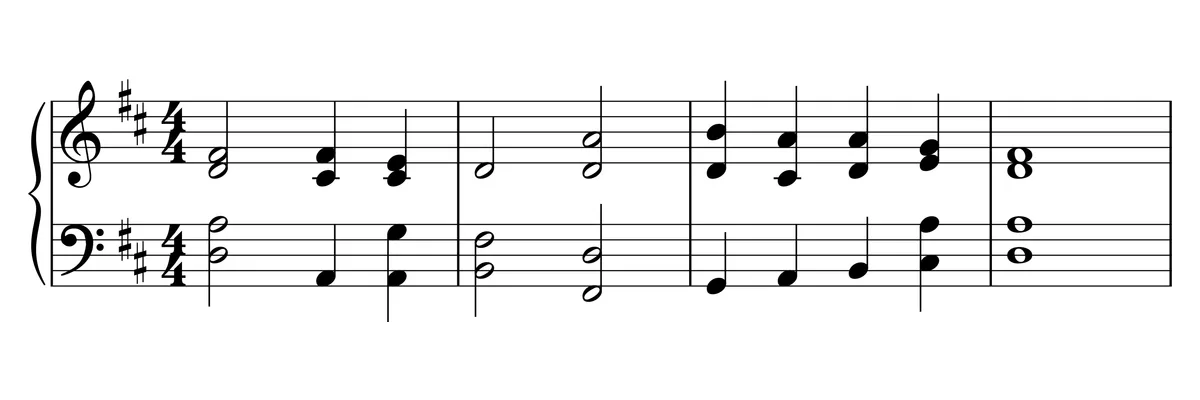
Typed into PlayableNotes“Make this hymn easier for a second-year student. Put it in D major so there are only two sharps, keep the melody exactly as written, and give the left hand two-note chords from the hymn's harmony, nothing wider than a sixth and no eighth notes.”

What changed
The whole melody, note for note, over two-note left-hand chords that follow the Open Hymnal setting's harmony, a half step lower.
- Moved down a half step, from E-flat major (three flats) to D major (two sharps). The melody runs from the A below middle C to the D on the treble staff's fourth line.
- Right hand: the melody unchanged in all 16 bars, with the eighth notes in bars 1, 2, 9 and 14. A second note from the setting's alto joins it in a few places: D under F-sharp in bar 4, C-sharp under the melody in bars 5, 6 and 15, F-sharp under A at the end of bar 6, and D under A in bar 11.
- Left hand: two notes at a time in quarter, half and dotted-half notes, no eighth notes, nothing wider than a sixth. In bars 1, 3 and 11 it plays F-sharp and A, the setting's own shape, so the tonic chord has its third. The two minor chords keep theirs too: F-sharp and A in bar 6 (beat 2), B and D in bar 7 (beat 3).
- Where the setting puts the third or fifth of a chord in the bass, the left hand usually plays the root instead, as with the G under the climbing eighth notes in bar 9 and the D in bar 13. Bar 3, beat 3 has C-sharp where the setting has E, and bars 11 and 15 hold F-sharp where the setting's bass moves on.
- The setting's passing chords under the eighth notes in bars 1, 2, 9 and 14 are left out: the left hand holds the beat's main chord.
- Bar 12: the left hand drops to low G and F-sharp so it stays below the melody's B and A. The last bar is D with F-sharp; the setting ends with the third in the bass.
For teachers: For a second-year student who reads two-note chords and knows D major's F-sharp and C-sharp. Look at bars 2 and 12 first: the melody goes below middle C, onto ledger lines, close above the left hand. In D the hymn is a half step below the E-flat of many hymnals, still comfortable for singing.
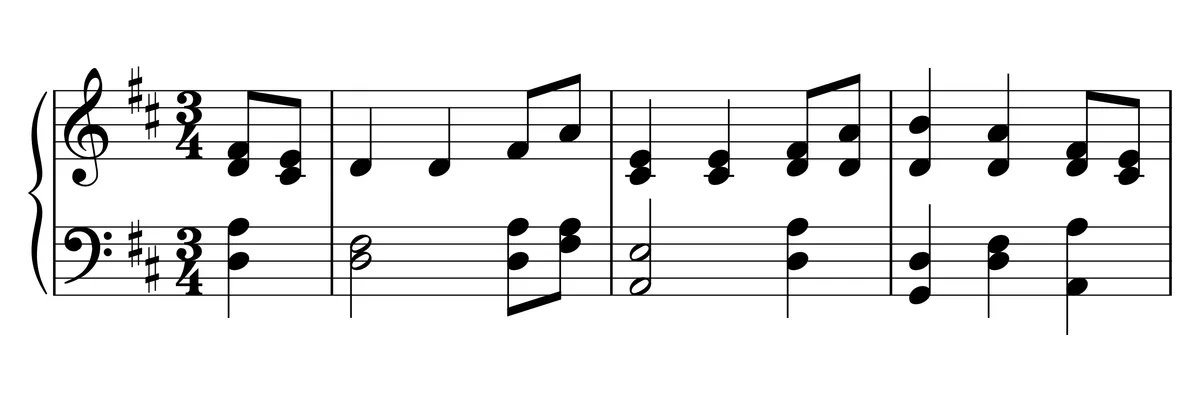
Typed into PlayableNotes“Make a beginner version for a first-year student. Put it in F major so the melody sits on the staff, keep the tune exactly as it is with the right hand alone, and give the left hand mostly single notes, mostly long ones.”

What changed
The melody alone in the right hand, in F major, over long left-hand notes, mostly one at a time, with open fifths in bars 4, 13 and 16.
- Moved up a whole step, from E-flat to F major: one flat. The melody runs from middle C to the F on the top line, and the tune itself never needs the B-flat; only the left hand plays it.
- Right hand: the melody alone, one note at a time, with the same rhythms, including the eighth notes in bars 1, 2, 9 and 14.
- Left hand: mostly one note at a time, in half and dotted-half notes, with quarter notes where the chord changes within the bar (bars 2, 3, 6, 7, 10, 11, 12, 14 and 15). The notes come from the setting's chords: F, B-flat and C, with A for the minor chord in bar 6 and D in bar 7. Open fifths (F and C) in bars 4, 13 and 16, and A with F in bar 8.
- Where the setting puts the third or fifth of a chord in the bass, the left hand plays the root instead, so it stays mostly on F, B-flat and C: for example F in bars 1, 3 and 13 where the setting has A or C, and C then F in bar 15 where it has G then C. This happens on at least one beat in bars 1, 2, 3, 9, 10, 11, 13, 14, 15 and 16.
- Bar 9: the left hand holds B-flat for the whole bar; the setting's passing chords under the eighth notes are left out.
- Last bar: F and C under the melody's F; the setting ends with the third in the bass.
For teachers: For a first-year student who reads in F. The tune spans an eleventh, so the right hand moves through five positions. Three stretch to a sixth over a key the tune skips there: thumb on middle C for bars 1 to 4 (C, D, F, G, A), on A from bar 9 to the first beat of bar 11 (A, C, D, E, F), and on F for the last line (F, G, A, C, D). Two are smaller: thumb on G for bars 5 to 8 (G, A, C, D), and back on middle C from the second beat of bar 11 (C, D, E, F). Most moves come after a held note at the end of a line. The one to practice is in bar 11, where the hand leaps down a fifth, from C to F, in the middle of the phrase. Mark the moves in pencil before the first play-through.
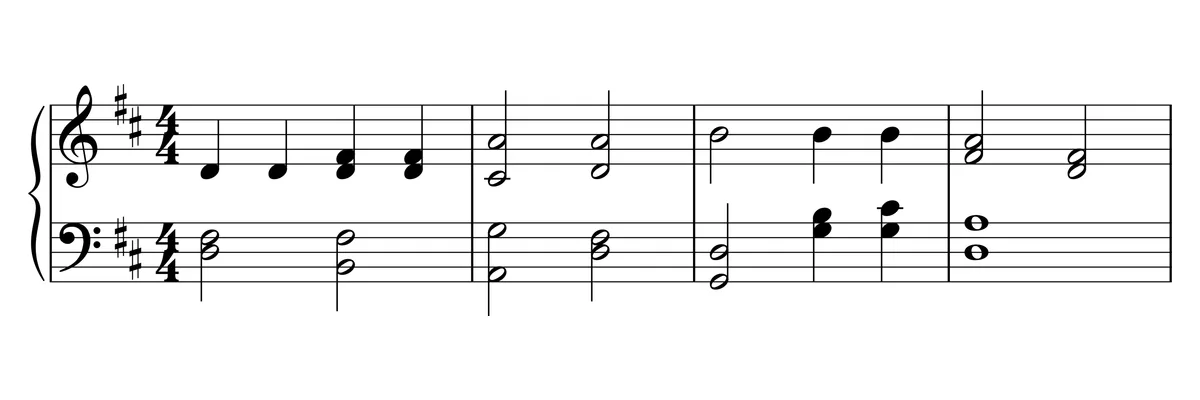
Typed into PlayableNotes“I play this hymn for our congregation. Keep this four-part harmony in E-flat, add a four-bar introduction from the last line, set it up so I can repeat it for each verse with a proper ending on the last one, and fix anything that's awkward to reach on piano.”


What changed
The Open Hymnal's four-part setting in E-flat with a four-bar intro, repeat signs for the verses and a root-position final chord.
- Bars 1 to 4: an introduction from the hymn's last line (hymn bars 13 to 15), ending on a full E-flat chord with a pause, so the congregation hears the key and the tempo.
- Bars 5 to 20: one verse between repeat signs. The first ending (bar 20) is the setting's last bar, with G in the bass, and leads back to bar 5; the second ending (bar 21) is a root-position E-flat chord with a pause, for the last verse.
- Bar 10 (hymn bar 6), beat 2: the tenor's B-flat moves to the right hand, which the setting would leave to a left hand stretched a tenth from the low G.
- Bar 12 (hymn bar 8): the alto moves up to G on beat 2 instead of beat 3, because the tenor arrives on the same E-flat on beat 2 and two hands cannot hold one key.
- Bar 14 (hymn bar 10), beat 3: E-flat in the bass instead of G. Bars 3 and 19 (hymn bar 15), beat 1: B-flat in the bass instead of F. Both remove parallel octaves between the melody and the bass.
- Everything else is the Open Hymnal setting note for note: the same melody, alto, tenor and bass. It may differ from the harmony in your church's hymnal.
For teachers: For a church pianist or an intermediate student. Lift both hands at the pause in bar 4 so the singers can breathe, then start bar 5 in tempo. Repeat bars 5 to 20 for each verse and take the second ending on the last. Practice bar 12 slowly: in each hand one note holds while another moves.
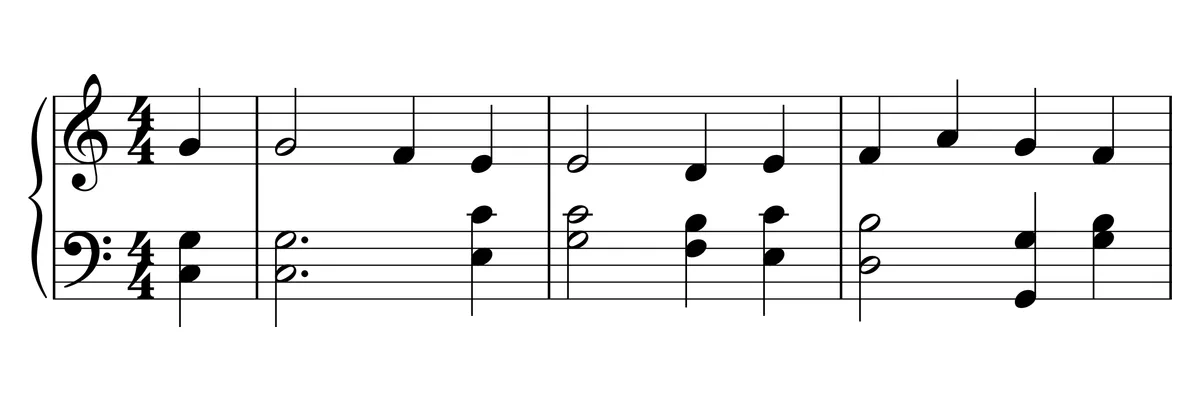
Typed into PlayableNotes“Turn this into a short piano solo I can play as a prelude or offertory. Two verses: the first quiet, with the tune where the hymn has it, the second an octave higher with fuller chords. Give the left hand flowing broken chords, keep it in E-flat and keep the hymn's harmony.”


What changed
Two verses in E-flat over flowing left-hand broken chords: the tune quietly in its own register first, then an octave higher in full chords, with a short amen.
- Left hand: flowing eighth notes until the amen, broken chords from the Open Hymnal setting's harmony, mostly root, fifth, octave and tenth (E-flat, B-flat, E-flat, G). Where the chord changes within the bar (bars 2, 3, 6, 7, 10, 11, 12, 14 and 15, and the same bars in the second verse), the pattern follows each chord, with two eighth notes on a one-beat chord.
- Bars 1 to 16, first verse, marked p: the melody where the setting has it, alone in bars 1 to 3 and with a second note from the alto in most bars from bar 4 on; in bars 6, 7 and 10 the right hand adds a third note so each chord is complete.
- Bar 16: a crescendo, and two eighth notes (G, B-flat) lead up into the second verse, where the setting holds the last note.
- Bars 17 to 32, second verse, marked mf: the melody an octave higher, on top of three-note chords from the setting's harmony; bar 25 keeps the setting's two-note alto line under the climbing eighth notes.
- The hymn's chords fall on the same beats, mostly in root position; the passing chords under the eighth notes in bars 1, 2, 9 and 14 are left to the melody. At the cadence of each verse (bars 14 and 15, 30 and 31) the left hand moves to B-flat with E-flat, then G with E-flat, and B-flat with D, so it does not shadow the melody in octaves.
- Bars 33 and 34: an A-flat to E-flat amen, p, over low E-flat octaves, ending with a pause.
For teachers: For an intermediate pianist who wants the hymn to play alone. Learn the left hand first: most bars are one broken chord, and the same patterns come back in the second verse. Change the pedal with each new chord. In bars 2 and 12 the melody sits only a third above the left hand, so bring it out over the broken chord. The second verse sits high, with ledger lines in bars 22 to 30; read those bars before you play them.
The piece as published: Open Hymnal Project, 2008 revision: four-part setting by Mark Hamilton Dewey (2007), dedicated by him to the public domain in 2006 and 2007.
Original four-part setting
What changed
What changed
Mark Hamilton Dewey's four-part setting as the Open Hymnal prints it: soprano and alto on the treble staff, tenor and bass on the bass staff.
- Nothing: this is the source edition, checked note by note against the Open Hymnal's own MIDI and PDF.
- It is written for singers. In bar 6 the left hand would need a tenth (low G to B-flat), and in bar 8 the alto and tenor share an E-flat on beat 2; the version with an introduction rearranges both.
- It ends with G in the bass, a first-inversion chord, as printed; the arrangements end on the root. Other hymnals harmonize SLANE differently, so it may not match the book in your pew.
For teachers: Use it to hear the four parts as a choir sings them, or to check a part. To play it for a congregation, start with the version with an introduction, which changes four of its bars and adds an intro and a final ending.
Want it different? Just ask.
Open this version in PlayableNotes and ask for a change in words: simpler, another key, shorter, bigger notes. The result is a new version you can play, print and share with your student.
Free account. Changes, playback and printing are free; 50 free credits to read your own sheet music.
Watch how to ask for your own version · 1 min video
Make your own version
A real request in PlayableNotes, on Für Elise from the free library: say who it’s for and what to keep, and the AI writes a new version beside the original. It shows how to ask for a version of your own; its result is not one of the versions on this page.
About Be Thou My Vision
Be Thou My Vision sets an Old Irish prayer, traditionally attributed to Dallán Forgaill, though scholars date it centuries later, in Mary Byrne's English prose translation (1905) as put into verse by Eleanor Hull (1912). The tune, SLANE, is an Irish folk melody that Patrick Weston Joyce printed in 1909 as the tune of a ballad, "With My Love on the Road". It is named after the Hill of Slane in County Meath, where Saint Patrick is said to have lit his Easter fire. Words and tune were first paired, by most accounts, in the Church of Ireland's Church Hymnal of 1919.
The hymn is 16 bars in 3/4, four lines of four bars. The melody spans an eleventh, from the B-flat below middle C to the high E-flat in bar 9, and never uses the fourth note of the scale (A-flat in E-flat), which gives it its open, folk-song sound. Its widest leap is a fifth, in bar 11. The four-part setting used here, by Mark Hamilton Dewey for the Open Hymnal, is harder to play, because it is written for four singers: the left hand holds tenor and bass together, a tenth apart in bar 6, and in bar 8 the alto and tenor need the same E-flat at the same time. Your church's hymnal may harmonize the tune differently.
The easy version keeps every note of the melody, in D major, over two-note left-hand chords; the beginner version moves to F major, where the melody stays between middle C and the top line of the treble staff, over mostly single left-hand notes. For church there are two more: the four-part setting with an introduction and repeats for the verses, and a solo for a prelude or offertory with a flowing left hand. The setting as printed is here too.
Practice tips
- Learn the melody a line at a time. Bars 7 and 10 have the same three notes (C, B-flat, G in E-flat; B, A, F-sharp in D; D, C, A in F), and bars 1 and 3 start the same way, so the hymn has less to learn than it looks. Bar numbers in these tips are the hymn's: in the version with an introduction add four, and in the solo's second verse add 16.
- Bar 9 holds the hymn's highest note. Count it "one, two-and, three-and" and keep the four eighth notes even as they climb and step back; don't rush the top.
- In the E-flat and D major versions the melody drops below middle C in bars 2 and 12 (in the solo, only in the first verse). Find those ledger-line notes before the first play-through.
- Hold the long notes at the ends of the lines for full value (three beats in bars 4, 8 and 16; in the solo, bar 16 leads on into the second verse), and keep counting so the next line starts on time. Singers breathe there.
- For the solo, play the left hand alone at about 60 until the broken chords run without looking, then add the right hand one line at a time and raise the tempo with the player.
Questions about Be Thou My Vision
Who wrote Be Thou My Vision?
No single composer. The tune, SLANE, is a traditional Irish folk melody, first printed by Patrick Weston Joyce in 1909. The words are an Old Irish prayer traditionally attributed to Dallán Forgaill, translated into English by Mary Byrne (1905) and put into verse by Eleanor Hull (1912). The four-part setting on this page is by Mark Hamilton Dewey, who released it to the public domain in 2006 and 2007; the Open Hymnal Project publishes it.
What key is Be Thou My Vision in?
Many hymnals print it in E-flat major, as the Open Hymnal setting here does. The easy version on this page is a half step lower, in D major with two sharps, and the beginner version is in F major with one flat, where the melody stays between middle C and the top line of the treble staff.
Is Be Thou My Vision hard to play on piano?
The melody isn't: it moves mostly in quarter notes, with a few eighths and longer notes at the ends of the lines, in 3/4, by step and small leaps. A four-part hymn setting is harder because it is written for four singers, so the left hand holds two parts, a tenth apart in bar 6 of the Open Hymnal's. The easy and beginner versions give the left hand chords or single notes it can reach, and the version with an introduction keeps all four parts with that bar rearranged.
How fast should Be Thou My Vision be played?
The Open Hymnal edition marks 100 quarter notes per minute; the original on this page plays a little slower, at 96. Learn it around 66 to 72 and raise the tempo with the player on this page as it settles. The flowing solo sounds best a little slower, about 76.
Can I use these versions to accompany singing at church?
Yes. The version with an introduction is the Open Hymnal's four-part setting in E-flat, with a four-bar intro, repeat signs for the verses and a final ending. Its harmony may differ from the setting in your church's hymnal; the melody is the same. The easy version is in D, a half step lower, with the melody on top. The beginner version in F is a whole step higher than E-flat, so check the key before playing it with singers who read from a hymnal.
Can I download Be Thou My Vision as a PDF or MIDI file?
Yes, free and without an account. Every version has a Letter-size PDF to print and a MIDI file with the right and left hands on separate tracks.
Source and credits
- Composer
- Traditional Irish
- License
- Public domain
- Arranger
- PlayableNotes
All 16 bars were checked note by note against the Open Hymnal's own MIDI and PDF of the same file, and the melody against other copies of the tune; no notes needed correcting. Some copies fill the end of bars 4 and 8 with two eighth notes leading into the next line; this setting holds the note for the whole bar, and so do the versions here. The setting ends with G in the bass, as printed; the arrangements' final endings have E-flat (or the root of their own key) in the bass. No words are included.
Arrangements and facts checked