Free easy piano · Classical
Dance of the Sugar Plum Fairy, easy piano
Tchaikovsky's Dance of the Sugar Plum Fairy in four free piano versions: the whole dance made easy, a short late-beginner version with no sixteenth notes, an intermediate version close to the original, and the original. Play each one here, slow it down or loop a bar, then print the PDF or download the MIDI.
- Pyotr Ilyich Tchaikovsky
- Easy to intermediate, plus the original
- 52 bars · 2/4
- Free: play, print, MIDI
Versions of Dance of the Sugar Plum Fairy. Each version is a request typed into PlayableNotes. Pick one to hear and print it.
Typed into PlayableNotes“Make the Dance of the Sugar Plum Fairy easier for my third-year student. Keep the whole piece in E minor, with the melody one note at a time in the right hand. Keep the plucked bass-and-chord left hand but never more than two notes, slow the fast runs down, and turn the celesta cadenza into something they can play.”


What changed
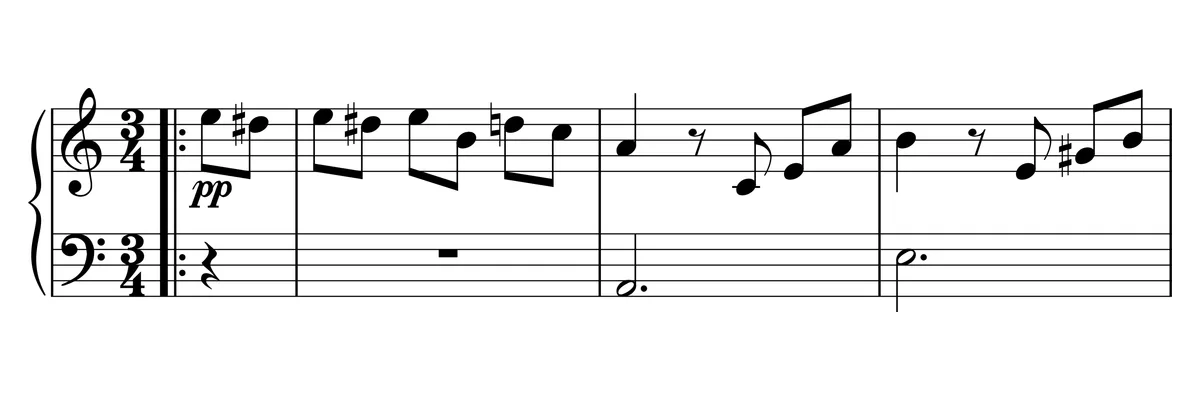
All 52 bars in E minor: Tchaikovsky's melody as a single line over the plucked bass and offbeat chords of the original.
- Right hand: the melody alone, without the chords that double it. Bars 5 to 16 and 37 to 48 are an octave below the original, so they read on the staff; bars 17 to 20 and 49 to 52 are at the original pitch. The return (bars 37 to 51) is written under an 8va line, so, as in the original, it sounds an octave higher than the first time.
- Bars 1 to 4: two-note chords in the right hand instead of three.
- Left hand: the bass note on the beat and a chord off the beat, as in the original, but never more than two notes at once. In bars 7, 15, 39 and 47 the second chord is A and D sharp instead of D sharp and F sharp.
- In bars 8, 16, 40 and 48 the chords have the E on top (G and E, F sharp and E, G and E) where the original has E and G, E and F sharp, E and G. Bar 8 also leaves out the A in the original's middle chord.
- In bars 17 to 19 (and again in 49 to 51) the left hand holds the original's open fifths (F sharp and C sharp, E and B, D and A). The single note before each fifth is an octave lower than in the original, so it sounds as a bass note.
- From the run at the end of bar 40, the left hand plays the return at the pitch of the first statement (bars 8 to 20), where the original moves it up an octave.
- The quick 32nd-note runs in the left hand become two sixteenths on the last eighth of the bar, the second and fourth notes of each run. They are at the original pitch in bars 8 and 12 and an octave lower in bars 16 to 19. In bar 36 the run after the cadenza becomes four sixteenths on the second beat.
- Bars 21 to 31: the chords that pass from hand to hand become two-note chords in the right hand. In bars 21, 22, 25, 26 and 29 to 31 the left hand adds a held low B. The little turn (B, C sharp, B) at the end of bars 22 and 26 is left out.
- Bars 23, 24, 27 and 28: the murmuring triplets shrink to two sixteenths, moved up an octave to sit above middle C. The accented D sharp to E (and C sharp to D), which the original gives to the left hand, move into the right hand an octave higher. In bars 23 and 27 a B on the last eighth stands for the end of the triplets, and the loud B in bars 24 and 28 is played by the left hand alone.
- Bars 32 to 36, the celesta cadenza: bar 32 starts with two-note chords (E and A, then D sharp and B) over a low B. After that, each two-octave arpeggio becomes two two-note chords, one in each hand, through Tchaikovsky's chords on the same beats.
- The hands take turns in the cadenza as in the original: the left hand plays on each eighth note and the right hand a sixteenth later, higher up under an 8va line. In bars 35 and 36 the chords stay in the register of bar 34 instead of climbing higher. The right hand's last chord comes on the second beat of bar 36, with the first note of the left hand's run.
- Bars 20 and 52: the flourish up to the high B is three sixteenths (D sharp, F sharp, B) instead of four 32nds; the low B that starts it is left out.
For teachers: For a student who reads sixteenth notes and is used to accidentals. The left hand's jump from bass note to chord is the main work: practice it alone, short and quiet, before adding the tune. In the cadenza (bars 32 to 36) the hands take turns, the right hand a sixteenth after the left: learn each bar as a chord progression with the hands together, then split it.
Typed into PlayableNotes“Make a short version of just the famous part of the Sugar Plum Fairy for my late-beginner student. Nothing faster than eighth notes, single notes in both hands, and mostly half and whole notes in the left hand, following the bass line. Keep the melody exact and in E minor, and end after the tune comes back once.”


What changed
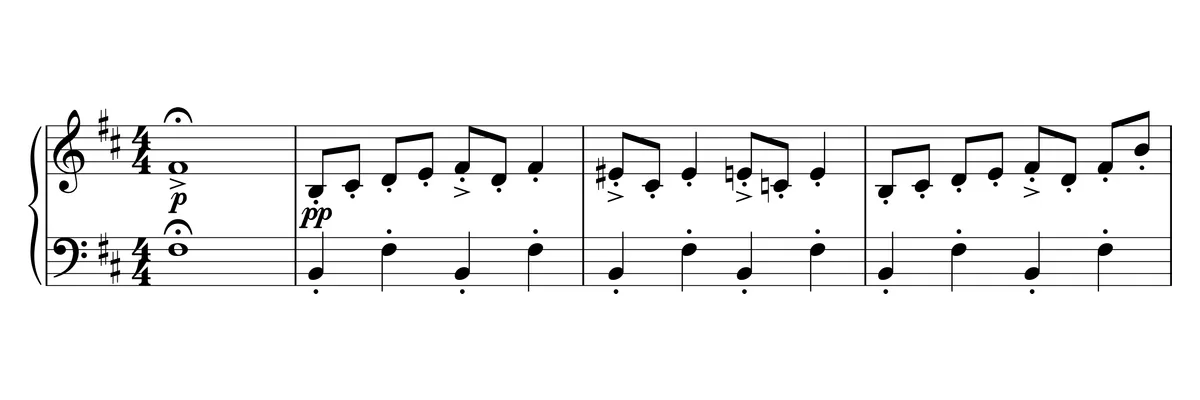
The opening and the main tune in 4/4 with every note value doubled, so nothing is faster than an eighth note, and one note at a time in each hand.
- Written in 4/4 with every note value doubled: each 2/4 bar of the original becomes one 4/4 bar, so its sixteenths are eighths here. Played at a quarter note of about 96, it sounds like the original at a slow tempo.
- Shortened to 26 bars: two bars of the plucked introduction (instead of four), the whole first tune (original bars 5 to 20), then the tune again in a short form (original bars 37 to 40 and 49 to 52) to end in E minor. The middle section and the celesta cadenza are left out.
- Right hand: the melody alone, kept within the treble staff (no higher than the G above it). Bars 3 to 14 are an octave below the original; bars 15 to 18 are at its pitch. The return (bars 19 to 26) stays at the same height instead of climbing an octave. The introduction keeps only the top note of each chord.
- Left hand: one note at a time, mostly whole and half notes, following Tchaikovsky's bass: the held E under the opening phrases, then A sharp, A, G, F sharp and B in bars 7 to 10, and the falling C sharp, B, A in bars 15 to 17 and 23 to 25.
- Bars 18 and 26: the flourish (D sharp, F sharp, high B) becomes two eighth notes, D sharp and F sharp; the high B is left out.
For teachers: For a late beginner who already reads sharps and naturals: nearly every bar has them, and the right hand moves around more than in a five-finger piece. Before the first play-through, point out the natural signs in bars 4 and 5 and the jump up to the high G, made during the quarter rest at the start of bar 3 (from the D sharp at the end of bar 2), and count the quarter rest that starts most phrases.
Typed into PlayableNotes“Keep the Sugar Plum Fairy as close to Tchaikovsky as you can for my intermediate student, but make it readable and playable: no notes four ledger lines up, no four-note chords in the right hand, and make the celesta cadenza something they can learn.”


What changed
The original transcription with lighter right-hand chords, 8va and 15ma lines instead of high ledger lines, and the cadenza in 32nd notes instead of 64ths.
- Bars 5 to 8 and 10 to 16: the right hand's highest passages are written an octave lower under an 8va line, so they read on the staff. They sound exactly as in the original.
- Bars 37 to 51, the return: the right hand is written as in bars 5 to 19, under a 15ma line (two octaves up) where it is highest and an 8va line in bar 41, the first half of bar 42 and bars 49 to 51, so it sounds an octave higher than the first time, exactly as in the original. The left hand is as in the original, in the treble clef from the end of bar 39.
- Four-note right-hand chords lose one note. In bars 7, 15, 39 and 47 and the second half of bars 11 and 43, it is the lowest note, which the left hand already plays. In the second half of bars 10 and 42 the E (sounding E6 and E7) is left out, and in the first half of bars 11 and 43 the D (sounding D6 and D7): inner notes of chords that are repeated unchanged. In bar 32 the B7 chord loses its low B, which the left hand plays.
- Bars 23, 24, 27 and 28: the accented notes (D sharp to E, C sharp to D), which the original gives to the left hand crossing over the right, are played by the right hand above its murmuring triplets. The left hand keeps the bass.
- Bars 32 to 36, the cadenza: Tchaikovsky's sweeps of eight 64th notes become sweeps of four 32nd notes spread evenly over the same two octaves: the left hand plays the first and third notes of its four, the right hand the second and fourth of its four, under an 8va line from the second half of bar 32. The chords are the same, on the same beats.
- Everything else is as in the original: the introduction, the left hand's chords and quick runs, the rest of the middle section (bars 21 to 31) and bars 20 and 52.
For teachers: Start with the cadenza: play each hand's pair of notes as a chord first, then play them as written, alternating hands: left, right, left, right. Keep the repeated chords in bars 6, 7, 10 and 11 light and close to the keys. In bars 23 and 27, murmur the triplets (G, A and B) with fingers 1, 2 and 3 and take the accented D sharp and E with 4 and 5; let the 32nd-note runs in the left hand stay soft and slurred, like the clarinet and bass clarinet that play them in the orchestra.
The piece as published: PDMX dataset: MuseScore score 1270291, "Dance of the Sugar Plum Fairy" (concert-suite version), uploaded by rketchum; checked against Stepán Esipoff's piano transcription and the orchestral score.
Original piano transcription
What changed


What changed
The complete dance in a two-hand transcription, checked bar by bar against Esipoff's transcription and two engravings of Tchaikovsky's orchestral score.
- A public-domain community transcription that matches Stepán Esipoff's piano transcription in most bars.
- Corrected against the orchestral score and Esipoff: wrong accidentals in bars 2, 4, 17, 18, 22, 26 and 50, and bars 30 and 31, which the upload had copied from bar 29 (the chords should rise by step). The left-hand run in bar 36 is moved up an octave, to B3.
- The celesta cadenza (bars 32 to 36), shown as block chords in the upload, is written out as Tchaikovsky's arpeggios: each eighth note is one chord swept over two octaves in 64th notes, left hand then right hand.
For teachers: For an advanced student: the repeated chromatic chords have to stay light and even, and the cadenza needs fast, smooth arpeggios passed between alternating hands.
Want it different? Just ask.
Open this version in PlayableNotes and ask for a change in words: simpler, another key, shorter, bigger notes. The result is a new version you can play, print and share with your student.
Free account. Changes, playback and printing are free; 50 free credits to read your own sheet music.
Watch how to ask for your own version · 1 min video
Make your own version
A real request in PlayableNotes, on Für Elise from the free library: say who it’s for and what to keep, and the AI writes a new version beside the original. It shows how to ask for a version of your own; its result is not one of the versions on this page.
About Dance of the Sugar Plum Fairy
The Dance of the Sugar Plum Fairy is from the second act of Tchaikovsky's ballet The Nutcracker, staged in St. Petersburg in December 1892; his concert suite from the ballet had been heard that March. He wrote the melody for the celesta, a bell-like keyboard instrument he had found in Paris in 1891. The suite version, used here, is 52 bars in E minor; the tune comes back an octave higher after a short cadenza.
On the piano the tune is not the hard part. The full transcription doubles it in chords of three and four notes, repeated in sixteenths high above the staff; the melody slides down by half steps (from D through C sharp and C to B), so nearly every bar has accidentals; and the cadenza in bars 32 to 36 is a string of two-octave arpeggios in 64th notes, shared between the hands.
The easy version keeps the whole dance and its melody, as a single line over the original's plucked bass-and-chord left hand, with the cadenza as two-note chords that pass from hand to hand. The short late-beginner version is the opening and the famous tune with note values doubled, so nothing is faster than an eighth note. The intermediate version keeps the original's texture, with lighter chords, 8va and 15ma lines instead of high ledger lines, and a cadenza in 32nd notes.
Practice tips
- Keep it light and short. Almost every note is staccato, like the celesta and the plucked strings; practice the left hand's bass-and-chord pattern alone, quietly, until the jump feels small.
- Learn the chromatic slide on its own: bars 6 and 7 (bars 4 and 5 in the short version) go D sharp, E, D, D, D, then C sharp three times and C natural three times. Say the note names aloud as you play; the natural signs are where most wrong notes happen.
- Count the rest at the start of each phrase. Each phrase of the tune starts after an eighth rest (a quarter rest in the short version), while the left hand plays the beat.
- Loop the cadenza (click bar 32, then bar 36) slowly. In the easy version, play each bar as a chord progression with the hands together, then let the right hand come in a sixteenth after the left; in the intermediate version, play each hand's two notes together as a chord first, then as the sweep with alternating hands.
- Use the Right and Left buttons and start at about two thirds of the version's tempo on the slider. Editions mark the piece Andante non troppo or Andante ma non troppo, a moderate walking pace, so even the finished tempo is not fast.
Questions about Dance of the Sugar Plum Fairy
Is the Dance of the Sugar Plum Fairy hard to play on piano?
The full transcription is advanced: chords of three and four notes repeated high in the treble, accidentals in nearly every bar, and a cadenza of 64th-note arpeggios. The melody itself is simple, so it simplifies well. The easy version on this page keeps the whole dance with the melody as a single line, and the short late-beginner version has nothing faster than eighth notes.
What key is the Dance of the Sugar Plum Fairy in?
E minor, in 2/4. The key signature has one sharp, but the melody and chords are full of chromatic notes: D sharps and C sharps turn up in most bars and A sharps in many, with C naturals after the C sharps, and F naturals in the chromatic slides and the cadenza. Every version on this page stays in E minor.
What instrument plays the Sugar Plum Fairy melody?
The celesta, a keyboard instrument whose hammers strike metal bars, which gives it a bell-like sound. It was invented in Paris in 1886 by Auguste Mustel, and this dance made it famous. On the piano, play the tune light, short and soft to come close to that sound.
How fast should the Dance of the Sugar Plum Fairy be played?
Editions mark it Andante non troppo or Andante ma non troppo: a moderate walking pace. Around 66 quarter notes per minute suits the original. Learn it at about two thirds of that speed and raise the tempo with the slider as the notes settle.
Can I download the Dance of the Sugar Plum Fairy as a PDF or MIDI file?
Yes, free and without an account. Every version has a Letter-size PDF to print and a MIDI file with the right and left hands on separate tracks.
Is the Dance of the Sugar Plum Fairy in the public domain?
Yes. Tchaikovsky died in 1893, and the piano transcription used here is marked public domain. The easy, late-beginner and intermediate versions were arranged from it by PlayableNotes.
Source and credits
- Composer
- Pyotr Ilyich Tchaikovsky
- License
- Public Domain Mark 1.0
- Arranger
- PlayableNotes
Corrected wrong accidentals in bars 2, 4, 17, 18, 22, 26 and 50, and the copied bars 30-31 (the chords rise by step, as in the score). The celesta cadenza (bars 32-36), shown as block chords in the upload, is written out as Tchaikovsky's arpeggios, and the left-hand run at its end (bar 36) is moved up an octave, to B3, as in the orchestral score and Esipoff.
The full edition is also in the library: Dance of the Sugar Plum Fairy, ready to play and edit.
Arrangements and facts checked