Free easy piano · Christmas
Angels We Have Heard on High, easy piano
Three free versions of Angels We Have Heard on High for easy piano: a beginner version in G, an easy version in F and a fuller carol-singing accompaniment. Play each one here, slow down or loop the Gloria, then print the PDF or download the MIDI.
- Traditional French
- Beginner to intermediate
- 17 bars · 4/4
- Free: play, print, MIDI
Versions of Angels We Have Heard on High. Each version is a request typed into PlayableNotes. Pick one to hear and print it.
Typed into PlayableNotes“Make an easy version of Angels We Have Heard on High for a second-year student, in F: the tune exactly as sung, verse and Gloria, with simple two-note chords in the left hand and no eighth notes for the left hand.”


What changed
The tune as sung in F major, verse twice and the Gloria twice, over two-note left-hand chords and a climbing bass under "in excelsis".
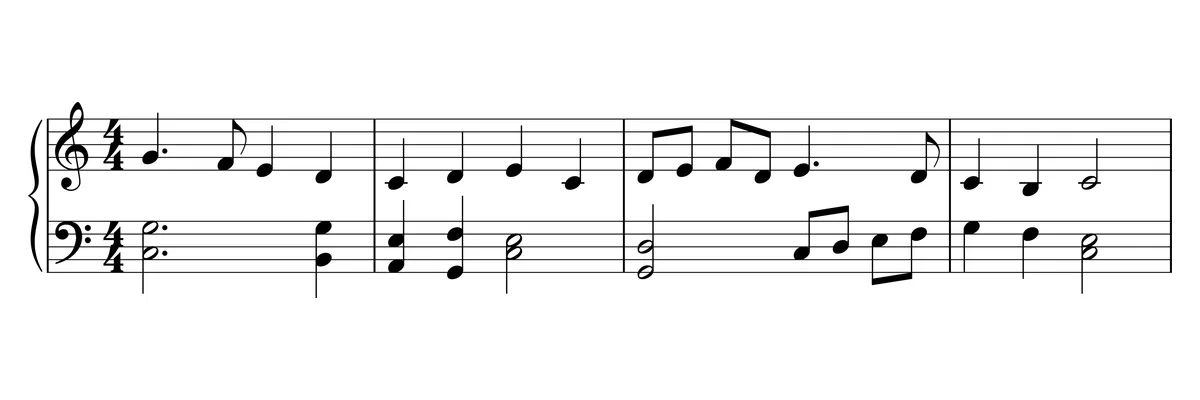
- Right hand: the tune as sung, note for note, in F major: the verse (bars 1–4, with a repeat), then the Gloria refrain twice (bars 5–10 and 11–17). It runs from middle C (bars 8 and 14) to the D on the fourth line of the treble staff (bars 5 and 11).
- Verse left hand: two-note chords in half notes, F–C and F–A for the F chord, C–G under the dotted rhythm of bar 2 and C–E under the cadence in bar 4. In bar 3 the bass steps F, E, F under the A G A at the start of the second line.
- Gloria left hand (bars 5–7 and 11–13): a new chord on beat 3 of each bar, falling with the tune's sequence: F then B♭, G minor then C, D minor then G minor (bar 11 starts on A–F instead of F–A). Bars 8 and 14 hold C chords under "ri-a".
- Bars 9 and 15 ("in excelsis"): the left hand climbs A, B♭, C, D in single quarter notes, an octave and a sixth below the tune's F, G, A, B♭.
- Bars 10 and 16: C–F then C–E the first time; C–F then C–B♭ (a C7) the second time, resolving to F–A in the last bar.
- Harmony: PlayableNotes' own, not a hymnal harmonization. No eighth notes in the left hand; its widest interval is the seventh C–B♭ in bar 16.
For teachers: For a second-year student who plays hands together and reads eighth notes. Learn the Gloria left hand alone first (bars 5–10): one change per half bar in bars 5–8, then single notes climbing A, B♭, C, D in bar 9. In the right hand, put the thumb on G for bars 5 and 6, so C–D–C–B♭–A is 4–5–4–3–2, then move it to F for bar 7.
Typed into PlayableNotes“Make a beginner version for a first-year student: put it in G so there are no sharps or flats to play, the tune alone in the right hand, and one long note at a time in the left hand without moving the hand.”


What changed
The tune as sung, moved to G major so it sits on the treble staff, over single half and whole notes in a left hand that never moves.
- Moved up a step from F (the key of the 1875 print) to G major: the tune sits on the treble staff, from the D just below it to the E in its top space. There is one sharp in the key signature but no F-sharp to play: the tune never uses it, and neither does the left hand.
- Right hand: the tune as sung, note for note: the verse (bars 1–4, played twice), then the Gloria twice (bars 5–10 and 11–17). The verse stays in G position, thumb on G.
- The Gloria needs the right hand to move: up a step (thumb on A) for bars 5–6 and 11–12, back to G position for bars 7 and 13, and down so the thumb takes the two low D's in bars 8 and 14, then back to G for "in excelsis".
- Left hand: one note at a time in half and whole notes, using only D, E, G and A in one position, little finger on the D on the middle line of the bass staff. G under most of the verse, D under the dotted rhythms of bars 2 and 4 and the ends of the Gloria's lines, E and A where the Gloria's harmony moves.
- Harmony: PlayableNotes' own, at most one bass note per half bar: G and D in the verse, with E minor and A minor added in the Gloria. Not a hymnal harmonization.
For teachers: For a first-year student who knows G position and reads eighth notes. The verse never leaves G position; practice the Gloria's right-hand moves on their own (bars 5–9) before adding the left hand, which stays put the whole time.
Then typed, on “Make it easy”“Now make this fuller so I can accompany a group singing it: keep it in F, keep the tune on top, add harmony in the right hand and a stronger bass with octaves, and nothing wider than an octave in either hand.”


What changed
The easy version filled out to lead singers: a harmony note under the tune, a held inner note through the Gloria, and fifths and octaves in the bass.
- Same key, tune and bar plan as the easy version: F major, verse twice, Gloria twice, the tune at singing pitch from middle C to the D on the fourth line.
- Verse right hand: a harmony note under each melody note, mostly a third or sixth (F under A, A under C, E under G in bar 3; in bar 2, E under C and B♭, a C7). Bar 4 closes with C–A, C–G, then F over A.
- Verse left hand: mostly fifths and octaves (F–C, F–F, C–G). Bar 3's bass moves F, E, D, A under the second line (F, C over E, D minor, F over A), and bar 4 opens on C–E.
- Gloria (bars 5–7 and 11–13): the thumb holds a lower note for each half bar (A then F, D then E, F then D) while the upper fingers play the run, so the eighths on "Glo-" stay smooth. Left hand: F octave then B♭–D, G octave then E–C, D–A then G–D; bar 11 starts on A–F.
- Bars 9 and 15 ("in excelsis"): an octave bass walking down F, E, D, B♭ (the easy version climbs here) under two-note chords in the right hand. Bars 10 and 16 sit on a low C octave; bar 16 then adds the seventh (C–B♭) before the final F chord.
- Harmony: PlayableNotes' own, the easy version's chords filled out; not the familiar hymnal harmonization. Widest stretch: a sixth in the right hand, an octave in the left.
For teachers: For an intermediate student or a church pianist who reads two voices in one hand. Play bars 15–17 as an introduction so the singers hear the key and the speed. In the Gloria, let the held thumb notes sound under the run and keep the eighths even; singers breathe before "Glo-", so give them a little time at the end of bars 4 and 10.
Compare the 3 versions
Level, key, bars, hands
| Version | Level | Key | Bars | Right hand | Left hand |
|---|---|---|---|---|---|
| Easy version in F | Easy | F major | 17 | Single notes, spans a ninth | Two-note chords to a seventh, spans an octave and a fourth |
| Beginner version in G | Beginner | G major | 17 | Single notes, spans a ninth | Held single notes, one five-finger position |
| Carol-singing accompaniment in F | Intermediate | F major | 17 | Chords to a sixth, spans an octave and a fourth | Two-note chords to an octave, spans two octaves and a second |
Want it different? Just ask.
Open this version in PlayableNotes and ask for a change in words: simpler, another key, shorter, bigger notes. The result is a new version you can play, print and share with your student.
Free account. Changes, playback and printing are free; 50 free credits to read your own sheet music.
Watch how to ask for your own version · 1 min video
Make your own version
A real request in PlayableNotes, on Für Elise from the free library: say who it’s for and what to keep, and the AI writes a new version beside the original. It shows how to ask for a version of your own; its result is not one of the versions on this page.
Transcript
Make piano music easier to play. Start from your own photo or PDF. Reading costs 1 credit per line of music. Or pick a piece from the free library. Open Für Elise and click Edit a copy. Your copy. Each change is a new version. Say what your student needs, in plain words. “Make this easier for a second-year student: keep the melody, one held left-hand note per bar, no leaps bigger than an octave.” The AI writes a new version. Sped up: the real wait was 1 min 43 s. “I simplified the left hand to one held note per bar and reduced right-hand chords to the melody.” Same melody here. One held left-hand note per bar. Saved as Version 2, with your request. The original is still here. Hear it first. Back to Version 2, and press Play. Notes light up as they sound. Try it free: 50 credits. playablenotes.com Library pieces, AI edits and playback are free.
Angels We Have Heard on High piano notes in letters
Right hand of the Beginner version in GBeginnerShow this version
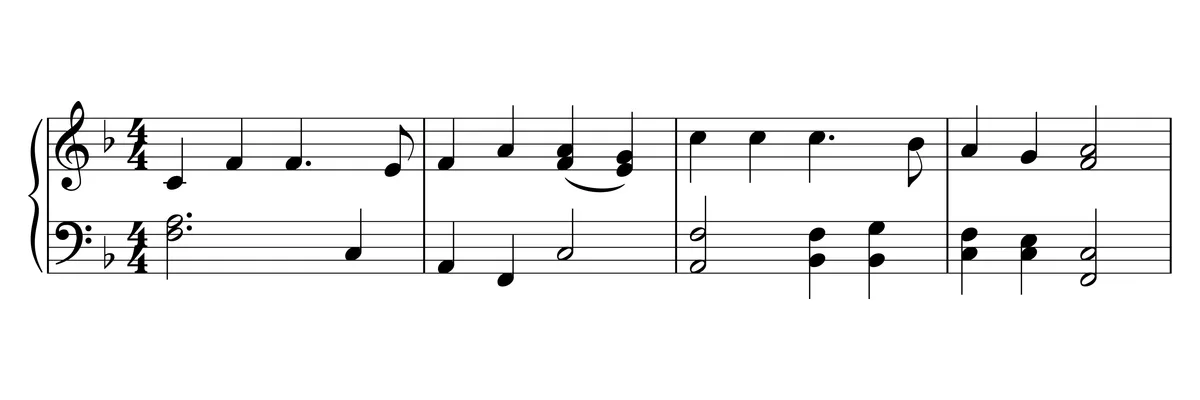
Letter notes phrase by phrase. This is the melody only: the left hand and any chords are in the sheet music. The score above shows another version, the easy version in F. Use the letters to learn the tune, then read it from the score.
The tune starts on the B above middle C. The small number after a line’s first letter is its octave: middle C is C4, and the C above it starts octave 5. Each next letter is the nearest key with that name, unless an arrow says to jump up or down a fifth or more. Sharps and flats are written on every note that has one.
- B4BBDDCB
- B4ABDBAG
- D5EDCBC
- D5CBAB
- C5BAGA↓DD
- G4ABCBA
- D5EDCBC
- D5CBAB
- C5BAGA↓DD
- G4ABCBAG
About Angels We Have Heard on High
The tune is a French carol, "Les anges dans nos campagnes" ("The angels in our countryside"). Its words were printed in southern France from the early 1800s, and the oldest known printing with this tune is a Paris collection of 1842; hymnals often give 1855 instead. The English words, a free paraphrase rather than a translation, are usually credited to James Chadwick, later a Catholic bishop in the north of England, around 1860. The refrain is the angels' song from the Christmas story in Latin: "Gloria in excelsis Deo", glory to God in the highest.
The verse is easy: four bars, played twice, mostly in quarter notes, with a dotted quarter and eighth in bars 2 and 4. The refrain is the hard part. On the single syllable "Glo-" the tune runs through 16 notes, over more than three bars: each bar is a half note and four eighths, the same shape a step lower than the last, so singers need one long breath or a planned one, and on the piano the run covers six keys and will not stay under one hand position. "Ri-a" then drops to the tune's lowest note before "in excelsis Deo" climbs back up.
Every version here is PlayableNotes' own arrangement of the traditional melody, with harmony written for this page. None of them uses the harmonization printed in many American hymnals (usually credited to Edward Shippen Barnes). Start with the beginner version in G, where the left hand never moves, then the easy version in F, then the carol-singing version, which keeps the easy version's key so singers can join in.
Practice tips
- Learn the Gloria as one shape played three times: bar 5, then bars 6 and 7 are the same five notes a step lower each time (C–D–C–B♭–A, B♭–C–B♭–A–G, A–B♭–A–G–F in F; D–E–D–C–B, C–D–C–B–A, B–C–B–A–G in G). Play bar 5 until it is easy, then just start a step lower.
- Plan the right hand's moves in the Gloria before you play it: thumb one step above the keynote for bars 5 and 6 (G in F, A in G), on the keynote for bar 7, then down so the thumb takes the low note of "ri-a" in bar 8 (C in F, D in G). Loop bars 5 to 9 slowly with the Right button until the moves come without stopping.
- Count the dotted rhythms in bars 2 and 4 and in bar 8: each is a dotted quarter and an eighth, and in bar 8 the eighth is the drop to the low note (C in F, D in G). Count "one, two-and" and play the eighth on the "and".
- Keep the eighths in the Gloria even and smooth, as one long breath. Practice them at about 70 first; they rush on the way down.
- The verse is played twice (the repeat sign at bar 4), then the Gloria twice: the first Gloria ends on a half cadence in bar 10, the second comes home to the keynote in bar 17.
Questions about Angels We Have Heard on High
What are the notes for Angels We Have Heard on High on piano?
In G major (the beginner version): the verse is B B B D, D C B, B A B D, B A G, played twice. The Gloria is D, E D C B, C, D C B A, B, C B A G, A, D D; then G A B C, B A. The Gloria is played twice, the second time ending B A, G. The first D of the Gloria is the D on the fourth line of the treble staff, and the two D's after the A are the D just below the staff. In F major (the easy version) every note is a step lower: A A A C, C B♭ A, and so on.
Is Angels We Have Heard on High easy to play on piano?
The verse is easy: four bars, mostly quarter notes, played twice, within five notes. The Gloria refrain is harder, a run of half notes and eighths that falls a step each bar and takes the right hand out of one position, then a drop to the low note on "ri-a". The beginner version on this page keeps the left hand to one note at a time so a student can concentrate on the right hand's moves.
What key is Angels We Have Heard on High in?
It is usually printed in F major, the key of the 1875 print this page follows. The easy and carol-singing versions here are in F; the beginner version is in G. With a free account you can open any version in PlayableNotes and ask for another key in words; editing is free, within a daily fair-use limit.
Who wrote Angels We Have Heard on High?
Nobody knows who wrote the tune; it is a traditional French carol, "Les anges dans nos campagnes". An early form of the French words was printed in Marseille in 1805, the oldest known printing with this tune is a Paris collection of 1842, and hymnals often date it to an 1855 collection. The English words are usually credited to James Chadwick, later Catholic Bishop of Hexham and Newcastle, around 1860.
Is this the harmony from the hymnal?
No. Many American hymnals print a four-part harmonization usually credited to Edward Shippen Barnes; this page does not use it. Every version here is PlayableNotes' own arrangement of the traditional melody, taken from a print of 1875, with harmony written for this page, so it will sound a little different from the hymnal under the same tune.
Can I download Angels We Have Heard on High as a PDF or MIDI file?
Yes, free and without an account. Every version has a Letter-size PDF to print and a MIDI file with the right and left hands on separate tracks.
Source and credits
- Composer
- Traditional French
- Source edition
- Carols for Use in Church during Christmas and Epiphany, ed. R. R. Chope (London: Metzler & Co., 1875), Carol 68, p. 139
- License
- Public domain
- Arranger
- PlayableNotes
Melody only: the traditional French tune ("Les anges dans nos campagnes", tune name GLORIA), taken note by note from this 1875 print (in F, 4/4: a four-bar verse with a repeat, then the Gloria refrain twice). Checked against a second print, Crown of Jesus Music (London, 1864), No. 138 "Angels we have heard on high", which has the same notes, and against the oldest known printing with music, Lambillotte's Choix de cantiques sur des airs nouveaux (Paris, 1842), where the second and fourth verse lines end on the third of the key (A in F) instead of the keynote; these versions follow the form sung in English, as both English prints have it. The harmony in every version is PlayableNotes' own, written for this page: it does not use the 1875 or 1864 accompaniments, nor the harmonization printed in many American hymnals (usually credited to Edward Shippen Barnes).
Arrangements and facts checked