Free easy piano · Classical
The Entertainer, easy piano
Scott Joplin's The Entertainer in four free piano versions: an easy version of the introduction and the first two strains, a late-beginner version of the famous tune, the whole rag without octaves for small hands, and Joplin's 1902 original. Play each one here, slow it down or loop a bar, then print the PDF or download the MIDI.
- Scott Joplin
- Easy to intermediate, plus the original
- 54 bars · 4/4
- Free: play, print, MIDI
Versions of The Entertainer. Each version is a request typed into PlayableNotes. Pick one to hear and print it.
Typed into PlayableNotes“Make The Entertainer easy for my second-year student. Keep Joplin's melody and harmony, the introduction and the first two strains with their repeats, and write it so there are no sixteenth notes. In the left hand, one bass note and a two-note chord, so it still sounds like ragtime.”


What changed
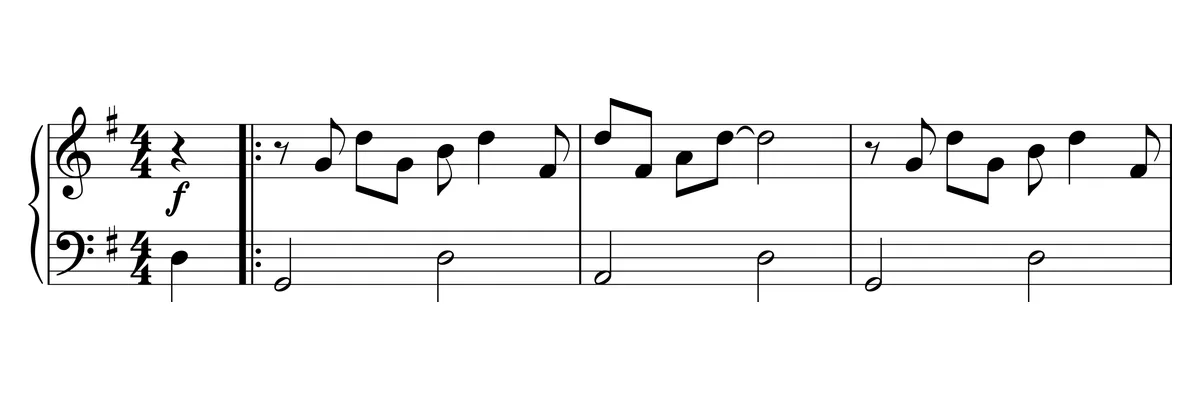
The introduction, both famous strains and the return of the first, with the melody on top and an oom-pah left hand.
- Written in 4/4 with every note value doubled: Joplin's sixteenth notes become eighths, and bar numbers still match the original's first 54 bars.
- Bars 55 to 92 (the trio in F and the last strain) are left out; the piece ends at the close of the first strain, bar 54.
- Right hand, first strain: the melody alone, on the lower note of Joplin's octaves, so it sits between the D above middle C and the E at the top of the staff. In bars 12 and 46 Joplin's F natural is kept under the held D, so the G7 chord is complete.
- Right hand, second strain (bars 21 to 38): Joplin's top line, so the pickups E, F, F-sharp in bars 21, 29 and 37 are at his upper octave. The E inside his chords is kept under G and A as a third or fourth, struck with each note; bar 28 has G–B and F-sharp–B, bar 29 keeps Joplin's B–G, and bars 36 to 38 have two-note chords, except that Joplin's F–E in bar 36 becomes the E alone. The last bar is a C major triad.
- Left hand: quarter notes, mostly a single bass note on beats 1 and 3 and a two-note chord on 2 and 4, never wider than a seventh, except bars 34 to 36, where the chords move on every beat, and the bars where Joplin starts with a chord (12, 20, 21, 29, 46 and 54). Joplin's bass octaves become single notes, and his walking basses stay: E, E-flat (bars 10 and 27), G, A, B (bars 12 and 20), F, E, D (bar 29), C, G, E, D (bar 37).
- Introduction: bar 1 in the right hand alone, bar 2 an octave lower in the right hand, bar 3 in the left hand, then the G chord and the pickup into bar 5.
- Bar 37: the pickup into the repeat of the second strain stays at written pitch. Joplin asks for the whole repeat an octave higher ("Repeat 8va"); once the strain is secure, try the repeat up an octave in the right hand.
For teachers: For a student who reads eighth notes and ties confidently. Learn the left hand of bars 5 to 8 first, at a steady tempo, then put the right hand on top: the tied notes only feel natural against an even left hand. Bar 2 goes down to the G below middle C, two ledger lines under the treble staff: read it as bar 1 an octave lower.
Typed into PlayableNotes“Now make it simpler still: just the famous tune, the melody alone in the right hand, one long note at a time in the left hand, in C major, with nothing faster than eighth notes.”


What changed
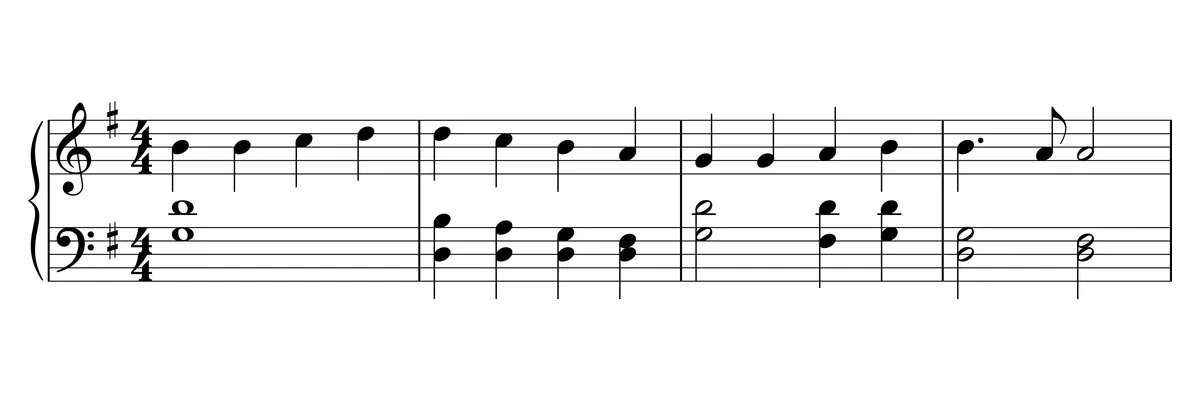
The famous first strain with its repeat, the melody alone over long single bass notes, 20 bars.
- Only the introduction and the first strain, bars 1 to 21 of the original, in 20 bars. The second ending closes on a C major chord instead of leading on.
- Written in 4/4 with doubled note values, like the easy version; the quickest notes are eighths.
- Introduction shortened to three bars: the opening figure twice at the same pitch in the right hand, the second time ending A, A-flat as in Joplin's bar 3, then G and the pickup D, D-sharp.
- Right hand: the melody alone, the same notes as the easy version. It moves between the D above middle C and the E at the top of the staff, so the hand shifts at each pickup. Its accidentals are D-sharp, F-sharp and A-flat; the left hand adds E-flat, B-flat and A-flat.
- Left hand: one note at a time, mostly half and whole notes (a few quarters, as in bars 3, 7, 9, 11, 19 and 20), on the bass notes Joplin uses: C–G, F–E, G, C. It stays mostly in C position (C, D, E, F, G below middle C); it leaves it in bar 3 for the low G, in bar 11 for Joplin's walk up G, A, B into the C of the next bar, and in bars 16 to 18 for his chromatic bass C, B-flat, A, A-flat, G.
- The left-hand chords between the bass notes are left out.
For teachers: For a student past the first method book: the range and the accidentals put it a step above a five-finger piece. The rhythm is the lesson here, so clap bar 4 before playing it. Bar 10 is the widest reach, a seventh from F-sharp up to E: play it 1, 2, 3, 5, opening the hand from the thumb, and let it close again on D, C, A with 4, 3, 2.
Typed into PlayableNotes“My student has small hands and can't reach an octave yet. Keep the whole rag as Joplin wrote it, in 2/4 with every strain and repeat, but take out the octaves in both hands, so no chord is wider than a minor seventh.”


What changed
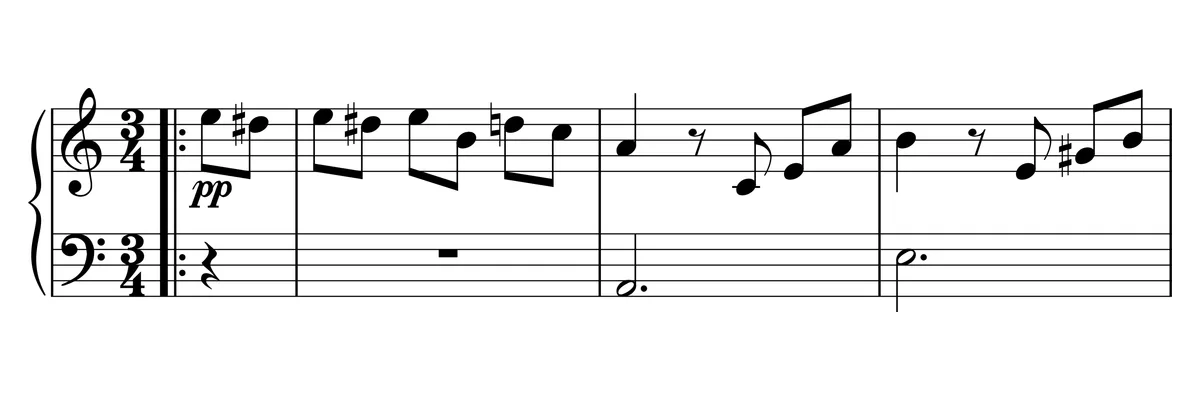
All 92 bars in Joplin's own rhythm and register, with every octave reduced so no chord is wider than a minor seventh.
- Right hand: each filled octave loses its lowest note, so E–G–E becomes G–E and the melody stays on top at Joplin's pitch; bare octaves, as in bars 17 and 18, become the top note alone. The major sevenths go too: C–F-sharp–B in bar 28 loses the C, F–E in bars 36 and 74 becomes E alone, and F–B–E in bar 90 becomes B–E.
- Left hand: bass octaves become the lower note, except in bars 4 and 71, where Joplin drops to the bottom of the keyboard: there each octave keeps its upper note (in bar 71, F3 then F2). The chords keep their notes: only C–G–C (bars 20, 21, 54) and F–A–C–F (bars 34, 72) lose their top note.
- Trio, bars 56, 58, 64 and 66: the held chord over the moving inner line is struck as an eighth and the line is written in the same voice, since holding both needs a hand span of more than an octave. In bars 58 and 66 the line's last note, B-flat, becomes a sixteenth so that Joplin's top G can follow it in the same voice.
- Bar 62: the left hand plays the G–C–E chord as an eighth before the low C, instead of holding it.
- Bar 37: the pickup into the second strain's repeat stays at written pitch. Joplin asks for the whole repeat an octave higher ("Repeat 8va"); play it up an octave once you know it.
- Every other note, rhythm, accidental, dynamic and repeat is Joplin's. The widest chord is a minor seventh: the left hand's D–C in bars 11, 36, 45, 74 and 82 (bar 82 starts with D-sharp–C, a diminished seventh, before the D–C), and the right hand's B–A in bar 81 and A–G in bar 88.
For teachers: The ragtime left hand is unchanged, leaps included (up to about two octaves, as from the low C to the chord in bars 22 and 30), so this still asks for an intermediate student. Learn the left hand of each strain alone first, looking at the chord, not the bass note. In bars 56, 58, 64 and 66, hold the pedal through the chord and the inner line, as Joplin's held chord implies, so the top note keeps sounding.
The piece as published: Mutopia Project no. 263, typeset by Chris Sawer and revised by Simon Albrecht, from the original 1902 edition.
Original
What changed


What changed
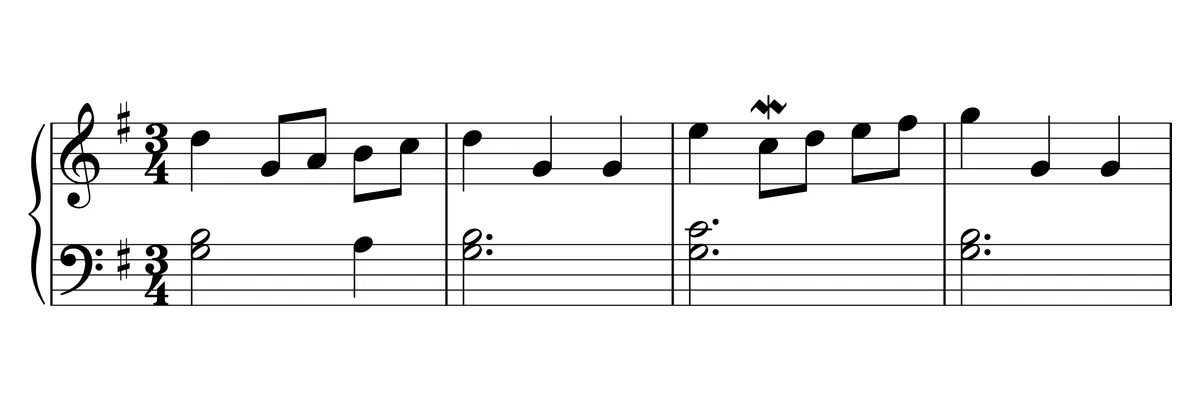
The complete rag as Joplin published it in 1902, with octaves and the ragtime left hand.
- Nothing: this is the source edition, all 92 bars with the repeats, checked note by note.
- The repeat of the second strain plays at written pitch here, with only the three pickup notes in bar 37 under the 8va line, as printed. Joplin asks for the whole repeat an octave higher ("Repeat 8va"), so play it up an octave once you know it.
For teachers: Once the no-octaves version is secure, the original adds one skill: filled octaves in the right hand. Practice bars 6 and 7 slowly, letting the wrist carry the hand rather than stretching the fingers.
Want it different? Just ask.
Open this version in PlayableNotes and ask for a change in words: simpler, another key, shorter, bigger notes. The result is a new version you can play, print and share with your student.
Free account. Changes, playback and printing are free; 50 free credits to read your own sheet music.
Watch how to ask for your own version · 1 min video
Make your own version
A real request in PlayableNotes, on Für Elise from the free library: say who it’s for and what to keep, and the AI writes a new version beside the original. It shows how to ask for a version of your own; its result is not one of the versions on this page.
About The Entertainer
Scott Joplin published The Entertainer in St. Louis in 1902, subtitled "A Rag Time Two Step" and marked "Not fast". It is laid out like a march, in 2/4: a four-bar introduction, the famous first strain (played twice), a second strain (played twice), the first strain once more, a trio in F major (played twice), a four-bar link back to C, and a last strain (played twice). In 1973 Marvin Hamlisch adapted it for the film The Sting, which made it famous all over again.
The tune is simple; Joplin's texture is not. In the first two strains the right hand plays much of the melody in octaves filled in with a third note, in sixteenth notes with ties across the beat, so it stretches an octave through most of the first half; the trio and the last strain are mostly thirds, sixths and chords. The left hand plays the ragtime bass: a low note on the beat, often doubled at the octave, and a chord on the off-beat, jumping between them on every beat, sometimes by more than an octave.
The easy version keeps the introduction, the first two strains with their repeats and the return of the first strain, written in 4/4 with every note value doubled, so the quickest notes are eighths and each bar still matches one of Joplin's. The right hand has the melody on top, with Joplin's E kept under it in the second strain, and the left hand keeps the ragtime bounce with one bass note and one two-note chord. The late-beginner version is the introduction and first strain, with the melody alone over long bass notes. The no-octaves version is the complete rag for a student who reads well but cannot reach an octave yet, and the original is here to compare.
Practice tips
- Clap and count the first bar of the tune before you play it. In the easy and late-beginner versions, count "1 and 2 and 3 and 4 and": the Cs above middle C land on "1-and", "3" and "4-and", and the last one is held across the bar line.
- Play the left hand alone until it is completely even: low note, chord, low note, chord. Ragtime depends on that steady beat; the right hand's syncopations only sound right against it.
- The pickup D, D-sharp into each phrase of the first strain is a half step up to E. In the easy and late-beginner versions, try fingers 2 and 3, then the thumb on E, so the fifth finger is ready for the C.
- Don't rush. Joplin wrote "Not fast" at the top of the score; learn it at a slow setting on the tempo slider and raise it a few beats at a time.
- In the second strain, loop bars 28 and 29 (click bar 28, then bar 29): the right hand climbs to B and the left hand walks down F, E, D, a common place to lose the beat.
Questions about The Entertainer
Is The Entertainer hard to play on piano?
The original is upper intermediate, roughly grade 5 or 6: filled octaves in the right hand, a ragtime left hand that jumps up to two octaves between bass note and chord, and sixteenth-note syncopations. The easy version on this page keeps the tune and the ragtime left hand at about grade 1 to 2, a second-year level, and the late-beginner version is the famous first strain with the melody alone.
Who wrote The Entertainer, and when?
Scott Joplin, the best-known ragtime composer. It was published in St. Louis in 1902. It became famous again through the 1973 film The Sting, whose music Marvin Hamlisch adapted from Joplin's rags.
Is The Entertainer in the public domain?
Yes. Joplin published it in 1902 and died in 1917, so the composition is in the public domain in the United States and most other countries. Modern arrangements, such as Hamlisch's for The Sting, are separate works; every version on this page is arranged from Joplin's own score.
How fast should The Entertainer be played?
Joplin marked it "Not fast". The original on this page starts at 72 quarter notes per minute. The easy and late-beginner versions are written with doubled note values, so the same speed would be 144 there; they start at 100 and 92 for practice.
Why is the easy version in 4/4 when Joplin wrote 2/4?
Doubling every note value turns Joplin's sixteenth notes into eighths, which are much easier to read, and it sounds the same at double the metronome speed. Each 4/4 bar is one of Joplin's 2/4 bars, so the bar numbers still match the original.
Can I download The Entertainer as a PDF or MIDI file?
Yes, free and without an account. Every version has a Letter-size PDF to print and a MIDI file with the right and left hands on separate tracks.
Source and credits
- Composer
- Scott Joplin
- Source edition
- Mutopia Project no. 263, typeset by Chris Sawer and revised by Simon Albrecht, from the original 1902 edition
- License
- Public domain
- Arranger
- PlayableNotes
All 92 bars were compared note by note with two public-domain transcriptions, MuseScore score 1341366 by jazz_piano and the complete The Entertainer (full), score 1809426 by AG v.d Walt (both under the Public Domain Mark), and every disagreement was settled on the Mutopia text. Score 1341366 is the copy in our library; it has a few slips that the original here corrects, the largest a right hand an octave too high in bars 26 to 36. The repeat of the second strain plays at written pitch here; Joplin asks for it an octave higher ("Repeat 8va"), so play it up an octave once you know it.
The full edition is also in the library: The Entertainer, ready to play and edit.
Arrangements and facts checked