Free easy piano · Classical
Maple Leaf Rag, easy piano
Scott Joplin's Maple Leaf Rag in three free versions: a beginner version of the famous first strain in G major, the complete rag without octaves for small hands, and Joplin's 1899 original. Play each one here, slow it down or loop a bar, then print the PDF or download the MIDI.
- Scott Joplin
- Beginner to intermediate, plus the original
- 18 bars · 4/4
- Free: play, print, MIDI
Versions of Maple Leaf Rag. Each version is a request typed into PlayableNotes. Pick one to hear and print it.
Typed into PlayableNotes“Make a beginner version of just the famous first part of Maple Leaf Rag: G major, 4/4 with eighth notes, the tune in the right hand with no stretch wider than a sixth, and held single notes in the left hand. Keep the repeat.”


What changed
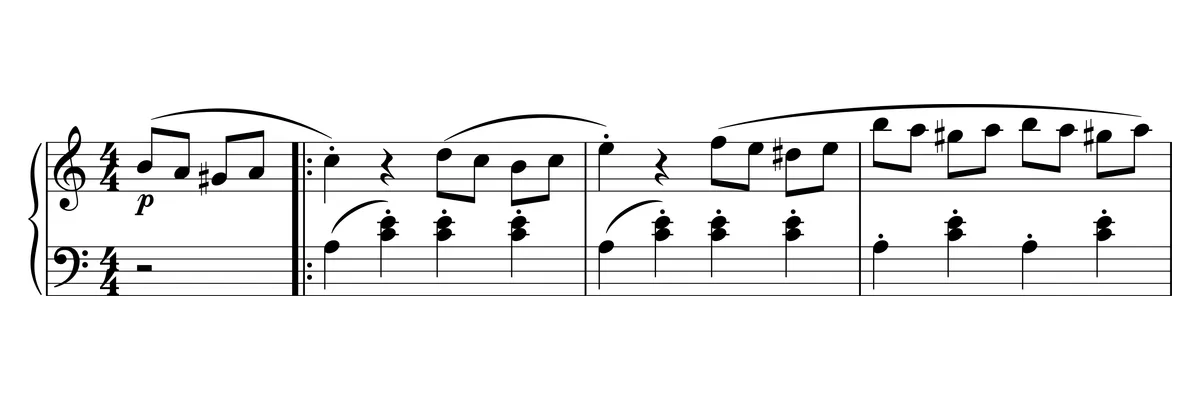
The famous first strain with its repeat: the tune in the right hand over held single notes in the left.
- The first strain only (bars 1 to 18, with the repeat), in G major, a half step below Joplin's A-flat, and in 4/4 with every note value doubled: Joplin's sixteenths become eighths, and each 4/4 bar is one of his 2/4 bars. It ends on G.
- Right hand: Joplin's tune as a single line in his rhythm, apart from the changes below and the held last note. No stretch is wider than a sixth.
- Left hand: one held note per half bar (G, A, D, E♭) instead of the oom-pah, and a whole note in bars 10, 11, 14 and 15 (C♯, then D). Apart from the break it stays between the G at the bottom of the bass staff and the E♭ just above the middle line.
- Bars 8 and 9, the break: rising G minor triads in groups of three (G–B♭–D, then B♭–D–G) instead of Joplin's G–B♭–G octaves, so neither hand has to stretch; the right hand ends on the G that starts bar 10.
- Bars 10 to 13 are played at the same height as bars 14 to 17, not an octave higher.
- Bar 13: the pickup G into bar 14 is left out, which gives the right hand a beat to move up.
For teachers: For a first-year student who counts eighth notes and can hold a left-hand note while the right hand moves. The right hand has three places to be: around the G above middle C in bars 2 to 9, around the G just above the staff in bars 10 and 11, and back near the G above middle C in bars 12 and 13. Bars 14 to 17 make the same moves. Make each move during a rest or a long note.
Typed into PlayableNotes“My student can't reach an octave yet. Take the octaves out of Maple Leaf Rag in both hands, including the broken ones in the break, and keep the jumps between bass and chord to a tenth at most, but keep Joplin's key, rhythms, harmony and all four strains, with no chord wider than a seventh.”


What changed
Joplin's rag in A-flat with the octaves taken out of both hands and the left hand's widest jumps narrowed: no chord is wider than a seventh, and no jump between bass and chord wider than a tenth.
- Right hand: every octave loses its lower note, so the tune is exactly the same. Joplin's chords without an octave stay, such as D–F–A♭–C in bar 33. The trio's four-note chords and the last chord have three notes; in bars 52, 53, 56, 57, 60 and 61 the second chord, which has no octave, also drops a note, keeping the note that moves (B-flat, or C in bars 60 and 61) and the top two.
- Left hand: each bass octave becomes one note, usually the lower one, so the bass stays deep, and Joplin's B♭–F–B♭ in bar 33 becomes the fifth B♭–F. The upper note is played for the E-flats in bars 17, 35, 71 and 79, where the lower one would mean a jump of more than a tenth to or from the chord, and for most of the trio's bass notes in bars 52 to 63 and 67, which keeps the bass close to the chords. No jump between a bass note and a chord is wider than a tenth (Joplin's go up to two octaves).
- The break in bars 8 and 9 (and 42 and 43): Joplin's four broken octaves, A♭–C♭–A♭, become A♭–C♭–E♭, so the figure climbs one unbroken A-flat minor arpeggio from the left hand up through the right and lands on the high A-flat of bar 10. Both of Joplin's low A-flats in bar 8 are left out, so the left hand only plays the climb.
- The second figure of bar 9 and bars 10 to 13 (and the second figure of bar 43 and bars 44 to 47) are under an 8va sign, which ends before the A-flat pickup at the end of bars 13 and 47. The right hand reads no higher than one ledger line above the staff instead of four, and everything sounds where Joplin wrote it.
- The left hand's chords in bars 10 to 17 and 44 to 51 stay as Joplin wrote them; the four-note chords in bars 10, 14, 44 and 48 span a sixth.
- The arpeggios in bars 31, 32, 35 and 68 still run up an octave (F–A–C–F, F–B♭–D♭–F, A♭–C–E♭–A♭ and D♭–F–A♭–D♭), because their top notes are the tune. They are broken chords, so the hand moves up with them instead of holding an octave stretch.
- Everything else stays: the same key, 2/4, rhythms, harmony, dynamics and repeats, and apart from the four notes changed in each break, every note is one of Joplin's. No chord is wider than a seventh: minor sevenths in both hands (for example the left hand's E♭–G–D♭ chords and the trio's chords), and one major seventh, Joplin's G♭–F in bar 66.
For teachers: Late intermediate, about grade 6, below the original: no octave to stretch and no jump between bass and chord wider than a tenth. Everything else is Joplin's: four flats (five in the trio), syncopated sixteenth notes, three- and four-note left-hand chords at oom-pah speed, three-note chords in the trio, arpeggios that run up an octave and 8va reading. For a student who reads well but cannot reach an octave yet. Learn the left hand alone first: the jumps between bass and chord are smaller than Joplin's but are still the main work. The widest stretch is the major seventh G♭–F in bar 66; if it will not reach, leave out the G♭. The trio's right-hand chords and many left-hand chords still span a minor seventh.
The piece as published: MuseScore community transcription (PDMX 145724, uploaded by Escherfan), checked against the 1899 first edition published by John Stark & Son.
Original
What changed


What changed
The rag as John Stark & Son published it in 1899, from a public-domain transcription checked against the first edition.
- Nothing beyond the corrections listed under the source.
- As in the first edition, the return of the first strain (bars 36 to 51) is written out and differs from bars 2 to 17 only in two inner notes, in bars 45 and 47, and in the last eighth of bar 51, which leads into the trio.
For teachers: Joplin marked it Tempo di marcia, with no metronome mark. The hardest parts are the right-hand octaves of the second strain, the left-hand jumps throughout and the trio's four-note chords; the no-octaves version is a way in.
Want it different? Just ask.
Open this version in PlayableNotes and ask for a change in words: simpler, another key, shorter, bigger notes. The result is a new version you can play, print and share with your student.
Free account. Changes, playback and printing are free; 50 free credits to read your own sheet music.
Watch how to ask for your own version · 1 min video
Make your own version
A real request in PlayableNotes, on Für Elise from the free library: say who it’s for and what to keep, and the AI writes a new version beside the original. It shows how to ask for a version of your own; its result is not one of the versions on this page.
About Maple Leaf Rag
Maple Leaf Rag was published in 1899 by John Stark & Son in Sedalia, Missouri, and is usually said to be named after the Maple Leaf Club there. It was Joplin's first big success. Like a march, it is in 2/4 and marked Tempo di marcia, and it is built from four 16-bar strains: the first in A-flat (played twice), the second (twice), the first again, a trio in D-flat (twice) and a last strain back in A-flat (twice).
The first strain's tune is simple: it rocks between A-flat and E-flat chords, with E-flats that land just off the beat. Joplin's texture is not. The right hand plays much of the rag in octaves, often with a note inside, in syncopated sixteenth notes; the left hand plays oom-pah, a bass octave and then a full chord, leaping back and forth through most of the rag. The key has four flats, and the trio five.
The beginner version is the famous first strain with its repeat, in G major, a half step lower. It is written in 4/4 with every note value doubled, so the quickest notes are eighths and each bar is one of Joplin's; the right hand plays the tune as a single line over held single notes in the left. The no-octaves version is Joplin's whole rag in A-flat with the octaves taken out and the widest left-hand jumps narrowed, for a student who cannot reach an octave yet, and the original is here to compare. Bar numbers count the opening pickup as bar 1.
Practice tips
- Count before you play. In the first strain the long notes start off the beat: on the "and" in the beginner version (eighth, quarter, eighth), and a sixteenth after or before the beat in Joplin's 2/4 (sixteenth, eighth, sixteenth). In the beginner version, clap bars 2 and 3 while counting "1 and 2 and 3 and 4 and" until the tied D in bar 3 lands without a bump.
- In the no-octaves version and the original, learn the left hand alone first. Play the bass a little louder than the chords and keep the chords short; that bounce is what makes it sound like ragtime. Find each chord by its shape so your eyes can stay on the music.
- Keep the left hand steady: it plays on the beat almost all the way through, and only the right hand syncopates. Hands together, go slowly and listen for the right-hand notes that fall between the left-hand beats.
- Loop the break in bars 8 and 9 (click bar 8, then bar 9): the bass climbs, the treble answers, and bar 10 starts high and louder. In the beginner version the left hand plays the whole climb in bar 8 and the right hand answers in bar 9.
- Practice each hand with the Right and Left buttons at a slow tempo, then put them together and raise the tempo a few beats at a time.
Questions about Maple Leaf Rag
Is Maple Leaf Rag hard to play on piano?
The original is: right-hand octaves in syncopated sixteenth notes, an oom-pah left hand that leaps between bass octaves and chords, and four or five flats. The beginner version on this page is the famous first strain alone, in G major, with the tune as a single line over held left-hand notes; the no-octaves version is the whole rag for a student who cannot reach an octave yet.
What grade is Maple Leaf Rag?
Joplin's original is advanced, about grade 8: it was set for ABRSM's 2025 and 2026 Grade 8 exams (List C), mostly because of the right-hand octaves and the left-hand leaps. The versions on this page start lower: the beginner version is the first strain for a first-year student, and the no-octaves version is late intermediate, about grade 6, for a student who cannot reach an octave.
Is Maple Leaf Rag the same as The Entertainer?
No. Both are rags by Scott Joplin, but they are different pieces: Maple Leaf Rag was published in 1899 and The Entertainer in 1902. The Entertainer is the one used in the 1973 film The Sting, and it has its own easy-piano page here.
How fast should Maple Leaf Rag be played?
Joplin marked it Tempo di marcia, a march tempo, with no metronome mark, and on several later rags he warned that it is never right to play ragtime fast. The original on this page starts at 72 quarter notes per minute and the no-octaves version at 66. The beginner version is written with doubled note values, so 72 in the original equals 144 there; it starts at 80 for practice.
Is Maple Leaf Rag in the public domain?
Yes. It was published in 1899 and Joplin died in 1917, so the composition is in the public domain worldwide. Every version on this page is arranged from Joplin's own score, not from a modern arrangement.
Can I download Maple Leaf Rag as a PDF or MIDI file?
Yes, free and without an account. Every version has a Letter-size PDF to print and a MIDI file with the right and left hands on separate tracks.
Source and credits
- Composer
- Scott Joplin
- License
- Public Domain Mark 1.0
- Arranger
- PlayableNotes
Checked bar by bar against page scans of the 1899 Stark first edition and against the Mutopia edition. Corrected from the upload: the tonic chord before the first strain's cadence (bars 17 and 51), the bass rhythm in bar 19, left-hand notes in bars 61 and 62, the last chord of bar 64, inner notes in bars 45 and 47 (where the return of the first strain differs from bars 11 and 13 in the edition), a missing natural in bar 61, the dynamics, and the first strain's second ending. The last bar is three eighths, completing the pickup, as printed.
The full edition is also in the library: Maple Leaf Rag, ready to play and edit.
Arrangements and facts checked