Free easy piano · Classical
Ode to Joy, easy piano
Beethoven's Ode to Joy in three free piano versions: an easy version in G, a beginner version in C where the right hand never moves, and a four-part hymn setting for Joyful, Joyful, We Adore Thee. Play each one here, slow it down or loop a bar, then print the PDF or download the MIDI.
- Ludwig van Beethoven
- Beginner to intermediate
- 16 bars · 4/4
- Free: play, print, MIDI
Versions of Ode to Joy. Each version is a request typed into PlayableNotes. Pick one to hear and print it.
Typed into PlayableNotes“Make Ode to Joy easy for my second-year student. Keep it in G and keep the whole tune, with Beethoven's syncopation before the last line. Give the left hand two-note chords that follow his harmony, nothing wider than an octave.”

What changed
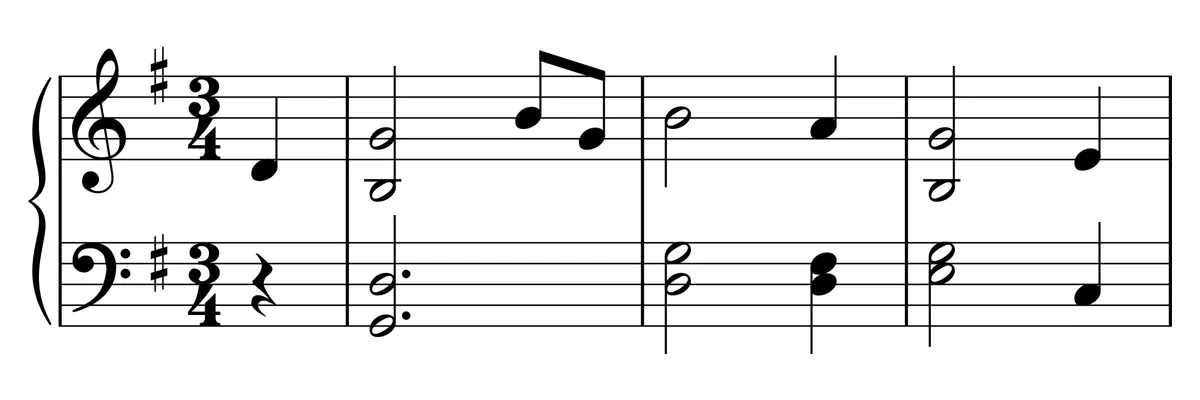
The whole 16-bar tune in G, with Beethoven's syncopation before the last line, over a left hand that follows his harmony: two-note chords, with single bass notes in bar 12.
- Right hand: the tune alone, one note at a time, between the D above middle C and the D an octave higher.
- Bars 12 and 13: Beethoven's rhythm. The B that starts the last line comes on beat 4 of bar 12 and is tied over the barline, as in the symphony. The source puts it on the downbeat of bar 13.
- Left hand, bars 1, 5 and 13: G and D held for the whole bar.
- Bars 2, 6 and 14: the little finger repeats D on every beat while fingers 1, 2, 3 and 4 walk down B, A, G, F♯, a tenth below the tune. These are Beethoven's chords over his held D: G, D7, G, D.
- Bars 3, 7 and 15: the bass steps G, F♯, G under a repeated D, for Beethoven's D chord on beat 3.
- Bar 4 resolves D–G to D–F♯ for the half cadence. Bars 8 and 16 end with D–C to G–B, the D7 to G cadence.
- Simplified: bars 1, 5 and 13 leave out Beethoven's passing chord on beat 3 (A minor over the held G), and in bars 4, 8 and 16 the left hand changes chord on beat 3, half a beat after his change on the tune's short note.
- Bars 9 and 10: D stays at the bottom for three beats, as in Beethoven's bass, then the hand moves to G–B on beat 4, where his bass moves to G. Bar 11 starts on D–F♯, then D♯–A gives his B7 chord, and in bar 12 the bass E, C♯, D follows his turn through E minor and A major back to D.
- Widest left-hand stretch: a seventh (D to C) in bars 8 and 16.
For teachers: For a student who plays hands together and reads two-note chords. Clap and count bars 12 and 13 before playing them: the B lands on beat 4 and is held through the next downbeat. In bar 12 the thumb moves from G down to the low D, then the hand returns to G position so finger 3 takes the B on beat 4. Practice that bar alone first.
Typed into PlayableNotes“Make a beginner version of Ode to Joy in C major so the right hand never leaves C position. Left hand single notes in C position, mostly long notes, and use the straight rhythm without the syncopation.”

What changed
The whole tune in C. The right hand stays on C–D–E–F–G with the thumb on middle C, and the left hand plays one note at a time, mostly long ones.
- Moved from G down to C major: no sharps or flats. The tune starts E E F G.
- Right hand: never leaves middle C position (C to G, thumb on middle C), with the source's straight rhythm in bars 12 and 13.
- Bar 12: the low G at the end of the third line is below the right hand's position, so the left-hand thumb plays it while the right hand rests.
- Left hand: whole and half notes in C position an octave lower, from the C below middle C up to G, except two quarter notes in bar 12. C for the C bars, G for the G (dominant) bars, and a held G in bars 9 and 10, where Beethoven's bass stays mostly on the dominant.
- Bar 11 ends on E, the root of Beethoven's E7 chord (B7 in G). Bar 12 is E and D in quarter notes, then a half-note G, for his A minor, D and G chords.
- Harmony simplified to one bass note per bar or half bar; the right hand carries the rest.
For teachers: For a first-year student who knows middle C position and can hold a note in one hand while the other moves. Bar 12 is the only place the hands take turns: the right hand plays C–D and the left-hand thumb takes the G. Practice bars 11 to 13 slowly until the G comes in on time.
Typed into PlayableNotes“I play for church. Write Ode to Joy as a four-part hymn setting for Joyful, Joyful, We Adore Thee, in G: soprano and alto in the right hand, tenor and bass in the left, with straight rhythms so the congregation can sing it.”


What changed
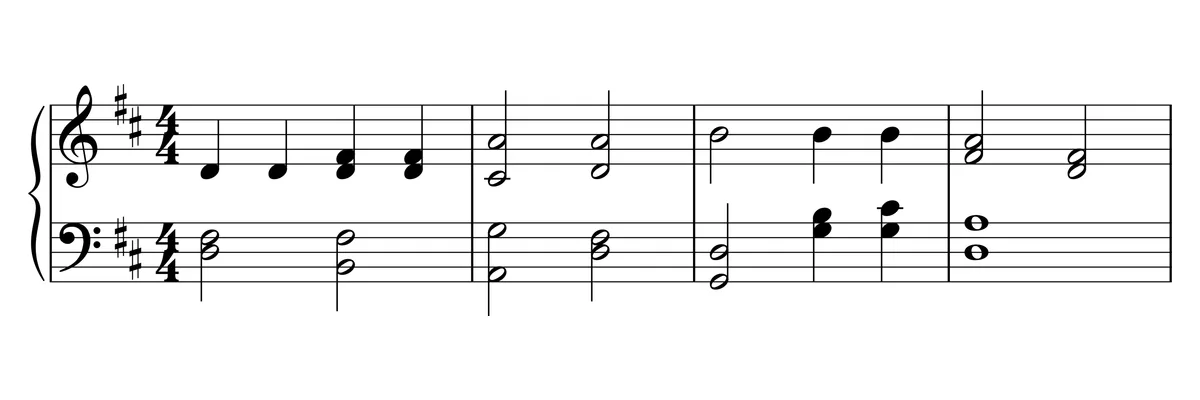
Soprano, alto, tenor and bass on two staves, as a hymnal prints them, on Beethoven's chords: the tune people sing as Joyful, Joyful, We Adore Thee.
- Four voices, printed as in a hymnal: soprano (the tune) and alto in the right hand, tenor and bass in the left, mostly in quarter notes.
- The tune is the source's, in G, with the straight rhythm in bars 12 and 13 (no syncopation).
- Harmony from Beethoven, voiced for four parts. The bass holds D under bars 2, 6 and 14 (G, D7, G, D above it, with alto and tenor kept within an octave of each other), and D7 with F♯ in the bass comes on beat 3 of bars 3, 7 and 15.
- Bars 9 and 10 sit over a D bass, as in the symphony. Bar 11 turns to B major and B7 over a D♯ held in the bass, and bar 12 goes through E minor and A7 to a D chord, with the alto joining the tune on its low D (one key, shared by both voices) and staying there into bar 13.
- Cadences: D7 to G in bars 8 and 16, where all four voices move with the tune's dotted rhythm, so the whole chord, bass included, changes to G on the short note. The last chord has a low G in the bass.
- Hand stretches: at most a sixth in the right hand and an octave in the left (D to D in bars 4 and 9 to 11, G to G in the last bar).
For teachers: For a church pianist or a student who is learning to read hymns. Play soprano and bass together first, then add the alto and tenor. When you lead singing, hold the half note at the end of each line for its full length, then lift briefly so the congregation can breathe before the next line.
Want it different? Just ask.
Open this version in PlayableNotes and ask for a change in words: simpler, another key, shorter, bigger notes. The result is a new version you can play, print and share with your student.
Free account. Changes, playback and printing are free; 50 free credits to read your own sheet music.
Watch how to ask for your own version · 1 min video
Make your own version
A real request in PlayableNotes, on Für Elise from the free library: say who it’s for and what to keep, and the AI writes a new version beside the original. It shows how to ask for a version of your own; its result is not one of the versions on this page.
About Ode to Joy
Ode to Joy is the main theme of the last movement of Beethoven's Ninth Symphony, first performed in Vienna in 1824. The soloists and chorus sing it to words from Friedrich Schiller's poem "An die Freude" ("To Joy"), but first the orchestra plays it on its own, starting quietly in the cellos and basses and building to the full orchestra. It is also the anthem of the European Union, played without words, and churches sing it as the hymn "Joyful, Joyful, We Adore Thee".
It is one of the first real tunes many piano students learn: 16 bars in four lines, with almost every note a step from the one before. In G it uses only G, A, B, C and D plus one low D, so the right hand can stay in one place apart from that low D. The hard parts are small: the dotted rhythm at the end of three of the lines, the drop to the low note in bar 12, and, in Beethoven's own version, a syncopation where the last line starts a beat early.
The source is the tune alone, with no accompaniment, so every left hand here was arranged from Beethoven's harmony in the full-orchestra statement of the theme. Where a version simplifies his chords or his bass, its notes say where and how.
Practice tips
- Sing or say the first line before you play it. Almost every note is a step from the one before, so once the shape is in your ear the hand follows.
- Three lines end with a dotted rhythm (bars 4, 8 and 16): count "one, two-and, three, four". The short note falls on the "and" of two, and the last note holds for beats 3 and 4.
- For the repeated notes that open every line (B B or A A in G; E E or D D in C), keep the finger on the key and let it rise just enough to play again, so both notes sound the same.
- Bar 12 is the only place the tune drops low. Loop bars 11 to 13 (click bar 11, then bar 13) and play them slowly until the low note and the climb back up are steady. In the beginner version, the left hand plays that note.
- Practice each hand alone with the Right and Left buttons at about 80; in the easy version, give bars 2, 6 and 14 extra time, where the left hand walks down under a repeated D. Then choose Both hands and raise the tempo a few beats at a time.
Questions about Ode to Joy
Who wrote Ode to Joy?
Ludwig van Beethoven wrote the tune for the last movement of his Ninth Symphony, first performed in Vienna in 1824. The words the chorus sings come from Friedrich Schiller's poem "An die Freude" ("To Joy"). The piano versions on this page have no words.
What are the piano notes for Ode to Joy?
In C major the first line is E E F G, G F E D, C C D E, then dotted E, short D, long D. The second line is the same but ends with dotted D, short C, long C. The third line is D D E C, D E-F E C, D E-F E D, C D G (the low G below middle C). Then the second line again. In G major the same tune starts B B C D. The beginner version on this page is the C major notes with a left hand.
What key is Ode to Joy in?
Beethoven wrote it in D major, which has two sharps. Easy piano books usually move it to C or G, which have fewer sharps to read (none in C, one in G). This page has it in C (beginner) and G (easy and hymn).
Is Ode to Joy easy to play on piano?
Yes. It is one of the first tunes many students learn: in C or G the right hand stays in one five-note position, apart from a single low note in bar 12. The beginner version gives that note to the left hand, so the right hand never moves at all.
Is Ode to Joy the same tune as Joyful, Joyful, We Adore Thee?
Yes. Henry van Dyke wrote the words of the hymn "Joyful, Joyful, We Adore Thee" in 1907 for Beethoven's tune, and hymnals name the tune HYMN TO JOY. The hymn setting on this page is in G for four voices. If your hymnal has it in another key, open it in PlayableNotes with a free account and ask for that key.
How fast should Ode to Joy be played?
Beethoven's metronome mark for this section is Allegro assai at 80 half notes (160 quarter notes) per minute, which is quick and lively. Learn it slowly, around 80 quarter notes per minute, and use the tempo slider to work up. About 100 suits the easy version and 96 the hymn setting.
Source and credits
- Composer
- Ludwig van Beethoven
- License
- Public Domain Mark 1.0
- Arranger
- PlayableNotes
The tune was checked note by note against the source's own MIDI, the Mutopia Project hymn setting (Mutopia-2009/08/05-528, public domain) and Beethoven's score (the CC0 full score, PDMX 4836125: the baritone's first sung statement and the violin and cello statements). Apart from small text-setting and bowing differences, it matches everywhere except bars 12 and 13, where Beethoven starts the last line a beat early, tied over the barline. The source straightens this, as most easy editions do. The easy version restores it; the beginner and hymn versions keep the straight rhythm. The source has no harmony: the chords come from the full-orchestra statement of the theme (bars 164 to 187 of the finale), cross-checked against a CC0 piano reduction of the movement (PDMX 192793). Schiller's words, which the source prints under the notes, are left out.
The full edition is also in the library: Ode to Joy, ready to play and edit.
Arrangements and facts checked