Free easy piano · Classical
In the Hall of the Mountain King, easy piano
Grieg's In the Hall of the Mountain King in four free piano versions: an easy version in the original key of B minor, a beginner version in A minor, the whole piece simplified for an intermediate player, and Grieg's own piano score. Play each one here, slow it down or loop a bar, then print the PDF or download the MIDI.
- Edvard Grieg
- Beginner to intermediate, plus the original
- 38 bars · 4/4
- Free: play, print, MIDI
Versions of In the Hall of the Mountain King. Each version is a request typed into PlayableNotes. Pick one to hear and print it.
Typed into PlayableNotes“Make In the Hall of the Mountain King easier for my second-year student. Keep it in B minor with Grieg's tune note for note, but move it up into the treble clef. Keep the staccato march bass in the left hand, nothing wider than an octave, and make it shorter: the theme, the answer, the loud ending and a short coda.”


What changed
Grieg's tune note for note in the treble clef, over his staccato march bass, with the loud ending: 38 bars at one steady tempo.
- Right hand: the tune two octaves higher than Grieg writes it, so it reads in the treble clef. In the original it starts on the B below the bass staff.
- Bar 1: the same two F-sharps as Grieg's opening octave, shared between the hands. Grieg plays both with the right hand while the left hand rests.
- Bars 14 to 17 repeat bars 10 to 13 at the same height; Grieg plays them an octave higher. The octaves on the long notes in bars 9 and 17 are his.
- Left hand: Grieg's staccato quarter notes, two octaves higher. B and F-sharp in the theme (D and A in bars 5, 9 and 21); F-sharp and C-sharp, or D and A-sharp, in the answer (bars 10 to 17); and his falling bass in bars 24 and 25: B, B, A, G, then F-sharp, E, D, C-sharp. The last note of bar 17 is the C-sharp below the F-sharp instead of above it, so the hand steps down to the B of bar 18.
- Bars 22 to 25 get a crescendo into the loud ending. Grieg stays pp here and builds through his bars 26 to 49, which this version leaves out (the tune in the middle register over left-hand turns and triplets).
- Bars 26 to 33 are Grieg's loud Più vivo, his bars 50 to 56, with his bar 73 as bar 33, so the second time the tune ends on B. The tempo stays the same.
- Bars 26 to 33, right hand: the tune an octave lower than Grieg's 8va, at the height of bars 6 to 9, and without the B he holds under it. Left hand: his falling bass, B, A, G, F-sharp (D, C-sharp, B, A in bar 29), as single notes; the first note of each group is the upper note of his octave.
- Bars 34 to 38 are Grieg's bars 74 to 77 and his last bar: two chord stabs, the rising phrase over G and F-sharp, and the final chord. The right-hand chords in bars 34, 35 and 38 are an octave lower than Grieg's 8va. The left-hand chords have two notes instead of three or four, and the bass octaves are single notes except in the last bar. The grace notes and Grieg's bars 78 to 87 (more stabs, the quiet repeated chords and the tremolo) are left out.
- Bar 38: the final chord is B and F-sharp in the left hand under D and B in the right, after the low B octave. Grieg's left hand has B, D, F-sharp and B.
For teachers: For a student who reads eighth notes and a key signature with two sharps. Learn bars 2 to 5 first: every other phrase is built from them. The left hand alternates two notes, so hands together comes quickly; in bars 10 to 17 it moves up close to the right hand. Bars 26 to 33 are the only place both hands move in eighth notes, so practice that left hand alone first.
Typed into PlayableNotes“Make a beginner version for my first-year student. Put it in A minor so there is no key signature, keep Grieg's tune, and keep the right hand in five-finger positions. Give the left hand single notes, mostly half notes, that hardly move. Nothing faster than eighth notes, no stretch wider than a sixth, and end with one loud chord.”


What changed
The tune in A minor with no key signature, the right hand in three five-finger positions, and a left hand that stays in one place: 26 bars.
- Moved down a whole step, from B minor to A minor: no key signature. The tune's own sharps and flats are printed where they occur: D-sharp and B-flat in bars 3, 7, 19 and 23, F-sharp and G-sharp in the answer (bars 10 to 17). A sharp is printed again when the same note comes back later in the bar.
- Bars 1 to 25 follow Grieg's bars 1 to 25: the opening note, the theme twice, the answer twice and the theme twice more, ending on the home note. Bar 26 is his last bar, the loud final chord, without the grace notes. Everything between them is left out.
- Bar 1: a single E in the right hand, where Grieg has an octave.
- Right hand: the tune note for note, always at the same height. Grieg plays bars 6 to 9, 14 to 17 and 22 to 25 an octave higher than the bars before them; here they repeat them. The long notes in bars 9 and 17 are single notes, not octaves.
- Right-hand positions: thumb on A for the start of each theme phrase, thumb on C from the middle of bars 4, 8, 20 and 24 (the little finger reaches the high A, a sixth above), and thumb on E for the answer, with the hand opening one key wider to reach C in bars 11, 13, 15 and 17.
- Left hand, bars 2 to 21: half notes in place of Grieg's staccato quarter notes, which alternate the home note and the fifth on every beat. A and E in the theme; in bars 3, 7 and 19 the second half note stays on A, which sounds cleaner under the B-flat than Grieg's fifth. C twice in bars 5, 9 and 21, the root of Grieg's chord there. In the answer, E twice, then C and E.
- Left hand, bars 22 to 25: Grieg's staccato quarter-note march, A and E on alternate beats, with a crescendo that is not in Grieg (he stays pp here). Bar 24 keeps that pattern where Grieg's bass starts to fall; bar 25 has the rest of his falling bass, E, D, C, B.
- The left hand never leaves one five-finger position, little finger on the A in the bottom space of the bass staff and thumb on the E above it. It plays one note at a time until the last chord: A, then A and E together under C and A in the right hand.
For teachers: For a first-year student who reads eighth notes and can play hands together over a slow left hand. Name the sharps and flats together before the first try: D-sharp and B-flat in bar 3, F-sharp and G-sharp from bar 10. Then show the hand moves, all on short staccato notes: up from A to C in the middle of bar 4 (E, C, E, A with fingers 3, 1, 3, 5), back to A for the next phrase, and down to E for the answer. In bar 25 the last note drops to the A where the thumb started, and the hand moves up again during the rest for the final chord, C and A with 1 and 5.
Typed into PlayableNotes“Keep the whole piece, all 88 bars in B minor with every note of the tune, but simplify the hardest parts for an intermediate student: the left-hand turns and triplets, the held notes and thickest chords in the fast section, and the tremolo. And make the low opening easier to read.”


What changed
All 88 bars with Grieg's tune, key, registers and build-up; only the hardest accompaniment figures, held notes and chords are made simpler.
- Bars 2 to 25: the left hand's low notes are printed an octave higher under 8vb lines, so they sound as Grieg wrote them but sit two ledger lines below the bass staff instead of six. The same applies to the first left-hand note of bars 26 and 88. The right hand is printed as Grieg wrote it, in the bass clef.
- Bars 26 to 41: the left hand's slurred sixteenth-note turn after each bass note becomes one staccato chord on beats 2 and 4.
- Bars 26 to 49, right hand: the notes Grieg adds under eighth notes are left out. Notes under the tune's quarter notes stay, written as chords.
- Bars 42 to 49: the left-hand triplets become steady eighth notes (bass note, fifth, upper note, fifth). In bars 48 and 49 the falling octaves are played without the B inside them.
- Bars 50 to 57 and 66 to 69: Grieg's B, held by the thumb under the tune, stays where the tune moves within a fifth of it. In bars 52, 56 and 68, where the tune climbs to the B an octave higher, it is held for the first half of the bar only.
- Bars 53, 57 and 69: the A and D held under the first half of the bar are left out, because the tune plays the same D; they come back for the second half.
- Bars 70 to 72: the B Grieg repeats under every note of the tune becomes a B held for each half bar (the first half only in bar 72). The notes between that B and the tune are left out too: the D under the F-sharp on beat 4 of bar 70, and the C-sharp and the C under the E-sharp and E on beats 2 and 4 of bar 71. Bar 73 is Grieg's top line alone, without the B under it.
- Bars 58 to 65, right hand: the tune's eighth notes are single notes, and its quarter and half notes have the F-sharp below them.
- Bars 58 to 65, left out: in bars 58 and 62, the F-sharp held through the first half of the bar, the C-sharp and F-sharp under beat 3 and the C-sharp under beat 4; in bars 60 and 64, the F-sharp repeated under the rising tune; and the lowest note (D, D-sharp or C-sharp) of each of Grieg's three-note chords.
- Bars 74 to 85: the four-note left-hand chords in bars 74, 78, 81 and 82 to 85 have three notes. They leave out the D, which the right hand plays, or in bar 81 the F-sharp, which is in the bass octave just before. The other left-hand chords already have three notes in Grieg.
- Bars 84 and 85: grace notes only before the first chord. Bars 86 and 87: the tremolo becomes alternating sixteenth notes.
For teachers: For a student around grade 4 who already plays octaves and reads 8va lines. The new skill is endurance: the Più vivo, bars 50 to 88, is high and fast for 39 bars. In bars 42 to 47 the left-hand eighth notes span a ninth or a tenth in each half bar, as in Grieg: finger them 5-2-1-2, let the hand turn toward the thumb, and use a little pedal on each half bar. From bar 50 the thumb holds B while the other fingers play the tune; where the tune reaches the B above, the thumb lets go at the half bar. Keep one steady tempo, around 90, until bar 88 is as clean as bar 2, then let it speed up from bar 34 as Grieg asks.
The piece as published: Mutopia Project no. 1888, typeset by Coyau from the University Society edition (New York, 1918, edited by A. Pero).
Original
What changed


What changed
Grieg's own piano version, Op. 46 No. 4, all 88 bars, from the Mutopia edition checked against the 1918 printing.
- Nothing beyond the corrections listed under Source and credits: this is the source edition, checked bar by bar against the 1918 printing. The bass tremolo in bars 86 and 87 is written out as alternating notes.
- Grieg's tempo directions are not shown in the score: Alla marcia e molto marcato (quarter note = 138), getting faster and louder from bar 34 (poco a poco più stretto e cresc.), Più vivo at bar 50, and faster still to the end (sempre stretto sin al fine). The edition's pedal marks are not shown either, and the player keeps one tempo throughout.
For teachers: The opening is easier to play than it looks: the hard part is reading the right hand in the bass clef and the left hand far below the staff. The fast section from bar 50 is where the work is; loop bars 58 to 65 and 82 to 88 on their own.
Want it different? Just ask.
Open this version in PlayableNotes and ask for a change in words: simpler, another key, shorter, bigger notes. The result is a new version you can play, print and share with your student.
Free account. Changes, playback and printing are free; 50 free credits to read your own sheet music.
Watch how to ask for your own version · 1 min video
Make your own version
A real request in PlayableNotes, on Für Elise from the free library: say who it’s for and what to keep, and the AI writes a new version beside the original. It shows how to ask for a version of your own; its result is not one of the versions on this page.
About In the Hall of the Mountain King
Grieg wrote it in 1874 and 1875 for the scene in Ibsen's Peer Gynt where Peer comes into the hall of the Mountain King and the trolls threaten him; the play was first staged in Christiania in 1876. He later put it in his orchestral Peer Gynt Suite No. 1, Op. 46 (1888), and arranged that suite for piano himself; that piano version is the original on this page. It is one four-bar tune in B minor, with an answering phrase on F-sharp, the dominant, played again and again. It starts very quietly, low in the bass, and climbs, getting louder and faster until it breaks off in loud chords.
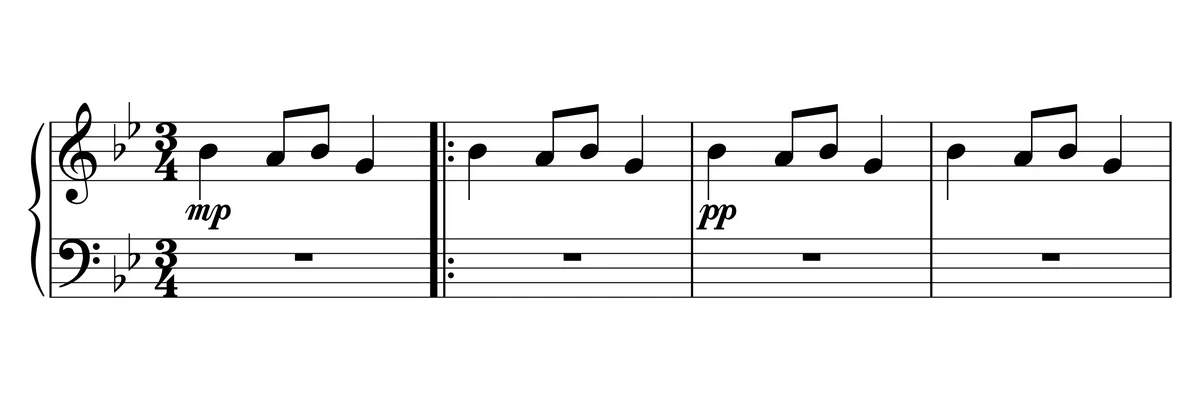
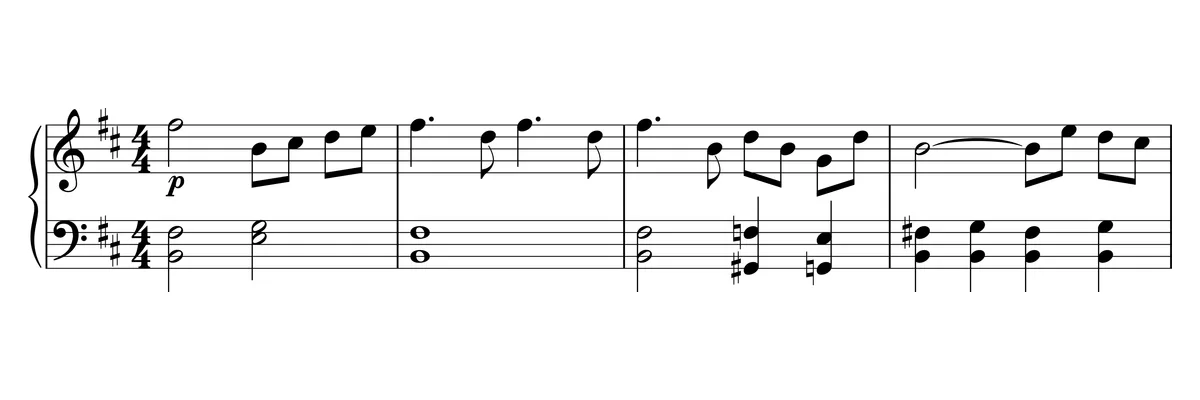
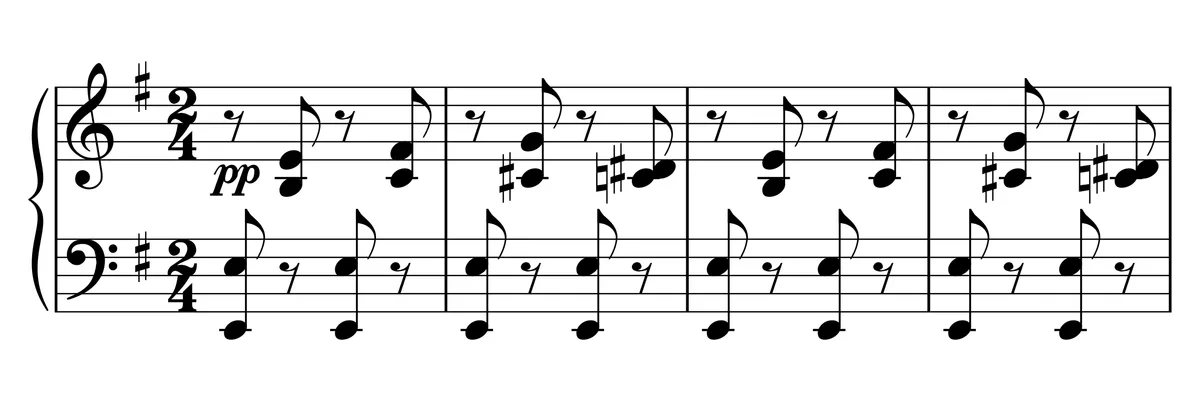
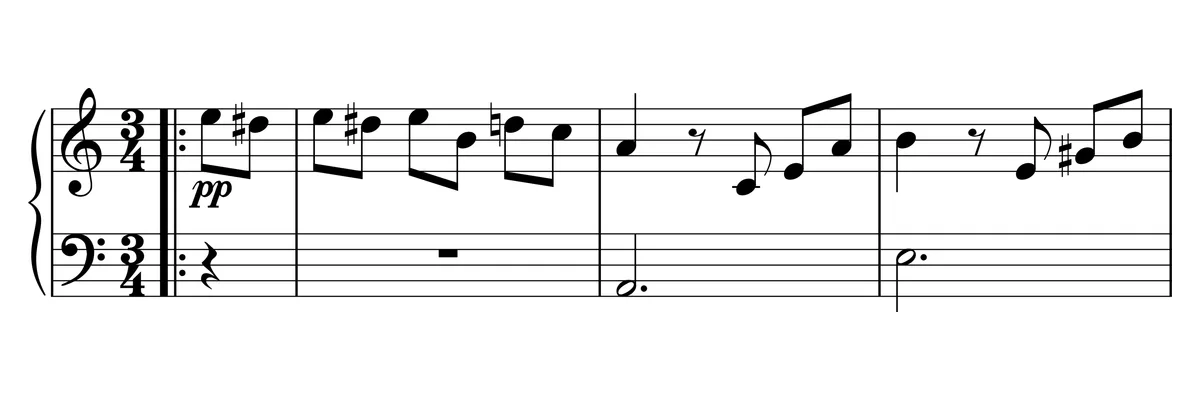
The tune itself is easy. In the original, the first 25 bars are easy to play but hard to read: the right hand reads in the bass clef and the left hand sits far below the staff. From bar 50 (Più vivo) it is fast, loud and high, mostly under 8va lines, with octaves, chords, grace notes and a tremolo. The easy version keeps Grieg's key, writes the tune in the treble clef over his march bass and then goes straight to the loud ending. The beginner version is in A minor, with five-finger positions and a left hand that stays in one place, and ends after the first 25 bars with one loud chord.
For a student who wants the whole piece, the intermediate version keeps all 88 bars, Grieg's key and every note of the tune, and simplifies only the hardest accompaniment figures, held notes and chords. The original is here too, so you can hear exactly what each version changed.
Practice tips
- Play everything short and quiet at first. Grieg marks the opening pp e sempre staccato, very soft and always detached, and the effect of the piece depends on saving the loud playing for the end.
- Bar 3 is the trickiest bar of the theme: it slides down by half steps, E-sharp (the same key as F) with C-sharp, then E and C natural (D-sharp, B, D, B-flat in the beginner version). Loop bar 3 alone until the fingers find the white and black keys without looking.
- Learn the four-bar phrase in bars 2 to 5 first. Nearly everything after it is the same phrase again, or the four-bar answer that starts in bar 10.
- Keep one steady tempo while you learn it: the easy version starts at 80 and the beginner version at 72, and you can set the tempo slider slower. Only when the whole version is secure, start slower and get faster toward the end, as Grieg asks.
- Practice the left hand alone in the loud section (bar 26 in the easy version, bar 50 in the original): B, A, G, F-sharp, twice in most bars, with an accent on each B.
Questions about In the Hall of the Mountain King
What is In the Hall of the Mountain King from?
From Peer Gynt, Henrik Ibsen's play, for which Grieg wrote the incidental music, Op. 23, first performed in 1876. It plays in the scene where Peer comes into the hall of the Mountain King and the trolls threaten him. Grieg later put it in his orchestral Peer Gynt Suite No. 1, Op. 46, and arranged that suite for piano himself; that piano version is the original on this page.
Is In the Hall of the Mountain King hard to play on piano?
The opening of Grieg's piano version is easy to play but hard to read: the right hand reads in the bass clef and the left hand sits far below the staff. From bar 50 it is fast, loud and high, with octaves, chords and grace notes. The easy and beginner versions on this page put the tune in the treble clef over a simple left hand.
Which version should a beginner play?
The beginner version: it is in A minor with no key signature, the right hand plays in five-finger positions, and the left hand stays in one position, playing one note at a time, mostly half notes. When that is secure, the easy version adds Grieg's key of B minor, his staccato march bass and the loud ending.
What key is In the Hall of the Mountain King in?
B minor, with two sharps in the key signature. The answering phrase sits on F-sharp, the dominant. The beginner version on this page is in A minor, which has no key signature, so only the tune's own sharps and flats are printed.
How fast should In the Hall of the Mountain King be played?
Grieg marks it Alla marcia e molto marcato, quarter note = 138 in this edition, then asks it to get faster and faster from bar 34, with a Più vivo at bar 50. Learn it much slower, at one steady tempo; the easy version starts at 80 here and the beginner version at 72, and you can change the tempo in the player.
Can I download In the Hall of the Mountain King as a PDF or MIDI file?
Yes, free and without an account. Every version has a Letter-size PDF to print and a MIDI file with the right and left hands on separate tracks.
Source and credits
- Composer
- Edvard Grieg
- Source edition
- Mutopia Project no. 1888, typeset by Coyau from the University Society edition (New York, 1918, edited by A. Pero)
- License
- Public domain
- Arranger
- PlayableNotes
Notes checked bar by bar against the 1918 University Society edition and two independent transcriptions. Wrong notes, accidentals and bass notes in the Mutopia text were corrected in bars 25, 27, 31, 43, 45, 47, 57, 60, 64, 65, 68, 69, 75, 79 and 81. Marks that the 1918 edition prints and the Mutopia text leaves out were added: the accent in bar 63, the p in bar 26 and the staccato dots on the left hand in bars 10 to 17. The bass tremolo in bars 86 and 87 is written out as alternating notes.
Arrangements and facts checked