Free easy piano · Beginner songs
Row, Row, Row Your Boat, easy piano
Row, Row, Row Your Boat in four free piano versions in C: the right hand alone, a beginner version with long left-hand notes, an easy version with a rocking left hand, and the round itself, one hand chasing the other. Play each one here, slow it down, then print the PDF or download the MIDI.
- Traditional American
- Beginner to easy
- 8 bars · 6/8
- Free: play, print, MIDI
Versions of Row, Row, Row Your Boat. Each version is a request typed into PlayableNotes. Pick one to hear and print it.
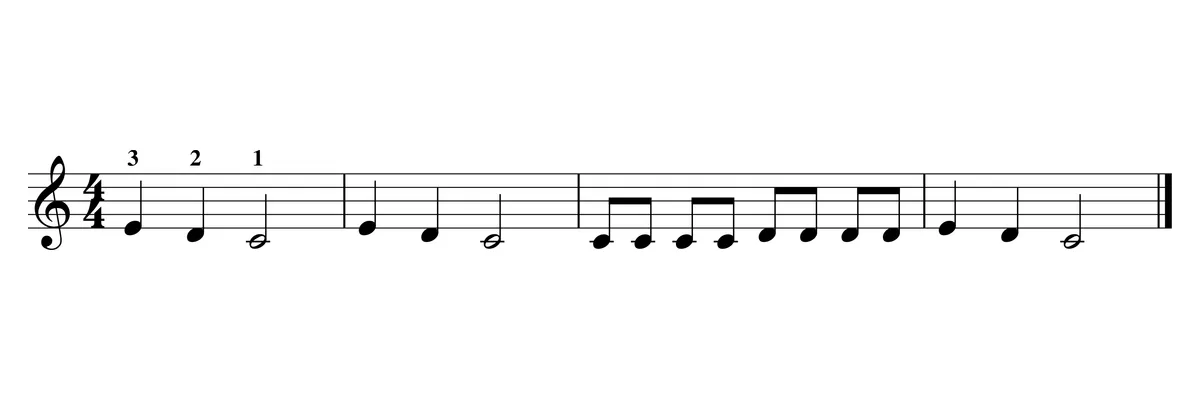
Typed into PlayableNotes“Make a first-lesson version: right hand only, in C, starting in C position with the thumb on middle C, with finger numbers and the one hand move marked.”

What changed
The tune for the right hand alone: C position with the thumb on middle C, and one move up to G position for the "merrily" bar.
- Right hand only, in C major, in 6/8.
- Bars 1 to 4 and 6 to 8: C position, thumb on middle C (C 1, D 2, E 3, F 4, G 5).
- Bar 5: the thumb moves up to G, so finger 4 plays the high C and the thumb the G's. In bar 6 the hand goes back to C position for E E E, C C C.
- Finger numbers on most notes, including the move in bars 5 and 6.
For teachers: For a student who has played a few five-finger pieces and is meeting 6/8. Count "one-two-three, four-five-six" and clap the first four bars before playing them. Practice bars 4 to 6 alone: the move up to G and back is the only hand move in the piece.
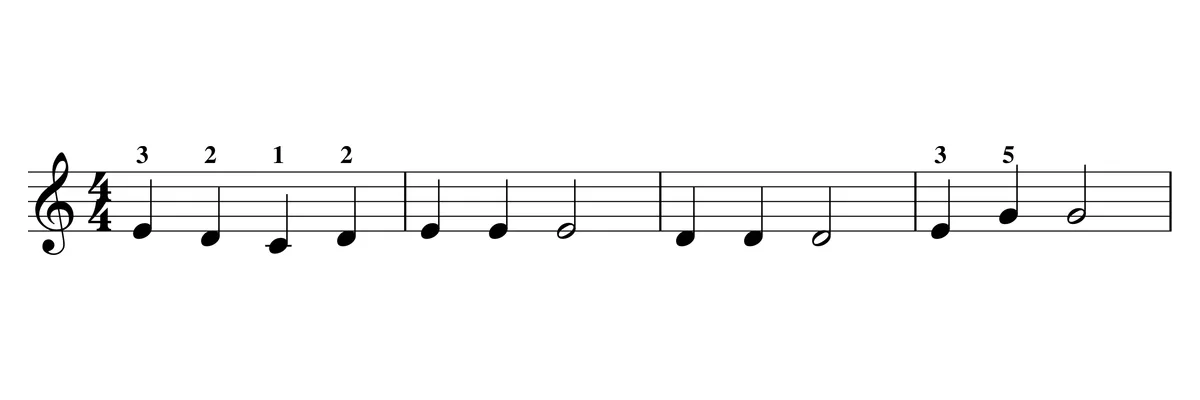
Then typed, on “First lesson: right hand only, in C”“Now add a left hand for a beginner: single notes, C and G below middle C, one or two long notes a bar.”

What changed
The same right hand over long left-hand notes on C and G, one or two a bar, always on a main beat.
- Right hand: as in the first-lesson version, without finger numbers.
- Left hand: only C an octave below middle C (little finger) and the G above it (thumb), so the hand never moves.
- Bars 1, 4 and 8: C held for the whole bar. Bars 2, 3, 5 and 6: C on the first beat, G on the second, each a dotted quarter.
- Bar 7: G held for the whole bar, for the G chord before the last note.
For teachers: For a student who can play the right hand alone. Each left-hand note starts on one of the bar's two main beats, together with a right-hand note. Play the left hand alone first, counting six eighths in each bar.
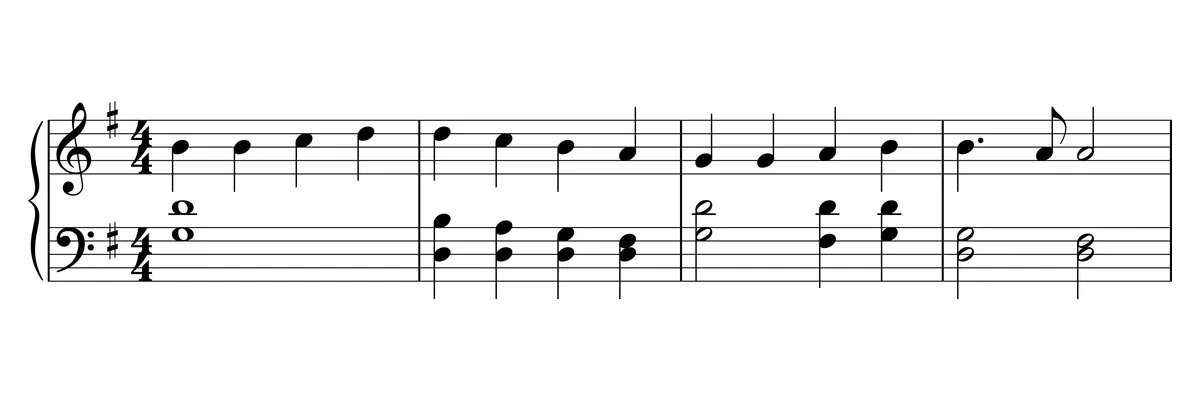
Typed into PlayableNotes“Make an easy version with a rowing left hand: broken chords in eighth notes, two strokes a bar, still in C.”

What changed
The tune over a left hand that climbs a broken C chord twice a bar in eighth notes, with the G chord in bar 7 and a held C chord at the end.
- Right hand: the tune as in the other versions.
- Left hand, bars 1 to 6: C, E, G in eighth notes, twice a bar.
- Bar 7: G, B, D, then G, B, F, the G seventh chord before the last note.
- Bar 8: C–E–G held as a chord.
- Widest stretch: G up to F (a seventh) in bar 7; everywhere else a fifth.
For teachers: For a student who can play steady eighth notes. Practice the left hand alone until it rocks evenly (C-E-G, C-E-G), then add the right hand one bar at a time. In bars 5 and 6 the right hand plays eighths too, so the hands move together on every note.
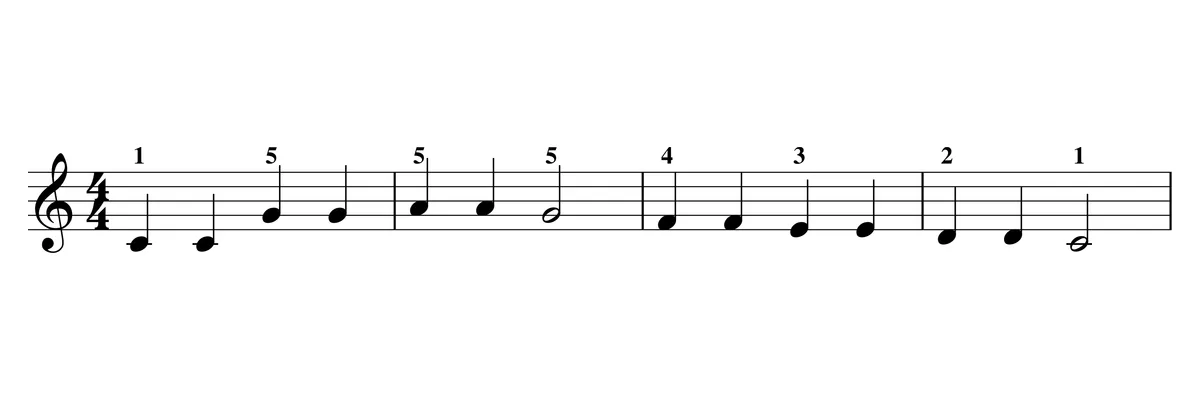
Typed into PlayableNotes“Make it a round for one player: the right hand plays the tune, and the left hand plays the same tune an octave lower, starting two bars later.”

What changed
The song as a round: the right hand starts, the left hand comes in two bars later with the same tune an octave lower, and the hands finish together.
- Right hand: the tune in bars 1 to 8, as in the other versions.
- Left hand: rests in bars 1 and 2, then plays the same tune an octave lower, from bar 3 to bar 10.
- Bars 9 and 10: added for the right hand while the left hand finishes its last line: a held G, then E, over the left hand's G F E D and C.
- Left hand fingering: little finger on the C below middle C. For its "merrily" bar (bar 7) the hand moves up so the thumb takes middle C, and comes back for bar 8. Its finger numbers are marked at the start and at the move.
For teachers: For a student who can already play the tune with each hand alone. Learn the left hand by itself (it is the tune, an octave lower), then put the hands together slowly: they play different bars of the same song, so listen for the two lines answering each other.
Compare the 4 versions
Level, key, bars, hands
| Version | Level | Key | Bars | Right hand | Left hand |
|---|---|---|---|---|---|
| First lesson, right hand in C | Beginner | C major | 8 | Single notes, spans an octave | Nothing to play |
| Beginner version in C, both hands | Beginner | C major | 8 | Single notes, spans an octave | Held single notes, one five-finger position |
| Easy version in C, rocking left hand | Easy | C major | 8 | Single notes, spans an octave | Mostly single notes, spans an octave |
| Round for two hands in C | Easy | C major | 10 | Single notes, spans an octave | Single notes, spans an octave |
Want it different? Just ask.
Open this version in PlayableNotes and ask for a change in words: simpler, another key, shorter, bigger notes. The result is a new version you can play, print and share with your student.
Free account. Changes, playback and printing are free; 50 free credits to read your own sheet music.
Watch how to ask for your own version · 1 min video
Make your own version
A real request in PlayableNotes, on Für Elise from the free library: say who it’s for and what to keep, and the AI writes a new version beside the original. It shows how to ask for a version of your own; its result is not one of the versions on this page.
Transcript
Make piano music easier to play. Start from your own photo or PDF. Reading costs 1 credit per line of music. Or pick a piece from the free library. Open Für Elise and click Edit a copy. Your copy. Each change is a new version. Say what your student needs, in plain words. “Make this easier for a second-year student: keep the melody, one held left-hand note per bar, no leaps bigger than an octave.” The AI writes a new version. Sped up: the real wait was 1 min 43 s. “I simplified the left hand to one held note per bar and reduced right-hand chords to the melody.” Same melody here. One held left-hand note per bar. Saved as Version 2, with your request. The original is still here. Hear it first. Back to Version 2, and press Play. Notes light up as they sound. Try it free: 50 credits. playablenotes.com Library pieces, AI edits and playback are free.
Row, Row, Row Your Boat piano notes in letters
Right hand of the Beginner version in C, both handsBeginnerShow this version
Letter notes phrase by phrase. This is the melody only: the left hand and any chords are in the sheet music. Use the letters to learn the tune, then read it from the score.
The tune starts on middle C. The small number after a line’s first letter is its octave: middle C is C4, and the C above it starts octave 5. Each next letter is the nearest key with that name, unless an arrow says to jump up or down a fifth or more. Sharps and flats are written on every note that has one.
- C4CCDEEDEFG
- C5CCGGGEEECCC↑GFEDC
About Row, Row, Row Your Boat
The words were first printed in 1852, with a different tune. The melody sung today first appears with them in 1881, in The Franklin Square Song Collection, which mentions Eliphalet Oram Lyte without making clear whether he wrote the tune or adapted it. It is usually sung as a round, for up to four voices, each starting two bars after the one before.
It is in 6/8: two beats a bar, each split into three eighth notes, which gives the song its rocking, rowing feel. That rhythm is the main thing to learn. The notes are simple, all white keys in C and mostly steps, but the tune spans a full octave: it climbs from middle C to G, then jumps to the C above for the "merrily" line, so the right hand has to move once.
These versions were written out by PlayableNotes from the traditional tune. The round version plays the song as it is meant to be sung: the right hand starts, the left hand comes in two bars later with the same tune an octave lower, and the two parts fit together.
Practice tips
- Count six eighth notes in every bar and clap bars 1 to 3 first: a dotted quarter lasts three eighths, a quarter two, an eighth one.
- In bars 2 and 3 the D in the middle is a single eighth note: it comes quickly between two longer notes.
- Keep the "merrily" eighth notes in bars 5 and 6 even and light, three to each beat.
- Move the hand up for bar 5 during the long G in bar 4, so the finger is on the high C before it is needed.
- Start around 70 with the tempo slider and work up: the song should rock gently, not race.
Questions about Row, Row, Row Your Boat
What are the piano notes for Row, Row, Row Your Boat?
In C major: C C, C D E, E D E F, G; then the high C three times, G G G, E E E, C C C (the "merrily" line); then G F E D, C. The first-lesson version on this page has these notes with their 6/8 rhythm and finger numbers.
What time signature is Row, Row, Row Your Boat in?
6/8: two main beats a bar, each divided into three eighth notes. Count "one-two-three, four-five-six", with the stress on one and four.
How do you play Row, Row, Row Your Boat as a round on piano?
One player can do it with the round version on this page: the right hand plays the tune and the left hand plays it an octave lower, starting two bars later. With more players or singers, each one starts two bars after the one before, up to four parts.
Who wrote Row, Row, Row Your Boat?
Nobody is sure. The words were printed in 1852 with a different tune, and today's melody first appears with them in 1881, in The Franklin Square Song Collection, which mentions Eliphalet Oram Lyte without saying whether he composed or adapted it. It is in the public domain.
Is Row, Row, Row Your Boat easy on piano?
The notes are easy: white keys in C, mostly steps. Two things take practice: the 6/8 rhythm, and the jump to the high C in the middle, the only place the right hand moves.
Source and credits
- Composer
- Traditional American
- Source edition
- Traditional tune (with these words since The Franklin Square Song Collection, New York, 1881), written out by PlayableNotes
- License
- Public domain
- Arranger
- PlayableNotes
There is no single source edition. The melody is the standard one in 6/8, in C. The song is a round, so it needs almost no harmony: the left hands here keep to the C chord, with the G chord in bar 7. The words are left out.
Arrangements and facts checked