Free easy piano · Beginner songs
Hot Cross Buns, easy piano
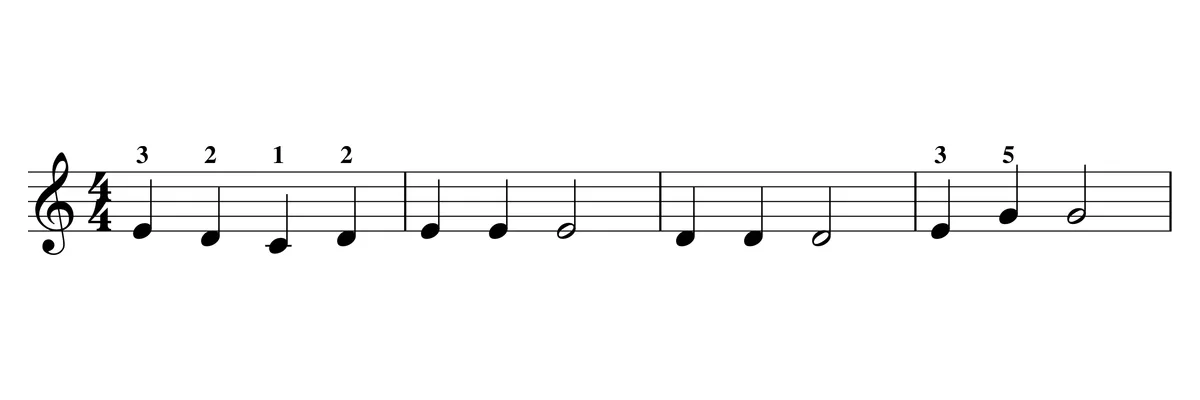
Hot Cross Buns on piano is E D C, E D C, C C C C D D D D, E D C, with the thumb on middle C. Here it is in three free versions in C: three fingers for a very first lesson, a beginner version with a left hand on C and G, and an easy version with left-hand chords. Play each one, then print the PDF or download the MIDI.
- Traditional English
- Beginner to easy
- 4 bars · 4/4
- Free: play, print, MIDI
Versions of Hot Cross Buns. Each version is a request typed into PlayableNotes. Pick one to hear and print it.
Typed into PlayableNotes“Make a very first piece: right hand only, thumb on middle C, just fingers 1, 2 and 3, with finger numbers.”

What changed
The tune for the right hand alone on three keys, E, D and C, with the thumb on middle C.
- Right hand only, in C major: E, D and C, fingers 3, 2 and 1, thumb on middle C.
- Bars 1, 2 and 4: E and D in quarter notes, then C as a half note.
- Bar 3: eight eighth notes, four C's then four D's.
- Finger numbers in bar 1; the fingers stay on the same keys to the end.
For teachers: For the very first lesson, or a student who has just found middle C. Clap bar 3 first, saying "one-a-pen-ny, two-a-pen-ny", then play it with the thumb and finger 2.
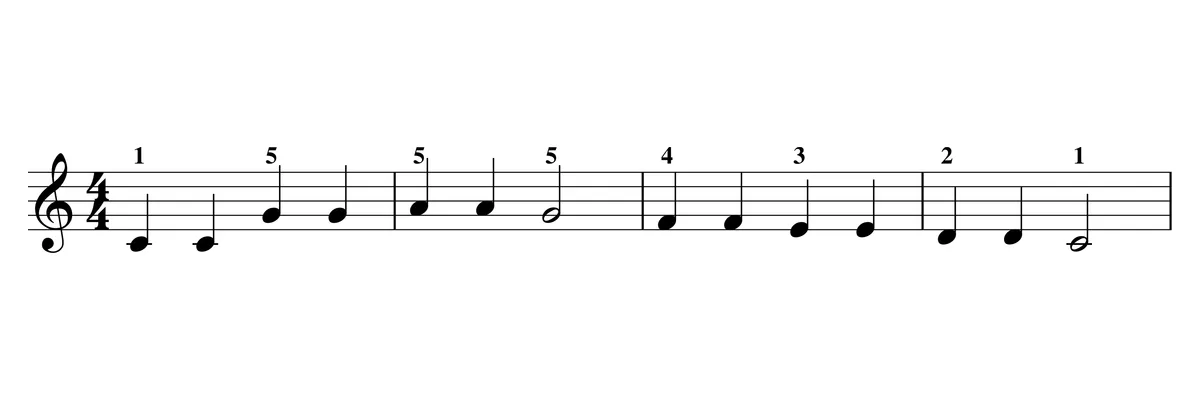
Then typed, on “First lesson: right hand only, three fingers”“Now add a left hand: one note at a time, only C and G below middle C.”

What changed
The same right hand with a left hand that plays only C and G below middle C: whole notes, then half and quarter notes.
- Right hand: as in the first-lesson version, without finger numbers.
- Left hand: C an octave below middle C (little finger) and the G above it (thumb).
- Bars 1 and 2: a whole-note C under the tune.
- Bar 3: C under the four C's, G under the four D's, in half notes.
- Bar 4: C, G, C, so the left hand moves with the right hand's E, D, C.
For teachers: For a student who can play the right hand alone. Bar 4 is the first place both hands move together on every note: play it slowly, hands together, until the two hands land at the same moment.
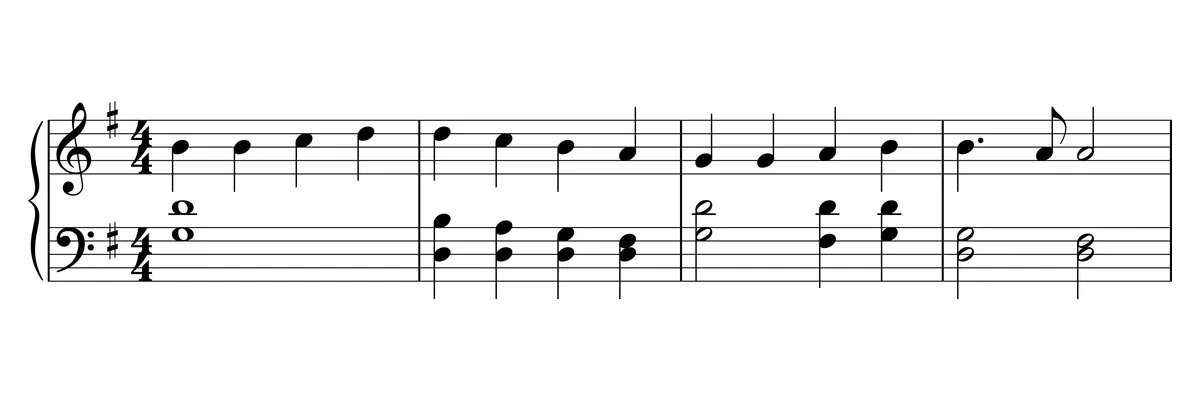
Typed into PlayableNotes“Make an easy version: the same tune in C, and give the left hand three-note chords, C and G, changing with the tune.”

What changed
The tune over three-note chords in the left hand, C–E–G and B–D–G (the C and G chords), changing with the tune.
- Right hand: the tune as in the other versions.
- Left hand: C–E–G under the C's and E's, and B–D–G under the D's: the G chord with B at the bottom, so only the little finger and finger 3 move down one key and the thumb stays on G.
- Bars 1, 2 and 4: C chord, G chord, then the C chord held for two beats.
- Bar 3: the C chord for two beats under the C's, the G chord for two beats under the D's.
- Fingering for both chords: 5, 3 and 1.
For teachers: For a student who has played the beginner version and is learning three-note chords. Practice the change from C–E–G to B–D–G with the left hand alone, slowly, until all three notes go down together.
Compare the 3 versions
Level, key, bars, hands
| Version | Level | Key | Bars | Right hand | Left hand |
|---|---|---|---|---|---|
| First lesson, right hand on C, D and E | Beginner | C major | 4 | Single notes, one five-finger position | Nothing to play |
| Beginner version in C, both hands | Beginner | C major | 4 | Single notes, one five-finger position | Held single notes, one five-finger position |
| Easy version in C, left-hand chords | Easy | C major | 4 | Single notes, one five-finger position | Chords to a sixth, spans a sixth |
Want it different? Just ask.
Open this version in PlayableNotes and ask for a change in words: simpler, another key, shorter, bigger notes. The result is a new version you can play, print and share with your student.
Free account. Changes, playback and printing are free; 50 free credits to read your own sheet music.
Watch how to ask for your own version · 1 min video
Make your own version
A real request in PlayableNotes, on Für Elise from the free library: say who it’s for and what to keep, and the AI writes a new version beside the original. It shows how to ask for a version of your own; its result is not one of the versions on this page.
Transcript
Make piano music easier to play. Start from your own photo or PDF. Reading costs 1 credit per line of music. Or pick a piece from the free library. Open Für Elise and click Edit a copy. Your copy. Each change is a new version. Say what your student needs, in plain words. “Make this easier for a second-year student: keep the melody, one held left-hand note per bar, no leaps bigger than an octave.” The AI writes a new version. Sped up: the real wait was 1 min 43 s. “I simplified the left hand to one held note per bar and reduced right-hand chords to the melody.” Same melody here. One held left-hand note per bar. Saved as Version 2, with your request. The original is still here. Hear it first. Back to Version 2, and press Play. Notes light up as they sound. Try it free: 50 credits. playablenotes.com Library pieces, AI edits and playback are free.
Hot Cross Buns piano notes in letters
Right hand of the First lesson, right hand on C, D and E, in C majorBeginnerShow this version
Letter notes phrase by phrase. This is the melody only: the left hand and any chords are in the sheet music. Use the letters to learn the tune, then read it from the score.
The tune starts on the E above middle C. The small number after a line’s first letter is its octave: middle C is C4, and the C above it starts octave 5. Each next letter is the nearest key with that name, unless an arrow says to jump up or down a fifth or more. Sharps and flats are written on every note that has one.
- E4DC2 times
- C4CCCDDDDEDC
About Hot Cross Buns
Hot Cross Buns began as a London street cry, sung by sellers of the spiced buns eaten on Good Friday. A version of the cry is recorded in Poor Robin's Almanack for 1733, and words close to today's were printed as a round in 1767. From the nursery it moved into music classrooms, where it is still one of the first tunes children play on a new instrument.
The tune is four bars long and uses three keys, E, D and C, played by fingers 3, 2 and 1 of the right hand. The only new thing is bar 3, where the eighth notes (four C's, four D's) go twice as fast as the quarter notes. Several melodies have been sung to these words; this is the three-note one most method books use.
These versions were written out by PlayableNotes from the traditional tune. The first-lesson version is the tune alone; the beginner version adds a left hand that only plays C and G; the easy version gives the left hand a three-note chord each time the harmony changes.
Practice tips
- Before you play, put fingers 3, 2 and 1 on E, D and C and leave them there: the hand never moves.
- Clap bar 3 while saying "one-and-two-and, three-and-four-and": the eighth notes are exactly twice as fast as the quarter notes, not just a little faster.
- Hold each half note for two full beats before the next bar starts.
- Start slowly with the tempo slider, then try it a few beats faster each time it feels easy.
Questions about Hot Cross Buns
What are the piano notes for Hot Cross Buns?
E D C, E D C, C C C C D D D D, E D C. In C major these are three neighboring white keys, played with fingers 3, 2 and 1 of the right hand, thumb on middle C.
Why is Hot Cross Buns used for first piano lessons?
It uses three keys and three fingers, it is four bars long, and the only rhythm beyond quarter and half notes is one bar of eighth notes. A student can learn it in one lesson and play it hands together soon after.
Where does Hot Cross Buns come from?
It was an English street cry, sung by sellers of hot cross buns, which are eaten on Good Friday. It is recorded in London in 1733 and was printed as a round in 1767. It is traditional and in the public domain.
Is there more than one Hot Cross Buns tune?
Yes, several melodies have been sung to the words. The three-note tune on this page (E D C) is the one most method books and school music classes use.
Can I print Hot Cross Buns for free?
Yes, without an account. Every version on this page has a Letter-size PDF to print and a MIDI file to download.
Source and credits
- Composer
- Traditional English
- Source edition
- Traditional English tune (London street cry, recorded 1733), written out by PlayableNotes
- License
- Public domain
- Arranger
- PlayableNotes
There is no single source edition. The melody is the three-note tune (E D C) used in schools and method books, in C, with the standard C and G chords. The words are left out.
Arrangements and facts checked