Free easy piano · Classical
Canon in D, easy piano
Pachelbel's Canon in D in four free versions: an easy version in D major (all 49 bars, no sixteenth notes), a beginner version in G, a two-minute wedding version and a fuller intermediate one. Play each one here, slow it down or loop a bar, then print the PDF or download the MIDI.
- Johann Pachelbel
- Beginner to intermediate
- 49 bars · 4/4
- Free: play, print, MIDI
Versions of Canon in D. Each version is a request typed into PlayableNotes. Pick one to hear and print it.
Typed into PlayableNotes“Make Canon in D easy for my second-year student. Keep it in D major with every bar and the tune as they are, but no sixteenth notes, and give the left hand something easier than the broken chords that still keeps moving under the long notes.”


What changed
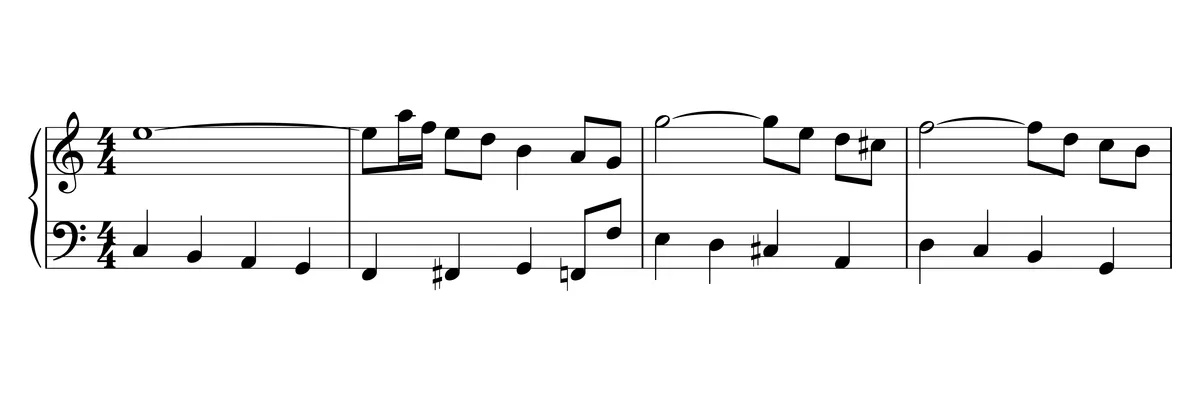
All 49 bars in D major, from the slow opening to the dotted tune, with steady eighth notes in place of the fast run.
- Left hand, bars 1 to 12, 29 to 36 and 45 to 48: two quarter notes per bass note, the bass and then the third of its chord, or the fifth where the right hand already has the third.
- Two exceptions: in bar 12 the A is held for two beats, to round off the tune in thirds before the next variation, and in bar 46 the F-sharp takes C-sharp, because the usual A would make parallel fifths with the melody.
- In bars 1 to 12 this replaces the source's broken chords in eighth notes; in bars 29 to 36 and 45 to 48, where the source has the bass alone, it keeps the music moving under the long notes.
- Left hand, bars 13 to 28 and 37 to 44: the bass alone in half notes, as in the source, so the hand rests while the right hand is busy.
- Right hand, bars 37 to 44: the sixteenth-note run in steady eighths. Beats 1 and 2 keep Pachelbel's eighth notes, with a note of his figure between them (A, F-sharp, A, G in bar 37).
- In the second half of those bars the eighths follow the shape of his run: the octave drop in bar 37, the climb to the high A in bar 40, the drop and climb back to D in bar 42.
- Right hand, bars 5 to 36 and 45 to 48: as in the source, including the octave jumps in bars 21 and 22 and the high B, C-sharp and D in bars 31 to 33.
- Bar 36, beat 2 is G, correcting a wrong note in the source (see Source and credits).
- The repeat of bars 45 to 48 stays, as in the source.
- Last bar: a full D major chord (F-sharp, A, D over D and A) with a pause, instead of two single notes.
- No stretch wider than a sixth in either hand.
For teachers: For a student who reads eighth notes in two sharps. Learn the left hand's eight-note bass first: it never changes, so once it is in the fingers every new variation is only a right-hand job. Bars 21 to 28 are the place to slow down.
Typed into PlayableNotes“Make a beginner version for my student in her first year: G major, one note at a time in each hand, the left hand just the bass in half notes, and keep it under 30 bars.”

What changed
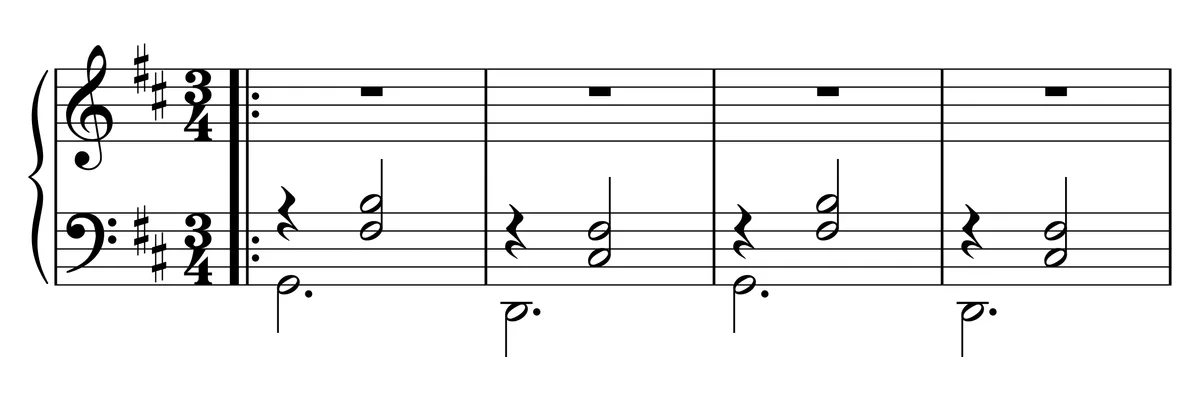
The opening tune and the high melody in G major, over the bass in half notes: 21 bars.
- Moved from D major to G major: one sharp (F-sharp) instead of two.
- Left hand: only the bass, G D E B C G C D in half notes, ending on a low G; all on the staff with no ledger lines.
- 21 bars: the bass alone (bars 1 to 4), the opening tune in half notes (5 to 8), the high melody from the source's bars 29 to 36 (9 to 16), the opening tune again (17 to 20) and a held G to finish.
- Bar 9 repeats the B instead of leaping up to it from the B below the staff, as the source does.
- Left out: the tune in thirds, the quarter-note tune, the eighth-note and sixteenth-note variations and the dotted tune.
- Right hand: one note at a time, quarter notes at the fastest, between the D above middle C and the G just above the staff; no ledger lines in either hand.
- Bar 13 keeps Pachelbel's octave drop (G down to G), the widest move in either hand.
For teachers: Have the student play the left hand alone through bars 1 to 4 first; it is the whole bass of the piece. The opening tune (bars 5 to 8 and 17 to 20) runs six notes, B down to D: start with finger 5 on B and move the thumb from E down to D in bar 7 (and 19). After that each phrase sits in one hand position, and the hand moves after a long note, a rest or the leap: up to G for bar 9, up to C for bar 11, down an octave in bar 13 and back to G in the rest in bar 15. The one exception is the last move, straight after the quarter-note D that ends bar 16: down so that finger 5 is on B for bar 17. Mark those spots and practice them on their own.
Typed into PlayableNotes“My student is playing Canon in D at her sister's wedding. Make a short version, about two minutes, not too hard, with a repeat we can take again if the walk is long and a proper ending.”


What changed
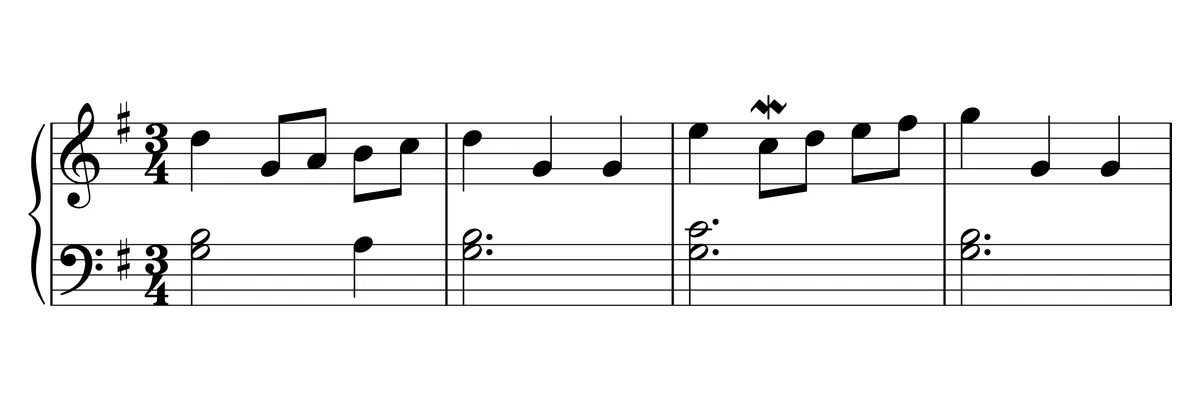
The opening, the high melody and the dotted tune in D major: about two minutes with the repeat, ending on a held D major chord.
- 25 bars: the bass alone (1 to 4), then a repeated section with the opening tune (5 to 8), the tune in thirds (9 to 12), the high melody (13 to 20) and the dotted tune (21 to 24), then a final chord.
- Bars 5 to 24 are the easy version's bars 5 to 12, 29 to 36 and 45 to 48; the quarter-note, eighth-note and sixteenth-note variations are left out.
- Left hand: two quarter notes per bass note, the bass and then the third of its chord, or the fifth where the right hand already has the third.
- In bar 12 the A is held for two beats, to round off the tune in thirds before the high melody, and in bar 22 the F-sharp takes C-sharp, because the usual A would make parallel fifths with the melody.
- Bar 25 is the easy version's last bar, not in the source: a D major chord in both hands with a pause, so the music ends instead of stopping.
- About two minutes at 84 with the repeat. For a longer walk, take the repeat again; to finish, play through to bar 24 and go on to bar 25 instead of repeating.
For teachers: Rehearse the ending as much as the beginning: bar 24 into bar 25, slowing a little in bar 24. The high notes in bars 15 to 17 (B, C-sharp and D above the staff) are the spot to check before the day.
Typed into PlayableNotes“Make it fuller and closer to Pachelbel for a grade 4 student: a flowing left hand, more harmony under the high melody, and keep the fast variation.”


What changed
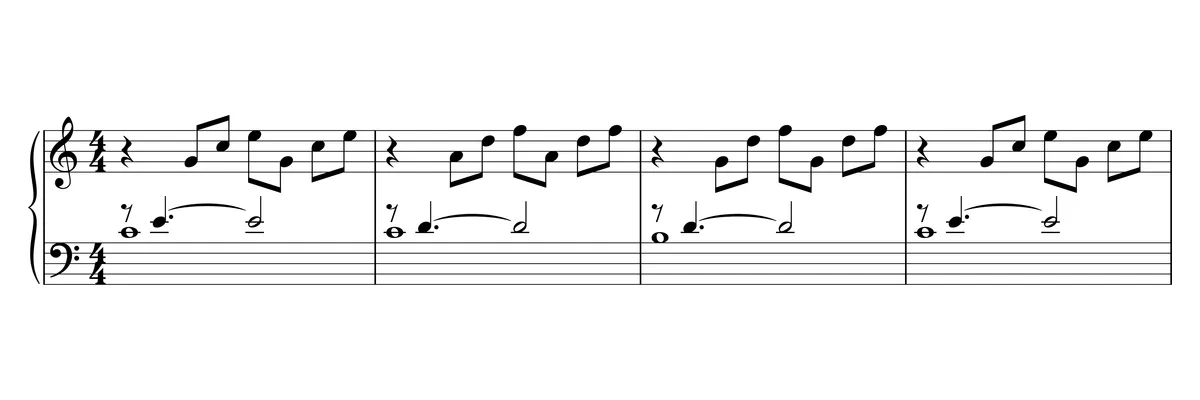
All 49 bars with a flowing left hand, harmony under the high melody and Pachelbel's own rhythms where the source simplified them.
- Left hand, every bar except 37 to 44 and the last: the bass as a half note, held by the pedal, under a figure in eighth notes. No third sounds below the C an octave below middle C.
- The figure has the third of the chord wherever the right hand does not: F-sharp and A over D, F-sharp and A over F-sharp, D and B over G.
- Over B the figure is F-sharp, D, F-sharp where the right hand has no D over the B (bars 2, 26, 34 and 46) and F-sharp, B, F-sharp where it does.
- Over A it is E, A, C-sharp, or E, A, E where the right hand has the C-sharp or sits low.
- Bars 12, 22, 24, 25 and 36: the second figure is turned around (A, E, A or A, C-sharp, A; A, F-sharp, A in bar 22), so it stays clear of the right hand.
- Bars 15 and 27: over the first G the figure is D, G, D, because the right hand plays the B.
- Bar 12: E under the C-sharp, the note Pachelbel's lower violin plays (the source has A).
- Bars 29 to 36: a second note under the high melody, all chord notes, mostly thirds and sixths, with A under the D in bar 34 as the violins have it.
- Pachelbel's rhythm restored in bar 20 (D held for a beat and a half, then C-sharp) and bar 35 (D held for three beats).
- Bars 45, 47 and 48 follow Pachelbel's dotted variation: a dotted A to start bar 45, D, C-natural, B, C, then A in the dotted rhythm in bar 47, and G, D, a dotted C-sharp and another C-sharp in bar 48.
- Bars 37 to 44: the sixteenth-note run as in the source, over the bass alone in half notes.
- Last bar: D major chord over a low D octave, with a pause. The repeat of bars 45 to 48 stays.
For teachers: Pedal: change with each bass note. The figure often reaches a tenth above the bass, so the pedal, not the hand, holds it. This version is for a student who can keep eighth notes even in the left hand while the right hand moves on its own. In bars 21 to 28 and 45 to 48 use half pedal so the right hand's eighth notes do not blur; in bars 37 to 44, where the left hand has only the bass, use little or no pedal. Practice bars 37 to 44 right hand alone at about 60, a bar at a time; that run is the hardest thing on the page.
Want it different? Just ask.
Open this version in PlayableNotes and ask for a change in words: simpler, another key, shorter, bigger notes. The result is a new version you can play, print and share with your student.
Free account. Changes, playback and printing are free; 50 free credits to read your own sheet music.
Watch how to ask for your own version · 1 min video
Make your own version
A real request in PlayableNotes, on Für Elise from the free library: say who it’s for and what to keep, and the AI writes a new version beside the original. It shows how to ask for a version of your own; its result is not one of the versions on this page.
About Canon in D
Johann Pachelbel wrote the Canon for three violins and basso continuo, paired with a gigue; when exactly is not known. The bass plays the same eight notes over and over (D, A, B, F-sharp, G, D, G, A), and above it the three violins play one long melody in canon, each entering one turn of the bass after the one before. It became widely known through Jean-François Paillard's 1968 recording, was famous by the 1970s and became a wedding favorite after that.
On the piano the left hand takes the bass and the right hand the violins' melody. The tune starts in slow half notes and changes pace with each variation: quarter notes, eighths, a slower high melody, a fast run and a dotted tune. That is the hard part: the left hand never changes while the right hand keeps changing speed. These versions start from a public-domain easy piano setting of Pachelbel's violin melody, written in note values twice as long as his.
In the slow sections of the easy version the left hand plays each bass note and then the third of its chord, or the fifth where the right hand has the third, so the minor chords keep their color; the fast run becomes steady eighth notes. The beginner version keeps one note at a time in each hand, the wedding version ends on a held D major chord, and the fuller version adds a flowing left hand and harmony under the high melody.
Practice tips
- Learn the bass by heart before anything else: D, A, B, F-sharp, G, D, G, A (G, D, E, B, C, G, C, D in the beginner version). It repeats every four bars here (two bars in Pachelbel's score) from start to finish, so once the left hand knows it, the rest of the piece is the right hand.
- Count the opening half notes slowly and hold each one for its full two beats. The canon is calm even when the right hand is busy, so pick a tempo the fastest bars can keep.
- Bars 21 and 22 of the easy and fuller versions jump an octave in eighth notes (D down to D, then back up). Loop the two bars and look at the lower note before you play it.
- Find the high notes before you start (bars 31 to 33, or 15 to 17 in the wedding version): B sits just above the first ledger line above the staff, C-sharp on the second, D just above it.
- The C naturals near the end (bar 48 of the easy version, 24 of the wedding version, 47 of the fuller one) are Pachelbel's, not misprints. In the easy and wedding versions the C-sharp right after them leads back up to D.
Questions about Canon in D
What are the chords of Canon in D?
D, A, B minor, F-sharp minor, G, D, G, A, one chord per bass note, repeated all the way through. In G major, as in the beginner version, they are G, D, E minor, B minor, C, G, C, D.
Is Canon in D hard to play on piano?
The bass is easy because it never changes; the right hand gets harder as the variations speed up. The opening tune suits a beginner, and so does the high melody once it is moved down, as in the beginner version in G (in D it climbs to two ledger lines above the staff). The eighth-note variation is a step up, and the fast run is intermediate, which is why the easy version rewrites it in eighth notes and the beginner version leaves it out.
Who wrote Canon in D, and when?
Johann Pachelbel (1653–1706), a German organist and composer. He wrote it for three violins and basso continuo, followed by a gigue. The exact date is not known.
How long does Canon in D take to play?
Pachelbel's full canon takes roughly three to six minutes, depending on the tempo. The easy version on this page takes about two and a half minutes at 80 with its repeat, and the beginner version about a minute at 84.
Can I play Canon in D at a wedding?
Yes, it is often played for the processional. The wedding version on this page takes about two minutes at 84 with its repeat. If the walk is longer, take the repeat again; when the procession reaches the front, finish the pass you are on and go from bar 24 to the final chord in bar 25.
What grade is Canon in D on piano?
It depends on the version. The beginner version in G suits a first-year student. The easy and wedding versions are about grade 1 to 2, for a student who reads eighth notes in two sharps. The fuller version, with its flowing left hand and sixteenth-note run, is about grade 3 to 4.
Source and credits
- Composer
- Johann Pachelbel
- License
- Public Domain Mark 1.0
- Arranger
- PlayableNotes
The setting is not Pachelbel's score, which is for three violins and continuo: it gives the right hand the violins' melody over the ground bass, taking Pachelbel's bars 3 to 22 and then the end of his dotted variation (his bars 45 and 46, repeated), and it leaves out his other variations. All 49 bars were checked against the upload's MusicXML and MIDI, and the right hand against two full scores of the canon. One wrong note was corrected: bar 36, beat 2 was F-sharp in the upload; it is now G, as in Pachelbel. The C naturals in bar 48 are Pachelbel's, not misprints.
The full edition is also in the library: Canon in D, ready to play and edit.
Arrangements and facts checked