How Much Piano Music Needs Big Hands? We Measured 15,237 Scores
A tenth is the stretch from C to the E above the next C. In a 2015 survey of 473 pianists' hands, a span of about 8.5 inches is what it takes to just reach one, on the outer edge of the keys and not at speed. At least three in four of the women in that survey had smaller hands than that.
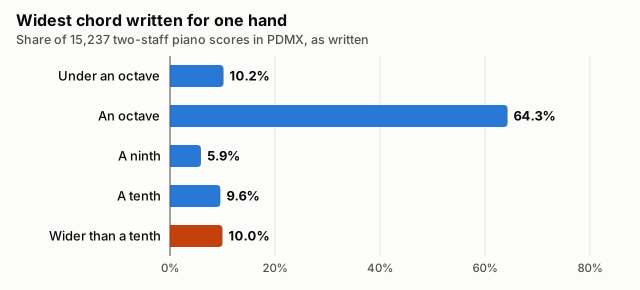
So how often does piano music ask for a tenth? We measured the widest chord written for one hand in 15,237 two-staff piano scores.
One in five scores writes a chord of a tenth or wider for one hand at least once. Among the 1,000 most-viewed scores in the set, it is more than one in four. Nearly half of those go wider than a tenth, past the widest stretch the survey measured.
What we measured
The scores come from PDMX, a research dataset from the University of California San Diego of scores that MuseScore users shared as public domain or under the Creative Commons CC0 dedication. We kept the scores written for one piano on two staves, at least eight bars long, with at least one chord, one copy of each piece, and none the dataset flags for a license conflict. That left 15,237.
In each score we found every chord written in one voice on one staff, and measured from its lowest note to its highest. The upper staff counts as the right hand and the lower staff as the left. We left out grace notes and chords marked to be rolled. Nothing was left out for being wide: chords wider than a tenth have a row of their own.
| Widest chord for one hand | Scores | Share |
|---|---|---|
| Under an octave | 1,548 | 10.2% |
| An octave | 9,800 | 64.3% |
| A ninth | 900 | 5.9% |
| A tenth | 1,470 | 9.6% |
| Wider than a tenth | 1,519 | 10.0% |
Most of the wide chords fall to the left hand. 15.0% of the scores write a tenth or wider on the lower staff, and 8.5% on the upper staff.
Which hand plays it?
A staff is not a hand. When the other hand is free, a pianist can take a note across, so a wide chord on one staff may never be played by one hand. We checked each chord of a tenth or wider for whether the other staff has a note sounding at that moment. For 89.7% of those chords it does, so the other hand is busy. Counting only those chords, 18.7% of the scores still write a tenth or wider for one hand, against 19.6% counting every chord, and no row of the tables below moves by more than about a point.
What the chords wider than a tenth are
We read 15 of the scores with a chord wider than a tenth, picked at random. Three were hymns set in four parts, with two voice parts written as one chord on the lower staff. One was a glissando written as a chord. The rest were wide spreads in one hand, such as the twelfth from C to G in the left hand in bar 17 of one Liebestraum No. 3 edition, which a pianist rolls, splits between the hands or holds with the pedal.
Popular scores reach further
The scores people open most ask for more. Of the 1,000 most-viewed scores in the set, 28.4% write a chord of a tenth or wider for one hand (14.8% a tenth, 13.6% wider), against 19.6% across all of them. The genre tags MuseScore users chose show the same spread: 16.8% of the scores tagged classical write a tenth or wider, and between 22% and 25% of those tagged pop, rock or soundtrack. Just over half of the 89 scores tagged jazz do, which fits the left-hand tenths of stride piano, though that is a small group.
What a hand can reach
The hand spans come from Boyle, Boyle and Booker (2015), who measured 473 adult pianists from the tip of the thumb to the tip of the little finger, stretched flat. The women's median was 7.9 inches and three quarters of them measured 8.3 inches or less. The men's median was 8.9 inches, and three quarters of them measured 8.5 inches or more.
The same paper gives the span at which a pianist can just reach each interval, with discomfort and not at speed: about 6.7 inches for an octave, 7.6 inches for a ninth and 8.5 inches for a tenth. Put that beside the scores:
| Your span, thumb to little finger | You can just reach | Scores with no one-hand chord wider than that |
|---|---|---|
| Under 6.7 in | Less than an octave | 10.2% |
| 6.7 to 7.5 in | An octave | 74.5% |
| 7.6 to 8.4 in | A ninth | 80.4% |
| 8.5 in or more | A tenth | 90.0% |
The other 10.0% write at least one chord wider than a tenth. The paper's measurements stop at the tenth, so we don't match those chords to a span; a very large hand reaches some of them, and most pianists roll or split them.
"Just reach" is not "play comfortably". The authors put the span for tension-free fast octaves at around 8.5 inches, so a hand that can reach every chord in a piece may still tire in it. Our count of octaves in 80 well-known pieces shows how much that varies: The Entertainer writes 282 of them and Für Elise writes 3.
A tenth is often one note too many
A wide chord can usually be made narrower without losing anything a listener would miss, because it often doubles a note that is already sounding. Satie's Gymnopédie No. 1 is a clear case. In bars 24 to 26, and again in bars 29 to 31, the left hand plays a low D on the first beat and holds it, then takes a four-note chord on the second beat that spans a major ninth.
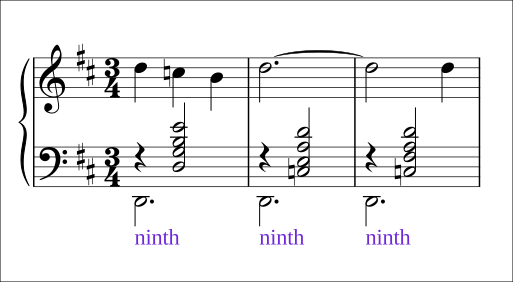
Each of those chords has one note that is already there:
- Bars 24 and 29: the chord is D, G, B, E. Its bottom D doubles the low D the left hand is holding, so it can go, leaving G, B and E, a sixth. That is the chord Satie writes one bar earlier, in bar 23.
- Bars 25 and 30: the chord is C, E, A, D. Its top D doubles the D the right hand is holding above it, so it can go, leaving C, E and A.
- Bars 26 and 31: the chord is C, F, A, D, and its top D sounds in the right hand too. Without it the chord is C, F and A.
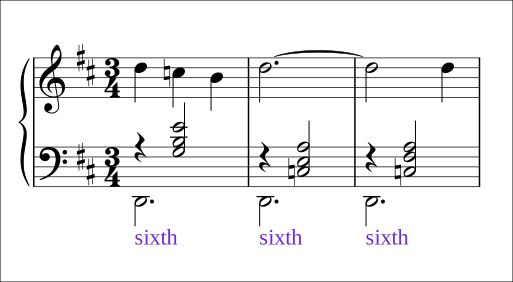
Every pitch class Satie wrote still sounds in those bars, and the widest stretch drops from a ninth to a sixth. The rest of the piece is unchanged. Play the whole arrangement here, slow it down, or play the left hand alone:
The player loads here.
When no note is doubled, the usual choices are to roll the chord from the bottom with the pedal holding it, or to give its top note to the other hand when that hand is free.
We made this version in PlayableNotes. Open a piece from the library, choose Edit a copy, and describe the change you want, for example "in bars 24 and 29, leave out the lowest note of the left-hand chord on beat 2". You can play the result, print it, or send it to a student as a practice link. Playing and printing library pieces needs no account; editing a copy needs a free one.
What this count doesn't see
- It reads the page, not the performance. An editor decides which staff a note sits on, and our check of the other hand asks only whether it has a note sounding, not whether it could spare a finger. Two lines written on one staff were measured separately, so a stretch between a held note and a moving one isn't counted.
- It counts chords, not broken chords. A left-hand figure that spreads over a tenth one note at a time doesn't appear here, though the hand still has to travel.
- It is one edition per piece, made by MuseScore users. Some are arrangements, and a few will have a note in the wrong octave. We checked twelve tenths chosen at random against the scores, and all twelve were written as counted.
- A span is not the only measure of a hand. Finger width, flexibility and the keyboard itself matter too.
The summary figures, by span and by genre, are in this CSV file, and the widest chords measured in each of the 15,237 scores are in the per-score file (what its columns mean). Both are free to reuse under CC BY 4.0, crediting PlayableNotes and PDMX.
FAQ
What counts as a small hand at the piano?
Definitions differ. Boyle, Boyle and Booker list several in their 2015 paper: unable to reach a ninth or to play an octave comfortably, a span of 8 inches or less, or unable to reach a tenth. By the last of these, most of the women and at most a quarter of the men in their survey had small hands.
How do I measure my hand span?
Spread your hand flat on a table as wide as it goes and measure from the outer tip of your thumb to the outer tip of your little finger. That is the span the survey and the table above use.
Which pieces suit small hands?
Chord width is one guide. Three in four of the scores we measured (74.5%) have no one-hand chord wider than an octave, though speed, leaps and stamina matter too. Our list of 80 well-known pieces names the ones that stay within an octave and the ones that go wider, and our page on piano music for small hands shows how to take the octaves out of a piece for a hand that can't reach them yet.
Can I make a piece easier for a small hand without changing how it sounds?
Often, yes. Leave out a note that another hand or a held note already plays, roll the chord, or move its top note to the other hand. Gymnopédie No. 1 above needs only the first of these.