How Far Does Beethoven Stretch One Hand? We Measured All 32 Sonatas
Beethoven died on 26 March 1827, and as the bicentenary nears, his 32 piano sonatas are still the music many pianists measure themselves against. Pianists with smaller hands often ask which of them stay within reach. So we measured the widest stretch Beethoven wrote for one hand in every sonata.
12 of the 32 sonatas never ask one hand to strike notes more than an octave apart. 22 stay within a ninth. None asks for more than a tenth.
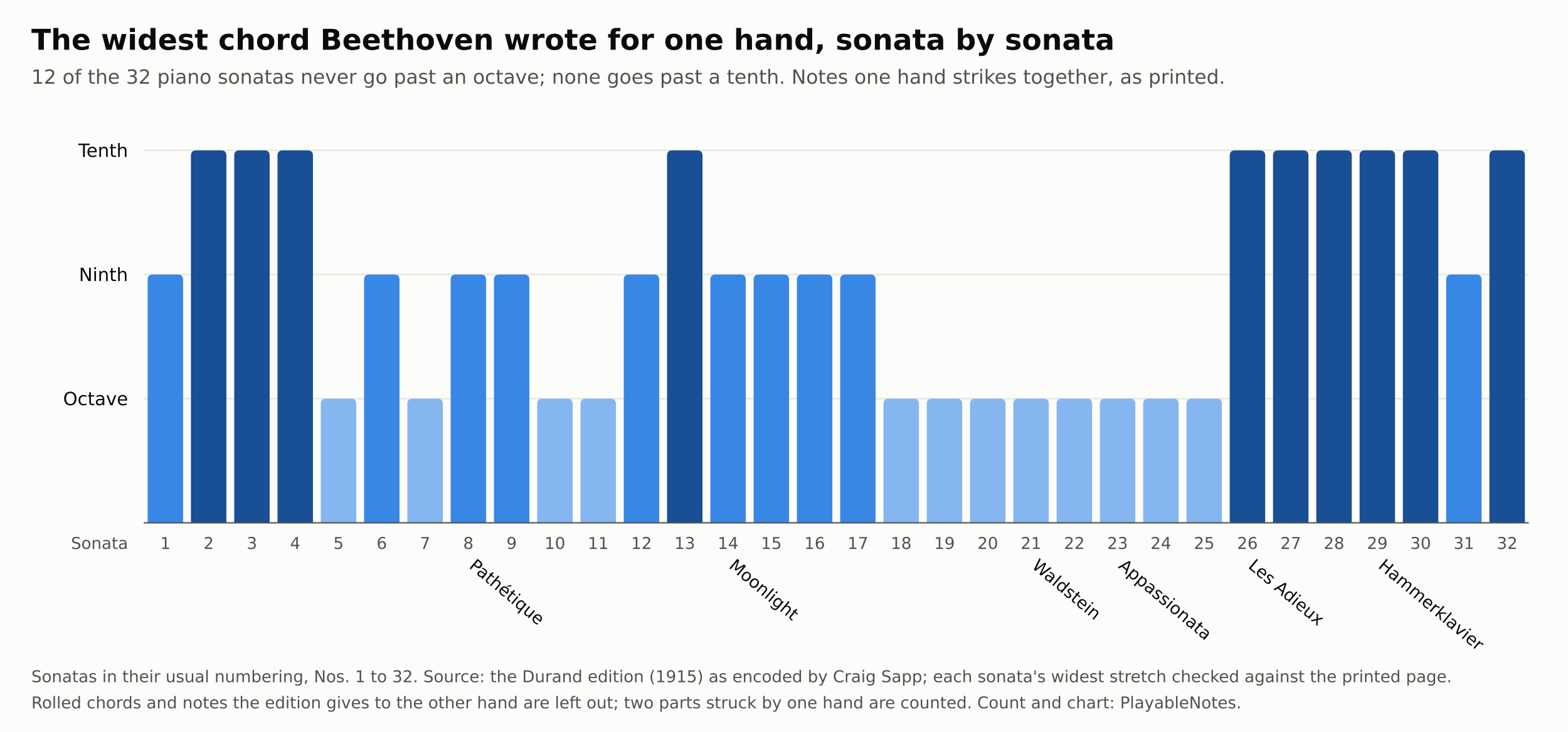
What we measured
We used Craig Sapp's digital edition of the sonatas, encoded from the Durand edition of 1915, all 103 movements, and measured in two passes.
First, chords on one stem. In each movement we found every chord written in one voice on one staff, notes struck together, and measured from its lowest note to its highest. Grace notes and chords marked to be rolled are out, and so are broken chords, where the notes come one after another. That gave 38,659 chords. Then we read every chord of a tenth or wider on the printed page. Of 58, four were notes the edition gives to the other hand, by a bracket or a stem drawn across to the other staff (in the funeral march of Op. 26, the middle of the Moonlight's finale and the first movement of Op. 28), and two were rolled, in the last bar of the Hammerklavier's slow movement. We left those six out. The other 52 are tenths written for one hand.
Second, two parts in one hand. A hand often strikes a bass note and a tenor note together, or a melody note over an inner part, and the page writes them as two parts with separate stems. So we listed every moment where the parts on one staff strike notes a ninth or a tenth apart, and read on the printed page the places that could change a sonata's widest stretch: 113 places in 17 sonatas. In 23 of them one hand strikes the stretch as printed. In 87 the page gives part of it to the other hand, by a bracket, a stem or beam drawn across the staves, or the other hand's fingering. Of the other three, two don't show which hand plays, and one is an octave on the page.
Reading the page also caught two slips in the digital edition, where it has a ninth and the page has an octave: bars 72 and 73 of the Appassionata's finale, and bar 116 of the last movement of Op. 110.
(This post first counted only chords on one stem and gave 16, then 18, octave sonatas. Since 11 November 2026 it also counts two parts struck by one hand: six of those sonatas ask for a ninth that way, and two others for a tenth.)
| Widest stretch for one hand | Sonatas |
|---|---|
| An octave | 12: Op. 10 Nos. 1 and 3, Op. 14 No. 2, Op. 22, Op. 31 No. 3, Op. 49 Nos. 1 and 2, Op. 53 (Waldstein), Op. 54, Op. 57 (Appassionata), Op. 78, Op. 79 |
| A ninth | 10: Op. 2 No. 1, Op. 10 No. 2, Op. 13 (Pathétique), Op. 14 No. 1, Op. 26, Op. 27 No. 2 (Moonlight), Op. 28 (Pastoral), Op. 31 No. 1, Op. 31 No. 2 (Tempest), Op. 110 |
| A tenth | 10: Op. 2 Nos. 2 and 3, Op. 7, Op. 27 No. 1, Op. 81a (Les Adieux), Op. 90, Op. 101, Op. 106 (Hammerklavier), Op. 109, Op. 111 |
Tenths are rare, and late
On one stem, tenths are rare. Across all 38,659 chords, 52 span a tenth: about one chord in 740. Nearly half of them, 24, are in the Hammerklavier. Three sonatas ask only once or twice: Op. 101 and Op. 109 have one each, at a fermata and a held chord, and Op. 111 has two.
They also come late. Five of the last six sonatas have a tenth on one stem, from Op. 90 of 1814 to Op. 111; only Op. 110 doesn't. Before them, only Op. 2 No. 3, Op. 7 and Les Adieux do. The first is right at the start: the left hand's G and B a tenth apart in bar 3 of Op. 2 No. 3.
Two early sonatas reach a tenth in two parts. In the Largo of Op. 2 No. 2 the left hand strikes a staccato C-sharp in the bass under the tenor's E a tenth above (bars 3, 34 and 70). In the first movement of Op. 27 No. 1 the right hand's melody reaches B-flat over the G and E-flat it repeats below (bar 11).
For comparison, in the 15,237 piano scores we measured for our count of one-hand chords, about one chord in 45, counted on one stem in the same way, spans a tenth or more.
Every sonata, and where to look
Here is each sonata's widest stretch for one hand with a bar where you can see it, so you can open any edition and check. Bars are counted from the first full bar of the movement; i, ii and iii are the movements. "Two parts" means the notes have separate stems and one hand strikes them together. For the eight sonatas with tenths on one stem, the last column is how many the sonata has.
| No. | Sonata | Widest stretch for one hand | Where to see it | Tenths on one stem |
|---|---|---|---|---|
| 1 | Op. 2 No. 1 | A ninth | i, bar 47, right hand, D♭5 to E♭6 | |
| 2 | Op. 2 No. 2 | A tenth | ii, bar 3, left hand, C♯2 to E3, two parts | |
| 3 | Op. 2 No. 3 | A tenth | i, bar 3, left hand, G2 to B3 | 5 |
| 4 | Op. 7 | A tenth | ii, bar 10, left hand, G2 to B3 | 6 |
| 5 | Op. 10 No. 1 | An octave | ||
| 6 | Op. 10 No. 2 | A ninth | iii, bar 71, left hand, D3 to E4, two parts | |
| 7 | Op. 10 No. 3 | An octave | ||
| 8 | Op. 13 (Pathétique) | A ninth | ii, bar 11, right hand, A♭4 to B♭5, two parts | |
| 9 | Op. 14 No. 1 | A ninth | i, bar 156, left hand, E2 to F♯3 | |
| 10 | Op. 14 No. 2 | An octave | ||
| 11 | Op. 22 | An octave | ||
| 12 | Op. 26 | A ninth | i, bar 24, right hand, F4 to G5, two parts | |
| 13 | Op. 27 No. 1 | A tenth | i, bar 11, right hand, G3 to B♭4, two parts | |
| 14 | Op. 27 No. 2 (Moonlight) | A ninth | iii, bar 58, right hand, C♯4 to D♯5 | |
| 15 | Op. 28 (Pastoral) | A ninth | i, bar 15, left hand, D3 to E4, two parts; the right hand can take the E | |
| 16 | Op. 31 No. 1 | A ninth | ii, bar 58, left hand, F♯1 to G2, two parts | |
| 17 | Op. 31 No. 2 (Tempest) | A ninth | ii, bar 12, left hand, F2 to G♭3 | |
| 18 | Op. 31 No. 3 | An octave | ||
| 19 | Op. 49 No. 1 | An octave | ||
| 20 | Op. 49 No. 2 | An octave | ||
| 21 | Op. 53 (Waldstein) | An octave | ||
| 22 | Op. 54 | An octave | ||
| 23 | Op. 57 (Appassionata) | An octave | ||
| 24 | Op. 78 | An octave | ||
| 25 | Op. 79 | An octave | ||
| 26 | Op. 81a (Les Adieux) | A tenth | ii, bar 21, left hand, B♭2 to D♭4 | 3 |
| 27 | Op. 90 | A tenth | i, bar 179, left hand, F2 to A3 | 10 |
| 28 | Op. 101 | A tenth | iii, bar 20, right hand, E3 to G♯4 | 1 |
| 29 | Op. 106 (Hammerklavier) | A tenth | i, bar 75, left hand, A2 to C4 | 24 |
| 30 | Op. 109 | A tenth | i, bar 84, right hand, A♯3 to C♯5 | 1 |
| 31 | Op. 110 | A ninth | i, bar 114, left hand, A♭1 to B♭2, two parts | |
| 32 | Op. 111 | A tenth | i, bar 94, right hand, F5 to A♭6 | 2 |
The data is free to use: the table above as a CSV file, and every place we read on the Durand page, with the notes of each chord and what the page shows, including the places we left out.
What a hand can reach
The spans come from Boyle, Boyle and Booker (2015), who measured 473 adult pianists from thumb tip to little-finger tip. They give the span at which a pianist can just reach each interval, with discomfort and not at speed: about 6.7 inches for an octave, 7.6 for a ninth and 8.5 for a tenth.
| Your span, thumb to little finger | You can just reach | Sonatas with no one-hand stretch wider than that |
|---|---|---|
| 6.7 to 7.5 in | An octave | 12 |
| 7.6 to 8.4 in | A ninth | 22 |
| 8.5 in or more | A tenth | 32 |
The median woman in that survey measured 7.9 inches, a ninth: 22 of the 32 sonatas have no one-hand stretch wider than that.
What this doesn't tell you
Notes struck together are one measure of reach, not the whole of it. Octaves at speed tire a hand long before a single tenth does, and the Hammerklavier and the Appassionata have plenty of those. Broken chords that open out over a tenth, one note after another, aren't counted, and neither are leaps. Notes a hand holds while it plays others aren't counted either. And where a bass note and a chord more than a tenth apart are printed for one hand at the same moment, no hand strikes them together: pianists break them or use the pedal, and we left them out.
Most of the tenths can be made narrower without losing a note. The first one is a good example. In bar 3 of Op. 2 No. 3, the left hand holds G and the B a tenth above it for the whole bar, the same figure as the C and G of bar 1, a fifth apart, moved to the dominant. The right hand's thirds move above it, between C-sharp and G. A smaller hand can roll the chord from the G, or let the right hand's thumb hold the B under its thirds. Either way every note Beethoven wrote still sounds.
We made both versions below with PlayableNotes. It read the four bars from a scan of the Durand page, and we compared every note with the edition. Then we described the change we wanted, the B of bar 3 moved to the right hand and nothing else touched, and it changed that one bar.
The player loads here.
The player loads here.
We used one edition. Durand's of 1915, edited by Paul Dukas, marks none of these tenths as editorial, but an Urtext edition may print a few chords differently.
A sonata for a hand that can't reach an octave
Op. 49 No. 2 in G is often one of the first sonatas a student plays, and it has the fewest octaves of the 32. In both movements the right hand never strikes anything wider than a sixth. The left hand strikes an octave ten times in the whole sonata: nine in the first movement (bars 1, 5, 52 twice, 53, 67, 71, 121 and 122) and one in the minuet (bar 120). The next fewest is Op. 49 No. 1, with 29.
Here is the first movement with the notes as Durand prints them, and then both movements with each of those ten octaves played as its lower note alone. In bar 42 of the first movement the left hand also holds a low G under the G an octave above; in the second version that low G is let go after one beat. With those changes neither hand has to span more than a seventh anywhere in the sonata. Grace notes and the trill are left out of all three scores.
The player loads here.
The player loads here.
The player loads here.
We made these scores from the same digital edition as the count. Then we compared every bar with a second edition, the Mutopia Project's: 233 of the 243 bars, the minuet's upbeat included, have the same notes, and we read the other ten on the Durand page. Eight are grace notes, and two are left-hand thirds that Durand prints where the other edition has one note.
Play them
The slow movement of the Pathétique, Op. 13, is in the PlayableNotes library, free to play at any tempo and to print, with no account: Adagio cantabile. We compared every bar of the library's copy with the Durand edition, and the notes match. It asks the right hand for a ninth twice, in bars 11 and 61, where the melody's B-flat is struck over the inner A-flat a ninth below. On one stem nothing in it is wider than an octave, and it writes 59 octaves, 43 of them in the left hand.
The rest of the library is mostly public-domain classical piano pieces, and you can slow any of them down, loop a passage or play the hands separately.