Large-print piano music: free pieces to play and print at 120%, 150% and 200%
This page is a free large-print resource for partially sighted pianists, their teachers and the people who print music for them. Three public-domain piano pieces are below, each engraved again at four music sizes on both US Letter and A4 paper. Download a PDF and print it, or open it on a tablet. Each piece also plays on this page at any tempo, one hand at a time. Nothing here needs an account.
The sizes answer two questions readers ask: how big does piano music have to be to count as large print, and how do you get it that big without sheets of paper that fall off the stand.
The pieces
Every score is from the free PlayableNotes library and was checked against a printed edition. The page counts are for the whole piece.
Erik Satie, Gymnopédie No. 1 (1888)
Slow, open and quiet, with a left hand that alternates a low bass note and a chord, so it reads clearly even at the largest size.
Play “Gymnopédie No. 1, bars 1 to 21” in the free library (bars 1–21 here).
| Music size | US Letter | A4 |
|---|---|---|
| 100% (standard) | PDF, 3 pages | PDF, 3 pages |
| 120% | PDF, 4 pages | PDF, 4 pages |
| 150% | PDF, 7 pages | PDF, 7 pages |
| 200% | PDF, 15 pages | PDF, 11 pages |
Frédéric Chopin, Prelude in E minor, Op. 28 No. 4
Short and slow, with a left hand of repeated chords: the kind of texture that turns grey at a small size. The library edition was checked bar by bar against the 1839 Breitkopf & Härtel first edition.
Play “Prelude in E minor, the first half” in the free library (bars 1–13 here).
| Music size | US Letter | A4 |
|---|---|---|
| 100% (standard) | PDF, 3 pages | PDF, 3 pages |
| 120% | PDF, 4 pages | PDF, 4 pages |
| 150% | PDF, 7 pages | PDF, 6 pages |
| 200% | PDF, 13 pages | PDF, 13 pages |
J. S. Bach, Little Prelude in C major, BWV 933
Sixteen bars of two-part writing, checked against the Bach-Gesellschaft edition of 1890. A good first piece for a student moving to large print, because each hand mostly plays one line.
Play “Little Prelude in C major, BWV 933” in the free library.
| Music size | US Letter | A4 |
|---|---|---|
| 100% (standard) | PDF, 2 pages | PDF, 2 pages |
| 120% | PDF, 4 pages | PDF, 4 pages |
| 150% | PDF, 8 pages | PDF, 6 pages |
| 200% | PDF, 9 pages | PDF, 8 pages |
How big is large print for piano music?
The American Printing House for the Blind (APH) publishes research-based guidelines for large print, and they set a plain threshold: "A document is not actually 'large print' unless it is in a font size 18 points or larger." They also ask for letters with an x-height of 1/8 inch.
Those rules are written for text, and sheet music has no font size. But engraved music is sized from one unit, the stave space (the gap between two lines of the staff), and a filled notehead is about one stave space tall. So the stave space plays the part that x-height plays in text. We measured it in the engraving these PDFs use:
| Music size | Stave space | In inches | Reaches 1/8 inch? |
|---|---|---|---|
| 100% | 2.70 mm | 0.106 in | No |
| 120% | 3.24 mm | 0.128 in | Yes, just |
| 150% | 4.05 mm | 0.159 in | Yes |
| 200% | 5.40 mm | 0.213 in | Yes |
That is why the PDFs above start at 120%: it is the first size whose noteheads reach APH's minimum. It is a floor, not a prescription. APH also publishes guidance on choosing a print size for one reader, and many readers will want 150% or 200%.
Why not enlarge on a photocopier?
RNIB's guide to Modified Stave Notation describes what usually happens: "If you've tried photocopying and enlarging your music yourself, you've probably ended up with huge sheets of paper that fall off the music stand."
The PDFs on this page enlarge the music, not the paper. Each score is engraved again at the larger size, so every page stays A4 or Letter, each line holds fewer bars, and the notes, clefs and accidentals all grow together.
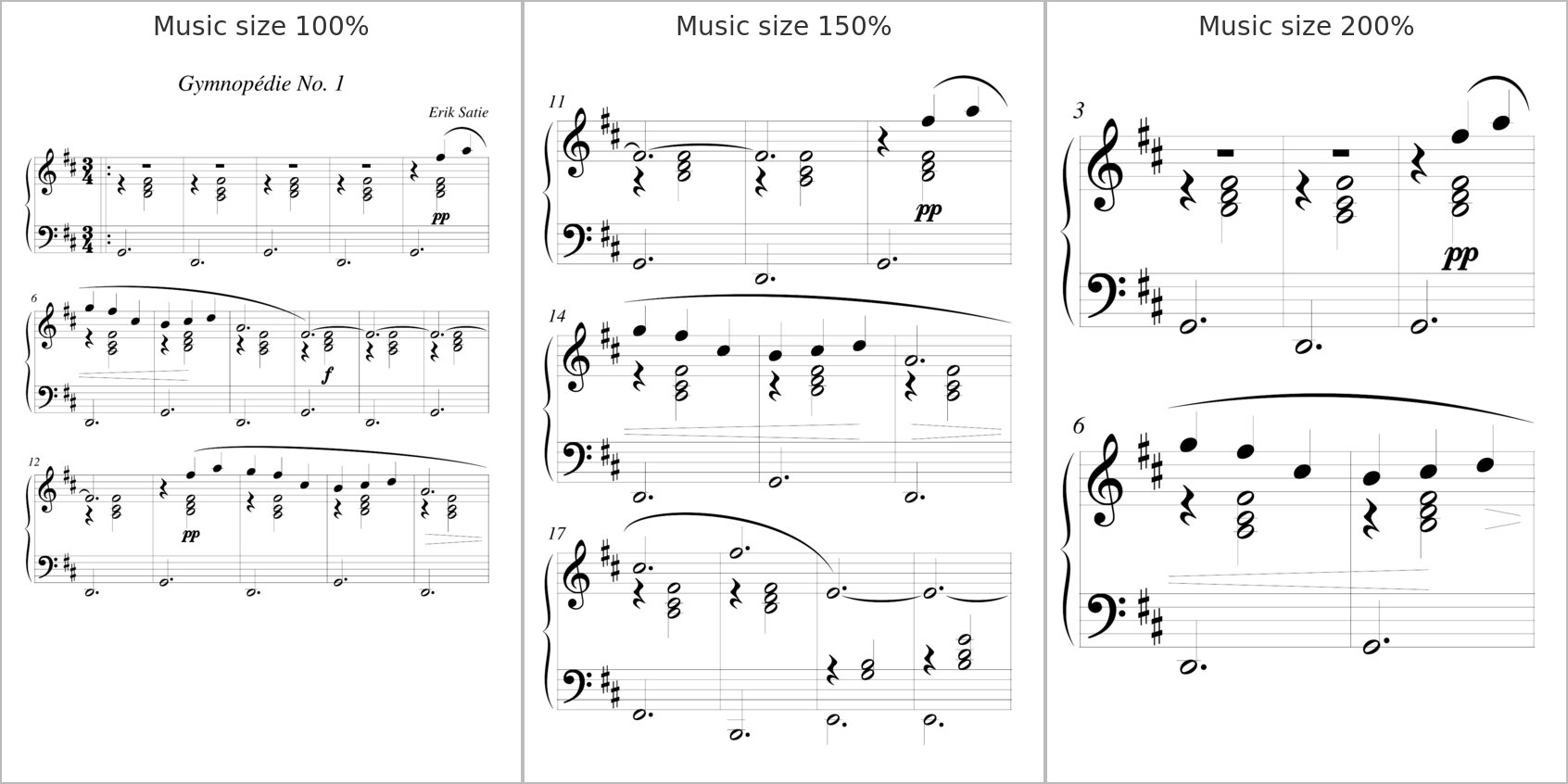
More pages is the trade. For most readers it is a better trade than a sheet twice as wide: each page fits a stand, a tablet or a page-turning pedal.
The line change is the cost to watch
APH's guidelines name the hardest part of reading with low vision: "The most difficult reading task that a person with low vision must do is the visual shift from the end of one line to the beginning of the next."
Bigger music means more of those shifts. Here is page 1 of the Chopin prelude on Letter at three sizes:
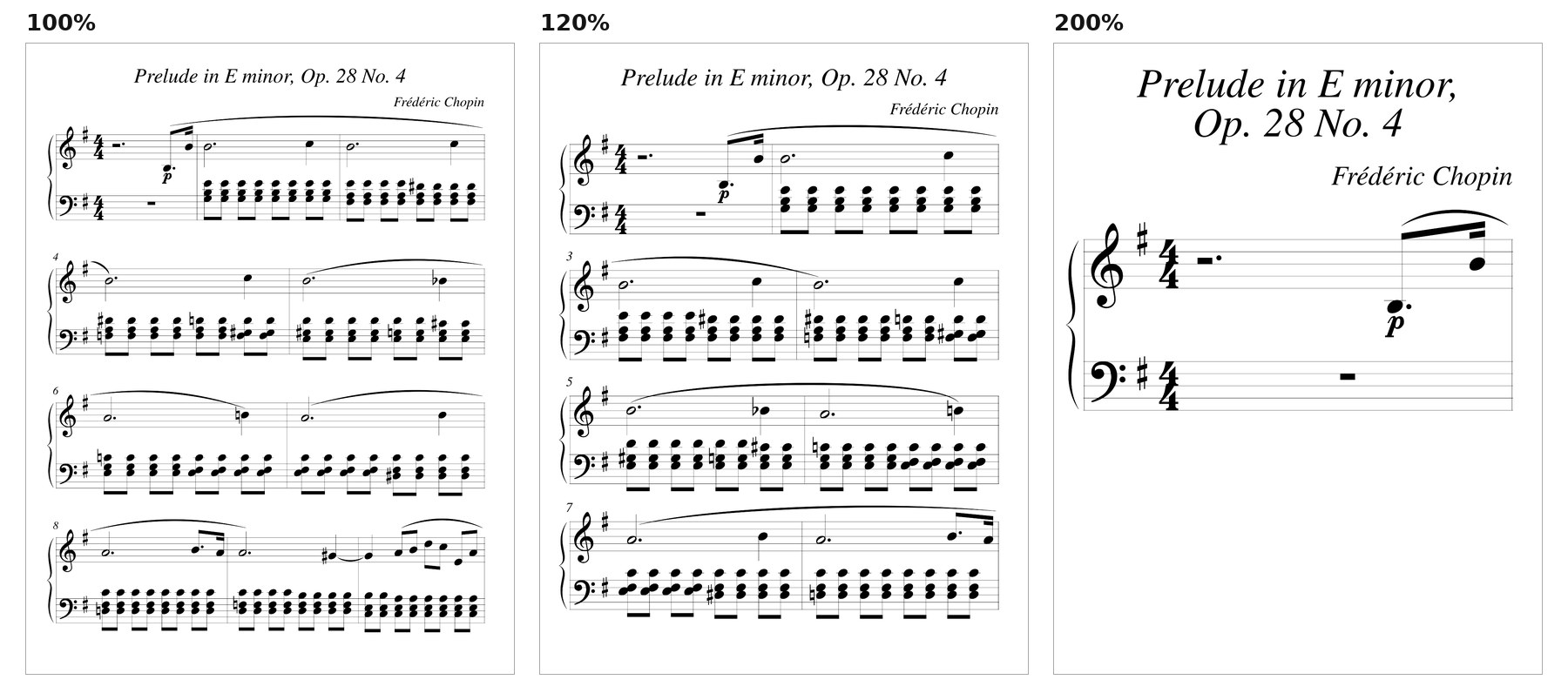
At 120% the prelude takes 4 pages instead of 3. At 200% it takes 13, with one bar on most lines, so every slurred phrase of the melody crosses a line break. For a reader who can manage 120% or 150%, that is a real saving. For a reader who needs 200%, a page turner, a tablet or a stand that holds two pages side by side helps more than any change to the score.
Learning a few bars at a time, close up
Some readers can't use any print size from the bench. Simon Miner, a pianist with limited vision, described his method in BayLines Express in May 2026: "I hold the music close to my face, examine a few measures, then set it down and attempt to play them from memory." He also learned the first movement of Beethoven's Pathétique that way before he had ever heard a recording of it, and realized years later, hearing a professional performance, how much nuance he had missed.
The scores on this page can support that way of learning:
- Hear the bars before you learn them. Each score plays at any tempo, so the passage you are about to memorize can be heard slowly first, one hand at a time.
- Loop one bar. Set the player to loop the bar you are studying and let it repeat while you check it against the page.
- Print only the page you need. Print the one page of the 150% or 200% PDF that holds your passage and keep it beside you, so each trip back to the music is shorter.
None of this replaces memorizing; it gives the ear a model to check the hands against.
What this doesn't replace
Enlarging a score keeps its proportions: stave lines, ties and dynamics grow by the same amount as the noteheads. Modified Stave Notation can go further for one reader, with bolder stave lines, larger fingering or wider spacing, and RNIB's transcription service makes it. The Sound Without Sight guide to large-print software compares apps that reflow PDFs on a screen. Readers who use braille music need a braille edition: APH's music toolkit lists braille music resources, and the National Library Service lends braille and large-print scores.
To print another library piece at these sizes, the larger piano notation page shows the music size setting.
Ask for a piece that isn't here
If you need a public-domain piano piece that isn't on this page, or a size that isn't here, email me at nathan.harmon@useplayablenotes.com with the piece, the paper (A4 or Letter) and the size you want. I'll engrave it and send you the PDF, free. Pieces still in copyright are the one thing I can't do.
FAQ
Do I need an account to use these?
No. The PDFs download from this page, and the scores play here without signing in.
Which size should I print?
Start with 120%, the smallest size that matches APH's 1/8 inch minimum for letters, then try 150% and 200% and let the reader choose. A short piece like the Bach prelude is a quick way to compare.
Is this the same as Modified Stave Notation?
No. These scores enlarge every symbol by the same amount and fit fewer bars on each line. Modified Stave Notation can also change proportions, such as bolder stave lines or larger fingering, to suit one reader.
Why A4 and Letter?
A4 is the standard paper in the UK, Europe and most of the world; Letter is the standard in the US and Canada. The same music size gives slightly different page counts on each, because the pages have different shapes.