Free easy piano · Classical
Minute Waltz, easy piano
Chopin's Minute Waltz (Waltz in D-flat major, Op. 64 No. 1) in four free versions: an easy version of the first two sections in C major, an even easier version of the opening, the whole waltz simplified in D-flat, and the original. Play each one here, slow it down or loop a bar, then print the PDF or download the MIDI.
- Frédéric Chopin
- Easy to intermediate, plus the original
- 36 bars · 3/4
- Free: play, print, MIDI
Versions of Minute Waltz. Each version is a request typed into PlayableNotes. Pick one to hear and print it.
Typed into PlayableNotes“Make the first two sections of the Minute Waltz (bars 1 to 35) easier for my second-year student. Put it in C major so there are no flats, keep Chopin's right hand, give the left hand a bass note and two-note chords, nothing wider than an octave, and end after the falling scale.”


What changed
The opening and the falling-scale section in C major, with Chopin's right hand over a two-note waltz bass.
- Key: C major, half a step below Chopin's D-flat major, so there are no flats. The opening figure reads F-sharp, G, B, A instead of G, A-flat, C, B-flat.
- Bars 1 to 35 of the original (the introduction, the opening section and the scale section), played once without the repeat, then a last bar on middle C.
- Right hand: Chopin's notes, without the ornaments in bars 10, 12, 18 and 20. In bars 21, 23, 29 and 31 the quick three-note turn on beat 1 becomes one quarter note.
- Left hand: the bass note on beat 1, then two-note chords instead of three-note ones, none wider than an octave: E–C and G–C under the opening, F–B under the high A. In bars 12 and 20 the bass stays on low G instead of jumping up.
- Bars 29 to 33: the right hand plays only the melody, and the left hand repeats its part from bars 21 to 25 instead of holding a rising bass while the right hand adds chords.
For teachers: For a student who reads eighth notes and is ready for a left hand that moves between a bass note and a chord. Learn the opening figure on its own first; it fills most of the first page. Then look at the ledger-line notes together: the high A from bar 9, the climb to the high E in bar 32 and the B below middle C in bar 27.
Typed into PlayableNotes“Make an even easier version of just the opening of the Minute Waltz in C major, with a proper ending. Left hand single notes, no chords, nothing faster than eighth notes, and keep the right hand in as few positions as possible.”


What changed
The introduction and the opening section in C major, ending on C, over a left hand of single notes.
- Key: C major, half a step below Chopin's D-flat major.
- Bars 1 to 19 of the original (the introduction and the opening section). Bar 20 ends on B and a new bar 21 closes on C, instead of leading on to the next section.
- Right hand: Chopin's notes, apart from bars 8 and 16, where the rising scale stops on E (a quarter note), so the hand finishes the scale in one position before the jump to the high A. No ornaments.
- Left hand: a half note and a quarter note in each bar instead of a bass note and two chords. C–G, E–G and E–C under the opening figure, then G–D and B–D in the next position down under the high A. Bar 20 holds a low G for the whole bar, so the bass moves G to C under the melody's B to C.
- Last bar: C in the right hand over a low C.
For teachers: For a student near the end of the first year or in the second, who can play eighth notes evenly and is ready to move the right hand around. The right hand learns one shape first: F-sharp, G, B, A, which fills bars 1 to 7. Then it uses three more positions: the A to E scale in bars 8 and 16, the jump up to the A above the staff in bars 9, 11, 17 and 19, and the steps down to C-sharp in the bars after. Find the high A and practice each move slowly before you play the bars in time.
Typed into PlayableNotes“Simplify the whole Minute Waltz for my intermediate student, but keep it in D-flat with Chopin's melody and bass line: two-note chords in the left hand, all on the bass staff, no chords under the melody, no ornaments or grace notes, the long trill written out in eighth-note triplets, plain notes instead of the quick turns and the four-against-three in bar 45, and a closing run in plain eighth notes.”


What changed
All 125 bars in D-flat, with the repeat and the slow middle section: Chopin's melody and bass line over two-note chords, without the ornaments.
- Left hand: two-note chords instead of three-note ones, all on the bass staff, keeping the notes that carry the harmony: D-flat and F under the opening figure; A-flat and G-flat (root and seventh) after the low A-flat under the high B-flat, and C and G-flat after the E-flat; F and D-flat over the A-flat bass before each cadence (bars 26 and 34, and where they return); A-flat and F after the low D-flat in bar 78, so the jump is no wider than Chopin's; A-flat and D-flat over the B natural in bar 49, so the chord before the cadence keeps its D-flat. Chopin's bass notes stay, except that the low C in bar 51 is an octave higher and the held bass notes in bars 62 and 68 become quarter notes.
- Bars 29 to 31, 102 to 104 and 118 to 120: the right hand plays only the melody, without the two-note chords under it, and the left hand plays its part from bars 21 to 23 instead of holding A, B-flat and C.
- Bars 32 and 33, 105 and 106, and 121 and 122: the left-hand chords Chopin wrote on the treble staff move down to the bass staff, as in bars 24 and 25. The bass D-flat in bars 32, 105 and 121 is an octave lower, the chord in bars 33, 106 and 122 leaves out its D-flat (G-flat, B-flat, E-flat), and the bass G-flat in bar 122 is an octave higher.
- Right hand ornaments: the quick three-note turn on beat 1 of bars 21, 23, 29 and 31 (and wherever they return) becomes one quarter note; the pralls in bars 10, 12, 18 and 20 (and 83, 85, 91 and 93) and the trill in bar 50 are left out; the four-bar trill in bars 70 to 73 is written out in eighth-note triplets, A-flat and B-flat, slower than a real trill, ending on a quarter-note A-flat on beat 3 of bar 73.
- Bar 45: four even notes across the bar (four against three) become a quarter note, two eighths and a quarter: C, E-flat, D-flat, B-flat.
- Bars 55 to 64: the A-flat grace notes above the melody are left out.
- Bars 121 to 124: the top F is an octave lower, and the 24-note closing run under an 8va sign becomes 18 eighth notes from the E-flat above the staff down to middle C, so the last bars are played like bars 32 to 35. Bar 123, a rest in the original left hand, gets the left hand of bar 34.
- Everything else is as Chopin wrote it: the melody, the bass line, the harmony, the repeat and the dynamics.
For teachers: For a confident intermediate student, about grade 4, who reads five flats: even simplified, the right hand plays eighth notes almost without a break, and the left hand still covers a lot of keyboard between its bass notes and chords. Learn it in sections: the opening (bars 1 to 20), the scale section (21 to 37), the slow middle section (38 to 69), then the return from bar 70, which brings back the first two sections. Keep the left-hand chords short and light so the right hand can move.
The piece as published: Mutopia Project no. 483, typeset by Magnus Lewis-Smith from the Edition Peters text.
Original
What changed


What changed
Chopin's waltz with the notes as printed in the Mutopia edition of the Peters text, with every ornament, the inner chords and the closing run.
- Notes, ornaments, dynamics and the repeat as printed, with the bar 85 misprint corrected (see Source and credits) and courtesy naturals added on the repeated G in the opening figure.
- Slurs, pedal marks, hairpins and the tempo and character words (Molto vivace, leggiero, sostenuto) are not shown. Bar 45's four-against-three and the closing run are written in equal note values that sound the same.
For teachers: Compared with the simplified whole waltz, the original adds the ornaments, the quick turns and the trills, the third note in the left-hand chords, the right-hand chords under the melody in bars 29 to 31, the grace notes in bars 55 to 64 and the run from the high F in bars 121 to 124. Chopin marked it Molto vivace; get it even at a moderate tempo before you push for speed.
Want it different? Just ask.
Open this version in PlayableNotes and ask for a change in words: simpler, another key, shorter, bigger notes. The result is a new version you can play, print and share with your student.
Free account. Changes, playback and printing are free; 50 free credits to read your own sheet music.
Watch how to ask for your own version · 1 min video
Make your own version
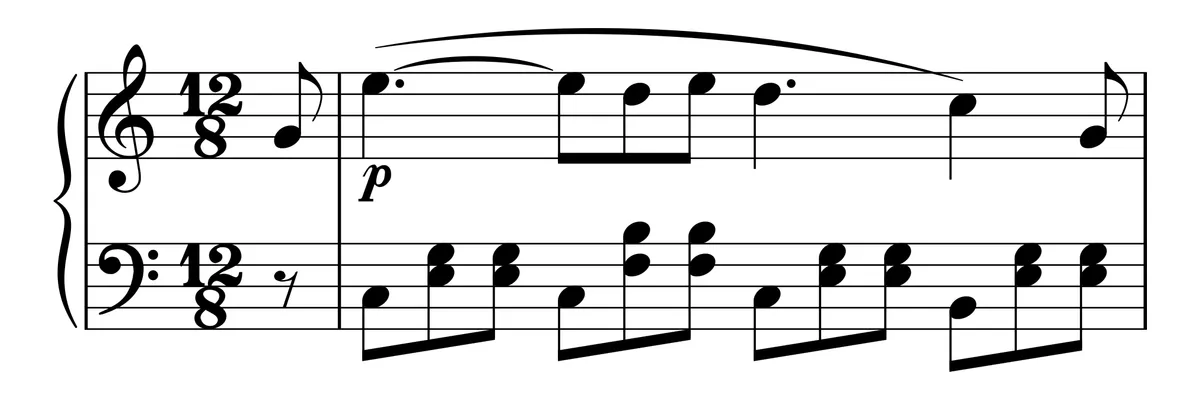
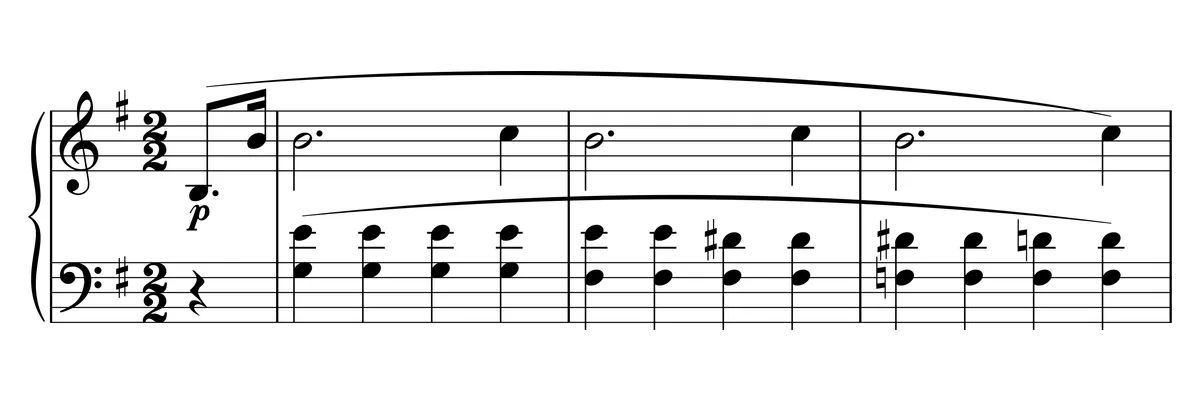
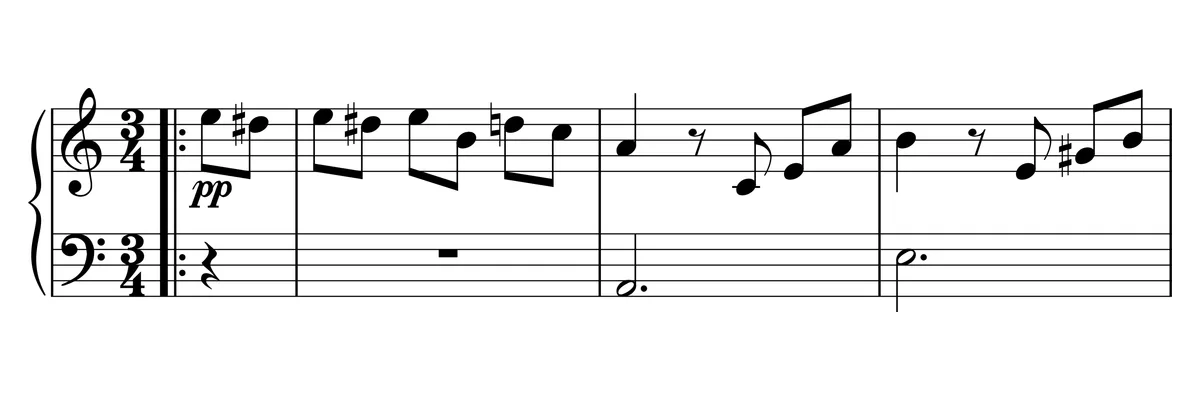
A real request in PlayableNotes, on Für Elise from the free library: say who it’s for and what to keep, and the AI writes a new version beside the original. It shows how to ask for a version of your own; its result is not one of the versions on this page.
About Minute Waltz
Chopin published the Waltz in D-flat major, Op. 64 No. 1, in 1847 and dedicated it to Countess Delfina Potocka. Its nickname uses minute in the sense of small, not as a measure of time. It opens with the right hand alone, a figure circling around A-flat, before a light waltz bass joins in bar 5; a second section, a little turning figure that runs into a long falling scale, answers it. A calmer, singing middle section (sostenuto) follows before the opening returns and a run sweeps down to the last note.
What makes it hard is speed and key: five flats, eighth notes that hardly stop in the right hand, and a waltz bass that has to cover a wide stretch of the keyboard in every bar. In the second section the right hand also plays chords under its own melody. The easy version moves the first two sections (bars 1 to 35) half a step down to C major, so they sound almost the same with no flats to read. It keeps Chopin's right hand and gives the left hand a bass note and two-note chords. The late-beginner version is the opening alone, over single notes.
For players who want all of it, the whole-waltz version keeps the complete piece in D-flat, with the middle section and the repeat, and keeps Chopin's melody and bass line. It leaves out the ornaments and grace notes, plays the quick turns and the four-against-three rhythm in bar 45 as plain notes, takes away the right-hand chords under the melody and the third note of each left-hand chord, writes out the long trill in bars 70 to 73 in slower triplets, and simplifies the closing run.
Practice tips
- Learn the opening figure first, right hand alone. From bar 3 it is four notes (F-sharp, G, B, A in the C major versions; G, A-flat, C, B-flat in D-flat) repeated in eighth notes, and since a bar holds six eighths, the figure only lines up with the barline every second bar. Count 1-and-2-and-3-and aloud and keep beat 1 clear.
- Except in the late-beginner version, treat the left hand as a waltz: a low note on beat 1, then lighter chords on beats 2 and 3. Practice the move from the bass note to the chord slowly with your eyes on the keys, and play the chords softer than the bass.
- Hold the high note at the start of bars 9, 11, 17 and 19 for its full dotted quarter. It is the longest note in the opening and gives the phrase its lift before the line steps down.
- Loop the falling scale (bars 25 to 27 in the easy, whole-waltz and original versions) and practice it right hand alone in groups of two eighths with a stop on each beat, then join the groups. Plan where the third finger crosses over the thumb before you play it at tempo.
- Practice each hand with the Right and Left buttons at the version's tempo, then hands together, and raise the tempo a few beats at a time. Even eighth notes matter more than speed.
Questions about Minute Waltz
Does the Minute Waltz really take one minute?
No. Minute here is pronounced my-NOOT and means little: it describes the size of the piece, not a time limit. Played complete with its repeat, most performances last between about one and a half and two minutes. The easy version on this page is 36 bars, so at its practice tempo it does take a little over a minute.
Is the Minute Waltz hard to play?
The original is advanced: fast, in five flats, with eighth notes that hardly stop, ornaments and trills, and a wide-ranging waltz bass. The simplified whole waltz on this page takes out the ornaments, the inner chords and the hardest rhythms, which brings it to a confident intermediate level; the five flats and the steady eighth notes remain. The easy version suits a second-year student, and the late-beginner version a student near the end of the first year who plays eighth notes evenly and can move the right hand between positions.
Why are the easy versions in C major?
Chopin wrote the waltz in D-flat major, which has five flats. C major is half a step lower, so the easy and late-beginner versions sound almost the same with no flats to read. The only accidentals left are the chromatic notes Chopin wrote, such as the F-sharp in the opening figure. The whole-waltz version and the original stay in D-flat.
Who was the Minute Waltz written for?
Chopin dedicated it to Countess Delfina Potocka, a friend and former pupil. It was published in 1847 as the first of the three waltzes of Op. 64. A popular story links it to George Sand's little dog chasing its tail, which is why it is also called the Little Dog Waltz (Valse du petit chien).
How fast should the Minute Waltz be played?
Chopin marked it Molto vivace, very lively, with no metronome mark. Concert performances often go well over 200 quarter notes a minute in the fast sections. Learn it far slower: each version here starts at a suggested practice tempo, and the tempo slider lets you raise it as the eighth notes settle.
Can I download the Minute Waltz as a PDF or MIDI file?
Yes, free and without an account. Every version has a Letter-size PDF to print and a MIDI file with the right and left hands on separate tracks.
Source and credits
- Composer
- Frédéric Chopin
- License
- Public domain
- Arranger
- PlayableNotes
Every note was checked against the edition's engraved PDF and MIDI, and compared with two independent transcriptions, CC0 MuseScore files. One error in the Mutopia file was corrected: the last right-hand note of bar 85 is B-flat, as in the parallel bar 12 and in both transcriptions, not B natural. Where the transcriptions differ from the edition elsewhere (for example the left hand in bars 12, 20 and 29), the Mutopia (Peters) reading is kept.
Arrangements and facts checked