How to read bass clef notes on the piano
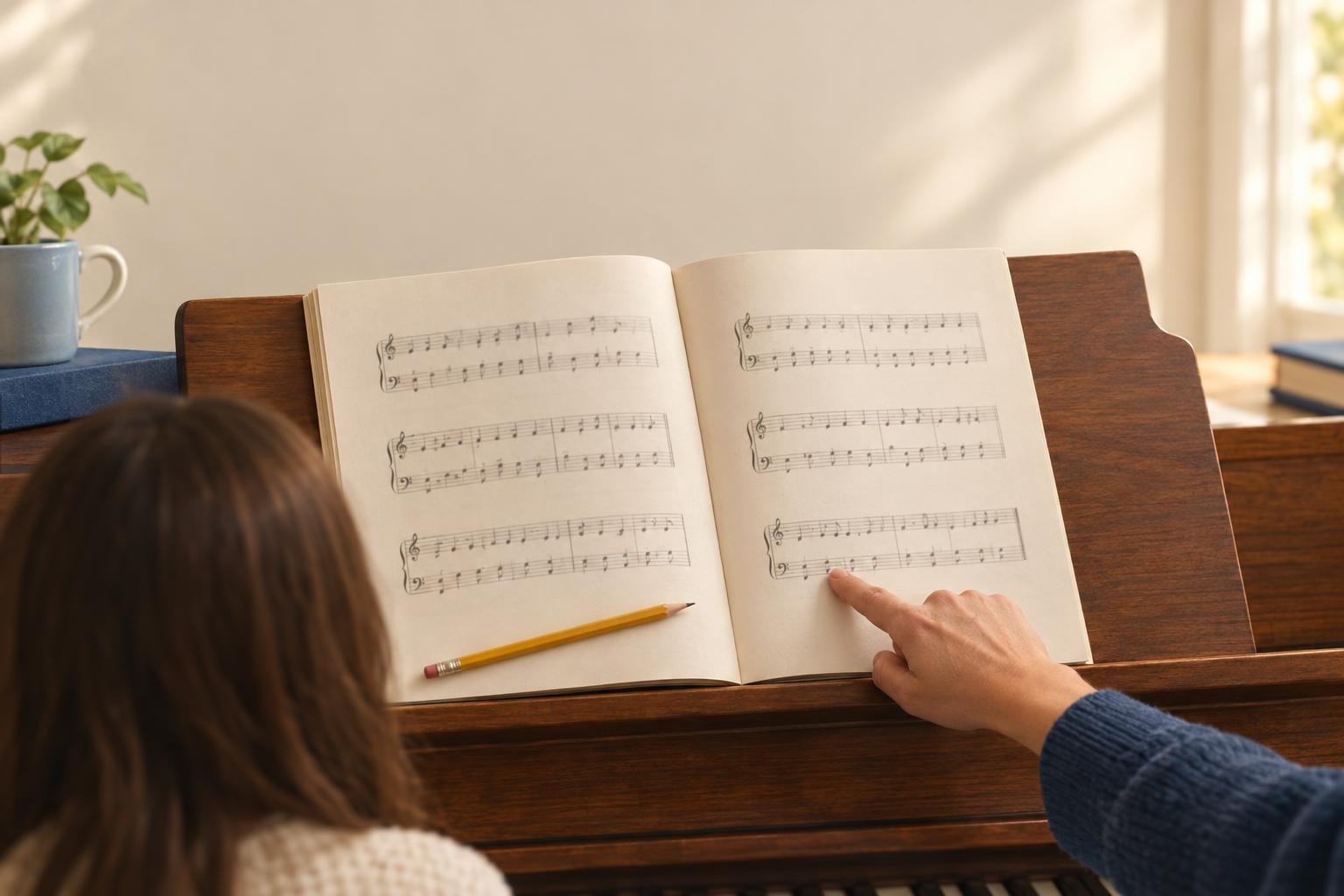
To read bass clef, start from the clef itself. Its two dots sit either side of the fourth line, and that line is the F below middle C. From there, the lines from the bottom up are G, B, D, F, A and the spaces are A, C, E, G. Learn a few landmark notes, then read every other note as a step or a skip from the nearest landmark instead of counting up from the bottom.
Bass clef is the lower staff in piano music, and it usually holds the left hand. Four notes are worth memorizing before anything else:
- Middle C, on the first ledger line above the staff.
- F, the fourth line, between the clef's two dots.
- C, the second space, an octave below middle C.
- G, the bottom line.
With those four, no note on the staff is more than two letter names from one you already know. A line to the space next to it is a step (G to A); a line to the next line is a skip (G to B).
The bass staff doesn't always mean the left hand, though: clefs can change partway through a piece, so check the clef at the start of every line.
If you already read treble clef, each bass clef note is two letter names above the note in the same spot in treble.
The two dots mark F below middle C
The bass clef is also called the F clef. It grew out of a written letter F, and its two dots sit on either side of the line it names: the fourth line from the bottom, the F just below middle C. Every other note can be worked out from that line.
| Bottom | Top | ||||
|---|---|---|---|---|---|
| Lines | G | B | D | F | A |
| Spaces | A | C | E | G |
The usual sentences help at the start: "Good Boys Do Fine Always" for the lines, "All Cows Eat Grass" for the spaces. But a student who recites the sentence for every note is still counting. The goal is to see the second space and know it's C.
Left-hand parts often go just outside the staff, so learn those notes too. Above the top line, B sits in the space, middle C on the first ledger line, D above it and E on the second ledger line. Below the bottom line, F sits in the space, E on the first ledger line, D below that and C on the second ledger line.
Read from landmarks, not from the bottom line
Counting up from the bottom line ("G, A, B, C...") works, but it's slow, and slower the higher the note sits. Read from the nearest landmark instead. Each one is a place on the staff and a key your student can find without counting:
| Landmark | On the staff | On the piano |
|---|---|---|
| Middle C (C4) | First ledger line above | The C nearest the middle of the keyboard, the fourth C from the left on 88 keys |
| F (F3) | Fourth line, between the clef's dots | The F just below middle C |
| C (C3) | Second space | One octave below middle C |
| G (G2) | Bottom line | The G just below that C |
| Low C (C2) | Second ledger line below | Two octaves below middle C |
The number is the octave: each one starts on C, and middle C is C4. Low C is a fifth landmark, for left hands that go below the staff. On the keys, every C is the white key just left of a pair of black keys, and every F the white key just left of a group of three.
To name a note, find the nearest landmark and count the moves. A note on the third line is one step above the C in the second space, so it's D; a note on the first ledger line below the staff is a skip down from the bottom-line G, so it's E.
Once the first note of a passage is named, read the moves rather than naming each note. Learn to see these four at a glance:
- A step goes from a line to the next space, or a space to the next line. That's one letter name.
- A skip goes from line to line, or space to space. That's two letter names.
- A fifth goes from a line to the line after next, or a space to the space after next, like C in the second space up to G in the fourth space. That's four letter names, and left-hand parts are full of it.
- An octave always goes from a line to a space, or a space to a line, with three lines in between. It lands on the same letter name.
The left hand of the Minuet in G, in its original version, is a good first test. In bars 2 to 6 it holds one note a bar: B just above the staff, middle C on its ledger line, B again, A on the top line, G in the top space. Read the B, and the rest is "step up, step down, step down, step down". Bar 16 ends with a drop from G in the top space to G on the bottom line: space to line, three lines between, an octave.
Coming from treble clef, shift two letter names
If your student learned treble clef first, the bass staff looks like a familiar staff with the wrong names. The relationship is fixed: any line or space in bass clef is two letter names above the same line or space in treble. Treble lines E, G, B, D, F become G, B, D, F, A; treble spaces F, A, C, E become A, C, E, G.
Middle C ties the two together: one ledger line below the treble staff and one above the bass staff are the same key on the piano.
Treat the shift as a bridge. Reading this way means two jobs per note (find the treble name, then add two), and the extra one slows the left hand down. Use it for a week or two, then have your student name bass notes from the landmarks directly.
A treble reader who forgets the shift reads the bass staff with treble names: the bottom line becomes E instead of G. Every note then lands two white keys too low, and because the shape of the passage stays the same, the hand doesn't feel anything wrong. If a whole left-hand passage sounds off in the same way, check that first.
Watch the clef, the ledger lines and the key signature
Students who know the lines and spaces still misread the left hand when they miss one of four things around the notes.
- A clef change partway through a line, which renames every note after it. A left hand that climbs high is often written in treble clef for a few bars.
- Ledger lines above the staff. Easy left-hand parts often sit around middle C, so B, C, D and E up there turn up a lot; read them from middle C.
- An "8vb" or "8va bassa" sign with a dashed line under the notes, which means play them an octave lower than written.
- The key signature, because sharps and flats sit in different places in bass clef.
In bass clef, F sharp is on the fourth line, the F line itself, and means the black key just right of each F. B flat is on the second line. Either one applies to that note in every octave, wherever on the staff the sign is drawn. A sharp, flat or natural written beside a single note lasts only until the bar line.
Practice on real left-hand parts, a few minutes a day
Flashcards teach note names, but the shapes a left hand plays come from reading real left-hand parts. The piano notes chart has a note-reading quiz for the names. Here's a routine for the reading minutes:
- Read the left hand alone, before the hands go together. Name the first note from a landmark, then read the moves.
- Say the note names out loud while playing very slowly. Then play it again without saying them.
- Start with music where the bass moves slowly, like the Minuet above, or the easy hymns for piano, which keep the melody and a simple bass.
- Pencil in a letter name only where your student gets lost, and rub it out the next week. A page with every note labeled gets read from the letters, not the staff.
- Check by ear. Play the bar back and listen: a wrong note is easier to hear than to spot.
If the left hand of a piece your student wants to play is too busy to read, an easier left hand keeps the tune and gives them fewer bass notes to read at once.
Hearing the bass line in PlayableNotes
In PlayableNotes, your student can check their reading by ear. Pick a public-domain piece in the library, open it in your account and share it as a practice link, all for free. Your student opens the link without an account, chooses the left hand so only the bass sounds, slows it to any tempo, loops the bars they're stuck on and watches each note light up as it sounds. Read a bar, name the notes, then play it back and see whether the highlighted notes are the ones you named.
For a page your student already has, upload a photo, screenshot or PDF. Reading costs 1 credit per line of music (treble and bass staff together); playing, printing, editing and practice links are free. It reads two-staff piano music only. Check the result against the page before your student practices from it.
That's as far as it goes. PlayableNotes isn't a note-reading course: it doesn't quiz your student, listen to them play or track their progress, so the reading practice is still theirs to do.
Try it with a page your student is reading now on your projects page; new accounts start with 50 free credits.
FAQ
What's the trick for remembering bass clef notes?
From the bottom up, the lines are G, B, D, F, A ("Good Boys Do Fine Always") and the spaces are A, C, E, G ("All Cows Eat Grass"). To read faster, learn a few landmarks by sight instead: G on the bottom line, C in the second space, F on the fourth line between the clef's two dots, and middle C on the ledger line above. Every other note on the staff is a step or a skip from one of them.
Where is middle C in bass clef?
Middle C is on the first ledger line above the bass staff. It's the same key on the piano as the C on the first ledger line below the treble staff; which staff it's written in usually depends on which hand plays it.
Is bass clef always played with the left hand?
Usually, but not always. A clef can change partway through a line, so a left hand that climbs high may be written in treble clef for a few bars, and a right hand that goes low may be written in bass clef. Check the clef at the start of every line.
Is bass clef read the same way on bass guitar?
Yes. The lines and spaces have the same names for every instrument that reads bass clef: G, B, D, F, A on the lines and A, C, E, G in the spaces. The difference is the octave: bass guitar and double bass parts are written an octave higher than they sound, which keeps their low notes on the staff instead of on ledger lines below it. Piano, cello, trombone, bassoon and tuba play bass clef at the written pitch.
How do you pronounce bass clef?
"Bass" sounds like "base", as in a bass singer, not like the fish. "Clef" rhymes with "chef". It's also called the F clef, because its two dots mark the F line.