How to read key signatures on the piano
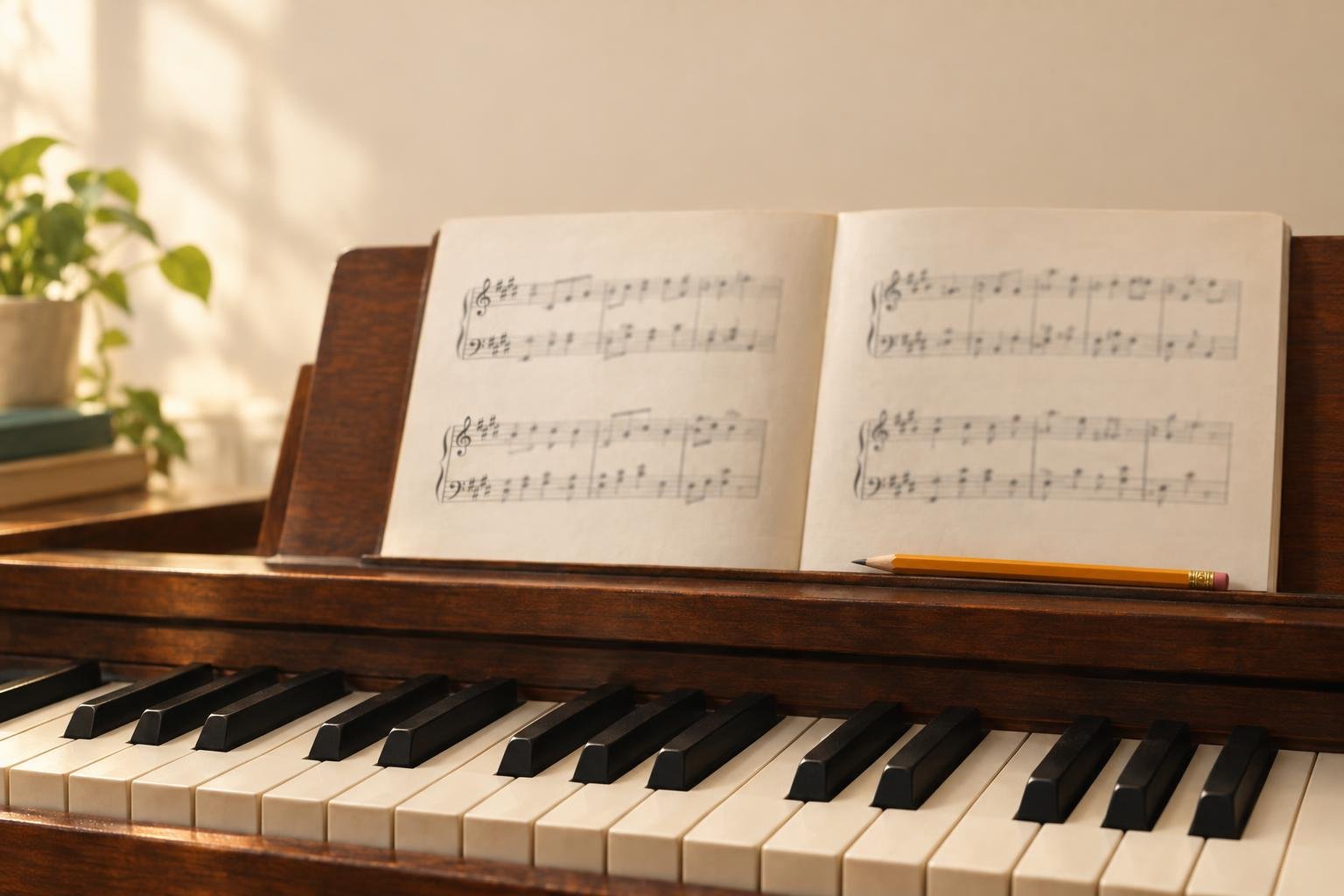
A key signature is the group of sharps or flats between the clef and the time signature, and it tells you two things. First, which notes change: every note on those letters is sharp or flat in every octave, in both hands, until an accidental or a new key signature overrides it. Second, the key: with sharps, go up a half step from the last sharp; with flats, the second-to-last flat names the key. One flat is F major.
Read it in this order, before the first note:
- Look between the clef and the time signature, on both staves.
- Name each sharp or flat from the line or space it sits on.
- Apply each one to that letter everywhere: every octave, both staves, every bar, until a new key signature appears.
- Name the major key: a half step above the last sharp, spelled on the next letter up, or the second-to-last flat.
- Check whether the piece is really in the relative minor, the minor key three half steps below that major key, which shares its signature.
No sharps or flats means C major or A minor. Sharps always appear in the order F C G D A E B, and flats in the reverse order, B E A D G C F, so three sharps are always F♯, C♯ and G♯. A sharp, flat or natural written beside a note in the music is an accidental: it overrides the key signature only until the next barline.
Every sharp or flat in the signature changes that note everywhere
The key signature sits right after the clef on both staves, and unlike the time signature, it's printed again at the start of every line.
Name each sign by the line or space it sits on, not by its place in the row. A sharp on the top line of the treble staff is F♯; a flat on the middle line is B♭. The bass staff has the same signature in the same shape, drawn one line lower: F♯ on the fourth line, the F line between the bass clef's dots, and B♭ on the second line. The bass clef guide covers the rest of that staff.
Then apply it everywhere. One F♯ in the signature is drawn on a single F, but it means every F in the piece is F♯, high or low, in either hand, in every bar. It holds until a new key signature replaces it.
On the keyboard, a sharp is the next key to the right and a flat the next key to the left, black or white. Usually that's a black key, but not always: E♯ is played on the white key F, and C♭ on the white key B. You'll meet those in keys with six or seven sharps or flats. On the piano notes chart, click any key, black or white, to hear it and see its name.
Sharps and flats always come in the same order
Sharps are added in one fixed order: F C G D A E B. Flats come in the reverse: B E A D G C F. One way to remember the sharps is "Father Charles Goes Down And Ends Battle", and read backwards for the flats, "Battle Ends And Down Goes Charles's Father". Use it until you can say the order without it.
Because the order is fixed, three sharps are always F♯, C♯ and G♯, never any other three, and two flats are always B♭ and E♭. Count the signs and you know which notes they are.
Each added sharp also moves the key up a fifth: C, G, D, A, E, B, F♯, C♯ major have zero to seven sharps. Each added flat moves it down a fifth: C, F, B♭, E♭, A♭, D♭, G♭, C♭ major have zero to seven flats. Drawn as a ring, those two lists are the circle of fifths.
Name the key from the last sharp or the second-to-last flat
With sharps, find the last one, the rightmost, and go up a half step. That's the major key, spelled on the next letter up from the last sharp. Three sharps end on G♯; a half step up is A, so the key is A major.
Six sharps end on E♯, which you play on the white key F. The next letter up is F, and the half step above that white key is the black key F♯, so the key is F♯ major, not F major.
With flats, the second-to-last flat is the key, and the name keeps its flat. B♭, E♭ and A♭: the second-to-last is E♭, so the key is E♭ major. One flat has no second-to-last, so learn that one by heart: one flat is F major. No sharps or flats is C major.
Every signature also belongs to a minor key, its relative minor, three half steps below the major keynote:
| Sharps | Which | Major key | Relative minor |
|---|---|---|---|
| 0 | none | C | A |
| 1 | F♯ | G | E |
| 2 | F♯ C♯ | D | B |
| 3 | F♯ C♯ G♯ | A | F♯ |
| 4 | F♯ C♯ G♯ D♯ | E | C♯ |
| 5 | F♯ C♯ G♯ D♯ A♯ | B | G♯ |
| 6 | F♯ C♯ G♯ D♯ A♯ E♯ | F♯ | D♯ |
| 7 | F♯ C♯ G♯ D♯ A♯ E♯ B♯ | C♯ | A♯ |
| Flats | Which | Major key | Relative minor |
|---|---|---|---|
| 1 | B♭ | F | D |
| 2 | B♭ E♭ | B♭ | G |
| 3 | B♭ E♭ A♭ | E♭ | C |
| 4 | B♭ E♭ A♭ D♭ | A♭ | F |
| 5 | B♭ E♭ A♭ D♭ G♭ | D♭ | B♭ |
| 6 | B♭ E♭ A♭ D♭ G♭ C♭ | G♭ | E♭ |
| 7 | B♭ E♭ A♭ D♭ G♭ C♭ F♭ | C♭ | A♭ |
Three pairs use the same piano keys under different names: six sharps and six flats (F♯ major and G♭ major), five sharps and seven flats (B and C♭), and seven sharps and five flats (C♯ and D♭).
Check whether it's the major key or the relative minor
The signature alone can't tell you which of its two keys a piece is in: G major and E minor both have one sharp. Whether it sounds sad is a guess; check these, in order:
- The last bass note and the final chord. A piece usually ends on its keynote.
- The first bass note or the first chord.
- A sharp or natural written in again and again on the note just below the minor keynote. That's the raised seventh: G♯ in A minor, D♯ in E minor, C♯ in D minor. The signature can't show it, so the composer writes it in each time.
Für Elise has no signature, so it's C major or A minor. The left hand comes in on A, G♯s are written in all through it, and it ends on A: A minor.
The first movement of the Moonlight Sonata has four sharps, the E major signature. But the bass starts on a low C♯, B♯ is written in again and again (the raised seventh, played on the white key C), and it ends on a C♯ minor chord. It's in C♯ minor, E major's relative minor.
Don't confuse the relative minor with the minor key on the same keynote. C minor doesn't share C major's signature: its relative major is E♭, three half steps up, so C minor has three flats. Going up three half steps from any minor key gives you its signature the same way: F minor is relative to A♭ major, four flats.
Watch for accidentals, naturals and key changes while you play
The signature is the default, and the music can change it for a moment or for good:
- An accidental lasts for that note, on that line or space, until the barline. Then the signature is back. A note tied across the barline keeps it.
- A natural (♮) cancels the signature for that note until the barline.
- A courtesy accidental, often in brackets, reminds you that a barline has cancelled an earlier accidental. It changes nothing.
- A key change is a new signature, usually after a double barline. It often starts with naturals cancelling the old sharps or flats, and the new signature holds from there, reprinted on every line, until the next change.
The notes to watch are the ones the signature changes with nothing printed beside them. Minuet in G has one sharp, so every F is F♯: in the right hand's run in bar 3 up to the high G, and the first note of bar 7, with no sign next to either. The easy Minuet in G page has an easier version in G and the same version in C, with no key signature at all, if the F♯ keeps catching your student out.
Get your hand into the key before you play
Before a new piece:
- Name the sharps or flats out loud. For two sharps: "F sharp, C sharp, D major."
- Touch each of those keys on the keyboard, in more than one octave.
- Play the scale of the key once. D major is D E F♯ G A B C♯ D.
- Pencil a sharp or flat beside only the notes your student keeps missing, and rub it out once they stop missing them. Pencil in every sharp and the student ends up reading the pencil instead of the signature.
If a piece has more sharps or flats than your student reads yet, they can learn it in an easier key first. How to transpose music shows how to move it by hand.
Hearing the key in PlayableNotes
When you practice alone, it's hard to hear whether you played F or F♯. PlayableNotes plays a score with a sampled piano and highlights each note as it sounds. Open a free public-domain piece from the library, slow it to any tempo, loop a passage or play one hand alone, then play the bar yourself and listen for the note that doesn't match. Send it to your student as a practice link, which opens without an account.
To set the signature aside for now, ask the AI chat to put the piece in another key, for example "a key with no sharps or flats". The result is a new version, and you can restore the earlier one. AI edits are free, within a fair-use cap of 100 a day.
For a page from your own book, upload a photo, screenshot or PDF. Reading costs 1 credit per line of music, and playing, editing, printing and practice links are free. It reads two-staff piano music only. Check the result, the key signature first: one missed sharp puts the same wrong note in every bar. Fix a wrong line in the measure editor or with the AI chat.
The theory stays with you. The measure editor names the two keys a signature belongs to, such as "G major / E minor (1 sharp)", but it won't tell you which of the two a piece is in. PlayableNotes doesn't quiz you on key signatures, listen to your student play or track their progress.
Try it with a piece in a key your student finds hard: open your projects, where new accounts start with 50 free credits.
FAQ
What's the trick for reading key signatures?
With sharps, the major key is a half step above the last sharp, named on the next letter up: three sharps end on G♯, so A major. With flats, the second-to-last flat is the key: B♭ E♭ A♭ is E♭ major. One flat is F major, and no sharps or flats is C major or A minor.
How do you know if a key signature is major or minor?
You can't from the signature alone: each one is shared by a major key and its relative minor, three half steps lower. Look at the last bass note and the final chord, then the first bass note, and look for a sharp or natural written in on the note just below the minor keynote, such as G♯ in A minor.
Does a key signature apply to every octave?
Yes. A sharp or flat in the key signature applies to every note of that letter in every octave, on both staves and in both hands, in every bar. Only an accidental written in the music overrides it, and only until the barline, or a new key signature replaces it.
What is the order of sharps and flats?
Sharps always come in the order F C G D A E B. Flats come in the reverse order, B E A D G C F. So a key signature with two sharps is always F♯ and C♯, and one with two flats is always B♭ and E♭.
How many key signatures are there?
Fifteen: seven with sharps, seven with flats and one with none. Each belongs to a major key and its relative minor. Three pairs sound the same on the piano under different names (F♯ and G♭ major, B and C♭ major, C♯ and D♭ major), so the fifteen signatures cover twelve different-sounding major keys.