Note values and rests, with a beat chart
A note value is how long a note lasts compared with the others, and you read it from the note's shape. An open note without a stem is a whole note; add a stem for a half note; fill it in for a quarter note; each flag or beam halves it again. With a quarter-note beat that's 4, 2, 1, ½ and ¼ beats. Every value has a matching rest, and a dot adds half again.
Note values are relative. Each one is half the one above it, so a whole note equals 2 halves, 4 quarters, 8 eighths or 16 sixteenths. The US names are those fractions of a whole note: a quarter note is a quarter of a whole note, not a quarter of a beat.
The beat counts in the chart below assume a 4 at the bottom of the time signature, which makes the quarter note the beat. Cut time (2/2) gives the beat to a half note, and 6/8 counts in eighths, felt at speed as two dotted-quarter beats. Seconds come from the tempo: at ♩ = 60 a quarter note lasts one second.
Three marks change a note's length:
- A dot adds half the note's value: a dotted half is 3 beats, a dotted quarter 1½.
- A tie joins two notes of the same pitch, so you play once and hold for both.
- A triplet fits three notes into the time of two, marked with a 3.
And one exception: a whole rest also means "rest for the whole bar", whatever the time signature.
Each note value is half of the one above it
| US name | UK name | What it looks like | Its rest | Beats when a quarter note gets the beat |
|---|---|---|---|---|
| Whole note | Semibreve | Open oval, no stem | A block hanging from the fourth line | 4 |
| Half note | Minim | Open oval with a stem | A block sitting on the middle line | 2 |
| Quarter note | Crotchet | Filled oval with a stem | A zigzag | 1 |
| Eighth note | Quaver | Filled, with one flag or one beam | A slanted stroke with one flag, like a 7 | ½ |
| Sixteenth note | Semiquaver | Filled, with two flags or two beams | A slanted stroke with two flags | ¼ |
Thirty-second notes (demisemiquavers, three flags) exist but are rare in beginner piano music. So is the double whole note (breve): two whole notes long, drawn as an open oval between short vertical lines, and mostly met in 4/2, where it fills a bar. Beams join eighths and shorter notes into beat-sized groups, and stems point up or down; neither changes how long a note lasts.
Every note has a rest of the same length
The two block rests are easy to mix up: the whole rest hangs from its line like a hole, the half rest sits on its line like a hat. Dots work on rests too. A whole rest also fills any empty bar, in 3/4 or 6/8 as much as in 4/4, so "a whole rest is always four beats" is wrong.
On the piano, one hand often rests while the other plays. In bar 28 of the original Minuet in G, in 3/4, the left hand plays a half note and a quarter rest while the right hand plays beat 3 alone.
A dot adds half the value, and a tie adds the next note
| Dotted note | Beats | Same as |
|---|---|---|
| Dotted half | 3 | Half + quarter |
| Dotted quarter | 1½ | Quarter + eighth |
| Dotted eighth | ¾ | Eighth + sixteenth |
| Double-dotted half | 3½ | Half + quarter + eighth |
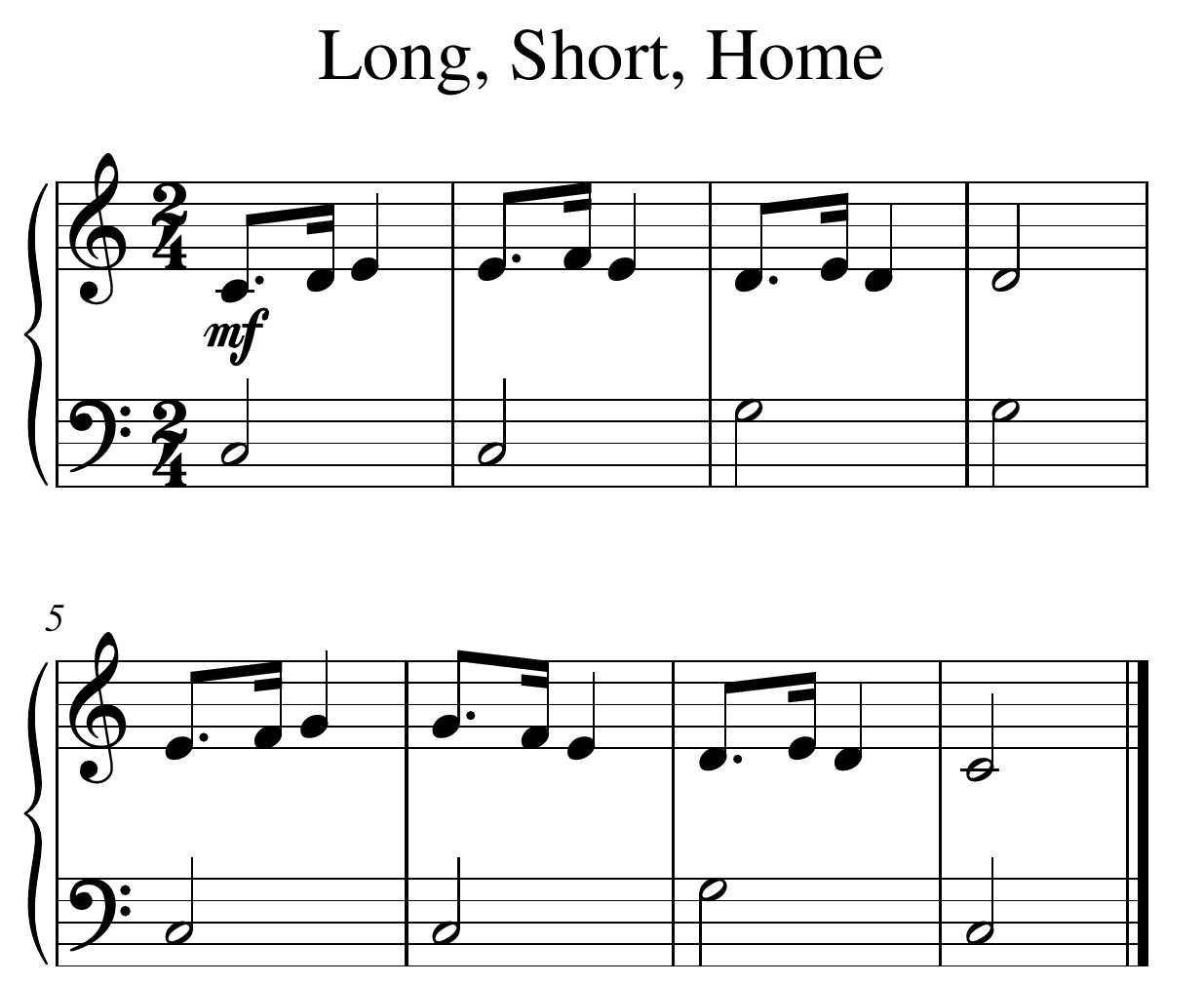
A second dot adds half of what the first one added. Pair a dotted eighth with a sixteenth and you get one beat. The piano rhythm study, eight bars in 2/4, is built on that pair plus a quarter, and you can play each hand on its own there.
A dot can't cross a barline but a tie can, so a note held into the next bar is written as two tied notes. Ties join notes of the same pitch, and slurs join different ones (more in how to read piano sheet music). Where the dot sits matters as well. To the right of the notehead it adds length; above or below, it's staccato, so play the note short and detached and count the rest of its beats as silence.
The time signature decides how many beats each value gets
The bottom number names the note that gets one beat (more in time signatures explained): 4 a quarter, 2 a half, 8 an eighth. So 3/4 keeps the chart's values, three beats to a bar. In 2/2, cut time (a C with a line through it), a quarter note is half a beat. Count 6/8 as six eighths at a slow tempo and as two dotted-quarter beats at speed. Three triplet eighths share one quarter-note beat.
Count each hand's bar before you play it
Each staff adds up to the time signature on its own. When a staff has two voices (stems up and stems down), each voice adds up too, unless the edition leaves that voice's rests out.
The easy Minuet in G shows both. In the easier-left-hand version, bar 1's right hand is a quarter and four eighths, counted 1, 2-and, 3-and, while the left hand plays G and B together as a half note, then A as a quarter on beat 3. Bar 25 of the original version has two voices in the left hand. The stems-up voice rests a beat, then holds D for two (1 + 2); the stems-down voice plays B as a half note, then a quarter (2 + 1).
To count a new bar, find its shortest value and count in that unit: "1-and" for eighths, "1-e-and-a" for sixteenths. Tap the right hand's rhythm on the lid while counting aloud, then the left's, then both together, and only then play it slowly.
Hearing note values in PlayableNotes
Open any of about 320 free public-domain pieces in the library and play it with a sampled piano, each note highlighted as it sounds. Slow it down, loop one bar, or play one hand to hear its rhythm alone. It doesn't count in or listen to your student; the counting is yours.
In the measure editor you can set note lengths to fix a rhythm, then print the score or send a practice link your student opens without an account. Reading your own photo or PDF costs 1 credit per line of music (two-staff piano music only; check the result). Playing, editing, printing and practice links are free.
Try it with a page your student is counting: upload it to PlayableNotes, where new accounts start with 50 free credits.
FAQ
How many beats is a dotted quarter note?
One and a half when a quarter note gets the beat: a quarter plus an eighth. In 6/8, felt in two, a dotted quarter is one whole beat.
What's the difference between a dot and a tie?
A dot adds half a note's value inside one bar. A tie joins two notes of the same pitch, played once and held for both, and can cross a barline.
What are note values called in British English?
Semibreve (whole), minim (half), crotchet (quarter), quaver (eighth), semiquaver (sixteenth) and demisemiquaver (thirty-second).
Does a whole rest always mean four beats?
No. Alone in a bar, it means a whole bar of silence in any time signature: three beats in 3/4, two in 2/4. In 4/4 that happens to be four.
Is a quarter note always one beat?
Only when the time signature's bottom number is 4. In 2/2 it's half a beat, and in 6/8 it lasts two eighth-note counts.