How to simplify piano sheet music for a student
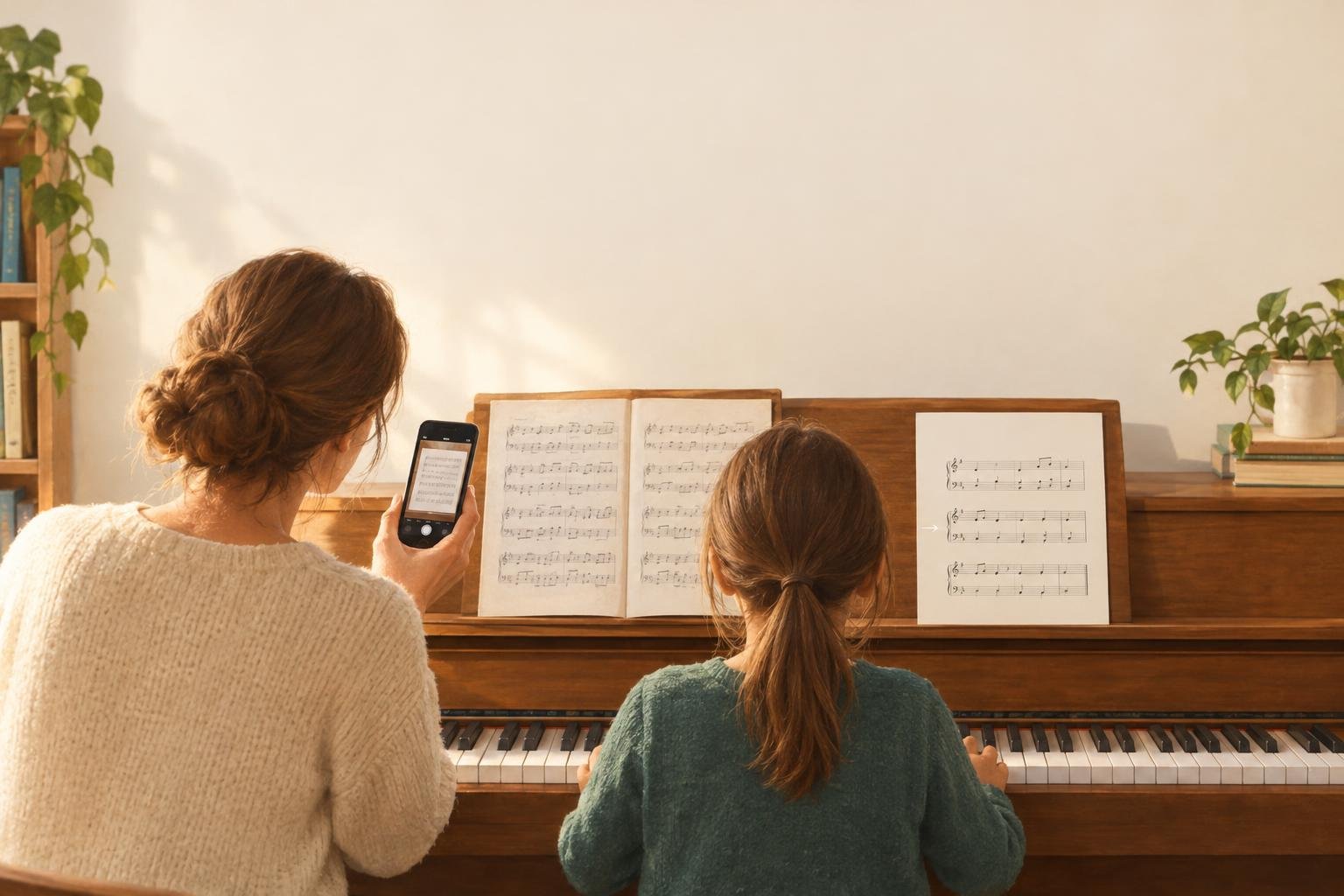
Your student wants to play a piece that is a little beyond them. You could say "next year", or you could make a version that fits them now. Simplifying piano sheet music comes down to three decisions: what is actually too hard, what must stay so the piece is still itself, and how far to go. Once those are settled, the mechanical part, writing out the easier version, is the part PlayableNotes does for you: upload a photo or PDF of the page, say what the student needs, and check the result.
First, find out what is in the way
"Too hard" is rarely the whole piece. Have the student play the first line or two and watch where it breaks down.
- The pulse collapses when the left hand moves. The accompaniment is the problem, not the tune.
- They stop at every octave or wide chord. It is reach, not reading.
- They keep missing sharps and flats. It is the key.
- They get lost in the middle. The piece is too long for one lesson, not too hard.
Each of these has a different fix, and fixing only the real problem keeps the most music on the page. A piece with its left hand reduced to a single bass note per bar still sounds like the piece. A piece with everything taken out does not.
Change only that
Most simplifications teachers make by hand fall into a short list.
| Problem | Change | What stays |
|---|---|---|
| Busy left hand | Block chords, or one bass note per bar | Melody, rhythm, harmony |
| Octaves and stretches | Single notes instead of octaves | Melody and bass line |
| Hard key | Transpose to C, G or F | Everything, in a different key |
| Fast runs | Leave out the ornaments and passing notes | The tune's shape |
| Too long | A shorter edition: first section and the ending | The parts the student will actually practise |
Decide what to protect before you start. For most pieces that is the melody and the rhythm of the melody. If the student can hear that it is still the same piece, the simplification worked. If the left hand becomes so plain that the piece loses its character, you have gone one step too far; put one thing back.
Write the brief in one sentence, the way you would say it to a colleague: "Take out the octaves so small hands can reach" or "Easier left hand, keep the right hand exactly as it is." A brief that names the problem gets a better result than "make it easier".
Make the version from a photo of the page
Making the easier version by hand means copying out the whole piece, which is why so many students end up waiting a year instead. With PlayableNotes the steps are:
- Upload a photo, screenshot or PDF of the page. Reading takes a minute or two and costs one credit per line of music; new accounts start with 50 free credits, so a first piece costs nothing. Pricing is on the pricing page.
- Check the reading against the page. A wrong note can be fixed by clicking it, and a line that came out badly can be read again from a sharper photo.
- Ask for the change in words: simpler, easier left hand, another key, fewer octaves, a shorter edition. The result is saved as a new version, so the original is still there.
- Play it back and listen for anything that sounds wrong. Then print it, or send the student a practice link they can open on a phone without an account.
Check the result the way you would check a colleague's arrangement. The AI is good at the mechanical part but it does not know your student. If a chord it chose is still too wide, ask again, or move the note yourself in the measure editor.
If the piece is a classic, you may not need the photo at all: about 470 public-domain pieces in the library are ready to open and arrange.
FAQ
Will the simplified version still sound like the piece?
Yes, if you change only what is in the way. Keep the melody and its rhythm, and reduce the left hand or the stretches. If the result sounds thin, put one element back rather than starting again.
How many credits does one piece cost?
One credit per line of music, where a line is the treble and bass staff together. A page of piano music is usually five to seven lines, so a two-page piece is roughly 12 credits. Everything after the reading, including edits, playback, printing and practice links, is free.
What if the reading gets a note wrong?
Click the note and move it, or ask the AI chat to fix the bar. If a whole line came out badly, usually from a dim or blurred photo, read it again from a sharper picture. A reading that fails costs nothing.